
Blog
WGU D269 Task 3 Guide and Example: Editing and Revising Text

By Dan Palmer, MBA · Academic strategy consultant for working adult learners · LinkedIn
Composition: Writing with a Strategy D269 Task 3 is the last assessment in the course, and it’s the only one where you change someone else’s writing. You choose one of four sample texts, mark exactly three revisions and five edits, explain every change, and then give the writer feedback. Spotting problems is the easy part, since the sample texts are full of them. The part that sends papers back is the distinction the rubric draws between a revision and an edit, and whether each change is clearly marked and explained.
This guide is for working students who want to finish WGU D269 Task 3 in a couple of evenings. It covers how to tell revisions from edits, how to mark changes so the evaluator can count them, and how to write explanations and feedback that meet the rubric. It also includes a complete D269 Task 3 example built on a practice text we wrote, so it can’t be copied into a real submission.
D269 Task 3 Assignment
You must use the rubric to direct the creation of your submission because it provides detailed criteria that will be used to evaluate your work. Each requirement below may be evaluated by more than one rubric aspect. The rubric aspect titles may contain hyperlinks to relevant portions of the course.
A. Select one of the following attached sample texts to revise and edit, and then submit the text with clearly designated markups of three revisions and five edits:
- “Sample Text 1”
- “Sample Text 2”
- “Sample Text 3”
- “Sample Text 4”
Note: The writing quality and similarity report matches of the original, unedited document will not be evaluated.
Note: You can revise and edit the document by hand or by using an editing function on a word-processing document (e.g., Track Changes in Microsoft Word). The written responses to parts B, C, and D should not be written by hand.
B. Discuss the changes you made to the text in part A by doing the following:
- Explain why each of the three marked revisions to the structure, content, and organization of the text were made.
- Explain why each of the five marked edits to the grammar, punctuation, and word choice of the text were made.
C. Provide feedback to the writer of your chosen text by doing the following:
- Explain why the introduction is successful or unsuccessful at capturing your attention.
- Describe the greatest strength of the text.
- Describe the weakest part of the text.
- Explain whether the conclusion is successful or unsuccessful at bringing the text to a close.
D. Acknowledge sources, using in-text citations and references, for content that is quoted, paraphrased, or summarized.
E. Demonstrate professional communication in the content and presentation of your submission.

What D269 Task 3 Asks You to Do
| Requirement | What you deliver |
|---|---|
| A | One sample text with clearly marked changes: three revisions and five edits |
| B1 | Why you made each of the three revisions to structure, content, and organization |
| B2 | Why you made each of the five edits to grammar, punctuation, and word choice |
| C | Feedback to the writer: the introduction, the greatest strength, the weakest part, and the conclusion |
| D | Citations and references for any source you quote, paraphrase, or summarize |
| E | Professional communication in your written responses |
The task directions note that the writing quality and similarity matches of the original, unedited sample text won’t be evaluated. You’re graded on your changes and your written responses, not on the errors you inherited.
Revisions Versus Edits: The Distinction That Matters Most
The rubric treats these as two different kinds of change, and mixing them up is the most common reason D269 Task 3 WGU submissions come back.
| Revision | Edit | |
|---|---|---|
| Level | The whole text, a paragraph, or the flow of ideas | A word, a phrase, or a single sentence |
| Covers | Structure, content, and organization | Grammar, punctuation, and word choice |
| Examples | Moving a paragraph, cutting an off topic section, adding a missing call to action, rewriting a weak introduction or conclusion | Fixing a misspelled word, correcting an apostrophe, joining a sentence fragment, replacing slang with a precise word |
| Test | Would the text be organized or argued differently after the change? | Would the text be correct or clearer at the sentence level after the change? |
If you fix a comma, that’s an edit even if it’s important. If you move a paragraph, that’s a revision even if you don’t change a word inside it. Count each type separately.
Choosing Your Sample Text
Each sample text is a different genre written for a different audience. Your revisions and feedback should be judged against what that reader needs:
| Sample | Genre | Intended reader |
|---|---|---|
| Sample Text 1 | Online restaurant review | Other diners deciding where to eat |
| Sample Text 2 | Cover letter for a preschool aide position | A university daycare’s hiring manager |
| Sample Text 3 | Letter emailed to an elementary school board | School board members |
| Sample Text 4 | College admission writing sample | An admissions committee reading a professional writing sample |
If you choose D269 Task 3 Sample 1, for example, ask which changes would help another diner decide whether to visit. For a cover letter, ask what would make a hiring manager more likely to call. Choose the text whose audience you understand best, because your B1 explanations and your Part C feedback both depend on it.
Part A: Marking Your Changes Clearly
The task says you may mark changes by hand or with an editing tool such as Track Changes in Microsoft Word. Track Changes is faster and easier to read. Whatever you use, “clearly designated” means the evaluator can find and count each change without guessing:
- Turn on Track Changes so every deletion and insertion shows.
- Add a comment to each change labeling it, such as Revision 1 or Edit 3.
- Use the same labels in Part B, so each explanation points to one marked change.
- Mark exactly three revisions and five edits. If you make extra changes, it becomes unclear which ones count, so stick to the required set.
Remember that your written responses to B, C, and D must be typed, even if you mark the text by hand.
Part B1: Explaining Your Three Revisions
For each revision, explain three things: what you changed, why it was a problem, and how the change helps the intended reader. A one line explanation such as “I moved this paragraph because it flows better” doesn’t explain why.
Stronger: “Revision 2 moved the benefits paragraph directly after the introduction. Readers deciding whether to volunteer need to know what they gain before they read the schedule, so this order answers their first question first.”
Make sure each revision is really about structure, content, or organization, and name which one in your explanation.
Part B2: Explaining Your Five Edits
Edits need a reason too, usually the rule involved. Name the rule in plain terms:
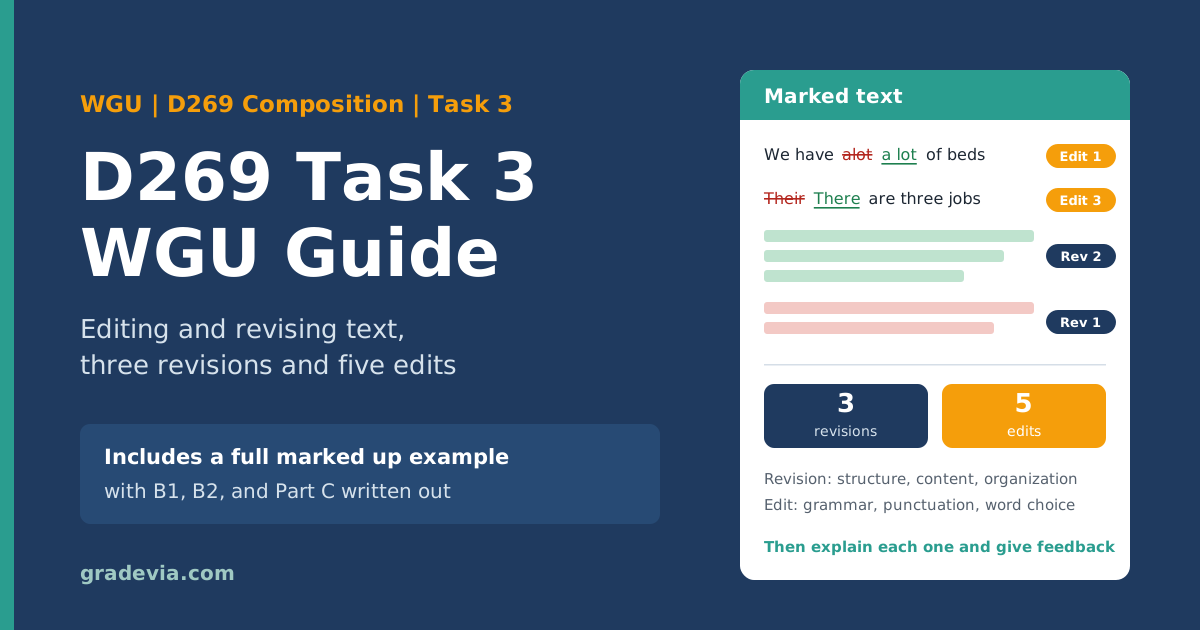
- “Edit 1 changed ‘alot’ to ‘a lot,’ because ‘a lot’ is always two words.”
- “Edit 4 joined the fragment to the previous sentence with a colon, because the list cannot stand alone as a sentence.”
Spread your edits across grammar, punctuation, and word choice rather than fixing five spelling errors. That shows the range the requirement describes.

Part C: Feedback to the Writer
Part C has four required pieces, and each one needs a clear judgment and a reason:
- Introduction: Is it successful or unsuccessful at capturing your attention, and why?
- Greatest strength: Name one specific strength, such as a vivid example, a clear purpose, or strong evidence.
- Weakest part: Name one specific weakness and explain its effect on the reader.
- Conclusion: Is it successful or unsuccessful at bringing the text to a close, and why?
Write to the writer, in a respectful and constructive tone. Give each piece its own heading so the evaluator can find all four. Many submissions skip either the strength or the conclusion judgment.
Parts D and E: Sources and Professional Communication
You don’t need sources for Task 3. If you cite a grammar handbook or style guide to support an explanation, cite it in APA. The references inside the sample texts belong to those writers, not to you. Grammarly for Education checks the written parts of your submission, so clear any Correctness flags before you submit.
Why Not Use D269 Task 3 Answers From Study Sites?
Searches for D269 Task 3 answers or a D269 Task 3 answer key turn up documents with someone else’s markups and explanations for the same four sample texts. The original sample text doesn’t count against your similarity score, but those explanations and feedback paragraphs do, and they’re exactly what the similarity checker compares against. A borrowed answer key also tends to mix revisions and edits in ways the rubric doesn’t accept. Doing your own eight changes is faster than fixing a flagged submission.
D269 Task 3 Example: A Practice Text, Marked and Explained
Our D269 Task 3 example uses a short practice text we wrote: a volunteer recruitment article from a fictitious community garden’s newsletter, written for neighborhood residents. It isn’t one of WGU’s four sample texts, so none of the changes or explanations apply to your submission.
The example shows the full process in Word:
- The practice text with real Track Changes markups, each labeled by a comment as Revision 1 to 3 or Edit 1 to 5
- B1 explanations for a paragraph move, a deleted off topic section, and a rewritten conclusion with a call to action
- B2 explanations for edits covering spelling, slang, a homophone, a sentence fragment, and an apostrophe
- Part C feedback with all four required judgments
Here’s one of the B2 explanations from the example:
Edit 3 changed “Their are three jobs” to “There are three jobs.” “Their” is a possessive pronoun, while “there” introduces that something exists. Using the wrong homophone in the first line of the details section would make readers question the care behind the whole article.
The example is for illustration only. Your submission must use one of the four WGU sample texts and your own changes.
Download the D269 Task 3 example (.docx)
Plan It Around Your Work Week
- Evening one: Read all four sample texts, choose one, and list every problem you notice. Sort the list into revisions and edits, then pick three and five.
- Evening two: Mark the changes with Track Changes and comments, write B1 and B2 using your labels, write the four Part C responses, run Grammarly, and review the similarity report.
Common Reasons D269 Task 3 Comes Back
- An edit counted as a revision, such as a punctuation fix listed under revisions
- Fewer than three revisions or five edits, or extra unlabeled changes that make the count unclear
- Markups that are hard to find because changes weren’t tracked or labeled
- Explanations that say what changed but not why
- Part C missing one of its four pieces
- Feedback that judges the introduction or conclusion without saying whether it is successful
Related WGU D269 Guides
- Our WGU D269 Task 1 guide covers purpose, audience, and rhetorical appeals, which help you judge what each sample text is trying to do.
- Our WGU D269 Task 2 guide covers introductions, thesis statements, transitions, and conclusions, the same elements you evaluate in Part C.
- See every D269 Composition guide, or browse all WGU assignment guides and samples.
Pre-Submission Checklist
- One of the four WGU sample texts is used
- Exactly three revisions are marked and labeled, each about structure, content, or organization
- Exactly five edits are marked and labeled, covering grammar, punctuation, and word choice
- B1 explains why each revision was made, using the same labels
- B2 explains why each edit was made, naming the rule or reason
- Part C covers the introduction, greatest strength, weakest part, and conclusion
- Written responses are typed, and any source used is cited
- Grammarly Correctness is clear and the similarity report has been reviewed
Frequently Asked Questions
What is the difference between a revision and an edit in D269 Task 3?
A revision changes structure, content, or organization, such as moving or cutting a paragraph. An edit fixes grammar, punctuation, or word choice at the sentence level.
Can I use Track Changes for D269 Task 3?
Yes. The directions allow markups by hand or with an editing function such as Track Changes in Microsoft Word. Your written responses must be typed.
Does the sample text count toward my similarity score?
The directions say the original, unedited sample text’s writing quality and similarity matches won’t be evaluated. Your explanations and feedback will be.
Do I need sources for D269 Task 3?
No. Cite any source you quote, paraphrase, or summarize, such as a grammar handbook.
Can I submit the D269 Task 3 example from this page?
No. It uses a practice text that isn’t one of the WGU sample texts, and copying any example would violate WGU’s academic integrity policy.
Want a Second Look Before You Submit?
If you’re working full time and want structured assignment support sorting revisions from edits, labeling your markups, or checking your Part C feedback, message Gradevia on WhatsApp at +1 564 544 6924.
References
Microsoft. (n.d.). Track changes in Word. Microsoft Support. https://support.microsoft.com/en-us/office/track-changes-in-word-197ba630-0f5f-4a8e-9a77-3712475e806a
Purdue Online Writing Lab. (n.d.). Steps for revising your paper. Purdue University. https://owl.purdue.edu/owl/general_writing/the_writing_process/proofreading/steps_for_revising.html
Western Governors University. (2026). D269 Composition: Writing with a Strategy, Task 3: Editing and revising text [Assessment directions]. Western Governors University.