
Blog
WGU D269 Task 2 Guide and Example: Professional Expository Essay

By Dan Palmer, MBA · Academic strategy consultant for working adult learners · LinkedIn
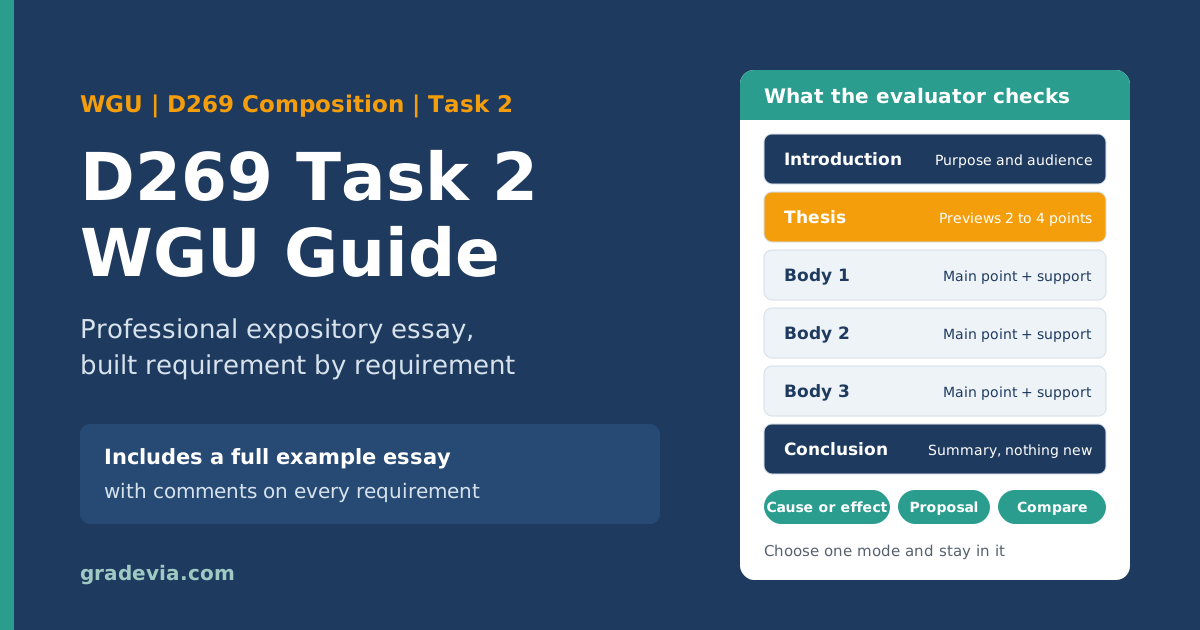
D269 Task 2 is the first time Composition: Writing with a Strategy asks you to write something of your own from scratch: a 2 to 3 page essay for a professional audience. Working students have an advantage here, because the best topic is usually a real problem from your own job. The catch is that the rubric checks specific parts of the essay one by one. A well written essay that never states its audience, or a thesis that doesn’t preview its main points, can still come back for revision.
This guide walks through every requirement of WGU D269 Task 2. It covers how to choose a mode and a topic, how to write the introduction and thesis the evaluator is looking for, and how to keep the conclusion from introducing anything new. It also includes a complete D269 Task 2 example essay built around a fictitious workplace.
D269 Task 2 Assignment
A. Compose an essay (suggested length of 2–3 pages) for a professional audience using one of the following expository structures:
- cause or effect essay (e.g., describe possible causes or effects of stress in the workplace)
- solution proposal essay (e.g., propose one or more possible solutions for low employee morale)
- compare and contrast essay (e.g., evaluate the benefits or disadvantages of an existing or proposed policy in your workplace)
Note: For your essay, you can select a topic from the list provided or you can use a topic based on your own professional interests. In addition, you will need to clearly describe the specific, real-world purpose and audience for your essay.
- Include the following components in your essay:
a. an introduction that establishes the topic and describes a specific purpose and intended audience for the essay
b. a thesis statement that previews 2–4 main points and aligns with the chosen expository mode
c. body paragraphs that include clear main points aligned with the thesis statement
d. appropriate development of the body of the essay
e. transitions
f. a conclusion that summarizes the essay without introducing new information
B. Acknowledge sources, using in-text citations and references, for content that is quoted, paraphrased, or summarized.
Note: Sources are NOT required for this task, but if sources are used, they must be acknowledged and cited appropriately.
C. Demonstrate professional communication in the content and presentation of your submission.
What D269 Task 2 Asks You to Do
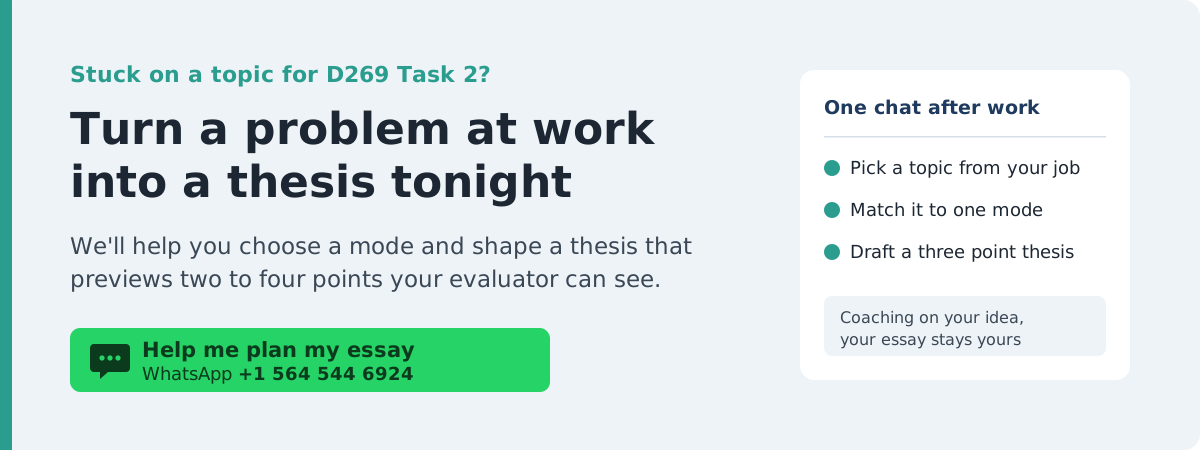
Composition: Writing with a Strategy D269 Task 2 asks for an essay of about 2 to 3 pages using one of three expository structures. The essay must include:
| Requirement | What the evaluator checks |
|---|---|
| A1a | An introduction that establishes the topic and describes a specific purpose and intended audience |
| A1b | A thesis statement that previews 2 to 4 main points and fits your chosen mode |
| A1c | Body paragraphs whose main points match the thesis |
| A1d | Enough development in the body to support each main point |
| A1e | Transitions |
| A1f | A conclusion that summarizes without introducing new information |
| B | Citations and references, only if you use sources |
| C | Professional communication |
Sources are optional. If you write entirely from your own professional experience, you don’t need any. If you quote, paraphrase, or summarize anything, cite it.
Choose Your Expository Mode
The D269 Task 2 WGU directions offer three structures. Pick the one that matches what you actually want to say about your topic:
| Mode | What it does | Thesis pattern |
|---|---|---|
| Cause or effect | Explains why something happens or what it leads to | “[Problem] stems from three causes: A, B, and C.” |
| Solution proposal | Recommends ways to fix a problem | “[Audience] can reduce [problem] by A, B, and C.” |
| Compare and contrast | Weighs the benefits and drawbacks of an existing or proposed policy, or of two options | “Compared with [option 1], [option 2] offers A and B but costs C.” |
Choose one mode and stay in it. A cause essay that drifts into recommendations in the last two paragraphs no longer “aligns with the chosen expository mode,” which is part of A1b.
Choose a Topic From Your Own Work
The task lets you choose a topic from WGU’s list or one “based on your own professional interests.” For working students, the second option is usually faster and stronger, because you already know the problem, the people involved, and the details that make body paragraphs convincing. Good topics are narrow enough to cover in 2 to 3 pages:
- Too broad: “Burnout in healthcare”
- Workable: “Why first year nurses on our hospital’s night shift leave within twelve months”
- Too broad: “Remote work”
- Workable: “Comparing our team’s current fully remote schedule with a proposed two day hybrid schedule”
The Introduction: State Purpose and Audience Out Loud
This is the most common gap in D269 WGU Task 2 submissions. The task asks you to clearly describe a specific, real world purpose and audience for your essay, and the introduction is where that has to happen. Don’t leave the evaluator to infer them.
Weak: “Employee turnover is a serious problem in many organizations.”
Specific: “This essay is written for the operations director of our regional distribution center, and its purpose is to recommend changes that would cut the errors caused by poor shift handoffs.”
Naming a real role, such as your director, your clinic’s practice manager, or your company’s HR committee, is what makes the audience specific. The purpose should say what you want that reader to understand or do.
The Thesis: Preview 2 to 4 Main Points
The thesis is usually the last sentence of the introduction. It must name your main points, between two and four of them, in the order the body will cover them. Three is the easiest number to develop in 2 to 3 pages.
Check your thesis against two questions:
- Can a reader list your body paragraph topics from the thesis alone?
- Does the thesis match your mode, naming causes, effects, solutions, or points of comparison?
Body Paragraphs and Development
Give each main point from the thesis its own body paragraph, in the same order. Open each paragraph with a topic sentence that clearly echoes its point from the thesis.
“Appropriate development” (A1d) means each paragraph explains and supports its point, not just states it. Useful support for a professional essay includes:
- A specific example from your workplace
- A number you observed, such as how often something happens or what it costs
- An explanation of why the point matters to your audience
- For a solution proposal, how the solution would work and what it would take to implement
A one or two sentence paragraph usually isn’t developed enough. For a 2 to 3 page essay with three main points, each body paragraph typically needs several sentences of explanation and support.
Transitions
Transitions (A1e) connect ideas between paragraphs and within them. Match them to your mode:
- Cause or effect: as a result, because of this, this leads to, a second cause is
- Solution proposal: first, in addition, to support this change, once this is in place
- Compare and contrast: in contrast, similarly, on the other hand, while both options
Start each body paragraph with a transition that links it to the previous one, so the essay reads as one argument rather than three separate notes.
The Conclusion: Summarize, Don’t Add
A1f is easy to lose. The conclusion should restate the purpose and summarize your main points, then close with a sentence directed at your audience. The most common mistake is adding a fourth idea at the end, such as a new recommendation or statistic that wasn’t in the body. If a point matters, move it into the body.
Sources, Similarity, and Professional Communication
If you use sources, cite them in APA with in text citations and a reference list. If you don’t, there’s nothing to cite. Don’t add filler sources to look academic.
Because many students write about the same suggested topics, essays on “stress in the workplace” or “low employee morale” with generic wording can match other submissions. Writing about a real situation from your own job, in your own words, is the best protection. Grammarly for Education checks professional communication, so clear any Correctness flags before you submit.
D269 Task 2 Example: A Solution Proposal Essay
Our D269 Task 2 example is a solution proposal essay written by a fictitious shift supervisor at a fictitious 24 hour distribution center. It recommends three ways to reduce errors caused by poor shift handoffs. It states the audience (the site’s operations director) and purpose in the introduction, previews three solutions in the thesis, develops each one in its own body paragraph, and closes without adding new information. The example is formatted in APA 7, and each part carries a comment explaining which requirement it meets.
Here’s the end of its introduction:
This essay is written for Dana Whitfield, the site’s operations director, and its purpose is to recommend practical changes that would reduce the errors that occur when one shift hands work to the next. Northgate can reduce handoff errors by adopting a standard handoff checklist, scheduling a fifteen minute overlap between shifts, and moving open issues to a shared digital log.
The example is for illustration only. Its topic isn’t on WGU’s suggested list, and your essay should be about a situation you know, in your own words.
Download the D269 Task 2 example essay (.docx)
Plan It Around Your Work Week
- Evening one: Choose your mode and topic, write one sentence naming your audience and purpose, and draft your thesis with three points.
- Evening two: Write the three body paragraphs, adding a workplace example or detail to each.
- Evening three: Write the introduction and conclusion, add transitions, run Grammarly for Education, and review the similarity report.
Common Reasons D269 Task 2 Comes Back
- The introduction never names a specific audience or purpose
- The thesis names a topic but not the 2 to 4 main points
- The body covers points in a different order, or includes a point the thesis never mentioned
- Paragraphs state points without examples or explanation
- The essay mixes modes, such as a cause essay that ends with recommendations
- The conclusion introduces a new idea or statistic
- Sources are quoted or paraphrased without citations
What Comes Next: RGM3 Task 3
After Task 2, D269 Task 3 WGU moves from writing to revising. In RGM3 Task 3, you edit and revise sample texts provided in the task, so the skills from this essay apply in reverse: you look for unclear purpose, missing transitions, and errors in someone else’s writing. You’ll see D269 Task 3 answers and D269 Task 3 answer key documents posted on study sites. They’re tied to specific sample texts and are exactly what the similarity checker compares against, so working through the revisions yourself is safer and faster. The same is true of any D269 Task 1 answer key you find for the rhetorical analysis.
Related WGU Guides
- Our WGU D269 Task 1 guide covers the rhetorical analysis template, including purpose, audience, and appeals, which feed directly into this essay.
- Writing for a specific workplace audience comes back in the WGU MBA. See our WGU C204 Task 1 guide on emails, letters, and messages for different readers.
- See every D269 Composition guide, or browse all WGU assignment guides and samples.
Pre-Submission Checklist
- The essay uses one mode: cause or effect, solution proposal, or compare and contrast
- The introduction names a specific, real world audience and purpose
- The thesis previews 2 to 4 main points that match the mode
- Each main point has its own body paragraph, in the thesis order
- Each body paragraph includes an example, detail, or explanation
- Transitions connect paragraphs and ideas
- The conclusion summarizes without adding new information
- Any source used is cited, and Grammarly Correctness is clear
Frequently Asked Questions
Do I need sources for D269 Task 2?
No. Sources aren’t required. If you quote, paraphrase, or summarize a source, you must cite it.
How long should the D269 Task 2 essay be?
The suggested length is 2 to 3 pages. Three well developed body paragraphs usually fit that range.
Can I write about my own workplace?
Yes. The task allows a topic based on your own professional interests, and a real workplace problem usually produces the most specific essay. Leave out confidential details.
How many main points should my thesis include?
Between two and four. Three is the easiest to develop fully in 2 to 3 pages.
Can I submit the D269 Task 2 example from this page?
No. It’s about a fictitious workplace, and copying any example would violate WGU’s academic integrity policy.
Want a Second Look Before You Submit?
If you’re working full time and want structured assignment support choosing a topic, tightening your thesis, or checking your essay against each requirement, message Gradevia on WhatsApp at +1 564 544 6924. Message us on WhatsApp