
Blog
WGU D269 Task 1 Guide and Example: Rhetorical Analysis Template

By Dan Palmer, MBA · Academic strategy consultant for working adult learners · LinkedIn
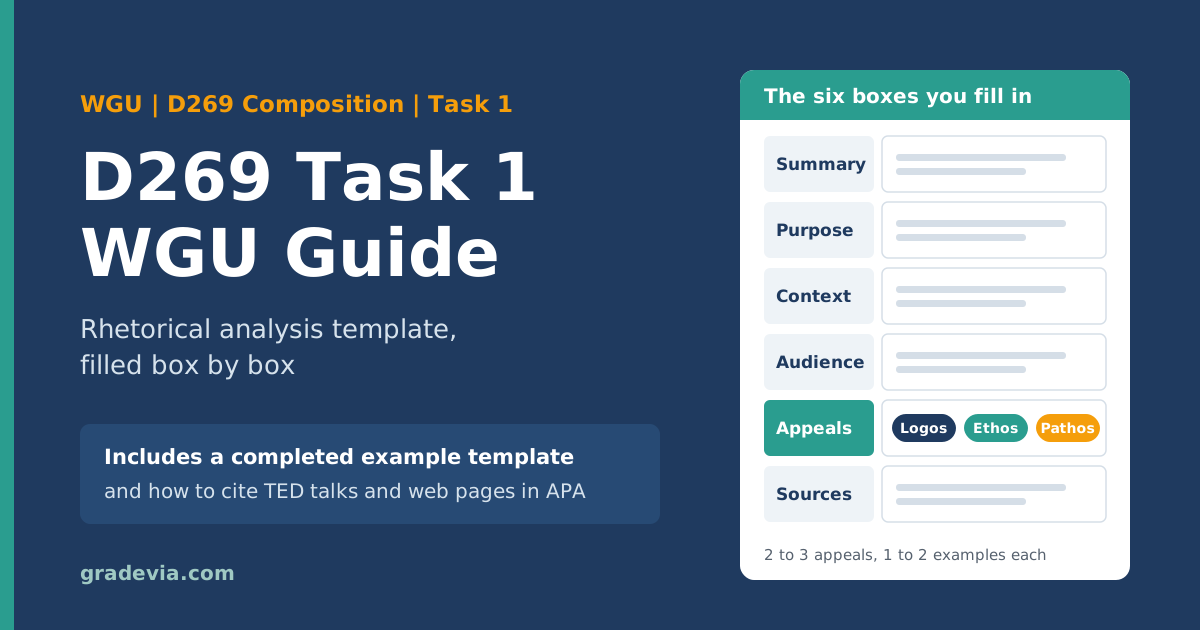
Composition: Writing with a Strategy D269 Task 1 is shorter than most WGU assessments, and that’s why it catches people out. You don’t write an essay. You fill six boxes in the D269 Task 1 Template: Summary, Purpose, Context, Audience, Appeals, and Sources. Each box is checked against its own requirement. A strong Appeals box won’t make up for a Context box that describes the speaker’s life instead of the moment the text was written in.
This guide is for working students who want to finish D269 Task 1 in a few focused evenings. It covers how to choose your text, what each box needs, how to cite videos and web pages in APA, and a complete filled template example built on a practice speech we wrote for this page.
D269 Task 1 Assignment
A. Compose an analysis using the Task 1 Template by doing the following:
- Choose a piece of persuasive writing from the “Texts for Analysis” list within the template.
- Analyze your chosen text by doing the following:
a. Summarize the text.
b. Discuss the author’s purpose for the text.
c. Explain the context of the text.
d. Describe the audience of the text.
e. Explain 2–3 appeals (i.e., logos, ethos, pathos) that are found within the text. For each type of appeal used in the text, include 1–2 examples.
B. Acknowledge sources, using in-text citations and references, for content that is quoted, paraphrased, or summarized.
C. Demonstrate professional communication in the content and presentation of your submission.

What D269 Task 1 Asks You to Do
D269 is WGU’s English composition course, and D269 English Task 1 is a rhetorical analysis. The task directions break it down like this:
| Requirement | Template box | What it asks for |
|---|---|---|
| A1 | (Before you start) | Choose one persuasive text from the “Texts for Analysis” list in the template |
| A2a | Summary | A complete overview of the text |
| A2b | Purpose | The author’s purpose for the text |
| A2c | Context | The larger historical or cultural moment when the text was written |
| A2d | Audience | The specific audience for the text |
| A2e | Appeals | 2 to 3 appeals (logos, ethos, pathos), with 1 to 2 examples each, connected to the appeal with discussion |
| B | Sources, plus in text citations | A complete reference for your text, and citations for anything quoted, paraphrased, or summarized |
| C | Whole template | Professional communication |
Use the D269 Task 1 Template, Not an Essay
Download the template from your course page and type your answers in the blank box under each heading. Don’t convert it into an APA paper with a title page and section headings. The task says to compose the analysis “using the Task 1 Template,” and the template is what your evaluator expects to see.
Two instructions printed in the template matter more than students expect:
The 30% match limit. No more than 30% of your written response can match other sources, including the text you are analyzing. Every quotation from the speech counts toward that limit. Quote short phrases for your appeal examples and put everything else in your own words.
Citation format. Every quote, paraphrase, or summary needs a parenthetical citation with the author’s last name and year, such as (Rogers, 2018) or (TED, 2023). The year is the year of the version you used, which leads to the trap explained under the Sources box below.
Choose Your Text: The Eight Options
The template lists eight texts. Here’s what each one is and where it comes from, so you can choose based on time and interest:
| Text | Format | Where and when |
|---|---|---|
| Brian Krebs, “Thinking of a cybersecurity career? Read this” | Blog post | KrebsOnSecurity, July 2020 |
| Chimamanda Ngozi Adichie, “The danger of a single story” | Talk (video) | TEDGlobal, 2009 |
| Fred Rogers, Dartmouth commencement address | Speech, presented in a news article | Delivered 2002; the linked Dartmouth article is from 2018 |
| Geoffrey Canada, “Our failing schools. Enough is enough!” | Talk (video) | TED Talks Education, 2013 |
| Sasha Luccioni, “AI is dangerous, but not for the reasons you think” | Talk (video) | TEDWomen, October 2023 |
| Scott Hardeman, “The fight to save healthcare for patients and physicians” | Written article | PubMed Central; check the page for publication details |
| Steve Jobs, “‘You’ve got to find what you love,’ Jobs says” | Commencement speech text | Stanford University, June 2005 |
| Storybook Maze, “A street librarian’s quest to bring books to everyone” | Talk (video) | TED Educator Talk, February 2024 |
If you’re short on time, a written text is faster to work from because you can search it for quotes. For a video, open the transcript on the TED page so you can quote exactly and find examples quickly.
Choose the text whose moment you can explain. The Context box asks about the larger historical or cultural setting, and that’s easier to write when you already know something about the period, such as AI debates in 2023, education reform in the early 2010s, or a healthcare policy fight.
Choosing the Steve Jobs Speech for D269 Task 1
D269 Task 1 Steve Jobs analyses are some of the most common, because the speech is short, familiar, and clearly organized around three personal stories. Two things to plan for if you choose it:
- Context is more than his biography. Jobs refers to his own health in the speech, but the Context box asks for the larger moment of 2005, not a profile of Jobs. Explain what was happening in technology, work, and graduate expectations at the time, and cite any outside facts you use.
- Similarity risk is higher. Because so many students analyze this speech, generic phrasing about “following your passion” tends to match other submissions. Your discussion of each appeal needs to be specific and in your own words.
Box by Box: What Each Section Needs
Summary
“A complete overview” means the main claim plus every major section of the text, in order, in your own words. A summary that covers only the opening story or the final line is incomplete. Leave out analysis here, because purpose and appeals have their own boxes.
Purpose
Purpose is what the author wants the audience to think, feel, or do after reading or listening. Start with a verb: persuade, urge, warn, inspire, challenge. In our practice example, “The purpose is to talk about tuition” describes the topic, not the purpose. “Delgado wants local employers to fund tuition for hourly workers” names a purpose.
Context
This box asks for “the larger historical or cultural moment when your selected text was written.” It’s the box students most often answer incorrectly, usually by writing about the speaker’s career. Describe what was happening in society, the industry, or public debate that made this text relevant when it appeared. If you bring in outside facts, cite them and add them to your references.
Audience
The template asks for the specific audience. “Everyone” or “the public” isn’t specific. Name the primary audience, the people in the room or the readers the author wrote for, and then the secondary audience, such as people watching the recording online. Explain briefly what they likely already believed or needed, because that’s what the appeals are aimed at.
Appeals
This box carries the most weight. For each of 2 or 3 appeals:
- Name the appeal. Logos appeals to logic and evidence, ethos appeals to the speaker’s credibility and character, and pathos appeals to emotion.
- Give 1 or 2 examples from the text, as short quotes or close paraphrases with a citation.
- Connect each example to the appeal with discussion. Explain how it works on this audience. A quote followed only by “this is pathos” is the most common reason this box comes back.
A useful pattern for each example is: the move the author makes, the evidence (quote or paraphrase with citation), and the effect on the specific audience you described.
Sources
The template asks for “a complete reference for your selected text, including author, date, title, and url.” Watch two traps:
- Use the version you actually viewed. The Fred Rogers link is a 2018 Dartmouth article that revisits a 2002 speech. Your reference uses the article’s details, and the 2002 date belongs in your Context discussion.
- Know who the author is for a YouTube video. In APA 7, the uploader is the author of a YouTube video. A TED talk watched on YouTube is cited with TED as the author, and you name the speaker in your sentence. A talk watched on the TED website is cited with the speaker as the author (American Psychological Association, 2020).
A D269 Task 1 Analysis That Passes: What It Gets Right
- The Summary covers the whole text, not just the opening
- Purpose names an action the author wants, starting with a verb
- Context describes the larger moment, not the speaker’s biography
- Audience names a specific primary audience and a secondary audience
- Each appeal is named, has 1 or 2 examples, and is connected to the audience with discussion
- Quotes are short, and the response stays under the 30% match limit
- The reference matches the version of the text you used, with author, date, title, and URL
Is There a D269 Task 1 Solution You Can Use?
No. Every D269 Task 1 WGU submission draws on the same eight texts, so copied wording from a D269 Task 1 solution posted online is exactly what WGU’s similarity checker is built to catch. The template’s own 30% limit also includes the text you’re analyzing, which leaves very little room for borrowed language.
That’s why the example on this page analyzes a practice speech that isn’t on the list. You can see what a complete, well cited template looks like without seeing an answer for any of the eight texts.
D269 Task 1 Example: A Filled Template for a Practice Speech
Most WGU D269 Task 1 examples online analyze one of the assigned texts, which makes them risky to read closely. Ours uses a fictitious speech by Marcus Delgado, a fictitious warehouse supervisor turned community college trustee. In the speech, he urges a fictitious chamber of commerce to fund tuition for hourly workers. The download includes the full practice speech and a completed template with all six boxes, APA citations, and a comment on each box explaining what it does.
Here’s an excerpt from the Appeals box:
Pathos: Delgado describes a coworker who studied at her kitchen table at 2 a.m. after a ten hour shift (Delgado, 2024). For an audience of employers, the image turns “turnover” into a person they might employ, making it harder to see tuition assistance as an abstract cost.
The example is for illustration only. Your submission must analyze one of the eight texts in the template, in your own words.
Download the D269 Task 1 example template (.docx
Plan It Around Your Work Week
- Evening one: Read or watch your text twice. The first time, just follow it. The second time, mark the main claim, each major section, and every moment that uses evidence, credibility, or emotion.
- Evening two: Fill Summary, Purpose, Context, and Audience, then the Sources box.
- Evening three: Write the Appeals box, check your quotes against the 30% limit, run Grammarly for Education, and review the similarity report before submitting.
What Comes After Task 1: RGM3 Task 2 and Task 3
D269 Task 1 is the first of three assessments. RGM3 Task 2 moves from analyzing someone else’s persuasion to writing your own professional essay. The audience, purpose, and appeals thinking from Task 1 is exactly what that essay needs. If you’re looking at WGU D269 Task 2 examples, check that they match the essay type and directions on your current task page before relying on them. The course ends with RGM3 Task 3, editing and revising text, where you improve sample texts rather than writing from scratch.
Related WGU Guides
These guides from our WGU library build on the same skills:
- Writing for a specific audience and purpose comes back in business communication. Our WGU C204 Task 1 guide covers emails, letters, and persuasive messages written for different readers.
- For more practice finding and citing sources in APA, see our WGU C210 Task 1 annotated bibliography guide.
- Browse every WGU assignment guide and sample in one place.
Pre-Submission Checklist
- The text is one of the eight on the template’s list
- All six boxes are filled in the template, not in a separate essay
- Summary covers the whole text, and Purpose starts with what the author wants
- Context explains the larger moment, with citations for outside facts
- Audience is specific, with primary and secondary audiences
- Each of 2 or 3 appeals is named, has 1 or 2 examples, and is explained
- Every quote and paraphrase has an author and year citation
- The reference includes author, date, title, and URL for the version you used
- No more than 30% of the response matches other sources, and Grammarly Correctness is clear

Frequently Asked Questions
Do I have to use the D269 Task 1 template?
Yes. The directions ask you to compose the analysis using the Task 1 Template, with your answers in the box under each heading.
How many appeals does D269 Task 1 need?
Two or three, chosen from logos, ethos, and pathos, with one or two examples for each.
Can I analyze a text that isn’t on the list?
No. Choose one of the eight texts listed in the template.
Who is the author when I cite a TED talk from YouTube?
In APA 7, the uploader is the author, so a talk on TED’s YouTube channel is cited with TED as the author. Name the speaker in your sentence.
Can I submit the example from this page?
No. It analyzes a fictitious practice speech that isn’t on the list, and copying any example would violate WGU’s academic integrity policy.
Want a Second Look Before You Submit?
If you’re working full time and want structured assignment support choosing your text, strengthening your Appeals box, or checking your citations, message Gradevia on WhatsApp at +1 564 544 6924.
References
American Psychological Association. (2020). Publication manual of the American Psychological Association (7th ed.). https://doi.org/10.1037/0000165-000