
Blog
WGU D078 Task 1 Guide and Example: TEM2 Organizational Structure

By Dan Palmer, MBA · Academic strategy consultant for working adult learners · LinkedIn
WGU D078 Task 1 gives every student the same short scenario: you’re starting a sustainability consulting firm with a mission, four goals, three student interns, and investors who want a say in decisions. Your job is to design its organizational structure on paper. The scenario is only a few paragraphs long, so it’s easy to answer from general knowledge and forget to apply it. That is where most of the rubric points sit.
This guide is for working students in WGU’s business programs who want to finish D078 Task 1 WGU requirements in a few evenings without guessing what the evaluator wants. It walks through every requirement of TEM2 Task 1: Organizational Structure. It shows which details in the scenario your answers should use and links to a complete APA 7 D078 Task 1 example built on a separate practice scenario.
Related Content: WGU D078 Task 2 Guide and Example: TEM2 Legal and Ethical Considerations
D078 (TEM2) Task 1 Assignment
Scenario
You have decided to create a consulting business to address increasing market needs for sustainability and innovation in the community. You want to emphasize how businesses can make incremental changes in the workplace to achieve sustainable results that increase profitability and brand reputation. The mission of the company is to “facilitate sustainable social, economic, and environmental development opportunities for the good of businesses in the community.” Your goals for this company include the following:
- Be a mission-driven, for-profit organization that will create partnerships that result in sustainable changes for the community.
- Achieve a level of success so your consulting firm can raise your city’s ranking in the “Most Sustainable and Innovative Communities” list from the top 20% of all U.S. communities to the top 10%.
- Assess the sustainability and innovation needs of 30 businesses in the local community in the first year. You will then share the results of those assessments with all business stakeholders to generate feedback that will be used to develop and implement proposals for consulting.
- Hire three university students as part-time interns to help you develop an organizational structure.
Before you design a business venture plan that includes its organizational design, you will identify how the business will generate revenue. You are interested in seeking investors in the business community who want to take a leadership role in the business and its decision-making.
You are excited about this opportunity and begin considering the organizational structure for your consulting business.
Note: Additional employees may be hired in the future.
A. Describe the organizational structure you would choose for the consulting business in the scenario by doing the following:
- Describe the main features of one of the following organizational structures and how this structure applies to the scenario:
- Functional
- Divisional
- Matrix
- Teams
- Using the chosen organizational structure described in part A1, explain how each of the following four factors works within the chosen organizational structure for the consulting business in the scenario:
- functions or departments
- chain of command
- centralized or decentralized structure
- level of formality
B. Describe one of the following organizational theories, including how it can be used to support the organizational structure described in part A1:
- scientific management
- bureaucratic
- administrative
- neoclassical
- modern
- contingency/situational
C. Explain how organizational structure can impact business effectiveness by doing the following:
- Identify one of the goals from the scenario for the consulting business.
- Explain how the chosen organizational structure from part A1 can impact the consulting business’s ability to meet the goal identified in part C1.
D. Acknowledge sources, using in-text citations and references, for content that is quoted, paraphrased, or summarized.
What D078 Task 1 Asks You to Do
D078 is Business Environment Applications I: Business Structures and Legal Environment. The assessment code for Task 1 is TEM2. Here’s how the requirements break down:
| Requirement | What you deliver |
|---|---|
| A1 | Choose one structure (functional, divisional, matrix, or teams), describe its main features, and explain how it applies to the scenario |
| A2 | Explain how four factors work in that structure for this firm: functions or departments, chain of command, centralized or decentralized, and level of formality |
| B | Describe one organizational theory (scientific management, bureaucratic, administrative, neoclassical, modern, or contingency/situational) and how it supports your structure |
| C1 | Identify one goal from the scenario |
| C2 | Explain how your structure affects the firm’s ability to meet that goal |
| D | In text citations and references for anything quoted, paraphrased, or summarized |
Everything in A2, B, and C2 depends on the structure you choose in A1, so choose carefully.
D078 Task 1 Template: How to Lay Out Your Paper
If your course page provides a D078 Task 1 template, use it. If it doesn’t, the simplest template is a Word document with APA headings that mirror the requirements:
- A1: Organizational Structure
- A2: Four Factors (with a subheading for each factor)
- B: Organizational Theory
- C1: Selected Goal
- C2: Impact of Structure on the Goal
- References
Headings that match the rubric let your evaluator find each aspect without searching. Four separate subheadings under A2 also make it obvious that you covered all four factors.
Read the Scenario Like an Evaluator
Every D078 WGU Task 1 answer should be traceable to details in the scenario. Before you choose a structure, list these:
- The mission: facilitating sustainable social, economic, and environmental development for businesses in the community
- The goals: being a mission driven, for profit firm built on partnerships; raising the city from the top 20% to the top 10% of sustainable and innovative communities; assessing 30 local businesses in year one and sharing results with stakeholders; and hiring three university students as part time interns to help develop the structure
- The people: you, three part time interns, investors who want a leadership role in the business and its decision making, and future hires
- The open question: you haven’t yet decided how the business will generate revenue
Each detail raises a structural question your paper should answer. Who do the interns report to? Where do investors sit in the chain of command? What changes when the firm hires more people? A paper that answers those questions for this firm reads as applied. A paper that only defines terms reads as generic.
A1: Choosing and Applying a Structure
You can choose any of the four structures, as long as you explain its features and connect them to the firm. Here’s what each one means, and the question each raises for this scenario:
| Structure | Main idea | Question it raises for this firm |
|---|---|---|
| Functional | Groups people by specialized function, such as operations, marketing, and finance | With one owner and three interns, which functions exist on day one? |
| Divisional | Groups people by product, region, or customer type, each division largely self contained | Does a one office firm with 30 clients have enough scale for divisions? |
| Matrix | People report to both a functional manager and a project or client manager | Can a very small team manage two reporting lines without confusion? |
| Teams | Organizes work around teams that own a task or client from start to finish | How do teams stay coordinated, and who has the final say? |
None of these is the “right answer.” What earns Competent is describing the features accurately and showing how they would work for a firm with this size, these people, and these goals. If you choose a structure that seems a stretch for a small startup, such as divisional, you can still succeed by explaining how it fits as the firm grows. The scenario says additional employees may be hired, and that sentence is there to be used.
A2: The Four Factors
Give each factor its own subheading and explain how it works in your chosen structure for this firm:
- Functions or departments: Name the actual functions or teams, such as client assessment, partnerships and outreach, or finance and reporting, and say who staffs them.
- Chain of command: State who reports to whom, including the interns and the investors. The scenario says investors want a leadership role in decision making, so your paper needs to place them somewhere specific, such as an advisory board or a board of directors.
- Centralized or decentralized: Choose one or describe a deliberate mix, and say which decisions sit where. “Pricing and investor relations stay with the founder, while assessment teams schedule their own client visits” is specific.
- Level of formality: Describe the rules, written procedures, and documentation, and why that level fits. A standardized assessment form for all 30 businesses is an example of useful formality.
B: Choosing an Organizational Theory
Choose the theory you can connect most directly to your structure:
- Scientific management: Efficiency through standardized, measured tasks
- Bureaucratic: Formal rules, hierarchy, and defined roles
- Administrative: Management functions and principles for running the whole organization
- Neoclassical: Adds human relations, motivation, and informal groups to classical ideas
- Modern: Treats the organization as a system that interacts with its environment
- Contingency/situational: No single best structure; the right design depends on size, environment, and tasks
Contingency theory is a popular choice because a startup that expects to grow fits its logic well. If you choose it, summarize it accurately. Organizational scholars have debated how much empirical support the original structural contingency theory gained over time (Shenkar & Ellis, 2022). Your paper doesn’t need that debate, but it does need a precise description rather than “it depends.”
Whatever theory you choose, the second half of B, how the theory supports your structure, is what’s being evaluated. Connect at least one specific idea from the theory to one specific feature of your structure.
C1 and C2: Connecting Structure to a Goal
Choose the goal your structure affects most clearly. The year one goal of assessing 30 businesses and sharing results is concrete and measurable, which makes it easy to analyze. The top 10% ranking goal is ambitious, but harder to link to day to day structure.
C2 asks how your structure can impact the firm’s ability to meet that goal. The strongest answers cover both directions: how the structure helps, and where it could slow the firm down, with a sentence on how you’d manage that risk. Research on organization design treats coordination and control as central design problems (Joseph & Sengul, 2025), so explaining how your structure coordinates the work behind the goal is a solid angle.
Are There D078 Task 1 Answers You Can Copy?
No. Because every student works from the same consulting firm scenario, posted D078 Task 1 answers are exactly what WGU’s similarity checker is built to catch. Searching for WGU D078 Task 1 answers, or for D078 WGU Task 1 answers posted on study sites, also tends to turn up papers that pick a structure and then apply it to a generic company, which costs points even before the similarity report comes in.
That’s why our example uses a different practice scenario. You get a model of the structure, depth, and citations without text that maps onto your submission.
D078 Task 1 Example: The Harvest Hall Practice Paper
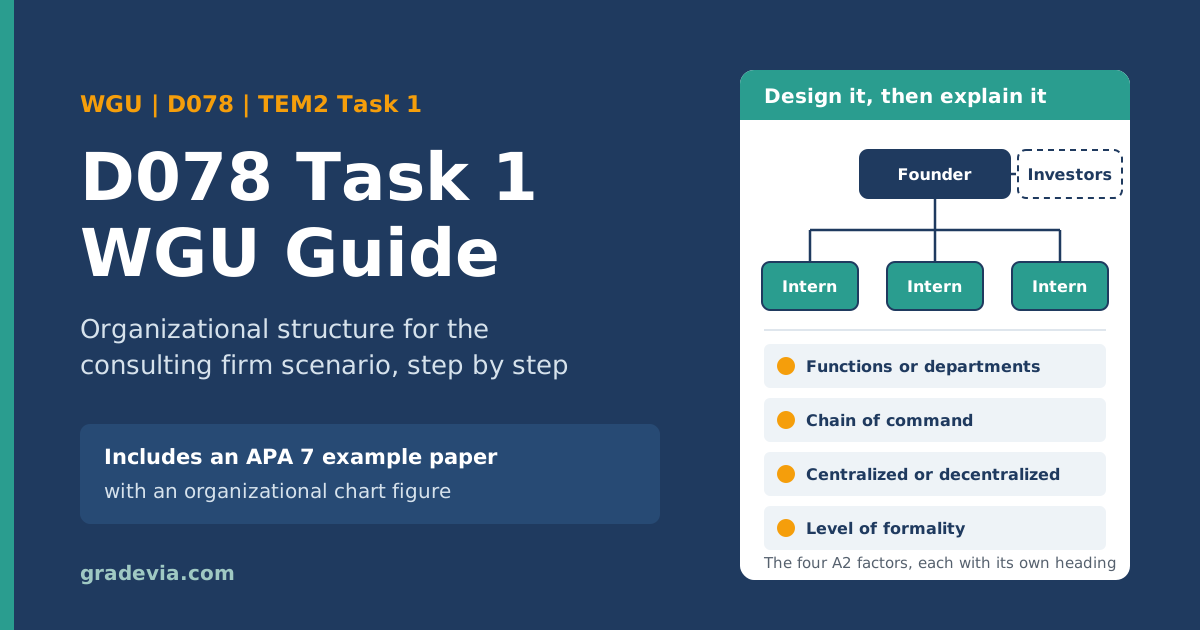
Our WGU D078 Task 1 example applies the same requirements to a fictitious business, Harvest Hall Kitchen Collective. It’s a for profit shared commercial kitchen and food business incubator, with its own mission, goals, part time instructors, and investors on an advisory board. The paper chooses a functional structure, covers all four factors, applies contingency theory, and analyzes one goal. It also includes an APA figure of the organizational chart. Each section carries a comment explaining which requirement it satisfies.
Here’s an excerpt from the chain of command section:
The three investors serve on an advisory board that meets quarterly and approves any expense over $10,000, but they do not direct staff. Keeping the board outside the daily chain of command lets investors shape major decisions without giving instructors three different people to answer to.
This D078 Task 1 example WGU students can study is for illustration only. Your submission must use the consulting firm scenario from your task directions, in your own words.
Download the D078 Task 1 example paper (.docx)
Plan It Around Your Work Week
- Evening one: List every detail in the scenario, choose your structure, and sketch a simple org chart showing you, the interns, and the investors.
- Evening two: Write A1 and the four A2 factors.
- Evening three: Write B, C1, and C2, add citations, and review the similarity report before you submit.
Common Reasons D078 Task 1 Comes Back
- Describing a structure in general terms without applying it to the consulting firm
- Covering three of the four A2 factors, or merging them into one paragraph
- Leaving the investors and interns out of the chain of command
- Describing a theory without explaining how it supports the chosen structure
- Choosing a goal in C1 that isn’t one of the scenario’s goals
- Explaining only how the structure helps the goal, with no specific mechanism
- Paraphrasing a textbook definition without an in text citation
Related WGU Guides
D078 introduces ideas that come back later in WGU business courses:
- How structure shapes team effectiveness is a core part of our WGU C205 Task 1 Leading Teams guide, which covers leader directed, self managed, and cross functional teams.
- Designing how an organization changes its structure and systems is the focus of our WGU C208 Task 1 change strategy guide.
- Writing clearly to investors, partners, and staff, the same stakeholders in the D078 scenario, is covered in our WGU C204 Task 1 guide.
- Browse every WGU assignment guide and sample.
Pre-Submission Checklist
- One structure is chosen from the four listed, with its main features described
- A1 explains how the structure applies to the consulting firm specifically
- A2 has a separate section for each of the four factors
- The chain of command places you, the interns, and the investors
- One theory from the list is described and connected to the structure
- C1 names a goal taken directly from the scenario
- C2 explains how the structure affects that goal, with a specific mechanism
- Every paraphrased definition has a citation and a matching reference
Frequently Asked Questions
Which structure is best for D078 Task 1?
There’s no single correct structure. Any of the four can earn Competent if you describe its features accurately and apply them to the consulting firm’s size, people, and goals.
Do I have to include the investors in the chain of command?
The scenario says investors want a leadership role in decision making, so your chain of command should show where they fit, for example on an advisory board or board of directors.
Is there an official D078 Task 1 template?
Use the template on your course page if one is provided. Otherwise, write in Word with APA headings that match A1, A2, B, C1, C2, and references.
Can I use more than one organizational theory?
The task asks you to describe one theory. Mentioning another briefly for contrast is fine, but build section B around one.
Can I submit the D078 Task 1 example from this page?
No. It uses a different practice scenario, and copying any example would violate WGU’s academic integrity policy.
Want a Second Look Before You Submit?
If you’re working full time and want structured assignment support choosing a structure, mapping the chain of command, or checking your theory section, message Gradevia on WhatsApp at +1 564 544 6924.
References
Joseph, J., & Sengul, M. (2025). Organization design: Current insights and future research directions. Journal of Management, 51(1), 249–308. https://doi.org/10.1177/01492063241271242
Shenkar, O., & Ellis, S. (2022). The rise and fall of structural contingency theory: A theory’s “autopsy.” Journal of Management Studies, 59(3), 782–818. https://doi.org/10.1111/joms.12772