Blog
WGU C208 Task 1 Guide: How to Pass the JHM2 Change Strategy on Your First Submission

By Dan Palmer, MBA · Academic strategy consultant for working adult learners · LinkedIn
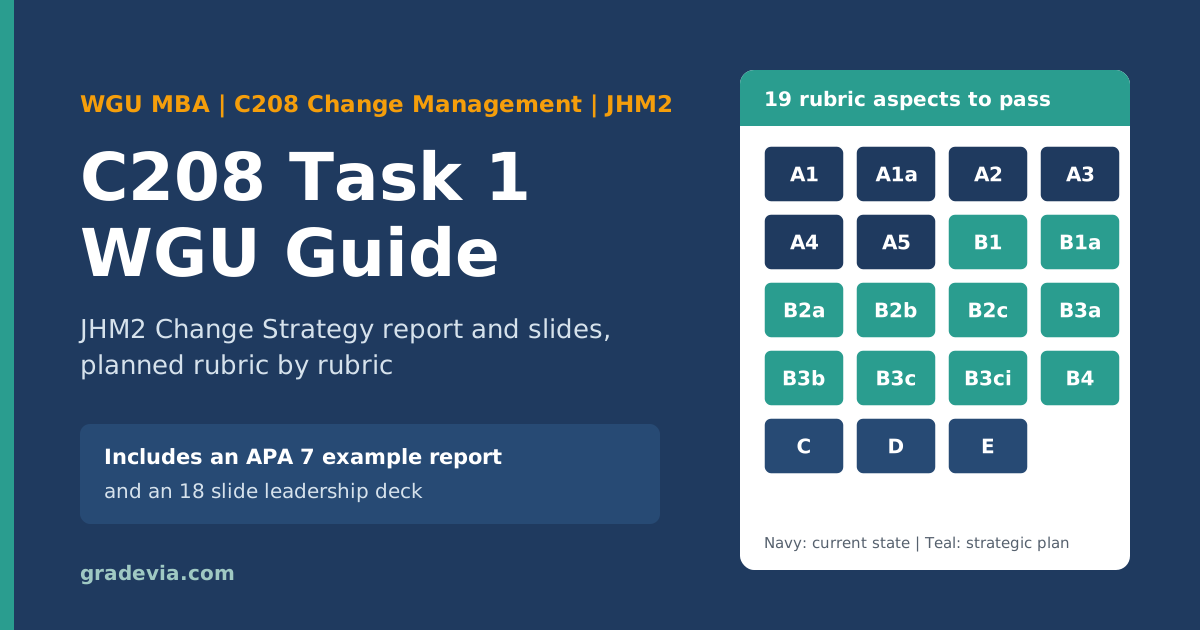
C208 Task 1, Change Management and Innovation, asks you to do something most working MBA students already do informally: look at an organization you know, name what is broken, and propose a way to fix it. The difference is that JHM2 Task 1 wants that thinking in two deliverables, a business report and a 15 to 20 slide presentation, scored across 19 separate rubric aspects.
That aspect count is the real challenge. A report can be well written and still come back if B2b (resources) or B3ci (contingency plans) is thin, because every aspect must reach Competent on its own. This guide walks through the JHM2 Task 1 Change Strategy one aspect at a time, shows you how to build the report and deck in parallel, and includes a full annotated example of both built around a fictitious company.
C208 (JHM2) Task 1 Assignment Prompt
Introduction
An organization’s ability to survive depends on its leadership’s capacity to effectively lead innovation and planned change. Sustainable change depends on accurate diagnosis and effective intervention.
For this assessment, you will outline a change strategy for an organization of your choice. Your chosen organization must be one that you have experience with and one that has opportunities for you to develop a strategic plan. Your strategic planning should help the organization address its fundamental problems and help create sustained organizational change.
Note: Any information that would be considered confidential, proprietary, or personal in nature should not be included in the actual task submission to WGU. Do not include the actual names of people, suppliers, the organization(s), or other identifiable information. Fictional names should be used. Also, organization-specific data, including financial information, should not be included but should be addressed in a general fashion as appropriate. Work performed for a client, or an employer is their property and should not be used without written permission.
Requirements
Your submission must represent your original work and understanding of the course material. Most performance assessment submissions are automatically scanned through the WGU similarity checker. Students are strongly encouraged to wait for the similarity report to generate after uploading their work and then review it to ensure Academic Authenticity guidelines are met before submitting the file for evaluation. See Understanding Similarity Reports for more information.
Grammarly Note:
Professional Communication will be automatically assessed through Grammarly for Education in most performance assessments before a student submits work for evaluation. Students are strongly encouraged to review the Grammarly for Education feedback prior to submitting work for evaluation, as the overall submission will not pass without this aspect passing. See Use Grammarly for Education Effectively for more information.
Microsoft Files Note:
Write your paper in Microsoft Word (.doc or .docx) unless another Microsoft product, or pdf, is specified in the task directions. Tasks may notbe submitted as cloud links, such as links to Google Docs, Google Slides, OneDrive, etc. All supporting documentation, such as screenshots and proof of experience, should be collected in a pdf file and submitted separately from the main file. For more information, please see Computer System and Technology Requirements.
You must use the rubric to direct the creation of your submission because it provides detailed criteria that will be used to evaluate your work. Each requirement below may be evaluated by more than one rubric aspect. The rubric aspect titles may contain hyperlinks to relevant portions of the course.
Create a business report, including a multimedia presentation, for the leadership of your chosen organization that clearly outlines a change strategy by completing the following steps:
A. Analyze the current state of the chosen organization by doing the following:
- Describe the mission statement of the chosen
- Describe the goals for the organization over the next three years.
- Identify the key external and internal stakeholders of the organization (e.g., board members, employees, the community, shareholders).
- Discuss the current leadership (e.g., structure, policies, procedures, organizational systems) in the chosen
- Analyze at least two fundamental problems in the chosen
- Explain why fundamental change is necessary for the chosen organization to meet its mission and goals
B. Create a strategic plan that addresses the organization’s fundamental problems by doing the following:
- Propose a strategy to address the organization’s fundamental problems.
a. Explain how your strategy will benefit the organization and its stakeholders
2. Explain how you will implement your strategic plan by doing the following:
a. Explain at least three steps key stakeholders need to take to prepare the organization for change implementation.
b. Identify the resources needed for each step in your implementation
c. Outline an implementation timeline for each step within your plan.
3. Explain how you will evaluate your strategic plan by doing the following:
a. Describe at least two success metrics that will be used to evaluate the plan.
b. Explain how you will sustain the changes suggested in your plan.
c. Discuss at least three challenges that might negatively affect the implementation of your plan.
i. Discuss a contingency plan for each anticipated challenge discussed in part B3c
Explain how you will communicate your strategic plan to the internal and external stakeholders identified in A2.
C. Create a multimedia presentation (suggested length 15–20 slides) for the leadership of your chosen organization that clearly outlines the key points of your business report.
D. Acknowledge sources, using in-text citations and references, for content that is quoted, paraphrased, or summarized
E. Demonstrate professional communication in the content and presentation of your submission
What JHM2 Task 1 Change Strategy Actually Asks For
The C208 Task 1 prompt has three content sections and three delivery requirements:
| Section | Aspects | What it covers |
|---|---|---|
| A: Current state | A1, A1a, A2, A3, A4, A5 | Mission, three year goals, stakeholders, leadership, at least 2 fundamental problems, why fundamental change is needed |
| B: Strategic plan | B1, B1a, B2a, B2b, B2c, B3a, B3b, B3c, B3ci, B4 | Strategy, benefits, at least 3 preparation steps, resources, timeline, at least 2 metrics, sustainment, at least 3 challenges with a contingency for each, communication plan |
| C: Presentation | C | 15 to 20 slides for leadership covering the report’s key points |
| D and E | D, E | APA citations and references, Grammarly Correctness |
Two things in the task directions trip up more students than any single rubric aspect:
The organization must be one you have experience with. Your employer, a former employer, or an organization where you volunteer all work. The evaluator expects detail only someone inside the organization could provide.
You must disguise it. Use a fictional name for the organization, its people, and its suppliers, and describe financial information in general terms rather than real figures. “Revenue declined for three consecutive years” is fine. Actual dollar amounts are not.
Plan the Work Across Two Weeks
JHM2 is heavier than a typical C200 series paper because of the deck. For a full time professional, this schedule keeps it manageable:
- Week one, two evenings: Choose your organization, pull its mission and goals, and draft section A.
- Week one, weekend session: Draft section B, building the implementation table (steps, resources, timeline) first because B2a, B2b, and B2c all come from it.
- Week two, two evenings: Build the deck from your finished report. Each major report heading becomes one or two slides.
- Week two, final evening: Add citations, run Grammarly for Education on the report, check the similarity report, and review slide notes.
Section A: Analyzing the Current State
A1 and A1a: Mission and Three Year Goals
Quote or paraphrase the mission statement (with the organization’s fictional name), then describe what it means in practice. For A1a, list goals that are specific to the next three years, not permanent aspirations. “Grow” is not a goal. “Open a fifth branch and raise maintenance plan enrollment by the end of year three” is.
Keep these goals in view. A5, B1a, and B3a all have to connect back to them, and evaluators notice when a strategy solves a problem that has nothing to do with the stated goals.
A2: Stakeholders
This aspect is scored Competent or Not Evident, with no middle level. Identify both internal and external stakeholders by name of group, and write one sentence on each group’s stake in the change. Build this list carefully, because B4 requires you to communicate with every group you name here.
A3: Current Leadership
The prompt lists structure, policies, procedures, and organizational systems. Cover all four explicitly:
- Structure: who reports to whom, and where decisions are made
- Policies: the rules that govern the problem area
- Procedures: how work actually gets done day to day
- Organizational systems: the software, tools, and information flows people rely on
A paragraph that describes only the CEO’s leadership style is the most common reason for Approaching Competence here.
A4: At Least Two Fundamental Problems
The rubric asks for a plausible analysis with sufficient support. Support means evidence from inside the organization, described generally: symptoms you have observed, trends in customer complaints, turnover patterns, or process failures. For each problem, separate the symptom (missed appointments) from the root cause (three disconnected scheduling tools). Fundamental problems are root causes.
A5: Why Fundamental Change Is Necessary
Explain why incremental fixes will not get the organization to its mission and goals. The strongest move is naming a fix the organization already tried and explaining why it failed. That shows the evaluator the problem is structural, not a matter of effort.
Section B: Building the Strategic Plan
B1 and B1a: The Strategy and Its Benefits
Propose one integrated strategy that addresses every problem from A4. Ground it in a recognized change management approach. Phillips and Klein (2023) reviewed 16 change models and found that practitioners most often rely on strategies involving communication, stakeholder involvement, encouragement, organizational culture, vision, and mission, which gives you a sourced basis for the design choices in your plan.
For B1a, write the benefits by stakeholder group from A2. A small table works well here and doubles as slide content.
B2a, B2b, and B2c: Steps, Resources, and Timeline
These three aspects score separately but describe the same plan, so build one table first:
| Step | Who acts | Resources | Timeline |
|---|
Then write a paragraph explaining each step in detail. The task asks for at least three steps key stakeholders take to prepare the organization for implementation, so readiness activities (forming a change team, assessing readiness, piloting, training) fit better than post-launch tasks. Name specific resources for every step: people, budget categories, software, training time, outside expertise. A timeline in months or quarters for each step completes B2c.
B3a: At Least Two Success Metrics
Each metric needs a definition, a data source, a baseline described generally, a target, and a review frequency. “Employee satisfaction will improve” fails. “Twelve month voluntary technician turnover, tracked in the HR system and reviewed quarterly, with a target of reducing it by one third from the current baseline” passes.
B3b: Sustaining the Changes
Explain how the change becomes the normal way of working: new policies, updated job descriptions, metrics added to manager scorecards, onboarding that teaches the new process, and scheduled reviews. Errida and Lotfi (2021) grouped the factors behind successful change into 12 categories, and several of them, such as monitoring and reinforcement, map directly onto this aspect.
B3c and B3ci: Three Challenges, Three Contingencies
Pair them one to one. For each challenge, explain why it is likely at this specific organization, then give a contingency with a trigger (“if pilot adoption is below target after 30 days…”) and a specific response. A contingency without a trigger reads as a general hope.
B4: Communicating the Plan
Return to every stakeholder group from A2 and give each a message, a channel, a sender, and a frequency. A communication matrix table satisfies this cleanly, as long as the paragraph around it explains why each channel suits that audience.
Section C: The 15 to 20 Slide Presentation
The audience is the organization’s leadership, not your evaluator. Write it as if you were presenting to the owner or executive team:
- One title slide, one agenda slide, and one closing or request slide
- One or two slides per major report section, in the same order as the report
- Tables and visuals for the implementation plan, metrics, and communication matrix
- Speaker notes that carry the detail, so slides stay readable
“Multimedia presentation” means a slide deck at minimum. Some students add narration. Check the current task page for any recording requirement before you decide.

Sections D and E: Sources and Grammarly
Cite your course materials plus two to four current scholarly sources on change management. Every in text citation needs a matching reference, and the report is the file Grammarly for Education scores, so fix every Correctness flag before you submit. Also let the similarity report finish before you click submit.
See the Full Annotated Example
The example report and slide deck below are built around Tallgrass Comfort Services, a fictitious residential heating, cooling, and plumbing company with four branches. The report is formatted in APA 7 and includes a comment on every section explaining which rubric aspect it satisfies. The deck has 16 slides with speaker notes.
Both are for illustration only. Your JHM2 submission has to be about an organization you know, and WGU’s similarity checker compares submissions against published examples like these.
C208_Task_1_Example_Tallgrass (Click to Download)
C208_Task_1_Example_Presentation_Tallgrass (Click to Download)
How C208 Task 1 Connects to C208 Task 2
C208 Task 2 is a separate performance assessment, so confirm its current requirements on your own task page before planning around it. The change leadership thinking you build in JHM2 Task 1, especially stakeholder analysis, readiness, and sustaining change, is the foundation the rest of the course builds on, so time spent getting section B right here is not wasted.
Pre-Submission Checklist
- The organization is one you have experience with, under a fictional name
- No real names, suppliers, or actual financial figures appear anywhere
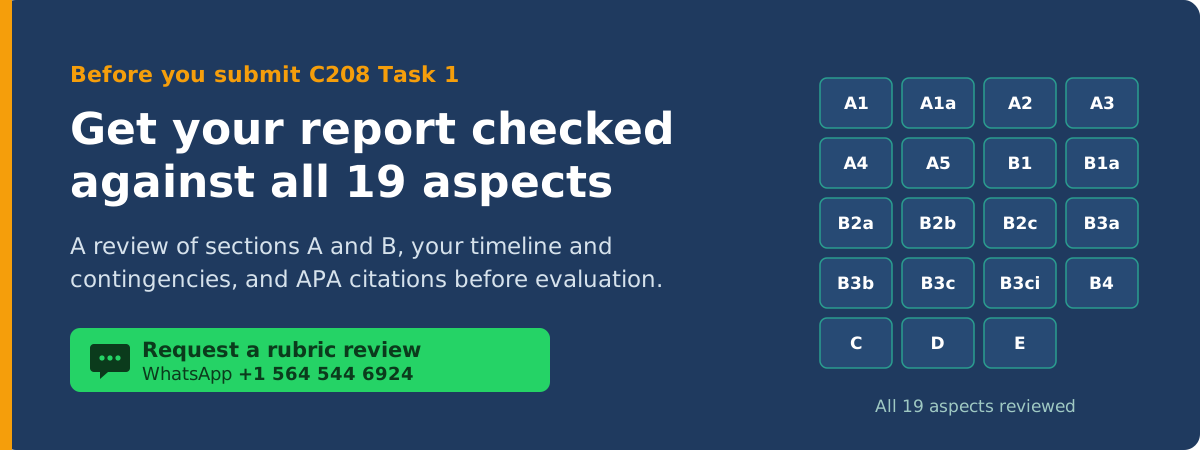
- Each of the 19 rubric aspects has its own heading in the report
- Goals in A1a connect to the strategy in B1 and the metrics in B3a
- Every stakeholder group in A2 appears in the B4 communication plan
- B2a has at least three preparation steps, each with resources and a timeline
- B3c and B3ci pair each challenge with its own contingency
- The deck has 15 to 20 slides and follows the report’s order
- Every citation has a matching reference, and Grammarly Correctness is clear
Frequently Asked Questions
Can I use a fictional organization for C208 Task 1?
The task requires an organization you have experience with, presented under a fictional name. Inventing an organization from scratch is risky because the evaluator is looking for detail drawn from real experience.
How long should the JHM2 report be?
The task does not set a page count. With 19 aspects to cover, plan for enough length to give each aspect its own heading and full paragraphs. The example report linked above runs about nine pages of body text, double spaced.
Does C208 WGU Task 1 need speaker notes?
The rubric asks for a presentation that clearly outlines the key points of the report. Speaker notes are the easiest way to add detail without crowding slides.
Can I reuse my employer’s real data?
No. Describe financial and performance information in general terms, and remove anything confidential or identifying.
Need Help With Your Change Strategy?
If you’re working full time and want structured assignment support choosing your organization, tightening section B, or turning your report into a leadership deck, message Gradevia on WhatsApp at +1 564 544 6924.
Related WGU Content
WGU C210 Task 1 (MKM1): Annotated Bibliography Guide and Example
WGU C212 Marketing Guide: Task 1 and Course Overview
WGU C214 Financial Management Guide: What to Study and How to Pass
How to Pass WGU C213: A Practical Study & OA Strategy
References
Errida, A., & Lotfi, B. (2021). The determinants of organizational change management success: Literature review and case study. International Journal of Engineering Business Management, 13. https://doi.org/10.1177/18479790211016273
Phillips, J., & Klein, J. D. (2023). Change management: From theory to practice. TechTrends, 67(1), 189–197. https://doi.org/10.1007/s11528-022-00775-0