Blog
WGU C210 Task 1 (MKM1): Annotated Bibliography Guide and Example

Updated on: Sep 2, 2026
WGU C210 Task 1
Management and Leadership Capstone, C210, is the final course in WGU’s Master of Science, Management and Leadership (MSML) program, and MKM1 Task 1 is its opening assessment: a full annotated bibliography pulling from every course you’ve completed across the degree. Students search for this task under both names, C210 Task 1 and MKM1 Task 1, and often land on threads on r/WGU asking the same handful of questions, so this guide answers them directly: how many sources you actually need, what a strong entry looks like, why Prompt B trips people up, and how to avoid a revision this late in the program.
The scope is the single biggest thing that catches students off guard. You’re not writing one bibliography, you’re writing nine, one for each MSML course, with two to five scholarly articles apiece. That’s a minimum of 18 annotated entries and a maximum of 45. Treating this as a normal-sized assignment is how students end up rushing it in the final week before graduation.
WGU C210 Task 1 Annotated Bibliography Assignment
Introduction
Note: This task is designed to be taken after successful completion of all courses within the Master of Science, Management and Leadership (MSML) program. Before beginning this task, ensure all program courses are completed, or obtain permission from your program mentor and course instructor.
In your capstone project, you will apply competencies from throughout the MSML program. This course is designed for you to synthesize and reflect on key concepts learned within your MSML program.
In this task, you will create an annotated bibliography with references from each course in your MSML program. In creating each annotation, you will reflect on each course in your program and choose articles for each course that you find to be most important to your management and leadership practice. Next, you will reflect on the concepts presented in the articles and how you can apply them in your personal and team management and leadership practices. At the end of this task, you will have a robust portfolio of leadership concepts as you leave your program.
Requirements
Your submission must represent your original work and understanding of the course material. Most performance assessment submissions are automatically scanned through the WGU similarity checker. Students are strongly encouraged to wait for the similarity report to generate after uploading their work and then review it to ensure Academic Authenticity guidelines are met before submitting the file for evaluation. See Understanding Similarity Reports for more information.
Grammarly Note:
Professional Communication will be automatically assessed through Grammarly for Education in most performance assessments before a student submits work for evaluation. Students are strongly encouraged to review the Grammarly for Education feedback prior to submitting work for evaluation, as the overall submission will not pass without this aspect passing. See Use Grammarly for Education Effectively for more information.
Microsoft Files Note:
Write your paper in Microsoft Word (.doc or .docx) unless another Microsoft product, or pdf, is specified in the task directions. Tasks may notbe submitted as cloud links, such as links to Google Docs, Google Slides, OneDrive, etc. All supporting documentation, such as screenshots and proof of experience, should be collected in a pdf file and submitted separately from the main file. For more information, please see Computer System and Technology Requirements.
You must use the rubric to direct the creation of your submission because it provides detailed criteria that will be used to evaluate your work. Each requirement below may be evaluated by more than one rubric aspect. The rubric aspect titles may contain hyperlinks to relevant portions of the course.
- Using the “MSML Annotated Bibliography Template” in the Supporting Documents section, create an annotated bibliography with references for 2–5 scholarly articles you select for each of the following courses in your MSML program:
- C200: Managing Organizations and Leading People
- C203: Application of Effective Leadership
- C202: Managing Human Capital
- C201: Business Acumen
- C204: Management Communication
- C205: Leading Teams
- C206: Ethical Leadership
- C208: Change Management and Innovation
- C209: Strategic Management
Note: A scholarly source is written by an expert for an audience of other experts, researchers, or students. Additionally, you may cite other reputable editor-reviewed articles and books. A reputable source is defined as an article from a respected industry publication, government organization, educational institution, or industry leader. These can be found in the WGU Library or within the course.
Note: Students transferring credits from other programs towards completion of the MSML program are still required to create an annotated bibliography for 2-5 scholarly articles for each of the transferred courses in order to demonstrate overall mastery of the course material required in the MSML program.
Each article reference in the annotated bibliography should contain the following:
- a synopsis of the article’s contents, including key points
- a description of why this article is important from a management and leadership perspective
B. Discuss in detail a total of three examples of how you will apply concepts from the articles in part A in your personal or team management and leadership practices.
Note: Remember to complete Prompt B as part of the Task 1 submission.
C. Acknowledge sources, using in-text citations and references, for content that is quoted, paraphrased, or summarized.
D. Demonstrate professional communication in the content and presentation of your submission.
What Is WGU C210 Task 1 (MKM1)?
MKM1 Task 1 is designed to be completed after you’ve finished every other course in the MSML program, or with permission from your program mentor if you haven’t. It asks you to look back across your entire degree and select the scholarly articles from each course that were genuinely most valuable to your development as a manager and leader, then reflect on how you’ll apply those concepts going forward.
The task has two distinct, separately graded parts. Prompt A is the annotated bibliography itself, covering all nine courses. Prompt B, three detailed examples of how you’ll apply the concepts in your own practice, is a completely separate rubric row that a surprising number of students skip or underwrite. Missing it, or treating it as an afterthought, is one of the most common reasons this task comes back for revision.
The 9 MSML Courses You Must Cover
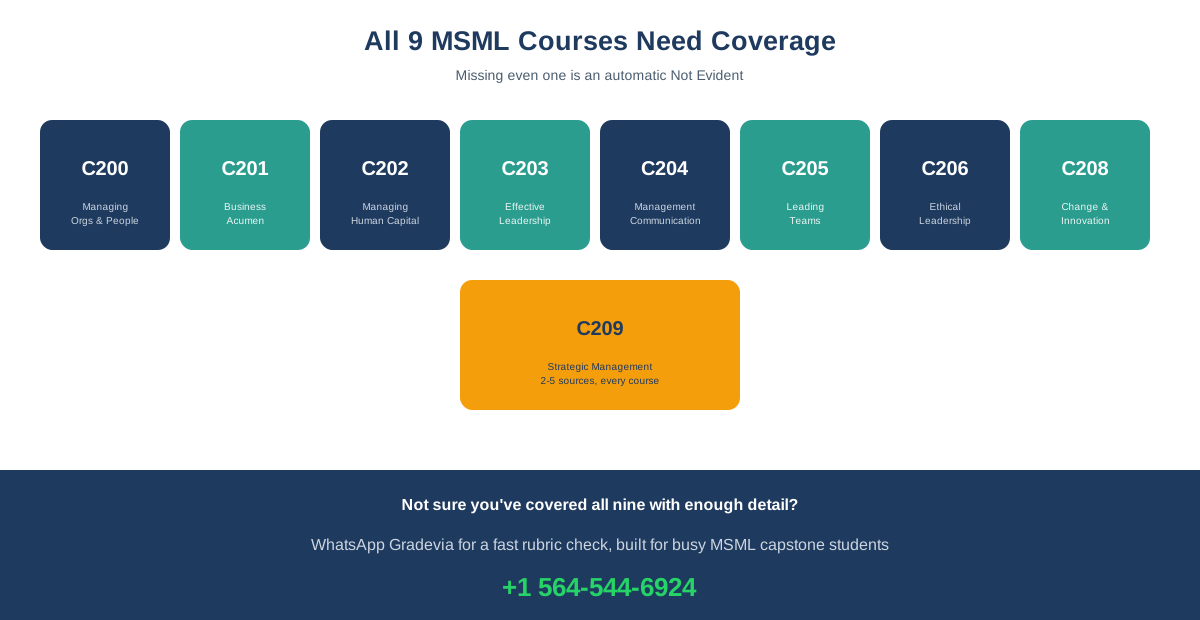
Every course below needs its own 2 to 5 scholarly articles. Skipping one results in Not Evident on the annotation rubric, there’s no partial credit for covering eight out of nine.
| Course Code | Course Name |
|---|---|
| C200 | Managing Organizations and Leading People |
| C201 | Business Acumen |
| C202 | Managing Human Capital |
| C203 | Application of Effective Leadership |
| C204 | Management Communication |
| C205 | Leading Teams |
| C206 | Ethical Leadership |
| C208 | Change Management and Innovation |
| C209 | Strategic Management |
Transfer credit students: if you tested out of or transferred credit for any of these courses, you’re still required to write 2 to 5 annotations for that course. Transfer credit doesn’t exempt you from demonstrating mastery of the material here.
What Counts as a Scholarly Source for MKM1 Task 1?
A scholarly source is written by an expert for an audience of other experts, researchers, or students. You can also cite reputable editor-reviewed articles and books, defined as content from a respected industry publication, a government organization, an educational institution, or a recognized industry leader. Everything you cite should be findable in the WGU Library or within your course materials. General websites, blogs, and non-peer-reviewed content don’t satisfy this requirement.
How to Structure Each Annotated Entry
The official MSML Annotated Bibliography Template, provided as a supporting document inside your task, sets out the exact font, spacing, and page-break requirements for your submission. Confirm those specifics against your current copy of that template rather than relying on secondhand descriptions, since supporting documents do get updated. What stays consistent is the content structure the rubric itself specifies, every entry needs three components:
| Entry Section | What Evaluators Expect |
|---|---|
| APA 7 Citation | Full citation: author, year, title, journal, volume, issue, pages, DOI, with a hanging indent |
| Synopsis of Contents | One paragraph summarizing the article’s key points and arguments, with specific detail |
| Management and Leadership Importance | One paragraph explaining why this article matters from a management and leadership perspective |
The trap to watch for: the rubric explicitly distinguishes Approaching Competence from Competent based on whether your entries are “supported by specific details.” A synopsis that describes what an article is generally about, without naming a specific finding, framework, or argument, reads as vague even if it’s technically on-topic.
A Fictitious Example Annotated Entry
Illustrative example only, fictitious article details created for teaching purposes, not an official WGU submission. Always cite the real articles you actually select and read.
Course: C205, Leading Teams
APA 7 Citation: Whitfield, R. M., & Osei, K. (2023). Psychological safety and team performance in distributed work environments. Journal of Organizational Behavior Studies, 41(2), 118–134. https://doi.org/10.xxxx/example
Synopsis of Contents: Whitfield and Osei examine how psychological safety, defined as a shared team belief that it’s safe to take interpersonal risks, correlates with performance outcomes in distributed and hybrid teams. Drawing on survey data from 34 remote-first organizations, the authors find that teams with higher reported psychological safety showed measurably stronger problem-solving performance and lower voluntary turnover than teams scoring low on the same measure, even after controlling for tenure and team size. The article’s central argument is that psychological safety in distributed teams depends heavily on how consistently a leader responds to mistakes in visible, asynchronous channels, such as shared chat platforms, rather than on any single team-building exercise.
Management and Leadership Importance: This article is directly relevant to leading a hybrid team, a context where informal cues that build trust in person, tone of voice, body language, are largely absent. It reframes psychological safety as something a leader actively builds through visible, consistent responses to error rather than a passive team characteristic, which gives me a concrete lever to pull rather than an abstract goal to aim for.
Prompt B: The Three Application Examples
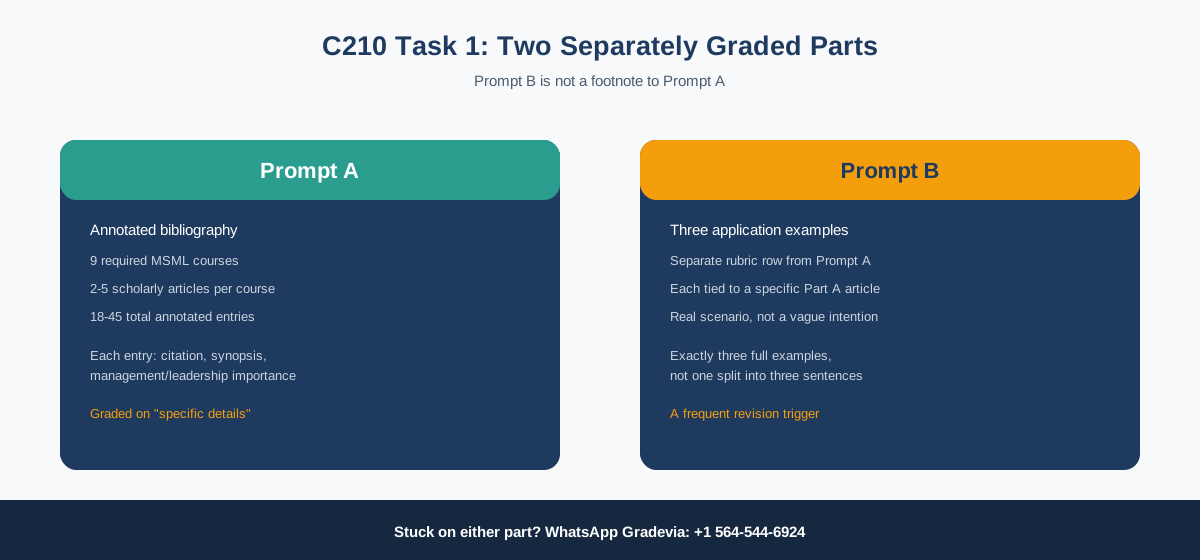
Prompt B asks for three detailed, specific examples of how you’ll apply concepts from your Part A articles in your own personal or team management and leadership practice. It has its own rubric row, separate from the annotated bibliography, and submissions that skip it or treat it as a closing paragraph won’t pass regardless of how strong the bibliography itself is.
What makes a strong Prompt B response:
- Each example ties back to a specific article or concept from your own Part A bibliography, not a generic leadership theory floating free of any source
- Examples describe a real, specific application, a scenario, a team context, a decision you’ll actually face, not a vague intention
- Three full examples are required, not one expanded into three sentences
Weak Prompt B example: “I will use transformational leadership principles to motivate my team.”
Stronger Prompt B example: “Drawing on the psychological safety research in my C205 annotation, I will implement a practice of acknowledging mistakes publicly in our team’s shared project channel within 24 hours of identifying them, modeling the visible error-response behavior the research identifies as central to building trust in distributed teams, a practice I’ll begin with my current cross-functional project team this quarter.”
Not sure whether your own Prompt B drafts are specific enough to satisfy the rubric? Message Gradevia on WhatsApp and send us what you’ve written, we’ll tell you exactly where it needs more specificity.
Two Automatic Checks That Can Fail Your Submission
Grammarly for Education. WGU automatically runs your submission through Grammarly for Education before it reaches an evaluator, and the overall submission won’t pass if it fails the Correctness category, regardless of how strong the content is. Review that feedback and resolve every flagged issue before you submit.
The WGU similarity checker. All submissions are automatically scanned for similarity. Wait for the report to generate after uploading, then review it before you submit for evaluation. Write every annotation in your own words, don’t copy from an article’s abstract, paraphrase and synthesize, then cite properly with APA 7.
Both checks run before a human evaluator ever sees your work. Build time into your submission window to review both reports rather than treating them as a formality.
Common Mistakes That Cause Revisions in MKM1 Task 1
Missing a course. All nine MSML courses need representation. Evaluators check this against the required list directly, missing even one triggers Not Evident on the annotation rubric.
Fewer than two articles per course. The requirement is 2 to 5 articles for each individual course, not 2 to 5 spread across the whole bibliography.
Annotations without specific details. Approaching Competence is explicitly defined as annotations that include the required points “but are not supported by specific details.” Name the actual finding, methodology, or argument from each article, not just its general topic.
Skipping or underwriting Prompt B. This is graded separately, and three brief sentences won’t satisfy a requirement asking for three full, detailed examples.
Formatting drift. Font, spacing, and page-break requirements come from your current MSML Annotated Bibliography Template, deviating from it is a professional communication issue an evaluator will flag.
APA 7 errors. Missing DOIs, incorrect capitalization, missing italics, or inconsistent author formatting can result in Not Competent on the Sources rubric even when your citations are otherwise complete.
APA 7 Formatting Tips for MKM1 Task 1
The Sources rubric requires that your references “accurately identify the author, date, title, and source location as available.” Common errors worth double-checking:
- Article titles use sentence case, capitalize only the first word and proper nouns
- Journal names are italicized and use Title Case, every major word capitalized
- The volume number is italicized, the issue number in parentheses is not
- Include the DOI as a full hyperlink (https://doi.org/…) whenever one exists
- Format every author as Last name, First initial.
- Apply a hanging indent (0.5 inch) to every reference entry
- Cite in-text for anything paraphrased or quoted inside your annotations, not just direct quotes
What Comes After C210 Task 1?
WGU C210 continues with C210 Task 2 and C210 Task 3 as you move through the capstone, later stages typically build on the reflection work you complete here, though structure and naming can shift between course versions, so confirm the specifics against your current task instructions once you reach them. If you’re researching C210 Task 2 WGU requirements while still finishing Task 1, bookmark this page and come back once you’ve got your Task 2 instructions in front of you.
Frequently Asked Questions About WGU C210 Task 1
How many articles are required for MKM1 Task 1? 2 to 5 scholarly articles for each of the 9 required MSML courses, meaning your finished bibliography contains between 18 and 45 annotated entries total.
What are the 9 courses I need to cover? C200, C201, C202, C203, C204, C205, C206, C208, and C209, listed in full in the table above.
What format is required for C210 Task 1? The official MSML Annotated Bibliography Template, provided as a supporting document in your course, sets the specific font, spacing, and formatting requirements. Confirm against your current copy of that template.
What does each annotation need to include? Three elements: a complete APA 7 citation, a synopsis of the article’s contents with specific supporting detail, and a paragraph explaining why the article matters from a management and leadership perspective.
Is there a WGU C210 Task 1 example? A fictitious, clearly labeled illustrative entry is included above, showing the structure and level of detail a strong annotation needs. Never copy an example directly into your own submission, your citation, synopsis, and importance paragraph all need to reflect an article you actually read.
Are there reliable C210 Task 1 answers, a C210 Task 1 pdf, or a full C210 Task 1 template floating around on Reddit or elsewhere I can use? Full bibliographies posted online reflect someone else’s article selections and someone else’s reflections, they can’t be repurposed for your own submission without becoming exactly the kind of unoriginal work the WGU similarity checker is built to catch. What you’ll actually find useful on r/WGU threads about C210 is scheduling advice and moral support, not a bibliography you can submit.
What is Prompt B and is it required? Yes, it’s a separate, graded section requiring three detailed, specific examples of how you’ll apply concepts from your Part A articles. It cannot be skipped or condensed into a sentence or two.
Will my submission be checked for similarity? Yes, automatically, before an evaluator ever reviews it. Wait for the similarity report after uploading and review it before you submit for evaluation.
Does Grammarly check my submission automatically? Yes. Your submission won’t pass if it fails the Correctness category, review that feedback before you submit.
I transferred credits for some MSML courses, do I still need annotations for them? Yes, WGU requires annotations for all nine MSML courses regardless of how credit was earned.
Can someone help me with WGU C210 Task 1? Yes, legitimate academic support, rubric breakdowns, help selecting sources efficiently across all nine courses, feedback on your own draft annotations and Prompt B examples, and APA 7 review, is different from having someone write the bibliography for you. See how Gradevia can help below.
Working Full-Time and Finishing Your MSML Capstone?
You’re this close to done. MKM1 Task 1 is one of the largest single assessments in the MSML program, nine courses, up to 45 sources, and a separate Prompt B section, and it lands right at the point in your degree when your patience for another dense writing task is running lowest. You don’t need someone to hand you a finished bibliography to submit as your own, that’s not a shortcut, it’s a risk this late in your program. What actually helps is a second set of eyes on your own source selection, your own drafted annotations, and your own Prompt B examples, checking specifically against what this rubric rewards.
What Gradevia offers for WGU C210 Task 1:
- A rubric breakdown turning all nine course requirements into a practical, trackable checklist
- Help identifying efficient search strategies so you’re not starting from zero on 18 to 45 sources
- Feedback on your own draft annotations, specifically checking for the “supported by specific details” standard the rubric requires
- Feedback on your own Prompt B examples, checking that each one ties back to a specific Part A article with real specificity
- APA 7 citation and reference review
- Guidance if your submission comes back for revision, mapped directly to the rubric criterion the evaluator flagged
📱 Working full-time and stuck on WGU C210 Task 1? Message Gradevia on WhatsApp at +1 564-544-6924 and tell us where you’re stuck, whether that’s finding sources efficiently across nine courses, tightening your synopses, or making sure your Prompt B examples have enough specific detail. No long email chains, no waiting days for a reply, most students hear back the same day.
Recent Scholarly Starting Points by Course
Searching “C210 Task 1 answers” or browsing a C210 Task 1 pdf someone else assembled won’t give you sources that fit your own selected articles anyway, since your synopsis and management/leadership importance paragraphs need to reflect your own reading. What actually helps is knowing where to start looking. The five peer-reviewed articles below (2022–2025, all with verified DOIs) are real starting points across a few of the nine required courses, useful for seeing what a current, citable source looks like before you search the WGU Library for your own full set.
- Kourkouni, V., Galanis, P., Athanasakis, K., & Igoumenidis, M. (2025). Impact of ethical leadership and organizational culture on nursing personnel’s organizational commitment: A cross-sectional study. Cureus, 17(6), e86440. https://doi.org/10.7759/cureus.86440, relevant to C206, Ethical Leadership
- Younas, A. (2023). Uptake of innovations in nursing: The necessity for implementation science. Creative Nursing, 29(2), 177–181. https://doi.org/10.1177/10784535231195426, relevant to C208, Change Management and Innovation
- Cai, M., Wang, M., & Cheng, J. (2024). The effect of servant leadership on work engagement: The role of employee resilience and organizational support. Behavioral Sciences, 14(4), 300. https://doi.org/10.3390/bs14040300, relevant to C203, Application of Effective Leadership or C205, Leading Teams
- Larabi, C. (2025). Organizational culture as driver of strategy implementation success: Managerial perspective. Corporate and Business Strategy Review, 6(4), 54–64. https://doi.org/10.22495/cbsrv6i4art5, relevant to C209, Strategic Management
- Pasaribu, S. B., Goestjahjanti, F. S., Srinita, S., Novitasari, D., & Haryanto, B. (2022). The role of situational leadership on job satisfaction, organizational citizenship behavior (OCB), and employee performance. Frontiers in Psychology, 13, 896539. https://doi.org/10.3389/fpsyg.2022.896539, relevant to C202, Managing Human Capital
Use these as a model for what a citable source looks like, not as a shortcut past the other 13 to 40 articles you’ll still need to find and read yourself.
Related Content
WGU C200 Task 1: Personal Leadership Evaluation, Complete Guide + Example
How to Pass WGU C203 Task 1 Without Revisions: Complete Pass Guide
WGU C202 Managing Human Capital Guide: OA Prep and Course Overview
WGU C210 Task 1 (MKM1): Annotated Bibliography Guide and Example