
Blog
WGU D269 Composition: Writing with a Strategy, the Complete Course Guide

By Dan Palmer, MBA · Academic strategy consultant for working adult learners · LinkedIn
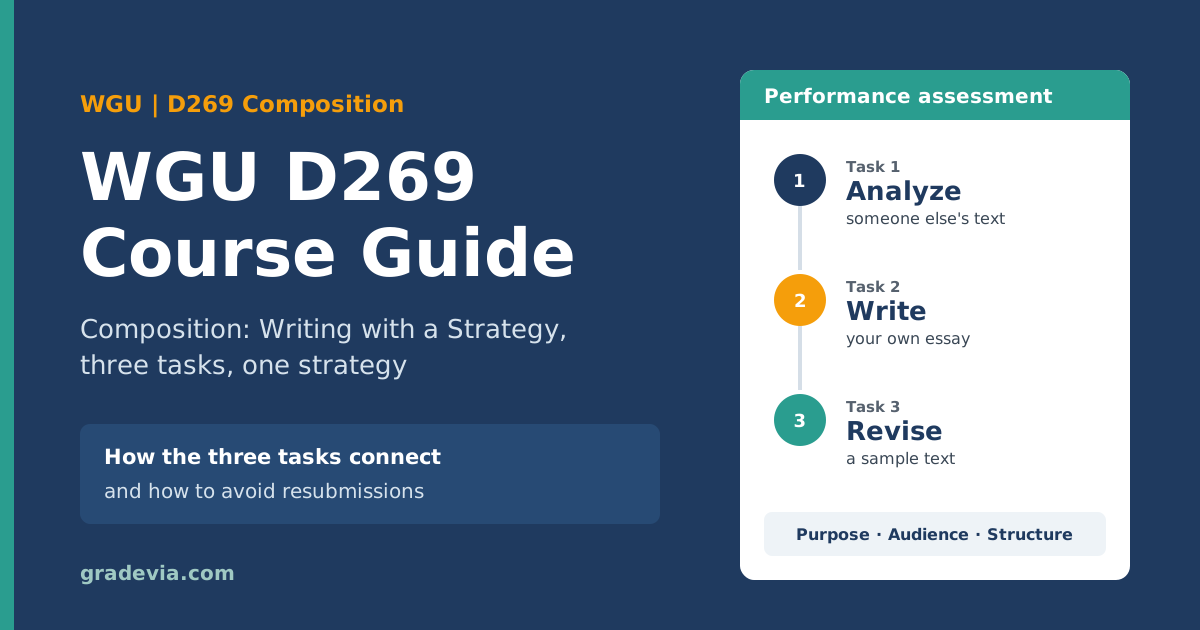
WGU D269, Composition: Writing with a Strategy, is the general education writing course in many WGU bachelor’s programs. You won’t sit a multiple choice exam. You’ll complete three written tasks: an analysis of a persuasive text, an essay you write for a professional audience, and a revision and edit of someone else’s writing.
Each task is short. What sends D269 submissions back for revision is rarely the quality of the writing. It’s a missing rubric element: an audience that’s implied but never stated, a thesis that names a topic but not its points, a punctuation fix labeled as a revision. If you know what each task checks before you open it, you can finish D269 around a full work week instead of losing evenings to resubmissions.
This page explains the whole course: what D269 is, how it’s assessed, how the three tasks differ and build on each other, and how to plan them. Each task also has its own detailed guide with a worked example, linked below.
D269 at a Glance
| Course | D269 |
| Title | Composition: Writing with a Strategy |
| Competency units | 3 |
| Assessment | Performance assessment with three written tasks |
| Assessment code in current task materials | RGM3 |
| Main topics | Purpose, context, and audience; writing strategies and techniques; editing and revising |
| What you submit | A completed analysis template, a 2 to 3 page essay, and a marked up sample text with written explanations and feedback |
The term D269 falls in depends on your program. Recent WGU program guidebooks place it in Term 1 of the Public Health degree and Term 4 of the User Experience Design degree, so check your own degree plan.

What Is WGU D269?
WGU’s course description lists three topics: “understanding purpose, context, and audience, writing strategies and techniques, and editing and revising.” In practical terms, the course checks whether you can do three things a workplace actually asks of you:
- Read strategically. Look at a piece of writing and explain who it was written for, what the writer wanted, and how they tried to get it.
- Write strategically. Produce a clear, organized document for a specific reader with a specific purpose.
- Improve writing. Tell the difference between a structural problem and a sentence level error, fix both, and explain your reasoning to the writer.
Each of the three tasks maps to one of those skills. That’s why D269 rewards students who understand what each task is measuring more than students who simply write well.
Is WGU D269 an OA or PA?
D269 is a performance assessment (PA). The current task directions describe three written tasks, each evaluated by a WGU evaluator against a rubric. None of them is a proctored multiple choice exam.
For a working student, that changes how you prepare. You don’t need to memorize grammar terms or study practice questions. Your time goes into reading each task’s directions and rubric carefully, drafting to those requirements, and checking your draft against them before you submit. Practice tests sold as D269 “exam” material don’t match how the course is assessed.
WGU D269 Tasks Overview
| D269 Task | Main focus | What you do | Key skill | Detailed guide |
|---|---|---|---|---|
| Task 1 | Analysis of a text | Choose one persuasive text from the list in the Task 1 Template and fill each box: summary, purpose, context, audience, appeals, and sources | Rhetorical analysis | D269 Task 1 guide and example |
| Task 2 | Professional expository essay | Write a 2 to 3 page essay for a professional audience in one of three modes: cause or effect, solution proposal, or compare and contrast | Organizing your own writing for a reader | D269 Task 2 essay guide |
| Task 3 | Editing and revising text | Choose one of four sample texts, mark three revisions and five edits, explain each change, and give the writer feedback | Revising, editing, and explaining writing decisions | D269 Task 3 revising and editing guide |
Planning D269 around a full time job? Gradevia offers assignment support for working WGU students, from choosing your Task 1 text to checking your Task 3 markups. Message us on WhatsApp at +1 564 544 6924.
D269 Task 1: Analysis of a Text
Task 1 asks you to analyze one piece of persuasive writing chosen from the “Texts for Analysis” list in the Task 1 Template. The list includes talks, speeches, a blog post, and articles, such as Steve Jobs’s Stanford commencement address and Sasha Luccioni’s TED talk on AI. You don’t write an essay. You type your answers into the template’s boxes: a summary of the text, the author’s purpose, the context, the audience, and 2 to 3 appeals (logos, ethos, or pathos) with 1 to 2 examples each.
What students misunderstand most: the Context box asks for the larger historical or cultural moment when the text was written, not the speaker’s biography. And each appeal example needs discussion that connects it to the audience. A quote followed by “this is pathos” isn’t analysis.
Before you start: the template states that no more than 30% of your written response can match other sources, including the text you are analyzing. Every quotation counts toward that limit, so plan to quote short phrases and explain in your own words.
Our WGU D269 Task 1 guide walks through each box, compares the eight texts, explains how to cite a TED talk watched on YouTube, and includes a filled template for a practice speech that isn’t on the list.
D269 Task 2: The Professional Essay
Task 2 is the only task where you write something entirely your own: an essay of about 2 to 3 pages for a professional audience. You choose one expository structure, either cause or effect, solution proposal, or compare and contrast. The topic can come from WGU’s list or from your own professional interests, which is usually the faster route for a working student because you already know the details.
The rubric checks the essay part by part:
- an introduction that establishes the topic and describes a specific purpose and intended audience
- a thesis that previews 2 to 4 main points and fits your chosen mode
- body paragraphs whose main points match the thesis, with appropriate development
- transitions
- a conclusion that summarizes without introducing new information
Common mistakes: leaving the audience implied instead of naming it, writing a thesis that announces a topic but not its points, drifting from one mode into another, and adding a new idea in the conclusion. Sources aren’t required for Task 2, but anything you quote, paraphrase, or summarize must be cited.
Before you submit: check that someone could list your body paragraph topics from your thesis alone.
For a step by step walkthrough and a full solution proposal essay with comments on each requirement, see our D269 Task 2 guide and example essay.
D269 Task 3: Editing and Revising Text
Task 3 gives you four sample texts with deliberate problems. You choose one, mark exactly three revisions and five edits, then explain every change and give the writer feedback.
The key distinction:
- A revision changes structure, content, or organization, such as moving a paragraph, cutting an off topic section, or rewriting a conclusion.
- An edit fixes grammar, punctuation, or word choice at the sentence level.
You can mark changes by hand or with Track Changes in Word, but your written responses must be typed. Part B explains why you made each revision and each edit. Part C gives feedback on four points: whether the introduction captures your attention, the text’s greatest strength, its weakest part, and whether the conclusion brings it to a close. The directions note that the writing quality and similarity matches of the original, unedited sample text won’t be evaluated.
Common mistakes: counting a punctuation fix as a revision, making extra unlabeled changes so the evaluator can’t tell which eight count, and explaining what changed without explaining why.
Our guide to revising and editing for D269 Task 3 shows how to label each change, write B1 and B2 explanations, and cover all four Part C judgments, with a marked up practice text you can download.
D269 Task 1 vs Task 2 vs Task 3
| Task 1 | Task 2 | Task 3 | |
|---|---|---|---|
| Whose writing? | Someone else’s (from a list) | Yours | Someone else’s (a sample text) |
| Your role | Analyst | Writer | Editor and reviewer |
| Format | Task 1 Template boxes | Essay, about 2 to 3 pages | Marked up text plus typed explanations and feedback |
| Purpose and audience | You identify the author’s | You state your own | You judge whether the text serves its reader |
| Sources | Required for the text you analyze | Only if you use them | Only if you use them |
| Easiest way to lose points | Context written as biography, or appeals without discussion | Audience never named, or thesis without its points | Edits counted as revisions, or explanations without reasons |
How the Three D269 Tasks Fit Together
The tasks look unrelated, but they practice the same thinking from three angles.
Purpose and audience run through all three. In Task 1, you work out who an author was writing for and what they wanted. In Task 2, you have to state your own purpose and audience in the introduction. In Task 3, you judge whether someone else’s text works for its intended reader, and your revisions and feedback depend on that judgment.
Structure moves from noticing to building to repairing. Task 1’s summary trains you to see how a text is organized. Task 2 asks you to organize your own ideas around a thesis with transitions. Task 3 asks you to spot where organization breaks down and fix it with revisions.
Explaining your decisions is the final step. Task 3 doesn’t just ask you to fix writing. It asks you to explain why each change was made and to give constructive feedback, which is the skill most workplace writing reviews actually use.
That’s why we recommend working through the tasks in order. By Task 3, you’ve already spent two tasks thinking about purpose, audience, and structure, and the revision decisions come faster. Your course page is the authority on any required submission order.
How to Approach D269 as a Busy Working Student
D269 is easy to underestimate because each task is short. The time drain is resubmission: a returned task means rereading feedback, reopening a document you’d mentally closed, and waiting through another evaluation. These habits cut that risk.
1. Start with the rubric
The Task 3 directions say it plainly: “You must use the rubric to direct the creation of your submission because it provides detailed criteria that will be used to evaluate your work.” The same applies to all three tasks. Open the rubric next to the directions and treat each aspect as a checklist item your submission must visibly satisfy.
2. List every requirement before you write
Spend ten minutes turning the directions into a list. For Task 2, that list includes “name the audience in the introduction” and “thesis previews 2 to 4 points,” both easy to miss once you’re drafting. For Task 3, it includes “exactly three revisions” and “exactly five edits.” Writing to a list prevents the rewrite that happens when you discover a missing element after the draft is done.
3. Separate drafting from checking
Draft in one sitting without polishing each sentence, then check in another. Trying to perfect wording while you’re still deciding what to say slows both jobs down. On a weeknight after work, a rough complete draft is more useful than a polished half.
4. Keep your sources organized as you go
Task 1 always needs a reference for the text you analyze, and any outside fact in your Context box needs a citation too. When you pull a quote or a fact, paste the URL, author, date, and title into a notes file right away. Rebuilding a citation at midnight from browser history is where APA errors creep in.
5. Check the finished draft against every rubric aspect
Before you upload, go through the rubric one aspect at a time and point to where your submission meets it. If you can’t point to it, the evaluator can’t either. Then run Grammarly for Education and review the similarity report once it generates.
6. Use evaluator feedback surgically
If a task comes back, the feedback identifies which aspects weren’t met. Fix those aspects only. Rewriting the whole submission can introduce new problems in parts that already passed. Read the comment, find the exact requirement in the directions, revise that section, and recheck it against the rubric.
Task returned for revision? Send Gradevia your evaluator feedback on WhatsApp at +1 564 544 6924 and get a clear plan for the flagged aspect.
Common WGU D269 Mistakes
These are the mistakes most likely to send a D269 task back, based on what each rubric checks:
- Answering the topic instead of the requirement. A thoughtful Task 1 response that summarizes the speaker’s life doesn’t answer the Context box.
- Leaving the audience implied. Task 2 requires the introduction to describe a specific purpose and intended audience. “Employees” isn’t specific. “The operations director of our distribution center” is.
- A thesis that doesn’t preview its points. Task 2’s thesis must name 2 to 4 main points that the body then covers.
- Mixing expository modes. A cause essay that ends with recommendations no longer fits its mode.
- New information in the conclusion. Task 2’s conclusion must summarize without adding anything.
- Summary instead of analysis. In Task 1, appeal examples need discussion of how they work on the audience.
- Over quoting. Task 1’s 30% match limit includes the text you analyze.
- Confusing revision with editing. In Task 3, a comma fix is an edit no matter how important it is.
- Explanations that don’t match the markups. Every Task 3 explanation should use the same label as the change it describes.
- Unacknowledged sources. Every task requires citations for anything quoted, paraphrased, or summarized.
- Submitting from an example. Copied wording from a posted D269 answer is exactly what the similarity checker compares against.
How to Use the D269 Rubric
Strong writing alone doesn’t satisfy the rubric. An evaluator scores each aspect separately, so an excellent essay that never names its audience can still come back. Use this process for each task:
- Read the requirement in the directions, word for word.
- Identify what must appear in your submission to show it. For example, “a thesis statement that previews 2 to 4 main points” means the main points must be named in the thesis sentence itself.
- Draft that component with the requirement in front of you.
- Compare the draft to the rubric aspect. Ask whether an evaluator who reads only that part of your submission would see the requirement met.
- Fix anything missing before moving on.
- Do a final professional communication check. Professional communication is a requirement in all three tasks, so check grammar, spelling, formatting, and tone last.
D269 Submission Checklist
Before writing
- Read the task directions and the rubric side by side
- Identify the audience and purpose (the author’s in Task 1, your own in Task 2, the sample text’s in Task 3)
- Use the required format: the Task 1 Template for Task 1, an essay for Task 2, a marked up sample text for Task 3
- Note whether the task requires sources
While writing
- Address each requirement in a part of the document an evaluator can find
- Keep writing to the same audience throughout
- Use clear organization and transitions
- Support claims with examples or cited evidence
- Keep quotations short, especially in Task 1
Before submission
- Every rubric aspect can be pointed to in the submission
- Every quote, paraphrase, and summary has an in text citation and a reference
- Formatting matches the task (template, essay, or labeled markups)
- Grammar and spelling are checked with Grammarly for Education
- The similarity report has been reviewed
- The submission answers the task as written, not a similar task you found online
D269 Examples and Guides: How to Use Them
A good example is useful for seeing four things: how a requirement can be addressed, the level of detail an evaluator expects, how a document is organized, and what professional tone looks like. It’s not something to copy.
That’s why each Gradevia D269 example is built around material that isn’t part of the actual task:
- The Task 1 example analyzes a practice speech that isn’t on the template’s list.
- The Task 2 example is about a fictitious workplace and a topic that isn’t on WGU’s suggested list.
- The Task 3 example marks up a practice text we wrote, not one of the four WGU sample texts.
Read an example to understand the structure, close it, and then write your own response from your own text, topic, or sample.
Academic Integrity and AI Tools
WGU’s student policy handbook includes academic integrity rules and a policy on the use of artificial intelligence tools. Read the current versions in the WGU Student Policy Handbook, since policies change and WGU’s own guidance is the authority. For D269, the safe practice is simple:
- Write every response in your own words.
- Cite anything you quote, paraphrase, or summarize.
- Don’t submit anyone else’s work, including posted D269 answers.
- Use examples to understand structure, not to reproduce answers.
On AI specifically, there’s a clear line between using a tool to learn and submitting its output as your own. Asking a tool to explain the difference between ethos and pathos is learning. Pasting generated paragraphs into your essay is submitting someone else’s work. WGU has also described returning submissions without evaluation when they cite sources that can’t be verified, so check every source you cite yourself.
Frequently Asked Questions
What is WGU D269?
D269 is Composition: Writing with a Strategy, a 3 competency unit writing course in many WGU bachelor’s programs. It covers purpose, context, and audience; writing strategies and techniques; and editing and revising.
Is WGU D269 an OA or PA?
It’s a performance assessment. The current task directions describe three written tasks evaluated against a rubric, with no proctored multiple choice exam.
How many tasks are in D269?
Three. Task 1 is an analysis of a persuasive text, Task 2 is a professional expository essay, and Task 3 is editing and revising a sample text.
Which D269 task should I start with?
Task 1. The tasks build on each other: identifying purpose and audience in Task 1 prepares you to state your own in Task 2 and to judge someone else’s in Task 3.
Does D269 require an essay?
Only Task 2. Task 1 uses a template with boxes for each part of the analysis, and Task 3 uses a marked up sample text with typed explanations and feedback.
Does D269 require sources?
Task 1 does, because you must reference the text you analyze. Tasks 2 and 3 don’t require sources, but anything you quote, paraphrase, or summarize must be cited.
What is the difference between revision and editing in D269?
A revision changes structure, content, or organization, such as moving or cutting a paragraph. An edit fixes grammar, punctuation, or word choice at the sentence level. Task 3 requires three revisions and five edits.
How can I avoid revisions on D269?
Read the rubric before writing, list every requirement, and check your finished draft against each rubric aspect before you submit. Most returned tasks are missing a specific required element rather than suffering from weak writing.
Can I use examples to help with D269?
Yes, to understand structure and the level of detail expected. Don’t copy them. Submissions are checked for similarity, and your work must be your own.
Get Help With D269
If you’re working full time and want structured assignment support with any D269 task, from choosing a Task 1 text to tightening your Task 2 thesis or checking your Task 3 markups, message Gradevia on WhatsApp at +1 564 544 6924.
References
Western Governors University. (2024). Program guidebook: Bachelor of Science, Public Health (BSPH 202409). https://www.wgu.edu/content/dam/wgu-65-assets/western-governors/documents/program-guides/health-professions/BSPH.pdf
Western Governors University. (2025). Program guidebook: Bachelor of Science, User Experience Design (Catalog version 202510). https://www.wgu.edu/content/dam/wgu-65-assets/western-governors/documents/program-guides/business/BSUXD.pdf
Western Governors University. (2025, June 24). Guiding responsible student use of AI. https://www.wgu.edu/blog/guiding-responsible-student-use-of-ai2506.html