
Blog
WGU D078 Business Environment Applications I: Complete Course Guide

By Dan Palmer, MBA · Academic strategy consultant for working adult learners · LinkedIn
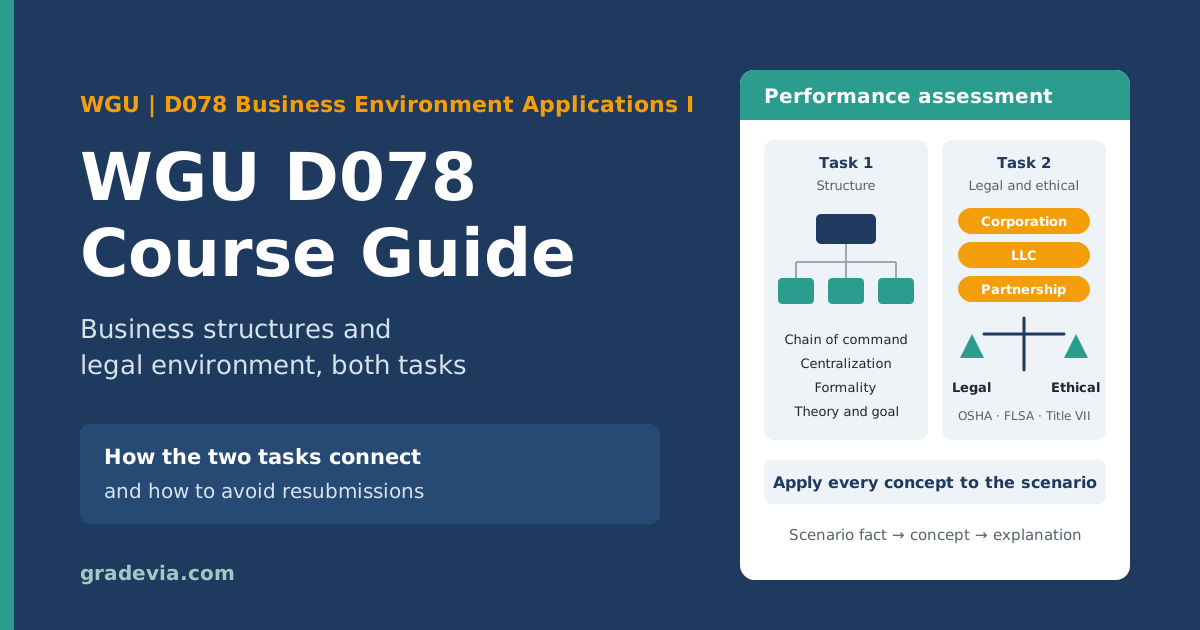
WGU D078, Business Environment Applications I: Business Structures and Legal Environment, is a short business course with two written tasks. Task 1 asks you to design the organizational structure for a new consulting firm. Task 2 asks you to compare legal entity types for a farmers market venture and identify the legal and ethical obligations of its employer and employees.
Neither task is long, and both come with a scenario. That’s what makes D078 both manageable and easy to get wrong: the rubric rewards answers that apply each concept to the scenario’s details, and a paper of accurate textbook definitions can still come back for revision. If you know what each task is checking before you start, you can plan D078 around a work week rather than around resubmissions.
This page explains the whole course: how it’s assessed, how the two tasks differ, the concepts you’ll need, and a workflow for getting each task right the first time. Each task also has a detailed Gradevia guide with a worked example, linked below.
D078 at a Glance
| Course | D078 |
| Title | Business Environment Applications I: Business Structures and Legal Environment |
| Competency units | 2 |
| Assessment | Performance assessment with two written tasks |
| Assessment code in current task materials | TEM2 |
| Task 1 focus | Organizational structure and organizational theory for a sustainability consulting firm |
| Task 2 focus | Legal entity types and the legal and ethical obligations of a farmers market venture |
| Where it appears | Term 2 in the WGU Business Administration program guidebooks we checked; confirm in your own degree plan |
| What comes later | Business Environment Applications II: Process, Logistics, and Operations, later in the same programs |
What Is WGU D078?
WGU’s program guidebooks describe Business Environment Applications I as “a generalist overview of the business environment and a deeper look at a number of topics that make up the non-discipline areas of business.” In practical terms, D078 covers two questions every business has to answer:
- How will the business be organized? Who reports to whom, where decisions get made, how formal the rules are, and which management theory supports that design.
- What legal form will it take, and what does it owe people? How the choice of corporation, LLC, or partnership affects taxes, owner liability, and control, and what the law and ethics require of an employer and its employees.
Task 1 tests the first question. Task 2 tests the second.
Is WGU D078 an OA or PA?
D078 is a performance assessment (PA). The current task directions, labeled D078 (TEM2), describe two written tasks, each built around a scenario and evaluated against a rubric. Neither is a proctored multiple choice exam.
That matters for how you spend your time. Some sites sell D078 “exam questions” and practice pre assessments. Those don’t match how the current course is assessed. Preparing for D078 means reading each scenario closely, learning the specific concepts each task names, and writing answers that apply those concepts to the scenario.
How Many Tasks Are in D078?
Two.
| Assessment | Main focus | What you do | Detailed guide |
|---|---|---|---|
| WGU D078 Task 1 | Organizational structure | Choose one structure (functional, divisional, matrix, or teams) for a new sustainability consulting firm, explain four structural factors, connect one organizational theory, and link the structure to one of the firm’s goals | D078 Task 1 guide and example |
| WGU D078 Task 2 | Legal and ethical considerations | Compare two legal entity types for a farmers market venture, describe one legal and one ethical obligation of the employer, and one ethical obligation of the employees | D078 Task 2 guide and example |
Working full time and short on study hours? Gradevia offers assignment support for working WGU students on both D078 tasks. Message us on WhatsApp at +1 564-544-6924.
D078 Task 1 Overview: Organizational Structure
The Task 1 scenario describes a consulting business you’re starting to help local companies become more sustainable and innovative. It gives you a mission statement, four specific goals, three planned university interns, and investors who want a leadership role in decisions. You’ll answer four requirements:
- A1: Choose one structure (functional, divisional, matrix, or teams), describe its main features, and explain how it applies to the scenario.
- A2: Explain how four factors work within that structure for this firm: functions or departments, chain of command, centralized or decentralized structure, and level of formality.
- B: Describe one organizational theory from the list (scientific management, bureaucratic, administrative, neoclassical, modern, or contingency/situational) and how it supports your structure.
- C: Identify one of the scenario’s goals and explain how your structure affects the firm’s ability to meet it.
Sources must be cited for anything quoted, paraphrased, or summarized.
What students most often miss: every answer must stay with the same structure from A1. A2, B, and C all ask how things work “within the chosen organizational structure,” so a paper that drifts into describing a different structure in Part C loses the thread the rubric follows. The other common gap is the investors. The scenario says they want a leadership role, so your chain of command and centralization answers should account for them.
Our WGU D078 Task 1 guide walks through each requirement, shows how to pair structures with theories, and includes a complete APA 7 WGU D078 Task 1 example built on a separate practice scenario, so it shows the reasoning without giving you WGU D078 Task 1 answers to copy.
D078 Task 2 Overview: Legal and Ethical Considerations
Task 2’s scenario follows a local farmer and a supermarket retailer opening a weekend farmers market. The first half covers forming the venture: the retailer wants control and outside investors, and the farmer wants to limit personal financial risk and outside influence. The second half jumps two years ahead and describes several workplace problems involving pay, how work is assigned, safety, and honesty with customers.
The requirements:
- A1 and A2: Describe two different entity types from the scenario (corporation, LLC, or general partnership), and for each one explain how it affects taxation, liability, and ownership and control for this venture.
- B1: Describe one legal obligation the employer has under one law: OSHA, the FLSA, or Title VII of the Civil Rights Act of 1964.
- B2: Describe an ethical obligation of the employer that is different from the legal obligation in B1.
- C: Describe one ethical obligation of the employees.
- D and E: Cite sources and demonstrate professional communication.
What students most often miss: covering only two of the three factors for an entity type, and writing a B2 ethical obligation that simply repeats the B1 legal one in different words. Legal claims also need accurate sources. A Task 2 answer that gets a basic rule of the FLSA or Title VII wrong can’t be rescued by good writing.
For the full walkthrough, including how to read each half of the scenario and which legal details students most often get wrong, see our WGU D078 Task 2 guide. It includes a WGU D078 Task 2 example in APA 7 built on a different practice scenario.
D078 Task 1 vs Task 2
| D078 Task 1 | D078 Task 2 | |
|---|---|---|
| Primary area | Organizational structure | Legal and ethical environment |
| Scenario | A new sustainability consulting firm with a mission, four goals, interns, and investors | A farmer and a retailer forming a farmers market, then running it two years later |
| Main question | How should this business be organized? | What legal form should it take, and what does it owe its people? |
| Choices you make | One structure, one theory, one goal | Two entity types, one law, one ethical obligation for the employer and one for employees |
| Type of thinking | Design: fitting a structure to a business’s needs | Judgment: weighing tradeoffs and separating legal duties from ethical ones |
| Where answers come from | Management concepts applied to the firm | Legal rules from authoritative sources, plus ethical reasoning, applied to the venture |
| Professional communication | Not listed as a separate requirement in the Task 1 directions | Listed as Part E |
| Detailed guide | D078 organizational structure guide | D078 legal and ethical considerations guide |
The shift in thinking is the important part. Task 1 asks you to design something: there are several defensible structures, and the rubric checks whether you explain your choice well. Task 2 asks you to judge something: the legal rules aren’t a matter of opinion, so accuracy matters more, and the ethical questions require you to explain why something is wrong even when no law addresses it directly.
The Big Picture: What D078 Is Really Teaching
This section is Gradevia’s practical interpretation of how the two tasks fit together, not an official WGU statement.
D078 follows a business from the inside out.
Task 1 is the inside view. Structure decides who has authority, how information moves, and how quickly decisions get made. The questions you answer in Task 1, such as how centralized decisions should be and how formal the rules are, determine how a business will behave once it’s operating.
Task 2 is the outside view. Once a business exists, the law shapes it from outside. The entity type decides how owners are taxed and how much of their personal money is at risk, and employment laws set minimum standards for how workers are paid, protected, and treated. Ethics covers the ground the law doesn’t reach.
The connection is control and accountability. In Task 1, you decide how much control the investors get in the chain of command. In Task 2, the same question appears as a legal choice: an entity type determines who owns and controls the business. And Task 2’s workplace problems show what happens when the people with authority use it badly. A student who sees D078 this way tends to write more connected answers in both tasks.
Key D078 Concepts
Organizational structure
How a company groups its work and people. A functional structure groups people by specialty, such as finance or marketing. A divisional structure groups them by product, region, or customer. A matrix gives people two reporting lines, and a teams structure organizes work around cross functional teams.
Chain of command
The line of authority from the top of the organization down to each employee. In Task 1, it answers who reports to whom, including where the interns and the investors fit.
Centralization and decentralization
Where decisions get made. In a centralized company, a small group at the top decides. In a decentralized one, decisions are pushed to the people closest to the work. A four person bakery owner who approves every supplier order is centralized. A bakery chain that lets each store manager choose local suppliers is decentralized.
Organizational theory
A theory explains why a structure should work. Bureaucratic theory, for example, values clear rules and hierarchy, while contingency theory argues that the best structure depends on the situation. In Task 1, the theory you choose should support the structure you chose, not just appear beside it.
Business entity
The legal form a business takes. Task 2 names three: corporation, limited liability company (LLC), and general partnership.
Liability
Whether owners are personally responsible for business debts. The U.S. Small Business Administration notes that general partners face unlimited personal liability, while LLC members and corporate owners generally aren’t personally liable.
Taxation
How profits are taxed. LLCs and partnerships generally pass profits through to the owners’ personal tax returns. A C corporation pays tax on its profits, and shareholders pay tax again on dividends, which the SBA calls “double taxation.”
Ownership and control
Who owns the business and who makes decisions are related but separate. Corporate shareholders own the company, but a board and officers run it. An LLC’s operating agreement can give one member more control than another.
Legal obligations
What the law requires. In Task 2, B1 focuses on one of three federal laws:
- OSHA: the Occupational Safety and Health Act requires employers to provide a workplace “free from recognized hazards that are causing or are likely to cause death or serious physical harm.”
- FLSA: the Fair Labor Standards Act sets minimum wage and overtime rules. Some salaried managers are exempt from overtime, and the Department of Labor currently lists the standard salary level for that exemption as $684 per week.
- Title VII: Title VII of the Civil Rights Act of 1964 prohibits discrimination in “compensation, terms, conditions, or privileges of employment” based on race, color, religion, sex, or national origin. It applies to employers with 15 or more employees.
These are educational summaries for understanding the task, not legal advice.
Ethical obligations
What a business should do, whether or not a law requires it. Hiding the poor quality of a product from customers can be wrong even where no specific law in the task applies. The difference between a legal and an ethical obligation is the core of Task 2’s B1 and B2.
The D078 Scenario: Why Application Matters
Both D078 tasks ask you to apply concepts to a scenario, and the gap between a definition and an application is where most points are won or lost.
Definition: “A functional structure groups employees according to their specialized functions.”
Application: “Grouping employees by function would put all of the firm’s assessment work under one lead, so the interns would report to one person and the assessment process would be consistent across every client business. The tradeoff is slower decisions when a client project needs input from several functions.”
The first sentence is accurate, but it could appear in any paper about any company. The second uses the business’s own people and goals to explain what the structure would do. These sentences are a generic illustration, not an answer for D078. Your submission must use the details in your actual task scenario.
A quick test: if you could paste a paragraph into a paper about a different company without changing a word, it’s a definition, not an application.
How to Approach D078 as a Busy Working Student
D078 has only two tasks, so the biggest time cost is a resubmission. This workflow is designed to prevent one.
Step 1: Read the entire task before writing
Read the scenario and every requirement in one sitting before you write anything. Task 2’s second half, for example, contains the material for B1, B2, and C, and you’ll choose better if you see all three questions first.
Step 2: Break the rubric into individual deliverables
Turn each requirement into a line on a checklist. Task 1’s A2 becomes four lines, one per factor. Task 2’s A1 and A2 become six lines: three factors for each of two entity types.
Step 3: Highlight scenario facts
Go through the scenario and mark every detail that a requirement could use: goals, people, numbers, constraints, conflicts. In Task 1, the four goals and the investors’ role. In Task 2, each partner’s concerns and each workplace problem.
Step 4: Build an answer map
For each checklist line, write one row:
Requirement → Scenario fact → Concept → Explanation → Citation
For example: A2 chain of command → investors want a leadership role → chain of command → where investors sit and what they approve → course text or source. The map becomes your outline.
Step 5: Write directly to the requirement
Open each section with a direct answer, then explain it with the scenario. Skip background on the history of management theory or on why businesses exist. The evaluator is looking for the requirement, not context around it.
Step 6: Review against the rubric
Read each rubric aspect and point to the sentences that meet it. If you can’t point to them, add them.
Step 7: Do a professional communication check
Check grammar, clarity, headings that match the requirements, APA citations, and the reference list. Then review the similarity report once it generates.
How to Use the D078 Rubric
- Read the requirement exactly as written.
- Identify the action verb. “Describe,” “explain,” and “identify” ask for different amounts of reasoning.
- Identify the concept. Which structure, theory, entity type, law, or obligation is this about?
- Identify the scenario information that the answer should use.
- Draft the answer.
- Check that it answers the requirement, not a nearby question.
- Add citations for anything quoted, paraphrased, or summarized.
- Review against the rubric again before moving to the next requirement.
On the verbs, as practical guidance rather than an official WGU definition:
| Verb in D078 | What it usually calls for |
|---|---|
| Identify | Name the item clearly. Task 1’s C1 only asks you to identify one goal. |
| Describe | Give the main features or characteristics, tied to the scenario where the task says so. |
| Explain | Give reasons: how or why something works, affects, or supports something else. Most of D078’s points sit on “explain” requirements. |
A paper that “describes” where the task says “explain” is the most common way to give accurate content and still fall short.
Common D078 Mistakes
- Textbook definitions with no scenario. Accurate but generic answers don’t apply the concept, and both tasks ask for application.
- Switching structures mid paper. Task 1’s A2, B, and C all depend on the structure chosen in A1.
- Missing one of the four factors in Task 1’s A2.
- A theory that sits beside the structure instead of supporting it.
- Leaving out a factor for an entity type. Task 2’s A1 and A2 each require taxation, liability, and ownership and control.
- Choosing the same entity type twice. A2 must describe a different entity from A1.
- Treating legal and ethical obligations as the same thing. B2 must be different from B1.
- Unsupported legal claims. State legal rules accurately and cite an authoritative source.
- Describing the employer’s ethics in Part C. Part C asks about the employees.
- Repeating the scenario instead of analyzing it. Retelling what happened isn’t the same as explaining what it means.
- Uncited paraphrasing. Every task requires citations for paraphrased and summarized material, not just direct quotes.
- Copying posted D078 answers. Every student gets the same scenarios, so shared answers are exactly what the similarity checker compares against.
Not sure your answers apply the scenario? Get a second look at your D078 draft before you submit. Message Gradevia on WhatsApp at +1 564-544-6924.
D078 Submission Checklist
Before writing
- Read the whole task and scenario
- Read the rubric
- List every requirement as a separate deliverable
- Mark the scenario facts each requirement can use
- Note which concepts need research and an authoritative source
While writing
- Answer the exact requirement in the first sentence of each section
- Apply each concept to the scenario
- Explain your reasoning where the task says “explain”
- Keep Task 1 consistent with one structure
- Keep Task 2’s legal and ethical obligations separate
- Cite every quote, paraphrase, and summary
Before submission
- Every rubric aspect can be pointed to in the paper
- Task 1: all four factors, one theory, one goal
- Task 2: three factors for each of two different entity types
- Legal statements match an authoritative source
- References are complete and in APA format
- Grammar, spelling, and headings are checked
- The similarity report has been reviewed
D078 Examples and Guides: How to Use Them
A good example shows you the structure of an answer, the level of detail an evaluator expects, and what applying a concept looks like. It isn’t something to copy, and for D078 copying would be easy to detect because every student works from the same scenarios.
That’s why both Gradevia D078 examples use different practice scenarios from the official tasks:
- The WGU D078 Task 1 example designs a structure for a fictitious organization that isn’t the consulting firm in the task.
- The WGU D078 Task 2 example works through a fictitious business venture that isn’t the farmers market.
Use them to see how a requirement can be answered, then close them and write your own submission from the official scenario.
Academic Integrity and AI Tools
WGU’s academic integrity rules and its policy on the use of artificial intelligence tools are published in the WGU Student Policy Handbook. Read the current versions there, since WGU’s own guidance is the authority. For D078, the safe practice is:
- Write in your own words, applied to the official scenario.
- Cite anything you quote, paraphrase, or summarize, including legal sources.
- Don’t submit anyone else’s work, including D078 answers posted online.
- Use examples to understand structure and reasoning, not to reproduce answers.
On AI specifically, there’s a clear line between using a tool to understand a concept, such as asking what the contingency approach means, and submitting generated text as your own. WGU has also described returning submissions without evaluation when they cite sources that can’t be verified, so confirm every source yourself. That matters for Task 2, where legal citations should point to real, authoritative pages.
How to Pass D078 at WGU: The Short Version
If you only remember five things about how to pass D078 at WGU:
- Answer every requirement, including every factor inside it.
- Apply each concept to the scenario instead of defining it.
- In Task 1, keep one structure throughout.
- In Task 2, keep legal and ethical obligations separate, and source the legal ones.
- Check the finished paper against the rubric before you submit.
Frequently Asked Questions
What is WGU D078?
D078 is Business Environment Applications I: Business Structures and Legal Environment, a 2 competency unit course in WGU’s business programs. It covers organizational structure and the legal and ethical environment of business.
Is WGU D078 an OA or PA?
It’s a performance assessment. The current task directions describe two written, scenario based tasks evaluated against a rubric, with no proctored exam.
How many tasks are in D078?
Two. Task 1 covers organizational structure for a sustainability consulting firm. Task 2 covers legal entity types and legal and ethical obligations for a farmers market venture.
What should I know before starting D078?
Both tasks reward applying concepts to the scenario, not defining them. Read each scenario closely and list every requirement, including each factor inside a requirement, before you write.
What is the difference between legal and ethical obligations in D078?
A legal obligation is required by law, such as OSHA’s requirement to provide a workplace free from recognized serious hazards. An ethical obligation is what the business should do even where no specific law in the task requires it. Task 2 requires one of each for the employer, and they must be different.
How can I avoid revisions on D078?
Turn the rubric into a checklist, map each requirement to a scenario fact, explain rather than define, and check every requirement before submitting.
Can I use examples to help with D078?
Yes, to understand structure and reasoning. Don’t copy them. Gradevia’s D078 examples use different practice scenarios for this reason.
Where can I find detailed D078 Task 1 and Task 2 guides?
Gradevia’s D078 Task 1 guide covers organizational structure, and the D078 Task 2 guide covers legal and ethical considerations. Each includes a worked APA 7 example.
Related WGU Guides
- Organizational structure and leadership come back in the WGU MBA. Our WGU C203 Task 2 guide evaluates an organization and its leadership.
- For more practice naming and analyzing ethical problems, see our guide to identifying the type of ethical dilemma in WGU C717 Task 2.
- Browse every WGU assignment guide and sample.
Get Help With D078
If you’re working full time and want structured assignment support with D078, from choosing a structure and theory in Task 1 to separating legal and ethical obligations in Task 2, message Gradevia on WhatsApp at +1 564-544-6924.
References
U.S. Department of Labor, Wage and Hour Division. (n.d.). Earnings thresholds for the executive, administrative, and professional exemption from minimum wage and overtime protections under the FLSA. Retrieved October 5, 2026, from https://www.dol.gov/agencies/whd/overtime/salary-levels
U.S. Equal Employment Opportunity Commission. (n.d.). Title VII of the Civil Rights Act of 1964. Retrieved October 5, 2026, from https://www.eeoc.gov/statutes/title-vii-civil-rights-act-1964
U.S. Occupational Safety and Health Administration. (n.d.). OSH Act of 1970, Section 5: Duties. Retrieved October 5, 2026, from https://www.osha.gov/laws-regs/oshact/section5-duties
U.S. Small Business Administration. (n.d.). Choose a business structure. Retrieved October 5, 2026, from https://www.sba.gov/business-guide/launch-your-business/choose-business-structure
Western Governors University. (2024). Program guidebook: Bachelor of Science Business Administration, Management (Catalog version 202311). https://www.wgu.edu/content/dam/wgu-65-assets/western-governors/documents/program-guides/business/BSBAMGC.pdf
Western Governors University. (2025, June 24). Guiding responsible student use of AI. https://www.wgu.edu/blog/guiding-responsible-student-use-of-ai2506.html