
Blog
WGU D082 Task 2 Guide and Example: Cultural Intelligence Reflection

By Dan Palmer, MBA · Academic strategy consultant for working adult learners · LinkedIn
WGU D082 Task 2 follows the same pattern as Task 1, with cultural intelligence (CQ) in place of emotional intelligence. You complete a 24 statement CQ Self-Inventory, reflect on your results, and then write two short explanations. The structure feels familiar, which is exactly why papers come back: students reuse their Task 1 approach and miss what’s different. Task 2 asks for two CQ actions without splitting them into intrapersonal and interpersonal, and its Part B and Part C ask two different questions that are easy to blur into one.
This guide is for working adults who want WGU Emotional and Cultural Intelligence Task 2 finished in an evening or two. It explains the four CQ domains in plain terms, shows the difference between a specific action and a vague one, separates ways (Part B) from reasons (Part C), and includes a WGU D082 Task 2 example written by a fictitious student.
D082 Task 2 Assignment
Competencies
3082.1.2: Cultural Intelligence
The graduate demonstrates cultural intelligence (CI) within multicultural and contemporary business situations.
Introduction
As a business professional, it is not only essential that you apply the principles of emotional intelligence (EI), but also the principles of cultural intelligence (CI) to positively impact the effectiveness of an organization.
Requirements
Your submission must represent your original work and understanding of the course material. Most performance assessment submissions are automatically scanned through the WGU similarity checker. Students are strongly encouraged to wait for the similarity report to generate after uploading their work and then review it to ensure Academic Integrity guidelines are met before submitting the file for evaluation. See Understanding Similarity Reports for more information.
Note: You must complete the “CQ Self-Inventory” from the Supporting Documents section before engaging with this task.
A. Provide a reflection on your results of the self-inventory by doing the following:
- Identify one of the four cultural intelligence (CQ) domains you believe is your strongest.
- Identify one of the four CQ domains you want to work on for your own personal development.
- Describe two specific actions you can take to improve your CQ skills.
B. Explain two ways to be more culturally intelligent in the workplace.
C. Explain two reasons why developing effective intercultural communication is important in the workplace.
D. Acknowledge sources, using in-text citations and references, for content that is quoted, paraphrased, or summarized.
E. Demonstrate professional communication in the content and presentation of your submission.
Download the D082 Task 2 example (.docx)
What D082 Task 2 Asks You to Do
The task requires you to complete the “CQ Self-Inventory” from the Supporting Documents section before you start. Your paper then covers:
| Requirement | What you deliver |
|---|---|
| A1 | The one CQ domain you believe is your strongest |
| A2 | The one CQ domain you want to work on for personal development |
| A3 | Two specific actions you can take to improve your CQ skills |
| B | Two ways to be more culturally intelligent in the workplace |
| C | Two reasons why developing effective intercultural communication is important in the workplace |
| D | In text citations and references for anything quoted, paraphrased, or summarized |
| E | Professional communication |
Step 1: Understand the Four CQ Domains Before You Rate Yourself
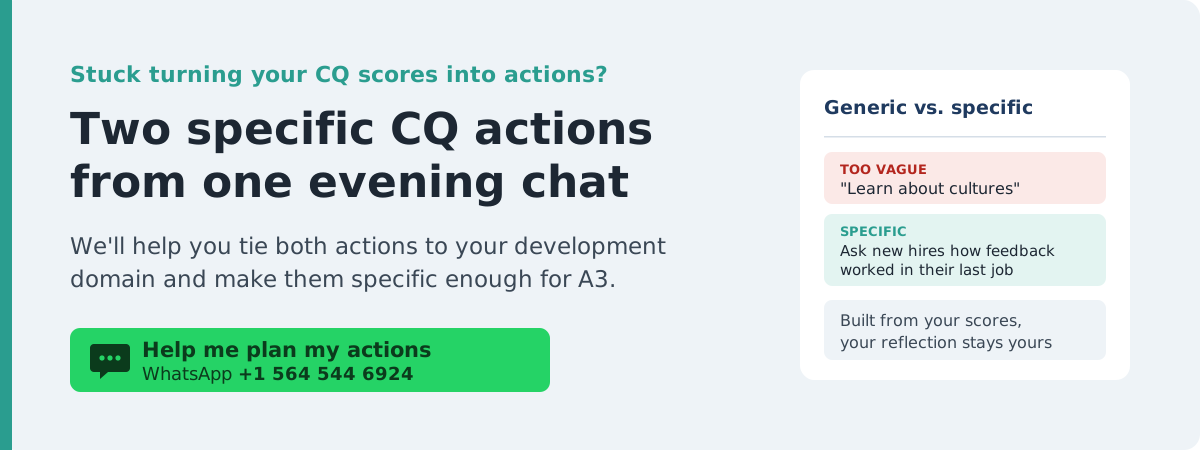
The CQ Self-Inventory has six statements in each of four domains. You rate each statement 1 (Rarely), 2 (Sometimes), or 3 (Often), so every domain total falls between 6 and 18. Knowing what each domain measures makes A1 and A2 much easier to write:
| Domain | What it measures | One statement from the inventory |
|---|---|---|
| CQ Drive (motivation) | Your interest and confidence in working across cultures | “I enjoy interacting with people from different cultures.” |
| CQ Knowledge (cognition) | What you know about how cultures differ | “I can explain major differences between individualistic and collectivist cultures.” |
| CQ Strategy (metacognition) | How you plan for, notice, and reflect on cultural differences | “I reflect on my cultural assumptions when meeting someone new.” |
| CQ Action (behavior) | How you actually adjust what you say and do | “I change my communication style based on the cultural context.” |
The domain students mix up most is Strategy versus Knowledge. Knowledge is what you know. Strategy is what you do with your thinking: planning before an interaction, checking your assumptions during it, and reflecting afterward. If your action is “learn about holiday traditions,” that builds Knowledge. If it’s “before each meeting with a new client team, write down one assumption I’m making and check it,” that builds Strategy.
Like the Task 1 inventory, this one notes that it is a reflection tool, not an assessment, and that a total isn’t a good or bad score. Use your honest ratings. The evaluator is reading your reflection, not grading your score.
Part A1 and A2: Strongest Domain and Development Domain
For each one, give the evaluator three things:
- The domain, named as the inventory names it (CQ Drive, CQ Knowledge, CQ Strategy, or CQ Action).
- Your total and one or two statements you rated highest or lowest.
- A short example from your job that shows it.
Vague: “My strongest domain is CQ Drive because I love other cultures.”
Specific: “My strongest domain is CQ Drive, with a total of 15. I rated ‘I enjoy interacting with people from different cultures’ a 3, and I volunteer to onboard every new hire on our dispatch team, including the three who joined from our Toronto office this year.”
If two domains tie, choose the one you can support with a clearer example and say why.
Part A3: Two Specific Actions to Improve Your CQ
Unlike D082 Task 1, Task 2 doesn’t split actions into intrapersonal and interpersonal groups. It asks for two actions to improve your CQ skills. The strongest papers tie both actions to the development domain from A2, so the reflection reads as one plan.
A specific action names what you’ll do, when or how often, and how you’ll know it’s working:
| Too generic | Specific |
|---|---|
| Learn about other cultures | Over the next eight weeks, read one chapter a week of a book on cultural differences at work and write a short note applying it to one interaction from that week |
| Be more open minded | Before each first meeting with a new vendor team, write down one assumption I’m making about how they’ll communicate, then check it afterward |
| Travel more | Attend two of my company’s employee resource group events this quarter and ask one question at each about a tradition I’m unfamiliar with |
| Be respectful | In any meeting with colleagues who speak English as a second language, replace idioms with plain language and send a written summary afterward |
Name the domain each action builds. That shows the evaluator you understand the model, not just the task.

Part B: Two Ways to Be More Culturally Intelligent at Work
Part B asks how: two ways a person can be more culturally intelligent in the workplace. These are behaviors or practices, and they should be different from each other. Two that hold up well:
- Check assumptions before interpreting behavior. Silence in a meeting, a short email, or reluctance to disagree with a manager can mean different things to people from different backgrounds. Asking before concluding is CQ Strategy in practice.
- Adapt how you communicate to the people in the room. Using plain language instead of idioms, confirming decisions in writing, and inviting input in more than one way (out loud and by message) are CQ Action in practice.
Support each one with a source or the course materials and a short workplace example. Keep Part B about your own and your colleagues’ behavior. The why belongs in Part C.
WGU D082 Task 2 Part C: Why Intercultural Communication Matters
WGU D082 Task 2 Part C asks for two reasons why developing effective intercultural communication is important in the workplace. This is where many papers repeat Part B. “Adapting your communication style” is a way to communicate well. A reason explains what’s at stake if communication fails, or what a business gains when it works.
Reasons that work well, each supported by current research:
- It prevents misunderstandings that wear teams down. In a study of 1,049 team members, Leifels and Zhang (2023) found that misunderstanding and disagreement were linked to wellbeing impairments in multicultural teams, but not in monocultural or bicultural ones. Communication problems carry a real cost in diverse teams.
- It helps diverse teams perform. Liao and Thomas (2025) propose that teams develop a shared “collective cultural intelligence” through members’ interactions and team learning, and that this collective capability enhances team performance in multicultural contexts. Those interactions depend on communication.
Other defensible reasons include serving customers from different backgrounds and building trust with international partners. Whatever you choose, each reason should answer “why does this matter to the organization?” and cite a source.
A quick test: if a sentence starts with “You can…” or “Employees should…”, it probably belongs in Part B. If it starts with “This matters because…”, it belongs in Part C.
Parts D and E: Sources and Professional Communication
Cite the course materials and any research you use in APA, with in text citations and a reference list. Part C almost always needs at least one outside source, because “reasons why” is a claim about workplaces in general. Run Grammarly for Education and review the similarity report before submitting.
Coming From D082 Task 1?
If you’ve finished WGU D082 Task 1, you already have a head start. The reflection structure is the same: one strongest domain, one development domain, inventory evidence, and work examples. Students who search for D082 Task 1 passed papers or D082 Task 1 examples are usually looking for that structure, and it carries straight over. What changes in Task 2:
| D082 Task 1 | D082 Task 2 | |
|---|---|---|
| Inventory | EI Self-Inventory | CQ Self-Inventory |
| Domains | Self-Awareness, Self-Management, Social Awareness, Relationship Management | CQ Drive, CQ Knowledge, CQ Strategy, CQ Action |
| Actions | Two intrapersonal and two interpersonal | Two CQ actions |
| Part B | Two ways EI relates to business ethics | Two ways to be more culturally intelligent at work |
| Part C | Two active listening actions from a course list | Two reasons intercultural communication matters |
If you haven’t started Task 1 yet, our WGU D082 Task 1 guide walks through the EI Self-Inventory, the Part C listening list trap, and a full example.
Why a WGU D082 Task 2 Answer Key Won’t Help
Searches for a WGU D082 Task 2 answer key, WGU D082 Task 2 answers, or a WGU D082 Task 2 PDF turn up papers built on someone else’s inventory scores and someone else’s job. Part A has to reflect your totals and your examples, so borrowed answers don’t fit. And the most shared D082 Task 2 examples are exactly what the similarity checker compares against. The directions and the CQ Self-Inventory are already in your course’s Supporting Documents, and an example is only useful for seeing how an answer is organized.
WGU D082 Task 2 Example: A Fictitious Student’s CQ Reflection
Our WGU D082 Task 2 example is written by a fictitious dispatch supervisor at a fictitious regional freight company, Harborline Freight. It includes a results table, both domain choices with work examples, two specific actions tied to the development domain, two ways to be more culturally intelligent, and two Part C reasons with current citations. It’s formatted in APA 7, and comments explain which requirement each section meets.
Here’s part of its Part C:
Effective intercultural communication matters because misunderstandings take a measurable toll on diverse teams. In a study of 1,049 team members, Leifels and Zhang (2023) found that misunderstanding and disagreement were associated with wellbeing impairments in multicultural teams, a link that did not appear in monocultural or bicultural teams.
The example is for illustration only. Your domains, scores, actions, and examples must come from your own CQ Self-Inventory and experience.
Download the D082 Task 2 example (.docx)
Plan It Around Your Work Week
- Evening one (about an hour): Complete the CQ Self-Inventory, total each domain, choose A1 and A2, and note one work example for each. Draft two actions tied to your development domain.
- Evening two (about two hours): Write Part B and Part C, find at least one current source for Part C, add references, run Grammarly for Education, and check the similarity report.
Common Reasons D082 Task 2 Comes Back
- A1 or A2 named without inventory evidence or a work example
- Actions too vague to act on, such as “learn more about other cultures”
- An action labeled as building one domain that actually builds another
- Part B and Part C saying the same thing in different words
- Part C listing ways to communicate instead of reasons communication matters
- Research paraphrased without a citation
Related WGU Guides
- Start with our WGU D082 Task 1 guide on the EI Self-Inventory, business ethics, and active listening.
- Cultural intelligence comes back in the WGU MBA. Our WGU C203 Task 1 guide covers leadership and CQ assessments.
- For applying communication skills to a team, see our WGU C205 Task 1 guide on leading teams.
- Browse all WGU assignment guides and samples.
Pre-Submission Checklist
- The CQ Self-Inventory is complete, with a total for each domain
- A1 and A2 each name one domain, with inventory evidence and a work example
- A3 has two specific actions, each tied to a named CQ domain
- Part B explains two different ways to be more culturally intelligent at work
- Part C explains two reasons, not ways, and cites a source for each
- Every quote, paraphrase, and summary has an APA citation and reference
- Grammarly Correctness is clear and the similarity report has been reviewed
Frequently Asked Questions
What are the four CQ domains in D082 Task 2?
CQ Drive (motivation), CQ Knowledge (cognition), CQ Strategy (metacognition), and CQ Action (behavior). The CQ Self-Inventory has six statements for each.
What is the difference between Part B and Part C in D082 Task 2?
Part B asks for two ways to be more culturally intelligent at work, which are behaviors. Part C asks for two reasons intercultural communication is important, which explain why it matters to the organization.
Do my two actions have to be intrapersonal and interpersonal like Task 1?
No. Task 2 asks for two specific actions to improve your CQ skills. Tying both to your development domain makes the reflection stronger.
Do I need sources for D082 Task 2?
Yes, for anything you quote, paraphrase, or summarize. Part C in particular is stronger with current research.
Can I submit the WGU D082 Task 2 example from this page?
No. It’s written by a fictitious student about a fictitious company, and copying any example would violate WGU’s academic integrity policy.
Want a Second Look Before You Submit?
If you’re working full time and want structured assignment support turning your CQ results into specific actions, separating Part B from Part C, or finding current sources, message Gradevia on WhatsApp at +1 564 544 6924.
References
Leifels, K., & Zhang, R. P. (2023). Cultural diversity in work teams and wellbeing impairments: A stress perspective. International Journal of Cross Cultural Management, 23(2), 367–387. https://doi.org/10.1177/14705958231188807
Liao, Y., & Thomas, D. C. (2025). The emergence of collective cultural intelligence in teams in multicultural contexts: A dynamic perspective. Group & Organization Management, 50(2), 420–460. https://doi.org/10.1177/10596011251314099
Western Governors University. (n.d.). Cultural intelligence (CQ or cultural quotient) self-inventory [Course resource]. D082 Emotional and Cultural Intelligence.