
Blog
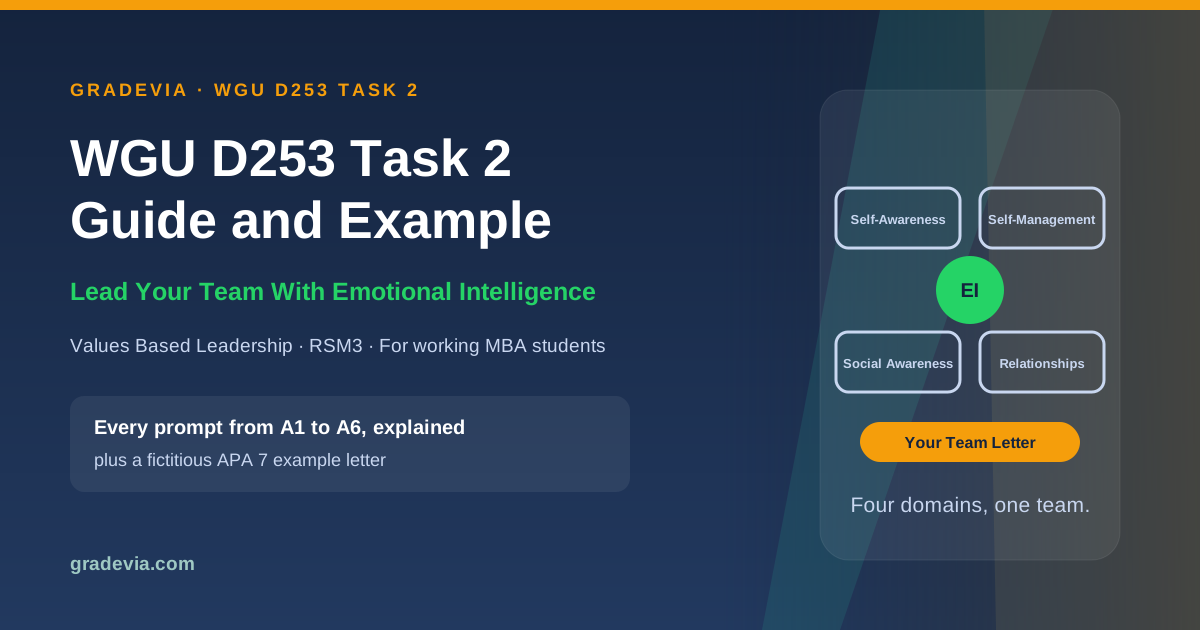
WGU D253 Task 2 Guide and Example: Leading Your Team With Emotional Intelligence

By Dan Palmer, MBA · Academic strategy consultant for working adult learners · LinkedIn
WGU D253 Task 2 picks up where Task 1 left off. You’re still the new customer service manager at Corollary Marketing Inc., and you’ve already identified your strengths through the VIA Character Strengths Survey. Now you write the document your team reads on your first week: who you are, which company value you lead with, and how all of you will use the four domains of emotional intelligence in your daily work.
That last part is where most first submissions come back. Every prompt in Part A asks how you and your team will use an element in your daily interactions, so a paper that defines self-awareness or empathy without showing what they look like on a Tuesday afternoon with a full queue won’t meet the requirement.
This guide is for working MBA students who want D253 Task 2 done in two or three evenings. It covers each prompt in the order the evaluator reads it, how to choose your elements so the paper hangs together, and how to handle the bias prompts, which are the easiest to get wrong. It ends with a WGU D253 Task 2 example built on a fictitious company, so you can see the structure without a paper to copy.
D253 Task 2 Assignment
Competencies
3109.1.1: Develops Self-Awareness and Personal Values
The learner identifies their personal values, including honesty, integrity, respect, emotional intelligence, and ethical responsibility, to develop self-awareness through self-assessment.
3109.1.3: Demonstrates How Leadership Delivers Results
The learner demonstrates how their leadership abilities, including active listening, influence, and ethical responsibility, solve problems and deliver results within an organization.
3109.1.4: Explains Leadership of Cultures
The learner explains how the leadership of cultures fosters diversity, inclusion, ethics, and problem-solving.
Introduction
In Task 1, you were provided with a scenario in which you assumed the role of a newly hired customer service manager. To help you grow as a leader, you completed the VIA Character Strengths Survey to identify your strengths and opportunities for growth. In this task, you will share your leadership vision with your new team.
Scenario
Now that you have begun your new role as the customer service manager for Corollary Marketing Inc., it will be important for you to introduce yourself as a leader to your team. The purpose of the introduction is to explain how you will use emotional intelligence to incorporate company values, unify the team, and begin to set team expectations.
Corollary Marketing Inc. Company Values:
- Excellence: In character, decision-making, and service to our clients and customers, we strive for distinction and actions of which we can be proud. Each of the following values contributes to this overriding charge.
- Integrity: We do the right thing, regardless of whether someone is watching. Our word is our bond; we carry a duty of care and responsibility to act ethically.
- Humility: We conduct our work without our egos. Our actions embody respect, humility, authenticity, and openness and invite feedback and input. We actively seek ideas and feedback from employees and value every voice and contribution.
- Trust: We extend the belief and feeling that others can be relied upon. We strive to be trustworthy by showing compassion and consistency and by communicating with care and truthfulness. We are authentic and transparent.
- Growth: Our best today may not be good enough tomorrow, and we continually seek to improve. Both personally and professionally, we aim to accelerate employee learning so that we can become better able to meet customer and company needs.
- Respect: We believe that each person (employee, customer, vendor, etc.) has value and rights. We act based on facts and always assume positive intent. We celebrate the differences in people and seek to utilize each person’s unique knowledge, skills, abilities, and perspectives.
A. Create a document, as the new customer service manager, to help your team understand the four domains of emotional intelligence (self-awareness, self-management, social awareness, and relationship management) by doing the following:
- Introduce yourself as the new customer service manager to your team, focusing on one of the six company values provided in the scenario.
- Discuss how you and your team will use one of the following elements of self-awareness in your daily interactions:
- emotional awareness
- accurate self-assessment
- self-confidence
- Discuss how you and your team will use one of the following elements of self-management in your daily interactions:
- emotional self-control
- transparency
- adaptability
- achievement
- initiative
- optimism
- Discuss how you and your team will use social awareness to practice empathy in your daily interactions.
a. Discuss how unconscious bias may affect ethical decision-making on your team.
b. Describe two types of cognitive bias, including an example of each bias.
5. Discuss how you and your team will use one of the following elements of relationship management in your daily interactions:
- Influence
- coaching and mentoring
- conflict management
- teamwork
- inspirational leadership
a. Discuss how you will create a culture of care within your team.
6. Explain why you and your direct reports will use at least one of the four domains of emotional intelligence (self-awareness, self-management, social awareness, and relationship management) to be effective as a team.
B. Acknowledge sources, using in-text citations and references, for content that is quoted, paraphrased, or summarized.
C. Demonstrate professional communication in the content and presentation of your submission
What D253 Task 2 Asks You to Do
The scenario: you introduce yourself to your team and explain how you’ll use emotional intelligence to bring Corollary Marketing’s values into the team, unify it, and begin setting expectations. Your document has to cover:
| Prompt | What you deliver |
|---|---|
| A1 | Introduce yourself to your team, focusing on one of the six company values |
| A2 | How you and your team will use one self-awareness element: emotional awareness, accurate self-assessment, or self-confidence |
| A3 | How you and your team will use one self-management element: emotional self-control, transparency, adaptability, achievement, initiative, or optimism |
| A4 | How you and your team will use social awareness to practice empathy |
| A4a | How unconscious bias may affect ethical decision making on your team |
| A4b | Two types of cognitive bias, with an example of each |
| A5 | How you and your team will use one relationship management element: influence, coaching and mentoring, conflict management, teamwork, or inspirational leadership |
| A5a | How you will create a culture of care within your team |
| A6 | Why you and your direct reports will use at least one of the four domains to be effective as a team |
| B | In-text citations and references for anything quoted, paraphrased, or summarized |
| C | Professional communication |
The six company values are Excellence, Integrity, Humility, Trust, Growth, and Respect. You’ll often see it listed as WGU D253 Task 2 RSM3, because RSM3 is the assessment code WGU uses for D253, the same one on your Task 1 directions.
Write It to Your Team, Not About Your Team
The directions ask you to create a document as the new customer service manager, for your team. That decides your voice. Write in the first person and speak to the team directly: “In my first month, I’ll…” and “When a call goes sideways, we’ll…” A formal essay that describes what “a manager should do” misses the scenario.
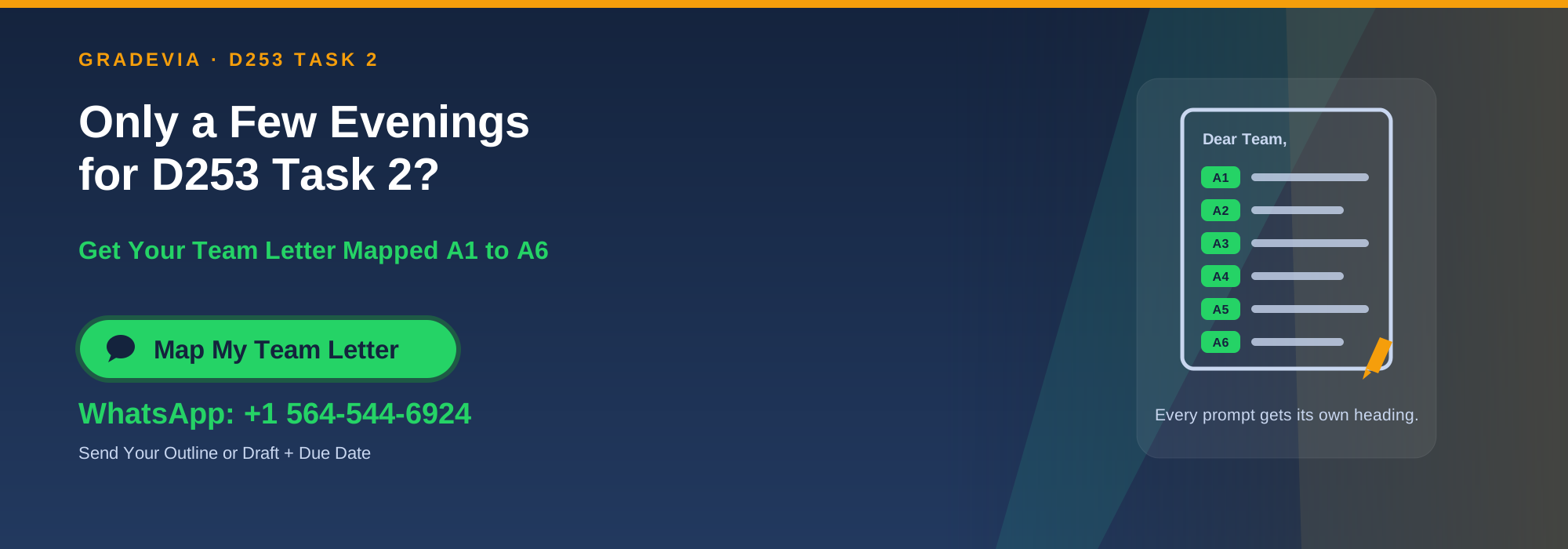
A welcome letter or team memo works well. Use a short heading for each prompt so the evaluator can find A1 through A6 without hunting, and keep the tone you’d actually use with a team of customer service representatives.
Choose Your Elements Before You Write
You pick one element each for A2, A3, and A5. The strongest papers choose them so they support each other and connect to the value you lead with in A1. Spend ten minutes on this before writing:
- Start from Task 1. Your VIA signature strengths and the three personal values you chose in WGU D253 Task 1 are the natural place to begin. A manager whose top strength is honesty pairs well with Integrity and transparency. One who scored high on perseverance might lead with Growth and achievement.
- Pick your A1 value. Choose the one you can tie to a real customer service situation.
- Pick elements that fit the job. Customer service has predictable pressure points: angry callers, queue spikes, quality scores, schedule changes, and escalations. Choose elements you can show in those moments.
| If you lead with | Self-awareness element that fits | Self-management element that fits | Relationship element that fits |
|---|---|---|---|
| Integrity | Accurate self-assessment | Transparency | Influence |
| Humility | Accurate self-assessment | Adaptability | Coaching and mentoring |
| Trust | Emotional awareness | Transparency | Teamwork |
| Growth | Accurate self-assessment | Achievement or initiative | Coaching and mentoring |
| Respect | Emotional awareness | Emotional self-control | Conflict management |
| Excellence | Self-confidence | Achievement | Inspirational leadership |
These pairings are starting points, not rules. Any combination works if you can explain it.
A1: Your Introduction, Focused on One Value
Introduce yourself briefly: your background, why you took the role, and what the team can expect from you. Then build the introduction around one value. Mentioning all six reads like a list. Explaining one in depth, with a commitment the team can hold you to, reads like a leader.
Weak: “I believe in all of Corollary Marketing’s values, especially Trust.”
Strong: “The value I’ll ask you to hold me to is Trust. That means when I change a schedule, you’ll hear the reason from me before the shift starts, not from the posted calendar.”
A2 and A3: Self-Awareness and Self-Management in Daily Work
For each element, cover three things:
- What it means, in a sentence, in your own words
- How you’ll use it, in a specific situation
- How the team will use it, in a specific situation
The team half is the one students skip. If you choose emotional self-control, your part might be pausing before you respond to a customer complaint that names a rep, and the team’s part might be a short reset between difficult calls.
Self-awareness and self-management are different domains, so keep them separate. Self-awareness is recognizing what you feel and how well you’re performing. Self-management is what you do with that recognition.
A4: Social Awareness and Empathy
The prompt asks how you and your team will use social awareness to practice empathy, so empathy must be the center of this section. In customer service, that has two directions: empathy toward customers (hearing the frustration behind a billing complaint) and empathy toward coworkers (noticing the rep who has taken three hostile calls in a row). Give one example of each.
Listening is the practical skill here. Research on listening at work links high quality listening to stronger relationships and trust between employees and supervisors (Kluger & Itzchakov, 2022), which makes it a credible source for this section.
A4a and A4b: The Bias Prompts
These two prompts ask for different things, and mixing them up is one of the most common reasons this section comes back.
A4a: unconscious bias and ethical decisions. Unconscious bias is an automatic attitude or association that shapes how we judge people without our noticing. The prompt asks how it may affect ethical decision making on your team. Point to real team decisions where fairness is at stake:
- Who gets the preferred shifts or the high value accounts
- Which representative gets credit, or blame, after an escalation
- How customer complaints are judged when a caller has a strong accent or a different communication style
- Who is considered for a team lead role
Then say what you’ll do about it, such as clear criteria for shift bids or reviewing call recordings before deciding a complaint.
A4b: two cognitive biases, each with an example. Cognitive biases are systematic errors in judgment. A review of four professional fields found that biases such as overconfidence, anchoring, and confirmation bias affect experienced professionals’ decisions, not only novices’ (Berthet, 2022). Name two, define each, and give a customer service example:
| Bias | What it is | Customer service example |
|---|---|---|
| Confirmation bias | Looking for information that supports what we already believe | A manager who thinks a rep is careless notices only that rep’s errors in quality reviews |
| Anchoring | Relying too heavily on the first piece of information | A rep’s first month of low scores sets how the manager rates them all year |
| Halo effect | Letting one positive trait shape the whole judgment | A rep with excellent customer survey scores isn’t questioned about skipped compliance steps |
| Recency bias | Weighting recent events more than the full record | One bad week before a review outweighs eleven strong months |
Two is the requirement. Each needs its own example, and a workplace example is stronger than a general one.
A5 and A5a: Relationship Management and a Culture of Care
For A5, choose one element and show it in daily interactions, the same way as A2 and A3. Coaching and mentoring, for example, might mean a weekly call review with each rep where the rep picks the call.
A5a asks how you will create a culture of care. Be concrete. “I care about my team” isn’t a plan. Specific practices are:
- A standing check in that covers workload and wellbeing, not only metrics
- A rule that anyone can step off the phones for five minutes after an abusive call
- Asking for feedback on your own decisions, and acting on it where you can
- Recognizing effort publicly and correcting errors privately
Psychological safety, the shared belief that it’s safe to speak up and take interpersonal risks, is a useful frame here, because research ties it to team learning and performance (Edmondson & Bransby, 2023).
A6: Why the Domains Make the Team Effective
A6 asks why you and your direct reports will use at least one domain to be effective as a team. Keep it focused on team results: fewer escalations, faster recovery after hard calls, better handoffs between shifts, and more consistent customer experiences. A review of research on emotional intelligence, leadership, and work teams found consistent links between emotional intelligence and team performance and wellbeing (Coronado-Maldonado & Benítez-Márquez, 2023). Pick one or two domains and explain the connection, rather than summarizing all four again.
Sources and Professional Communication
Cite anything you quote, paraphrase, or summarize, including definitions of the domains and biases. APA 7 is the format WGU expects. Run Grammarly, check that every prompt has its own heading, and read the document once as if you were one of your new reps.
Values Based Leadership in D253 Task 2: How It Connects to Task 1
D253 is a course in values based leadership. Task 1 asks you to identify your strengths and values; values based leadership in D253 Task 2 asks you to put them to work in front of a team. Evaluators notice when the two papers sound like two different people. If your WGU D253 Task 1 named honesty as a top strength, a Task 2 that leads with Integrity and transparency is consistent and easier to write. Our D253 Task 1 guide covers the VIA survey, the values list, and the team lead scenario.
WGU D253 Task 2 Example: A Team Letter for a Fictitious Company
Our WGU D253 Task 2 example is an APA 7 paper written by a fictitious manager at a fictitious company, not Corollary Marketing. Marisol Vega has just started as customer care manager at Tidewater Home Supply, a fictitious company with its own values: Accountability, Candor, Care, and Craft. Her letter shows:
- An introduction built around one value, with a commitment the team can check
- One element each for self-awareness, self-management, and relationship management, showing both Marisol and the team in daily situations
- Empathy toward customers and toward coworkers
- Unconscious bias tied to a real team decision, and two cognitive biases with an example each
- Four concrete culture of care practices
- A6 tied to team results, with APA citations and references
Here’s part of her A3 section:
I chose adaptability because our call volume can triple the day after a storm. On those days, I’ll pull the training block and take calls myself. For you, adaptability means switching from order support to damage claims without waiting for a new script. I’ll post a two minute summary in the team channel each morning a surge starts, so nobody is adapting blind.
The example uses fictitious people and a fictitious company and is for illustration only. Your submission must introduce you at Corollary Marketing Inc., use its values, and be written in your own words.
Download the WGU D253 Task 2 example (.docx)
Plan It Around Your Work Week
- Evening one (about 90 minutes): Reread your Task 1, choose your value and three elements, and draft A1 through A3.
- Evening two (about 2 hours): Draft A4, A4a, A4b, and A5a. Find your sources while you write, not after.
- Evening three (about 1 hour): Write A6, format the references, run Grammarly, and check each prompt against its heading.
Common Reasons D253 Task 2 Comes Back
- A section explains what the element means but not how the team will use it
- Examples are general (“in stressful situations”) instead of tied to customer service work
- A4a describes cognitive biases instead of unconscious bias and ethical decisions
- A4b gives two biases but only one example, or an example without the bias named
- A5a states that you care without saying what you’ll do
- The introduction lists several values instead of focusing on one
- Definitions are paraphrased from a source without a citation
Related WGU Guides
- See every D253 WGU guide in one place.
- Our WGU D253 Task 1 guide and example covers the VIA strengths, values, and ethics conversation your Task 2 builds on.
- Ethical decision making carries into C717. Our WGU C717 Task 2 guide covers three business dilemmas and three ethical theories.
- For conflict and negotiation behaviors, see our D268 Task 2 guide.
- Browse all WGU assignment guides and samples.
Pre-Submission Checklist
- Written to the team, in the first person, as the new customer service manager
- A1 introduces you and focuses on one Corollary Marketing value
- A2, A3, and A5 each name one element and show both you and the team using it in daily work
- A4 centers on empathy toward customers and coworkers
- A4a ties unconscious bias to an ethical decision on your team
- A4b names two cognitive biases, each with its own example
- A5a lists specific culture of care practices
- A6 explains why at least one domain makes the team effective
- Every paraphrased definition has an APA in-text citation and reference
- Grammarly is clear and each prompt has its own heading
Frequently Asked Questions
What is WGU D253 Task 2 about?
You’re the new customer service manager at Corollary Marketing Inc., writing to your team. You introduce yourself around one company value and explain how you and the team will use the four domains of emotional intelligence, including empathy, bias awareness, and a culture of care.
What does RSM3 mean in WGU D253 Task 2?
RSM3 is WGU’s assessment code for D253 Values Based Leadership. It appears on both the Task 1 and Task 2 directions.
How many emotional intelligence elements do I choose?
One each for self-awareness, self-management, and relationship management. Social awareness is assigned: you discuss empathy.
What is the difference between unconscious bias and cognitive bias in D253 Task 2?
A4a asks how unconscious bias, automatic attitudes about people, may affect ethical decisions on your team. A4b asks for two cognitive biases, which are errors in judgment such as confirmation bias or anchoring, with an example of each.
Can I submit the WGU D253 Task 2 example from this page?
No. It uses a fictitious company with different values and is for illustration only. Your paper must be written as the manager at Corollary Marketing, in your own words.
Want a Second Look Before You Submit?
If you’re working full time and want structured assignment support choosing elements that fit your Task 1 strengths, making each section show your team in action, or checking your bias examples before you submit, message Gradevia on WhatsApp at +1 564 544 6924.
Sources
Berthet, V. (2022). The impact of cognitive biases on professionals’ decision-making: A review of four occupational areas. Frontiers in Psychology, 12, Article 802439. https://doi.org/10.3389/fpsyg.2021.802439
Coronado-Maldonado, I., & Benítez-Márquez, M.-D. (2023). Emotional intelligence, leadership, and work teams: A hybrid literature review. Heliyon, 9(10), Article e20356. https://doi.org/10.1016/j.heliyon.2023.e20356
Edmondson, A. C., & Bransby, D. P. (2023). Psychological safety comes of age: Observed themes in an established literature. Annual Review of Organizational Psychology and Organizational Behavior, 10, 55–78. https://doi.org/10.1146/annurev-orgpsych-120920-055217
Kluger, A. N., & Itzchakov, G. (2022). The power of listening at work. Annual Review of Organizational Psychology and Organizational Behavior, 9, 121–146. https://doi.org/10.1146/annurev-orgpsych-012420-091013