
Blog
Shadow Health Abdominal Concept Lab: How to Complete It Successfully + Example

The Shadow Health Abdominal Concept Lab teaches the elements of an abdominal exam, and it’s built around one detail a lot of students forget under time pressure: the abdominal exam doesn’t follow the sequence you learned for most other body systems. Auscultation comes before percussion and palpation here, not after, and understanding why matters more for this concept lab than memorizing a list of steps.
This guide walks through what the Shadow Health Abdominal Concept Lab is actually testing, the four examination techniques and their unusual order, how to reason through evaluation activities, and what the “answers,” “evaluation answers,” and “PDF” searches around this lab are actually looking for, plus a more reliable way to get there.
Shadow Health Abdominal Concept Lab Assignment Prompt
In this assignment you will learn about the elements of an abdominal exam. Within the Shadow Health platform, complete the Abdominal Concept Lab. On average, this assignment should take 25 minutes to complete. Some students may need additional time.
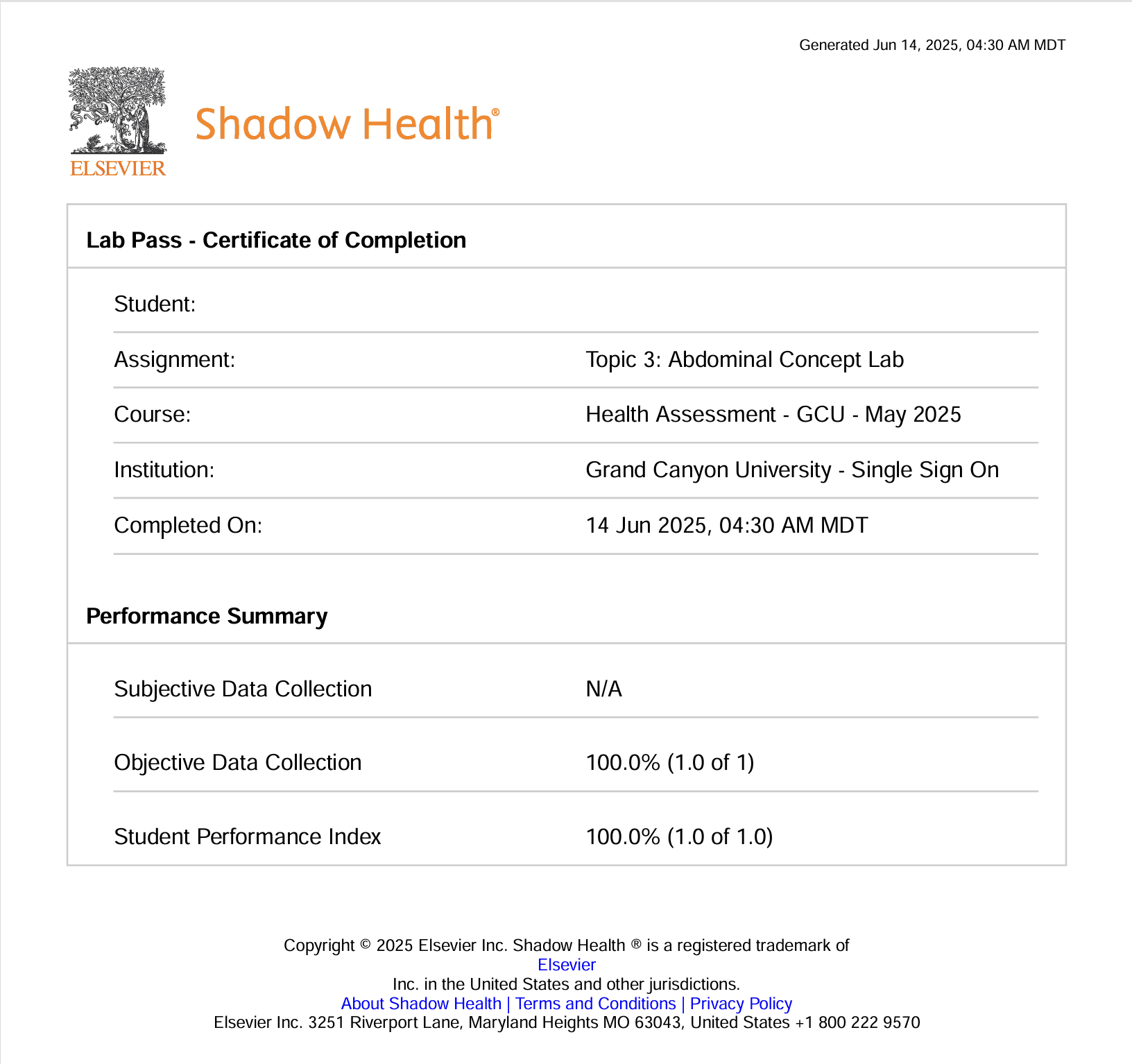
You can attempt this assignment as many times as you would like. After completing this concept lab, you will be awarded a Digital Clinical Experience (DCE) score. The DCE score will appear on your Lab Pass which you will submit to the classroom drop box. The DCE score will be used as your percentage grade for this assignment.
You are not required to submit this assignment to LopesWrite.

What Is Shadow Health Abdominal Concept Lab?
This concept lab teaches the elements of an abdominal exam inside the Shadow Health platform. A few things worth knowing before you start:
- The estimated average completion time is about 25 minutes, though some students reasonably need more.
- You can attempt the assignment as many times as you would like.
- Completing the lab awards a Digital Clinical Experience (DCE) score.
- That score appears on your Lab Pass, which you submit to your classroom drop box.
- The DCE score is used as your percentage grade.
- LopesWrite submission is not required for this assignment.
Shadow Health Abdominal Concept Lab Assignment Requirements
| Requirement | What It Means |
|---|---|
| Concept Lab | Learn the elements of an abdominal exam |
| Platform | Complete the activity inside Shadow Health |
| Average time | Approximately 25 minutes |
| Attempts | Multiple attempts are permitted |
| DCE score | Awarded after completing the lab |
| Lab Pass | Contains the DCE score |
| Submission | Submit the Lab Pass to the classroom drop box |
| LopesWrite | Not required |
The 25-minute figure is an average, not a target. The assignment itself notes some students will reasonably need more time, especially if the abdominal exam’s reversed sequence is new to you.
What Does the Abdominal Exam Actually Test?
Before starting the concept lab, make sure you can explain what inspection, auscultation, percussion, and palpation each accomplish, and why auscultation comes before the other hands-on techniques.
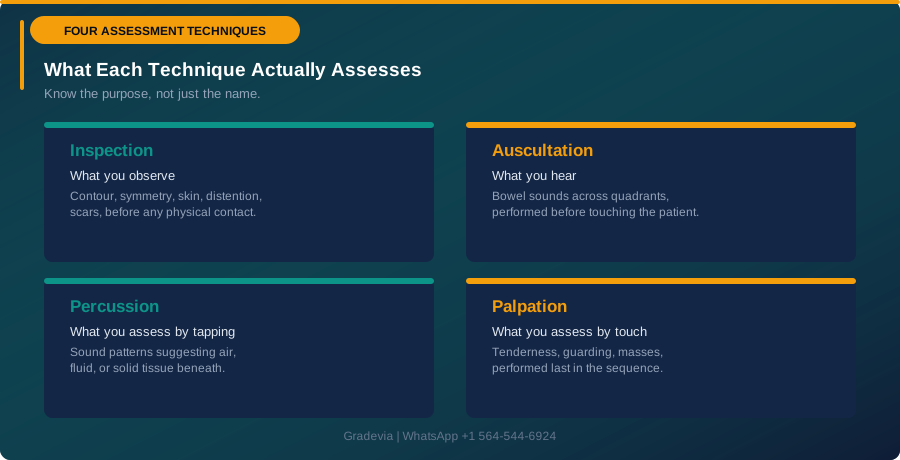
The four elements:
Inspection. Look before you touch. This covers what you can observe visually: contour, symmetry, skin characteristics, distention, scars, and other visible findings.
Auscultation. Listen next, before any physical manipulation. This is where the abdominal sequence diverges from most other systems.
Percussion. Tapping to assess what’s underneath the surface, complementing what inspection and auscultation already suggested.
Palpation. Touch last. This is where you assess tenderness, guarding, masses, and general discomfort, and it’s also the technique most likely to alter what you’d hear if you auscultated afterward instead of before.
The sequence: Inspect → Auscultate → Percuss → Palpate.

Shadow Health Abdominal Concept Lab Questions: What Concepts Should You Know?
This lab’s proprietary questions aren’t reproduced here, but the underlying concepts they’re built around are worth knowing cold before you start.
Inspection
Know what you’re looking for: abdominal contour (flat, rounded, distended, scaphoid), symmetry, skin characteristics (color, striae, visible veins), visible distention, scars, and any other observable abnormality, all before you’ve touched the patient at all.
Auscultation
Know what bowel sounds tell you, why you listen systematically across quadrants, and specifically why auscultation happens before palpation and percussion: manipulating the abdomen first can change bowel sound activity, which would give you inaccurate auscultation findings if you did it out of order. This guide won’t invent exact timing rules or scoring thresholds; if your course materials specify a particular auscultation duration or technique, follow that guidance directly.
Percussion
Know that percussion helps assess what’s beneath the surface: it can suggest fluid, air, or solid tissue depending on the sound produced, and it complements what inspection and auscultation already indicated. The specific distinction between expected and concerning percussion notes should be studied at a conceptual level here; the exact clinical interpretation follows your nursing curriculum.
Palpation
Know the conceptual difference between light and deeper palpation, and what each is generally used to assess: tenderness, guarding, and masses, among other findings. Palpation also involves patient communication, since a nurse needs to explain what they’re doing and check in with the patient throughout, not just perform the technique silently.
Shadow Health Abdominal Concept Lab Answers: What Should You Actually Study?
It’s a reasonable thing to search for. You want to know you’re getting this right before it affects your grade. The most reliable way to prepare is to understand why each abdominal assessment technique is performed rather than memorize a list of answers, since a memorized answer to one version of the lab may not transfer to yours.
| Concept | What to Understand |
|---|---|
| Inspection | What can be observed before touching the patient? |
| Auscultation | What information can be obtained through listening? |
| Percussion | What does percussion help assess? |
| Palpation | What can the nurse assess through touch? |
| Sequence | Why does abdominal assessment follow this order? |
| Communication | How should the patient be prepared and informed? |
| Findings | How should normal and abnormal observations be distinguished? |
No official Shadow Health answer key is reproduced or claimed here. This table is a study checklist, not an answer bank.
Shadow Health Abdominal Concept Lab Evaluation Answers
When you reach evaluation-style activities, work through this sequence instead of guessing:
- Identify what clinical concept the question is actually testing.
- Eliminate any answer that would violate the correct abdominal assessment sequence.
- Ask yourself what the nurse is trying to assess at that specific step.
- Distinguish the purpose of each examination technique from the others.
- Apply basic clinical reasoning rather than pattern-matching to a memorized answer.
- If you get it wrong, review the underlying concept before moving on.
- Retry the activity once you’ve actually addressed the gap, not just re-guessed.
Shadow Health Abdominal Concept Lab Example
Below are original practice evaluation questions, not actual Shadow Health questions, with the reasoning worked through:
- Which technique should be performed first during an abdominal assessment? Inspection, since it’s the only technique performed before any physical contact with the patient.
- Why is auscultation performed before percussion and palpation on the abdomen? Because percussion and palpation can alter bowel sound activity, which would make auscultation findings less accurate if performed afterward.
- A nurse observes abdominal distention during the assessment. What technique was used to identify this? Inspection, since distention is a visual finding.
- What is the nurse assessing when listening to bowel sounds in each quadrant? The presence, absence, and character of bowel sounds, which requires systematic listening across all four quadrants rather than one spot.
- What is percussion primarily used to assess in the abdominal exam? What’s beneath the surface, such as the presence of air, fluid, or solid tissue, based on the sound produced.
- A patient reports discomfort during light palpation. What should the nurse do? Communicate with the patient, note the finding, and adjust the approach rather than continuing without acknowledgment.
- Why shouldn’t a nurse perform deep palpation before auscultation? Because it risks altering bowel activity and could also cause unnecessary patient discomfort before the less invasive techniques have been completed.
- What distinguishes palpation from percussion? Palpation assesses through direct touch (tenderness, guarding, masses), while percussion assesses through tapping and interpreting the resulting sound.
Why Is the Abdominal Exam Sequence Different?
Most physical assessments follow inspection, palpation, percussion, auscultation, often remembered as IPPA. The abdominal exam uses a different order: inspection, auscultation, percussion, palpation, sometimes remembered as IAPP.
The reasoning is straightforward once you see it: percussion and palpation both involve physically manipulating the abdomen, and that manipulation can change bowel sound activity. If you percussed or palpated before listening, you might hear altered bowel sounds that don’t reflect the patient’s actual baseline. Listening first, before any manipulation, gives you an accurate auscultation finding. That’s the whole reason for the reversed order, and it’s a much easier thing to remember once you understand the mechanism instead of just the acronym.
Shadow Health Abdominal Concept Lab vs. Shadow Health Cardiovascular Concept Lab
Both concept labs teach body-system-specific physical assessment, which is why students often search for both together. They’re not interchangeable preparation, though.
| Concept Lab | Primary Focus |
|---|---|
| Abdominal Concept Lab | Elements and sequence of abdominal examination |
| Cardiovascular Concept Lab | Cardiovascular assessment concepts |
Completing one doesn’t automatically prepare you for the other. The assessment techniques, relevant anatomy, expected findings, and examination priorities differ enough that each lab needs its own focused preparation.
Shadow Health Abdominal Concept Lab PDF: Is It Useful?
Students search for PDFs hoping for a fast, reliable study reference. Not all PDFs serve that purpose equally well. Worth distinguishing:
- Legitimate study notes you or a classmate compiled from course material: genuinely useful for review.
- Instructor-provided materials: authoritative for your specific course.
- General abdominal assessment resources from nursing textbooks or reputable clinical sources: useful for the underlying concepts.
- Unofficial answer compilations claiming to be a Shadow Health answer key: unreliable, and not something this guide reproduces or links to.
A genuinely useful study PDF should help you understand examination sequence, technique purpose, normal versus abnormal concepts, and clinical reasoning, not hand you a list of item-by-item answers to memorize.
How to Use Multiple Attempts Strategically
The assignment explicitly allows multiple attempts. Use that as a learning tool, not just a retry button.
Attempt 1: map the concept lab. Focus on understanding what concepts are actually being tested rather than optimizing for a score on the first pass.
Review. Identify missed concepts, confusing terminology, sequence errors, and technique misunderstandings specifically.
Attempt 2: apply the concepts. Use clinical reasoning based on what you identified in the review, not a fresh round of guessing.
Review again. Look for whatever weak areas remain.
Final attempt. Complete the activity with an actual working understanding of the abdominal exam framework, not a memorized pattern from the previous attempt.
Multiple attempts should be used for learning, not blind repetition. Repeating the exact same approach on every attempt tends to reproduce the exact same gaps.
How to Improve Your Shadow Health DCE Score
Practical ways to improve performance, without promising a specific score:
- Know the examination sequence cold, and know why it’s ordered that way.
- Understand the purpose of each technique rather than just its name.
- Read questions carefully instead of pattern-matching to a keyword.
- Avoid rushed responses, especially early in the lab when you’re still getting oriented.
- Review incorrect concepts specifically, not just the item you missed.
- Use feedback from previous attempts to target your review.
- Practice distinguishing similar-sounding techniques (percussion vs. palpation, for instance) explicitly.
- Understand why a correct answer is correct, not just that it was correct.
None of this guarantees a perfect or specific DCE score. It’s a more reliable path to a better one than memorizing answers you can’t apply if the item is worded differently than expected.
25-Minute Shadow Health Abdominal Concept Lab Study Plan
This is a recommended planning framework, not an official Shadow Health timing requirement. The assignment itself notes some students will reasonably need more time.
| Stage | Focus |
|---|---|
| 0-3 minutes | Review the assignment objective |
| 3-8 minutes | Review the abdominal examination sequence |
| 8-18 minutes | Complete the concept lab carefully |
| 18-22 minutes | Review any difficult concepts |
| 22-25 minutes | Complete and review final activities |
Not getting the DCE score you expected from your Shadow Health attempts? Get practical academic guidance before your next try. WhatsApp Gradevia: +1 564-544-6924
Common Shadow Health Abdominal Concept Lab Mistakes
- Memorizing answers instead of understanding concepts. Correction: focus on why each technique exists, not what the answer key supposedly says.
- Forgetting the abdominal examination sequence. Correction: anchor it to the reasoning (auscultation before manipulation), not just the acronym.
- Using the general physical-assessment sequence automatically. Correction: remember the abdomen is the exception to IPPA, not an extension of it.
- Performing percussion before auscultation conceptually. Correction: always place auscultation second, right after inspection.
- Confusing inspection with palpation. Correction: inspection is visual only, before any touch; palpation is touch-based and comes last.
- Confusing percussion with auscultation. Correction: percussion is tapping and interpreting sound; auscultation is listening with a stethoscope.
- Not understanding why technique order matters. Correction: connect the order to the actual clinical reason (avoiding altered bowel sounds), not just memorizing the sequence.
- Rushing through questions. Correction: treat 25 minutes as an average, not a countdown you need to beat.
- Repeating attempts without reviewing mistakes. Correction: review specifically what you missed before attempting again.
- Depending completely on Quizlet or PDF answer compilations. Correction: use them for concept review only, not as a verified answer source.
- Assuming every online resource matches your current Shadow Health version. Correction: verify anything you study against your own course materials.
- Ignoring clinical reasoning in favor of pattern-matching. Correction: ask what’s actually being assessed at each step, not just which answer looks familiar.
- Failing to read the entire question. Correction: slow down enough to catch qualifying details before answering.
- Treating a concept lab as a memorization exercise. Correction: treat it as a reasoning exercise that happens to be graded.
Shadow Health Abdominal Concept Lab Final Checklist
Before starting
- I understand the assignment objective.
- I know the four major abdominal examination techniques.
- I know the correct sequence.
- I understand why auscultation comes before percussion and palpation.
During the Concept Lab
- I read each question carefully.
- I identify the clinical concept being tested.
- I avoid guessing when I can reason through the concept.
- I review difficult concepts as they come up.
After completion
- I reviewed my DCE score.
- I located the Lab Pass.
- I know the Lab Pass must be submitted to the classroom drop box.
- I understand that LopesWrite is not required.
- If needed, I can use another attempt to improve my understanding.
FAQ
- What is Shadow Health Abdominal Concept Lab? A Shadow Health activity that teaches the elements of an abdominal exam: inspection, auscultation, percussion, and palpation, in that specific order.
- How long does Shadow Health Abdominal Concept Lab take? About 25 minutes on average, though some students reasonably need more time.
- What does the abdominal Concept Lab cover? The four abdominal examination techniques, their purpose, and the reasoning behind the exam’s specific sequence.
- What are the Shadow Health Abdominal Concept Lab questions about? Concepts like inspection findings, bowel sound auscultation, percussion notes, palpation technique, and why the sequence matters, not memorized item-by-item content.
- Is there a Shadow Health Abdominal Concept Lab answer key? No verified official answer key is published for students. Understanding the underlying concepts is more reliable than memorizing answers, since the exact items can vary.
- Are Shadow Health Abdominal Concept Lab answers available online? Unofficial compilations circulate, but they may not match your version of the activity and don’t build the reasoning skill the lab is actually testing.
- Is a Shadow Health Abdominal Concept Lab PDF useful? A legitimate study PDF covering concepts, sequence, and technique purpose can help. An unofficial answer compilation is a less reliable substitute for understanding.
- What are Shadow Health Abdominal Concept Lab evaluation answers? The reasoning-based responses to evaluation activities, best approached by identifying the clinical concept being tested rather than searching for a matched answer list.
- How is the abdominal exam sequence different from other physical assessments? Most assessments follow inspection, palpation, percussion, auscultation. The abdomen uses inspection, auscultation, percussion, palpation, because manipulation from percussion and palpation can alter bowel sounds if performed before listening.
- Can I retake the Shadow Health Abdominal Concept Lab? Yes, the assignment allows multiple attempts.
- How does the DCE score work for this assignment? It’s the Digital Clinical Experience score awarded after completing the lab, and it’s used as your percentage grade.
- What is the Lab Pass? The document showing your DCE score, which you submit to the classroom drop box.
- Do I submit this assignment to LopesWrite? No, LopesWrite submission is not required for this assignment.
- What is the difference between the abdominal and cardiovascular Concept Labs? They cover different body systems with different techniques, anatomy, and findings. Completing one doesn’t prepare you for the other.
Related Content
Shadow Health Health History: How to Complete the Tina Jones Assessment
Shadow Health HEENT: How to Complete the Tina Jones Assessment
Shadow Health Conversation Concept Lab: How to Complete It
Shadow Health Respiratory Concept Lab: How to Complete It
Shadow Health Tina Jones MSN 572: Complete Guide + Example SOAP Note
Conclusion
The Shadow Health Abdominal Concept Lab is built around a sequence that only makes sense once you understand why it’s reversed from what you learned for other systems: inspect first, then listen before you touch, because touching first can change what you’d hear. That single piece of reasoning, applied consistently, carries you through most of what this concept lab is actually testing. Skip the search for an unverifiable answer key, and use the reasoning framework and multiple-attempt strategy in this guide instead. It transfers to whatever version of the lab you’re given, and it’s the same clinical judgment you’ll rely on in an actual abdominal assessment later.