
Blog
WGU C207 Task 2 Guide: Decision Tree Analysis + Example

Updated on: Sep 24, 2026
By Dan Palmer, MBA · Academic strategy consultant for working adult learners · LinkedIn
Working full time and trying to finish WGU C207 Task 2? Start here. C207 Task 2, formally QUM3 Task 2 under Data-Driven Decision Making, asks you to build a decision tree from data unique to your student ID, calculate expected value, and write a report recommending a course of action. The confusion most students hit isn’t the math, it’s not knowing what each of the seven parts (A through G) is actually asking for, and whether the “example” they found online has any bearing on their own numbers. This guide answers both.

C207 Task 2 Assignment Prompt
Introduction
Managers are required to organize, interpret, and display data that is reliable and relevant to the real-world decisions they must make in their businesses. The use of analytical tools will improve your ability to use data to make informed decisions.
In this task, you will address the business situation in the attached scenario. You will access the scenario and dataset by entering your student ID number in the “Start” tab of the “Decision Tree Analysis Resources” document found in the Supporting Documents section. The scenario and dataset are located in the “Decision Tree Scenario” tab. Using this dataset, you will perform a decision tree analysis and recommend a solution.
This recommendation will be included in a report you will write summarizing the key details of your analysis.
For full functionality of the scenario and data attachment, you must use Microsoft Excel, which is available via the Microsoft Office 365 subscription service provided to all WGU students. It can be downloaded using the “Microsoft Office 365” link in the Web Links section.
Scenario
Refer to the scenario located in the supporting document, “Decision Tree Analysis Resources.”
Requirements
Your submission must represent your original work and understanding of the course material. Most performance assessment submissions are automatically scanned through the WGU similarity checker.
Students are strongly encouraged to wait for the similarity report to generate after uploading their work and then review it to ensure Academic Authenticity guidelines are met before submitting the file for evaluation. See Understanding Similarity Reports for more information.
Grammarly Note:
Professional Communication will be automatically assessed through Grammarly for Education in most performance assessments before a student submits work for evaluation. Students are strongly encouraged to review the Grammarly for Education feedback prior to submitting work for evaluation, as the overall submission will not pass without this aspect passing. See Use Grammarly for Education Effectively for more information.
Microsoft Files Note:
Write your paper in Microsoft Word (.doc or .docx) unless another Microsoft product, or pdf, is specified in the task directions. Tasks may notbe submitted as cloud links, such as links to Google Docs, Google Slides, OneDrive, etc. All supporting documentation, such as screenshots and proof of experience, should be collected in a pdf file and submitted separately from the main file. For more information, please see Computer System and Technology Requirements.
You must use the rubric to direct the creation of your submission because it provides detailed criteria that will be used to evaluate your work. Each requirement below may be evaluated by more than one rubric aspect. The rubric aspect titles may contain hyperlinks to relevant portions of the course.
Complete your decision tree analysis and create a report by doing the following:
Note: The supporting document “Decision Tree Analysis Resources” contains a scenario, data set, and template. While you must use the scenario and data set provided in the supporting document, the template is optional. You are encouraged to use the template to complete your analysis. Please see supporting document, “QUM3 Task 2 Getting Started,” for help accessing the scenario and dataset.
A. Summarize the business scenario by doing the following:
Describe a business question that could be answered by applying decision tree analysis and is derived from the scenario in “Decision Tree Analysis Resources.”
Justify why decision tree analysis is the appropriate analysis technique, and include relevant details from the scenario to support your justification.
B. Identify the relevant data values required for your decision tree analysis, including the following:
demands
profits per unit
probabilities
C. Report how you analyzed the data using decision tree analysis by completing a decision tree diagram that includes each of the following:
state-of-nature nodes
calculated payoffs, each expressed out to two decimal places
expected values, each expressed out to two decimal places
Note: Include “Decision Tree Analysis Resources.” spreadsheet with your task submission for evidence of your calculations and decision tree diagram.
Note: Refer to “Prepare for the Performance Assessment Task2″ in the course of study to examples of acceptable output.
D. Summarize the implications of your decision tree analysis by doing the following:
Explain each step required to determine the expected value based on
List one limitation for each of the following:
any one of the data values listed in part B
the decision tree analysis
E. Recommend a course of action that addresses the business question from part A and is based on the results of your decision tree analysis.
F. Acknowledge sources, using in-text citations and references, for content that is quoted, paraphrased, or
G. Demonstrate professional communication in the content and presentation of your submission.
Important: Your C207 Task 2 Numbers May Be Different
Your dataset comes from entering your unique WGU student ID into the “Start” tab of the “Decision Tree Analysis Resources” spreadsheet. That ID pulls a specific data set assigned to you, meaning your demand values, profit-per-unit figures, probabilities, payoffs, and expected values are yours specifically, not a fixed set every student shares.
This is why searching for “C207 Task 2 answers” rarely helps the way it seems like it should. Another student’s finished numbers were built from their dataset, not yours, so even a perfectly correct paper won’t transfer. What actually transfers is the method: how to identify the right values, build the tree correctly, and calculate expected value step by step. That’s what this guide, and the downloadable examples below, are built to teach, using illustrative numbers that demonstrate the process rather than someone’s real submission.
C207 Task 2 at a Glance
| Part | What You Need to Do |
|---|---|
| A | Describe a business question your scenario raises, and justify why decision tree analysis fits it |
| B | Identify the relevant data values: demands, profits per unit, probabilities |
| C | Build a decision tree diagram with state-of-nature nodes, payoffs, and expected values (2 decimal places each) |
| D1 | Explain each step used to determine expected value from payoffs |
| D2 | State one limitation of a data value from Part B, and one limitation of decision tree analysis itself |
| E | Recommend a course of action that answers Part A’s business question and follows from your analysis |
| F | Cite sources, in-text and in a reference list, for anything quoted, paraphrased, or summarized |
| G | Demonstrate professional communication (checked automatically by Grammarly for Education) |
What You Need Before Starting
- Your current C207 Task 2 task instructions and rubric (check your WGU course for the most recent version)
- The “Decision Tree Analysis Resources” spreadsheet from your task’s Supporting Documents
- Your WGU student ID, entered in the spreadsheet’s Start tab to unlock your dataset
- The desktop version of Microsoft Excel with Microsoft 365 (the browser version won’t work for full functionality; check under File → Account if you’re not sure which version you have)
- The “QUM3 Task 2 Getting Started” document if you need help locating your data
- Any sources you plan to cite, formatted in APA
C207 Task 2 in Plain English
A. What business decision are you analyzing, and why does a decision tree fit it?
B. What data do you need? Demands, profits per unit, probabilities, pulled from your own spreadsheet.
C. What does the decision tree show? Each choice, its possible outcomes, and the payoff and expected value for each.
D1. How did you get from payoffs to expected value? Walk through the multiplication and the sum.
D2. What could make this analysis wrong? One weak spot in your data, one weak spot in the method.
E. Given all that, what should the business do, and does it actually answer the question from Part A?
Part A: The Business Question
Part A wants two things: a specific business question your scenario raises, and a justification for why decision tree analysis is the right tool to answer it, backed by details from your actual scenario.
Weak: “Should the company invest in a new product?” This could apply to almost any business decision tree assignment; it names no specific alternatives and no specific source of uncertainty.
Better: A question that names the actual choice on the table, the actual uncertain variable driving the outcome, and what “success” is being measured against, framed so that a decision tree analysis is clearly the tool that answers it, not just a plausible one.
Your justification in A2 should point to the specific source of uncertainty in your own dataset, your assigned probability split, not just restate that “decisions involve uncertainty” in the abstract. A justification that could be copy-pasted into any other student’s Task 1 A2 usually means it hasn’t engaged with the actual scenario yet.
Part B: Finding Your Data in Excel
- Open the Decision Tree Analysis Resources spreadsheet from your task’s Supporting Documents.
- Enter your WGU student ID in the Start tab, not your email address, to unlock your dataset.
- Open the Decision Tree Scenario tab, where your specific scenario and dataset load once your ID is entered.
- Identify the three required value types: demand levels, profit per unit for each, and the probability assigned to each demand scenario.
- Record each value with a one-line label in your report, clearly enough that a grader can check it against your spreadsheet without hunting for it inside a paragraph.
Part B is graded on accuracy and completeness, not analysis. A simple table works better than prose here.

Part C: Building the Decision Tree
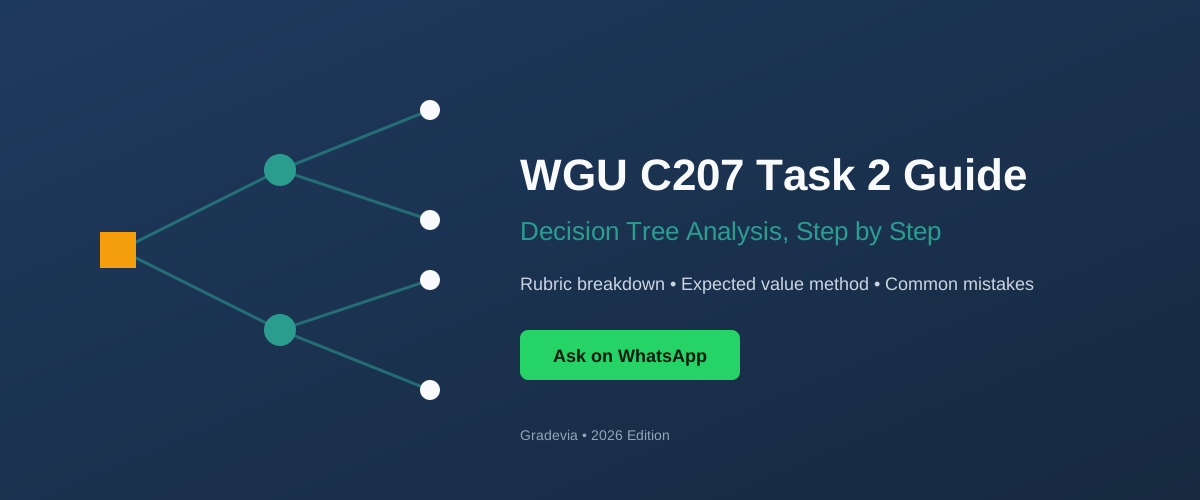
A decision tree maps a choice, its uncertain outcomes, and their payoffs into a branching diagram:
Decision → Chance (State of Nature) → Payoff → Expected Value
- Decision node (square): the choice itself, your alternatives
- Chance node (circle): the uncertain states of nature branching from each alternative, each carrying its probability
- Payoff: the calculated dollar result at each branch end, to two decimal places
- Expected value: each payoff multiplied by its probability, summed per alternative, to two decimal places
Part C is checked specifically for completeness: every state-of-nature node, every payoff, every expected value, each to two decimal places. A tree missing one branch’s expected value, even if the math elsewhere is correct, won’t reach Competent on this part.
Worked Example (Illustrative)
This example uses a fictitious company and invented numbers to demonstrate the method. It is not WGU’s dataset, and your own demand, probability, and profit figures will be different.
Bramwell Foods, a fictitious specialty food producer, is deciding between two alternatives: launching a new organic snack line, or reformulating its existing snack line to reduce sugar content. Each alternative faces two demand states, high and low, each with its own probability and profit per unit.
| Alternative | Demand State | Probability | Profit per Unit | Demand (Units) |
|---|---|---|---|---|
| New Organic Line | High | 0.55 | $4.25 | 80,000 |
| New Organic Line | Low | 0.45 | $1.75 | 30,000 |
| Reformulated Line | High | 0.65 | $2.50 | 60,000 |
| Reformulated Line | Low | 0.35 | $1.20 | 35,000 |
Step 1, payoffs. Payoff = profit per unit × demand.
- New Organic Line, High: $4.25 × 80,000 = $340,000.00
- New Organic Line, Low: $1.75 × 30,000 = $52,500.00
- Reformulated Line, High: $2.50 × 60,000 = $150,000.00
- Reformulated Line, Low: $1.20 × 35,000 = $42,000.00
Step 2, expected value. EV = Σ (payoff × probability) across each alternative’s branches.
- EV (New Organic Line) = (0.55 × $340,000.00) + (0.45 × $52,500.00) = $187,000.00 + $23,625.00 = $210,625.00
- EV (Reformulated Line) = (0.65 × $150,000.00) + (0.35 × $42,000.00) = $97,500.00 + $14,700.00 = $112,200.00
Step 3, compare. The New Organic Line’s expected value ($210,625.00) is higher, so it’s the branch the tree rolls back to at the decision node. Apply this same structure to your own dataset; the mechanics don’t change, only the numbers do.
The complete version of this example, decision tree diagram, full Excel calculations, and the APA-formatted report covering every part A through G, is available as downloadable files below.
Bramwell_Foods_C207_Task2_Example (Click to Download)
Bramwell_Foods_C207_Task2_Example (Click to Download)
Part D1: Calculating Expected Value
D1 asks you to explain the calculation, not just report the result. Walk through it as a process:
- Identify each payoff at every branch end (profit per unit × demand, or however your scenario defines it).
- Identify the probability assigned to each corresponding state of nature.
- Multiply each payoff by its probability to get that branch’s weighted value.
- Sum the weighted values within each alternative to get its total expected value.
Expected Value = Σ (Payoff at each outcome × Probability of that outcome)
Stating the formula alone doesn’t satisfy D1; the rubric is checking whether you can walk through each step with your own numbers, not whether you can recite the definition.
Part D2: Understanding Limitations
D1 explains the calculation. D2 explains what could make the analysis wrong.
You need exactly two limitations: one tied to a specific data value from Part B, and one tied to decision tree analysis as a method. A vague limitation (“the data might not be accurate”) won’t satisfy this part; it needs to be logically tied to your specific value or method and explain why it’s a limitation, not just name one.
Common, genuinely supportable angles:
- Data value limitations: probabilities are typically estimates from historical data or judgment, not certainties; profit-per-unit figures may not reflect how variable costs shift at different volumes; demand figures may not capture external factors like seasonality.
- Method limitations: the model treats probabilities and payoffs as fixed and known, understating real uncertainty; it doesn’t account for risk aversion, a lower-EV option might be preferable if it carries far less downside; a two-branch tree can’t represent every interdependent variable a real decision involves.
For a deeper breakdown with more limitation examples specific to D2, see C207 Task 2 D2 limitation examples.
Part E: The Recommendation
Data → Payoffs → Expected Values → Interpretation → Recommendation.
Part E isn’t a standalone paragraph; it’s the conclusion your Parts B through D1 already built toward. A strong recommendation names which alternative produced the higher expected value and explicitly reconnects that result to the business question from Part A, using language from that question rather than a generic “therefore, the company should…” closer. If your scenario includes a constraint beyond expected value, a risk threshold, a budget ceiling, acknowledge it; ignoring a scenario-specific constraint while recommending the highest-EV option can still cost you here even if the math is right.
Parts F–G: Sources and Professional Communication
- Use APA format for in-text citations and your reference list. Even a course resource or textbook you paraphrase needs a citation.
- Grammarly for Education checks Part G automatically before you can submit for evaluation; review its feedback before you finalize your draft, not after.
- Read your final draft aloud once. It catches phrasing issues Grammarly sometimes misses.
Common C207 Task 2 Mistakes
- Searching for another student’s numerical answers. Your dataset is yours; a matching answer key doesn’t exist.
- Mixing in numbers that don’t come from your own dataset. Even one borrowed figure can make your tree internally inconsistent.
- Treating Parts A–E as separate, disconnected questions. They’re one argument: question, data, tree, calculation, recommendation.
- Building the tree without understanding what each node represents. A visually complete tree with a node in the wrong place won’t read as accurate.
- Arithmetic errors in the expected value calculation. Double-check each multiplication before summing.
- A recommendation that doesn’t connect back to Part A. If a grader can’t see the link, it reads as unsupported.
- Confusing D1 and D2. D1 explains the calculation; D2 explains its limitations. They’re not interchangeable.
- Citing sources that don’t appear consistently in-text and in the reference list. Both are required, and they need to match.
- Submitting without checking the current rubric. Requirements can be updated between terms; the rubric is the final authority, not this guide or any other outside source.
Looking for C207 Task 2 Answers?
If you’re searching “C207 Task 2 sample answers” or a completed C207 Task 2 example, here’s why that search doesn’t get you what you actually need: your demand values, probabilities, and payoffs are pulled from a dataset tied to your student ID, so someone else’s numbers, however correct for their own submission, won’t apply to yours. Worse, submitting work built around someone else’s structure and numbers risks WGU’s similarity checker, since decision tree reports built from copied data tend to look identical in ways that are easy to flag.
What a C207 Task 2 example is actually useful for is learning the method: how to read your data, how to lay out the tree, how expected value is calculated step by step, how the recommendation should connect back to the business question. The worked example above, and the downloadable files below, are built for exactly that, illustrative numbers, real method, nothing to copy into your own submission.
Downloadable C207 Task 2 Examples
Two illustrative files are available, both built on the fictitious Bramwell Foods scenario above, extended into a complete report covering every part, A through G.
- Excel workbook: the full decision tree calculation, payoffs, and expected values laid out the way your own “Decision Tree Analysis Resources” submission should be, a useful C207 Task 2 Excel example for seeing the layout before you build your own. Bramwell_Foods_C207_Task2_Example
- APA 7 Word document: the complete written report, business question and justification (A), data values (B), decision tree summary (C), expected value explanation (D1), two limitations (D2), a recommendation tied back to the business question (E), and a properly formatted reference list (F). KCM1-Task-4-Complete-Fictitious-Example-APA7
Both are clearly labeled illustrative and are not built from WGU’s actual dataset. Use them to see the structure and depth expected, not as content to adapt into your own submission.
C207 Task 2 Submission Checklist
- Business question is specific and tied to your actual scenario
- Decision tree analysis is justified with details from your scenario, not a generic definition
- Required data values (demands, profits per unit, probabilities) are identified and labeled
- Decision tree includes every state-of-nature node
- Payoffs are calculated correctly, to two decimal places
- Expected values are calculated correctly, to two decimal places
- D1 explains each step of the expected value calculation, not just the result
- D2 includes one data-value limitation and one method limitation, each explained
- Recommendation names the higher-EV alternative and answers Part A’s question directly
- In-text citations and the reference list are both complete and match each other
- Grammarly for Education has been reviewed before submission
- “Decision Tree Analysis Resources” spreadsheet is included as a submission attachment
- Current WGU rubric has been checked one final time before submitting
Frequently Asked Questions
What is WGU C207 Task 2? A performance assessment in Data-Driven Decision Making (C207), also called QUM3 Task 2, asking you to build a decision tree from a dataset unique to your student ID, calculate expected value, and write a report recommending a course of action.
What is QUM3 Task 2? QUM3 is the internal WGU code for the same assessment referred to as C207 Task 2; they’re the same task.
Why are my C207 Task 2 numbers different from an example? Your dataset is generated from your own WGU student ID, entered into the Decision Tree Analysis Resources spreadsheet. No two students necessarily receive identical demand, probability, or profit figures.
Do I need Excel for C207 Task 2? Yes, the desktop version with Microsoft 365. The browser version of Excel won’t provide full functionality for the data file.
What is a decision tree? A diagram mapping a choice, its uncertain outcomes, and their payoffs, so you can compare alternatives using probability-weighted expected value instead of a single-outcome guess.
How do I calculate expected value? Multiply each possible payoff by its probability, then sum those weighted values for each alternative. The alternative with the higher expected value is generally the one your recommendation supports, unless your scenario specifies another constraint.
What is the difference between C207 Task 2 D1 and D2? D1 explains how you calculated expected value, step by step. D2 explains the limitations of your analysis, one tied to a data value, one tied to the method itself.
Can I use another student’s C207 Task 2 answers? No. Beyond the academic integrity risk, their dataset is different from yours, so their numbers wouldn’t be correct for your submission even if you wanted to use them.
How should I approach the C207 Task 2 recommendation? Name the alternative with the higher expected value, then explicitly connect that result back to the business question from Part A, in the same terms that question used.
What should I check before submitting? Run through the submission checklist above, then confirm every item against your current WGU rubric, since it’s the final authority on requirements.
Related WGU C207 Resources
If your dataset issue is specifically in D2, see C207 Task 2 D2 limitation examples for a deeper breakdown. For C207 Task 1, which covers linear regression rather than decision trees, see the WGU C207 Task 1 guide and worked example or the faster C207 Task 1 step-by-step checklist if you already understand the rubric and just need the sequence. You can browse every current WGU MBA course guide from the WGU MBA Course Guides and Examples Hub.
References
Ansari, Z., Hejazi, R., Zeraatkish, Y., & Khani Masoum Abadi, Z. (2021). Financial performance evaluation of companies using decision trees algorithm and multi-criteria decision-making techniques with an emphasis on investor’s risk-taking behavior. Advances in Mathematical Finance and Applications, 6(3), 555–566.
Liao, S., & Liu, Z. (2022). Enterprise financial influencing factors and early warning based on decision tree model. Wireless Communications and Mobile Computing, 2022, 1–11. https://doi.org/10.1155/2022/6260809
Raiffa, H. (1968). Decision analysis: Introductory lectures on choices under uncertainty. Addison-Wesley.
Sishi, M., & Telukdarie, A. (2021). The application of decision tree regression to optimize business processes. In Proceedings of the International Conference on Industrial Engineering and Operations Management 2021 (pp. 48–57). IEOM Society.
This guide is written for academic coaching and assignment support purposes. It is not affiliated with or endorsed by Western Governors University. Course requirements referenced above are drawn from the current C207 Task 2 (QUM3 Task 2) assignment instructions as provided and may not reflect every term version. Verify current assignment details and your own rubric before finalizing your submission.