
Blog
WGU KCM1 Task 4 Guide: Accreditation Audit, Staffing Analysis and Example

By Dan Palmer, MBA · Academic strategy consultant for working adult learners · LinkedIn
KCM1 Task 4 puts you in the role of director of accreditation. You review the case-study artifacts, rate the facility’s readiness across all 18 Joint Commission standard focus areas, identify at least two trends that threaten compliance, then analyze staffing data and build a plan to reduce falls. This guide walks through each rubric aspect in order. If you are working through the full course, the rest of our KCM1 assignment guides follow the same format.
WGU KCM1 Task 4 Assignment Prompt
Introduction
The accreditation process seeks to help organizations identify and resolve problems and to inspire them to improve the safety and quality of care and services provided. The process focuses on systems critical to the safety and the quality of care, treatment, and services.
For this task, you will assume the role of director of accreditation. You will review and analyze the materials (e.g., records, previous audit, trends, e-mails) provided in the case study to prepare for the audit. You will need to look across all departments and examine trends and patient care issues to determine readiness.
Requirements
Your submission must represent your original work and understanding of the course material. Most performance assessment submissions are automatically scanned through the WGU similarity checker. Students are strongly encouraged to wait for the similarity report to generate after uploading their work and then review it to ensure Academic Authenticity guidelines are met before submitting the file for evaluation. See Understanding Similarity Reports for more information.
You must use the rubric to direct the creation of your submission because it provides detailed criteria that will be used to evaluate your work. Each requirement below may be evaluated by more than one rubric aspect. The rubric aspect titles may contain hyperlinks to relevant portions of the course.
A. Facilitate an organization’s continuous accreditation compliance process as you determine the readiness for the accreditation audit of the healthcare facility in the attached Accreditation Audit Case Study – Task 4 Artifacts by doing the following:
- Discuss the current compliance status of the healthcare facility by including the compliance status of each of the 18 Joint Commission standard focus areas.
- Discuss at least two trends evident in the Accreditation Audit Case Study – Task 4 Artifacts that may cause the organization to not be compliant with the Joint Commission standards for patient
- Review the performance improvement standard regarding staffing in the healthcare facility’s patient care unit by doing the following:
a. Analyze the data to determine the staffing patterns of the patient care
b. Develop a staffing plan to minimize the number of falls in the patient care
Note: If you have problems opening the Audit Case Study – Task 4 Artifacts file, download the file first, and then open it.
B. Acknowledge sources, using in-text citations and references, for content that is quoted, paraphrased, or summarized
C. Demonstrate professional communication in the content and presentation of your submission
KCM1 Task 4 Worked Example
Illustrative KCM1 Task 4 example — not an official WGU answer and not to be copied or submitted. Need help with your own KCM1 Task 4? WhatsApp: +1 (564) 544-6924.
KCM1-Task-4-Complete-Fictitious-Example (Click to Download)
What Is KCM1 Task 4?
Short answer: KCM1 Task 4 (Accreditation Audit, AFT2) is a WGU performance assessment where you act as director of accreditation, use the Accreditation Audit Case Study Task 4 Artifacts to determine a facility’s audit readiness, and write a staffing plan to minimize falls on a patient care unit.
It maps to three competencies: 705.2.4 Regulatory Audit, 705.3.6 Organization Plans (including staffing plans), and 705.4.3 Compliance.
Everything you write must come from the case materials. WGU supplies two zip files: Accreditation Audit Case Study General Artifacts and Accreditation Audit Case Study Task 4 Artifacts. Download both before you start. If the Task 4 file will not open in the browser, download it first and then open it.
KCM1 Task 4 Requirements at a Glance
| Part | What you must do | Competent standard (from the rubric) |
|---|---|---|
| A1 | Discuss the facility’s current compliance status, including each of the 18 Joint Commission standard focus areas | Logical discussion, sufficient detail, all 18 covered |
| A2 | Discuss at least two trends in the artifacts that may cause noncompliance with Joint Commission patient-care standards | Logical discussion, sufficient detail, 2+ trends |
| A3a | Analyze the data to determine the unit’s staffing patterns | Plausible analysis with sufficient support |
| A3b | Develop a staffing plan to minimize falls on the unit | Plan with sufficient detail |
| B | In-text citations and a reference list for quoted, paraphrased, or summarized content | Author, date, title, source location as available |
| C | Professional communication | Satisfactory grammar, fluency, spelling, punctuation (checked through Grammarly for Education) |
Write the paper in Microsoft Word (.doc or .docx). Cloud links such as Google Docs are not accepted.
KCM1 Task 4 A1: 18 Joint Commission Focus Areas
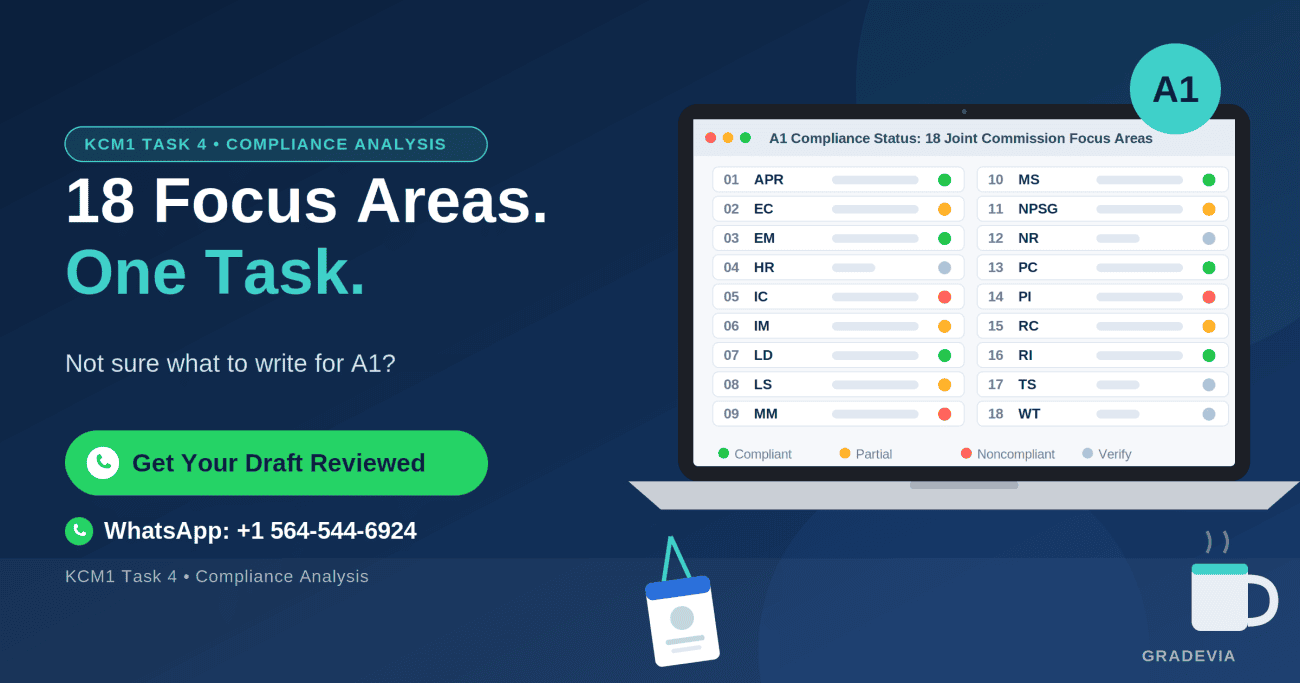
Short answer: A1 requires a status for every one of the 18 focus areas, plus a discussion explaining why each status is supported by the artifacts. A list of 18 labels with no evidence will not meet “sufficient detail.”
The 18 areas correspond to the chapters of the Joint Commission hospital accreditation manual as they are commonly listed in the KCM1 course materials. Confirm the exact list against your General Artifacts, because The Joint Commission has been restructuring its hospital program, and the case materials are the version your evaluator uses.
| # | Focus area | Abbreviation |
|---|---|---|
| 1 | Accreditation Participation Requirements | APR |
| 2 | Environment of Care | EC |
| 3 | Emergency Management | EM |
| 4 | Human Resources | HR |
| 5 | Infection Prevention and Control | IC |
| 6 | Information Management | IM |
| 7 | Leadership | LD |
| 8 | Life Safety | LS |
| 9 | Medication Management | MM |
| 10 | Medical Staff | MS |
| 11 | National Patient Safety Goals | NPSG |
| 12 | Nursing | NR |
| 13 | Provision of Care, Treatment, and Services | PC |
| 14 | Performance Improvement | PI |
| 15 | Record of Care, Treatment, and Services | RC |
| 16 | Rights and Responsibilities of the Individual | RI |
| 17 | Transplant Safety | TS |
| 18 | Waived Testing | WT |
How to Determine Each Compliance Status
Start A1 by building a planning table. Go through every artifact (previous audit, records, emails, trend reports, staffing data) and log each finding under the focus area it belongs to.
| Focus area | Evidence found (artifact + detail) | Status | What to explain |
|---|---|---|---|
| e.g., Environment of Care | [Artifact name, finding] | [Compliant / Partially compliant / Noncompliant / Insufficient evidence] | [Why this evidence supports the status] |
For each area, answer four questions:
- What is the status? Use a consistent scale and define it once at the top of A1.
- What evidence supports it? Name the artifact and the specific finding.
- Does the evidence show compliance or concern? A resolved finding from the previous audit, with documentation, supports compliance. An open corrective action does not.
- Why does the evidence support the status? This sentence is what separates “sufficient” from “insufficient” detail.
Two rules that prevent most A1 revisions:
- Do not call an area compliant just because nothing negative is mentioned. If the artifacts are silent, say so and state what documentation you would verify before the survey.
- Do not write “compliant because it has good policies.” Point to the evidence: a policy dated and reviewed, an audit score, a closed finding.
Identifying vs. discussing. “Medication Management: Noncompliant” identifies a status. “Medication Management is noncompliant because [artifact] shows [finding] across [time period], and the previous audit’s corrective action was not closed” discusses it. The rubric asks for discussion. The planning table is a working tool; if you keep a table in the final paper, follow it with narrative paragraphs or put full explanations in the table cells.
18 Focus Areas Confusing? Get Your Draft Reviewed. WhatsApp +1 564-544-6924
KCM1 Task 4 A2: Identify Two Noncompliant Trends
Short answer: A2 requires at least two recurring patterns in the Task 4 artifacts that could cause the organization to fail Joint Commission patient-care standards, each discussed with supporting evidence.
A1 vs. A2
- A1 asks: What is the current compliance status of each of the 18 focus areas?
- A2 asks: What recurring patterns in the evidence could cause noncompliance with patient-care standards?
A1 is a broad readiness scan. A2 zooms in on the two (or more) problems that repeat.
What counts as a trend
A trend shows up more than once: across several months of data, in more than one artifact, or in both the previous audit and current records. A single dramatic incident is an event, not a trend. If you used tracer thinking in the KCM1 Task 3 tracer methodology guide, apply the same habit here: follow the issue across documents.
Structure for each trend
Trend → Evidence → Pattern → Patient-care/compliance concern → Potential accreditation consequence
| Step | What to write |
|---|---|
| Trend | Name it in one sentence |
| Evidence | Two or more data points or documents from the artifacts |
| Pattern | Direction and timeframe (rising, persistent, recurring after correction) |
| Concern | Which focus area and patient-care standard it threatens |
| Consequence | What a surveyor could find (e.g., a Requirement for Improvement) |
Do not borrow trends from other schools’ samples or from general healthcare news. Your evaluator knows what is in the artifacts.
KCM1 Task 4 A3a: Analyze Staffing Patterns
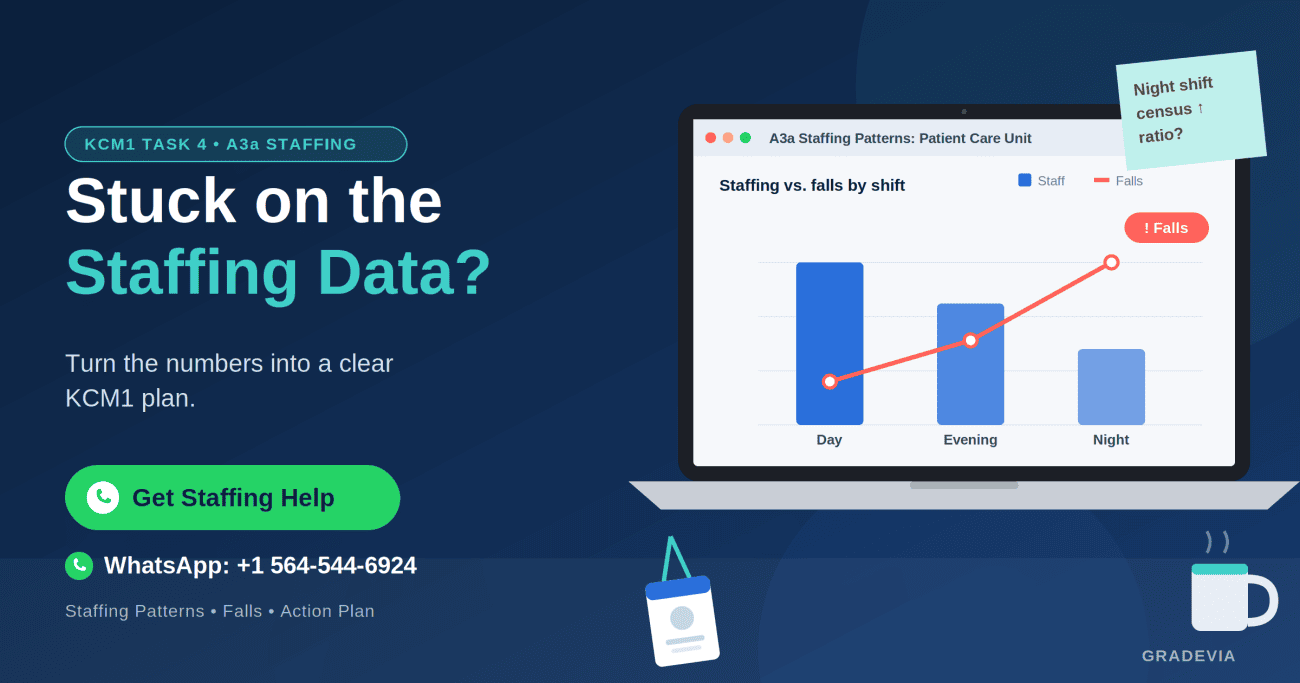
Short answer: A3a requires a data-driven description of the unit’s staffing patterns using the staffing data in the artifacts, with enough numbers to support your conclusion.
Use the chain Data → Pattern → Interpretation → Patient-safety implication. Look for:
- staffing levels by shift (day, evening, night) and day of week
- census compared with staffing on the same shifts
- shortfalls against the facility’s own target staffing, if one is provided
- when falls occur compared with when staffing is lowest
- use of agency, float, or overtime staff, if reported
Calculations to show (only with numbers from the artifacts):
- Patients per RN = census ÷ RNs on shift
- Staffing variance = scheduled or target staff − actual staff
- Falls per 1,000 patient days = (number of falls ÷ patient days) × 1,000
- Share of falls by shift = falls on that shift ÷ total falls
Show the formula once, then the result. Evaluators look for support, not just a conclusion.
Association vs. causation. If lower night staffing lines up with more night falls, write that the data “show an association.” Only claim a cause if the artifacts establish one.
KCM1 Task 4 A3b: Create the Staffing Plan
Short answer: A3b requires an actionable staffing plan, built from your A3a findings, designed to reduce falls on the patient care unit.
A3a answers “What does the staffing data show?” A3b answers “What should the organization do about it?” Every plan element should trace back to a pattern you identified.
| Staffing issue (from A3a) | Proposed change | Who implements it | Why it should reduce falls | How success is measured |
|---|---|---|---|---|
| [Pattern] | [Specific adjustment and target shift] | [Nurse manager, staffing office, CNO] | [Link to supervision, rounding, response time] | [Falls per 1,000 patient days, shift fill rate, audit results] |
A strong plan also states the implementation timeline and the monitoring frequency. Avoid arbitrary ratios. If you recommend a specific ratio, cite a credible source or tie it to the facility’s own target in the artifacts. Evidence-based fall-prevention practices such as purposeful hourly rounding and fall-risk reassessment are covered in the AHRQ hospital falls toolkit (Ganz et al., 2013) and can support staffing roles that make those practices possible.
Need Help With Your Staffing Plan? WhatsApp +1 564-544-6924
KCM1 Task 4 Answers: How to Approach Each Requirement
Students searching for “KCM1 Task 4 answers” usually need a method, not a copy. The approach that works:
- A1: Log every artifact finding under one of the 18 areas, then write a status and a “why” for each.
- A2: Pick the two patterns with the most supporting evidence across documents.
- A3a: Put the staffing data into a table by shift, calculate ratios and fall rates, and describe what lines up.
- A3b: Write one plan row for each staffing pattern you found.
- B: Cite the case artifacts and any external source you paraphrase.
Sources and APA References
Cite the case materials whenever you summarize them, plus any external source. Only use sources you have opened and verified. A reference entry needs author, date, title, and source location.
Starter sources to verify before use:
- Aiken, L. H., Clarke, S. P., Sloane, D. M., Sochalski, J., & Silber, J. H. (2002). Hospital nurse staffing and patient mortality, nurse burnout, and job dissatisfaction. JAMA, 288(16), 1987–1993.
- Ganz, D. A., Huang, C., Saliba, D., Shier, V., Berlowitz, D., Lukas, C. V., Pelletier, L., Neumann, P., & Shekelle, P. (2013). Preventing falls in hospitals: A toolkit for improving quality of care (AHRQ Publication No. 13-0015-EF). Agency for Healthcare Research and Quality.
- The Joint Commission. (2015). Preventing falls and fall-related injuries in health care facilities. Sentinel Event Alert, (55).
For the case study, follow your course’s citation guidance; a common format is: Western Governors University. (n.d.). Accreditation audit case study: Task 4 artifacts [Case study materials].
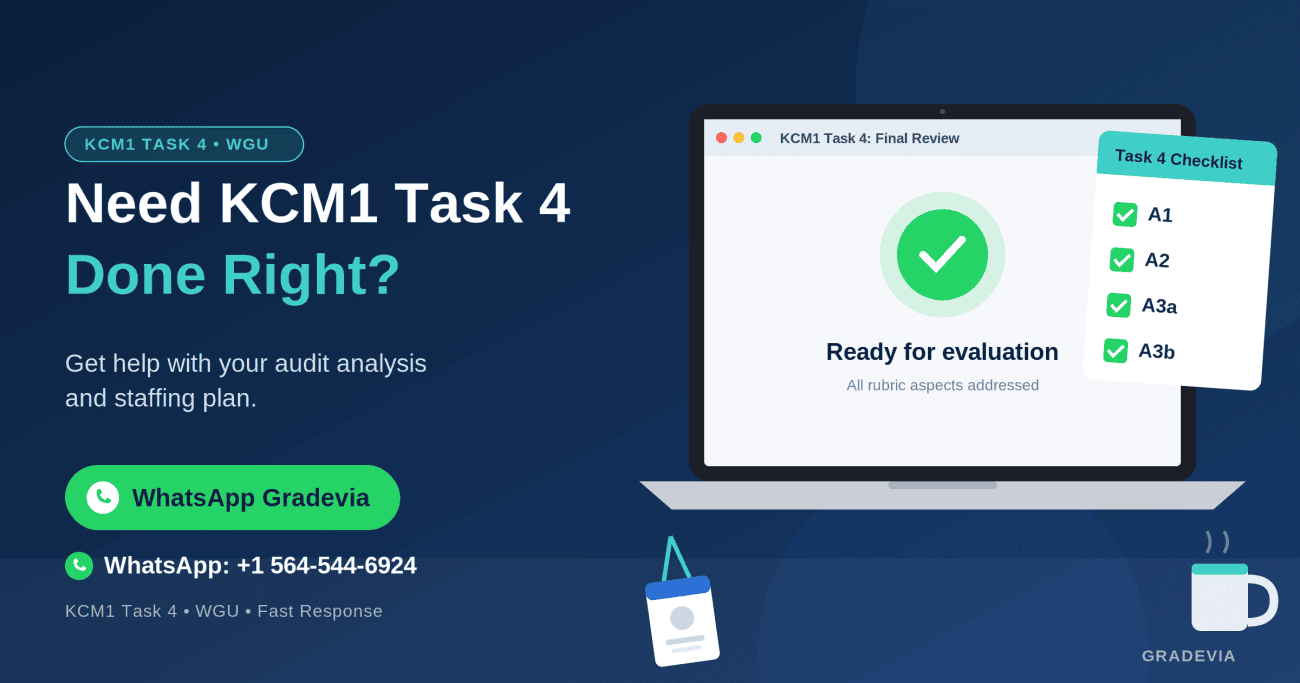
KCM1 Task 4 Final Submission Checklist
Content
- A1 covers all 18 focus areas individually, each with status and evidence
- Status scale defined once and used consistently
- No area marked compliant only because the artifacts are silent
- A2 includes at least two trends, each supported by more than one data point
- A3a includes numbers, formulas, and a pattern statement
- A3a uses association language unless causation is shown
- A3b plan rows trace back to A3a findings
- A3b includes roles, timeline, and outcome measures
Sources and communication
- In-text citation for every summarized artifact and external source
- Reference list with hanging indent, entries match citations
- Grammarly for Education Correctness issues cleared
- Similarity report reviewed before submitting
- File saved as .docx with an allowed file name
Need KCM1 Task 4 Support? Message Gradevia: +1 564-544-6924
KCM1 Task 1 and Task 2 Resources
Task 4 builds on the earlier KCM1 work. The KCM1 Task 1 accreditation audit guide covers the first accreditation audit task, and the KCM1 Task 2 root cause analysis guide covers the sentinel-event RCA. Browse other KCM1 assessment guides for the full sequence.
Frequently Asked Questions
What is KCM1 Task 4?
A WGU performance assessment in which you act as director of accreditation, assess a facility’s readiness for a Joint Commission audit using the Task 4 artifacts, and develop a staffing plan to reduce falls.
What is KCM1 Task 4 AFT2?
AFT2 is the assessment code shown on the task: “Accreditation Audit, AFT2.” It identifies this version of the performance assessment.
How many Joint Commission focus areas are required in KCM1 Task 4?
All 18. The task says “each,” and the rubric requires the compliance status of each area.
What should I include in A1?
An overall readiness statement, a defined status scale, and a status plus evidence-based explanation for every one of the 18 focus areas.
How do I identify the two trends for A2?
Look for problems that repeat across time periods or documents. Choose the two with the strongest evidence, and link each to a patient-care standard.
What does A3a require?
An analysis of the unit’s staffing data that identifies patterns, such as differences by shift and how staffing lines up with census and falls, supported by numbers.
What should a KCM1 Task 4 staffing plan include?
The staffing problem, target shift, specific change, responsible roles, implementation approach, fall-prevention rationale, and how results will be measured.
Where can I find a KCM1 Task 4 sample?
This page includes a sample paragraph and a downloadable illustrative example. Use them for structure only; your content must come from the artifacts.
Are KCM1 Task 4 answers available?
There is no answer key. The approach section above shows how to work each requirement from the artifacts.
What is the difference between KCM1 Task 4 and KCM1 Task 1?
Task 1 is covered in our KCM1 Task 1 guide. Task 4 specifically requires the 18-area readiness review, trend analysis, and a falls-focused staffing plan.
Where can I find KCM1 Task 2 resources?
If you searched for kcm1 kcm1 task 2 material, start with our KCM1 Task 2 root cause analysis guide.
{ "@type": "Article", "author": { "@type": "Person", "name": "Dan Palmer", "url": "https://gradevia.com/dan-palmer/", "sameAs": [ "https://www.linkedin.com/in/dan-palmer-mba" ] } }