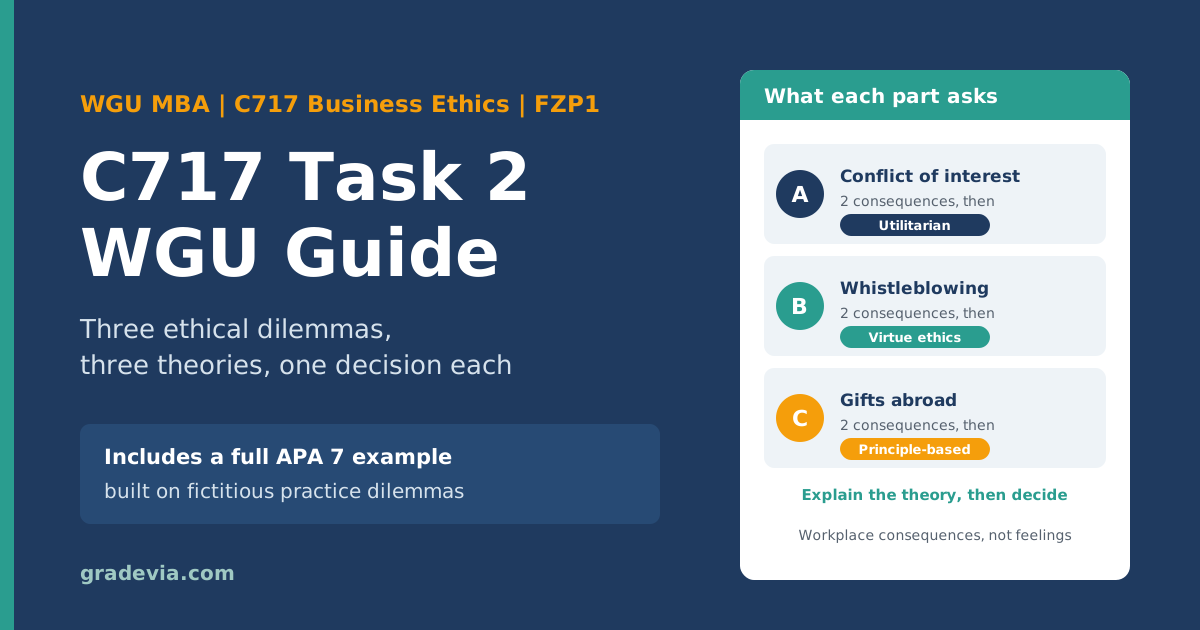
WGU Assignment Guides & Samples

WGU C717 Task 2 Help | Guide, Tips, & Example

Reading Time: < 1 minute WGU C717 Task 2: How to Actually Pass Business Ethics (Not Just Copy Someone's Paper)

WGU C717 Task 2: How to Actually Pass Business Ethics — Not Just Copy Someone's Paper

Reading time: ~20 min

Course: C717 Business Ethics
Variants: FZP1 & EKP1
Reading time: ~20 min
Updated: 2026

Here's something worth knowing before you start writing: the students who get C717 Task 2 sent back for revision aren't failing because they wrote badly. They're failing because they misunderstood what the assignment is actually asking for — and nobody told them until it was too late.

This guide is for people who want to understand the assignment, not just copy an answer. If you read to the end and actually apply what's here, you'll be in a better position than most students who submit this task. Not because you've seen what a passing paper looks like — but because you'll know why it passes.

Let's start with the single most important thing to understand about Task 2.

Before anything else: Task 2 is not Task 1

A lot of students come into Task 2 with the same energy they brought to Task 1 — looking for the "right" case study, the "correct" dilemma, the scenario that WGU wants. That's the wrong frame entirely.

Task 1 handed you the scenario. TechFite was given to you. You analyzed it according to course frameworks. Task 2 is the opposite — you bring the scenario. WGU wants to see if you can identify a genuine ethical situation in the real world, frame it properly, and apply what the course taught you.

That means there is no "right" dilemma hiding somewhere online. The right dilemma is one you frame and analyze well. The students downloading PDFs from Studocu and Scribd are, in a very real sense, solving the wrong problem — because the evaluator isn't grading the scenario, they're grading your analysis of it.

📋 Task variant note

If your task code says FZP1 or EKP1, the rubric structure is nearly identical for both. This guide covers the shared substance. Where a section heading or prompt wording differs slightly, your portal task document takes precedence — always cross-reference it as you read.

The six sections at a glance

Section What you're writing Target length
A1 Employee rights and their matching responsibilities 200–300 words
A2 Employer ethical responsibilities — beyond what the law requires 150–250 words
A3 hardest Your own ethical dilemma, described concretely 250–400 words
A4 Two or more ethical theories applied to your dilemma 300–450 words
A5 Ethical decisions from both employer and employee perspectives 200–300 words
A6 Why those decisions are ethically justified — using your theories 150–250 words
Section A1

Employee rights and responsibilities — the pairing almost everyone gets wrong

Section A1 looks like the easy part. You list a few employee rights, write a sentence or two about each, move on. And that's exactly the problem — because listing rights is not what the rubric is asking for.

The evaluator is checking whether you understand that rights and responsibilities are two sides of the same relationship. For every right an employee holds, there's a corresponding duty they carry. The rubric wants to see those pairs — not just one side of the equation.

Think about it this way: if an employee has the right to a safe workplace, that right only functions if employees also take responsibility for maintaining that safety. One without the other isn't a real understanding of workplace ethics — it's a wish list.

The three rights that work best — and why

You need at least three. These are the strongest choices because each is grounded in specific federal law, which gives you a clean, citable source:

⚖ The Right

Safe workplace. Every employee is entitled to work in an environment free of recognized hazards to their health and safety.

Occupational Safety and Health Act (OSHA), 1970
✦ The Responsibility

Employees are responsible for following workplace safety protocols, reporting hazards they observe, and not behaving in ways that create risk for colleagues.

⚖ The Right

Fair compensation. Employees have a right to be paid at least minimum wage, receive overtime when applicable, and have accurate time records kept.

Fair Labor Standards Act (FLSA), 1938
✦ The Responsibility

Employees are responsible for working their full scheduled hours, performing the role they were hired for, and not falsifying time records or taking unauthorized compensation.

⚖ The Right

Freedom from discrimination. No employee may be treated differently based on race, gender, religion, national origin, age, disability, or sexual orientation.

Title VII (1964), ADA (1990), ADEA (1967)
✦ The Responsibility

Employees are responsible for treating colleagues respectfully, refraining from discriminatory language or conduct, and reporting harassment they witness rather than staying silent.

A strong fourth right worth considering: whistleblower protection — the right to report illegal activity or policy violations without fear of retaliation. The corresponding responsibility is to raise concerns through appropriate channels rather than ignoring them or going to outside parties without first attempting internal resolution.

⚠ The mistake that triggers revision

Don't write three paragraphs about rights and then add one paragraph at the end vaguely mentioning "employees also have responsibilities." That structure signals that you're treating them as separate topics. Write them as pairs — right, its legal backing, and the matching employee duty — so the connection is unmissable.

Section A2

Employer ethical responsibilities — the "beyond the law" distinction nobody teaches you

There's a concept at the heart of Section A2 that, once you grasp it, makes the whole section click: ethical responsibility is not the same thing as legal obligation.

An employer can follow every regulation on the books — pay minimum wage, not discriminate in hiring, maintain OSHA compliance — and still treat people terribly. Creating a culture where employees are afraid to speak up. Tolerating a manager who subtly undermines women without ever crossing a legal line. Conducting performance reviews in ways that are technically fair but systematically favor certain people. None of that is illegal. All of it is ethically wrong.

Section A2 is asking you to demonstrate that you understand this gap. When you write about employer ethical responsibilities, you're writing about what organizations should do — the moral obligations that exist independent of what law requires. That's a different question, and evaluators can tell when a student is just listing legal requirements and calling them ethics.

"Following the law is the floor of ethical behavior, not the ceiling."

Three areas that demonstrate this distinction clearly

  • Psychological safety, not just physical safety. OSHA covers physical hazards. But an employer's ethical responsibility extends to ensuring employees feel safe raising concerns, disagreeing with decisions, and reporting wrongdoing — without fear of subtle retaliation or career damage. That's not legally mandated. It's ethically required.
  • Building a genuine ethical culture. A company can hand every new hire a code of conduct PDF and technically satisfy a compliance requirement. The ethical responsibility is for leadership to actually model that code — for accountability to apply equally up and down the hierarchy. Most ethics failures happen in organizations that have policies but not cultures.
  • Equity beyond formal fairness. Paying everyone the same wage for the same role is legally required if the difference maps to a protected class. But the ethical responsibility is broader: ensuring promotion opportunities, mentorship access, and everyday recognition are genuinely equitable — even when disparities are hard to prove and easy to deny.
✦ Optional but impressive

If you want to anchor this section theoretically, a brief reference to stakeholder theory (R. Edward Freeman, 1984) works well here. The idea: businesses have ethical obligations to all parties affected by their actions — employees, customers, communities — not just shareholders. It explains why employers have ethical responsibilities beyond legal compliance, which is exactly what this section is probing.

30% OFF NEW CLIENTS
✍️
Already feeling stuck?
We'll write C717 Task 2 for you — guaranteed pass.
12-hour turnaround · Pass or full refund · 30% off your first order
WhatsApp Us
Section A3

Your ethical dilemma — the section that makes or breaks the whole paper

If you underdeliver anywhere in this task, it will be here. Section A3 is the foundation that everything else is built on. A weak dilemma means a weak theory analysis (A4), weak perspectives (A5), and a weak justification (A6) — because you're building on shaky ground.

So before you write a single word of A3, you need to understand one thing with precision: what an ethical dilemma actually is.

A dilemma requires genuine competing obligations — not just a hard choice

An ethical dilemma exists when two or more legitimate moral obligations conflict with each other. Not a situation where one option is obviously right and the other is just tempting for selfish reasons. Genuine ethical tension — where a reasonable, well-intentioned person could make a defensible case for either choice.

Obligation A

You have a duty of loyalty to your employer — including protecting sensitive information and following leadership's direction.

vs
ethical tension
Obligation B

You also have a duty to act honestly and to protect colleagues from harm — even when doing so conflicts with organizational interests.

That tension — between loyalty and integrity, between protecting individuals and protecting organizations, between following orders and doing what's right — is what makes something a genuine dilemma. If one side of that tension doesn't have real moral weight, it's not a dilemma.

The four scenario types that hold up best under analysis

  • Conflict of interest. A personal relationship or financial stake creates bias in a professional decision — procurement, hiring, promotions. The dilemma: the relationship doesn't necessarily make the decision wrong, but it makes it untrustworthy. Do you disclose and lose the relationship? Stay silent and compromise your integrity?
  • Whistleblowing. You discover wrongdoing — fraud, safety violations, policy breaches. Reporting protects others. It also has real consequences for you, the person involved, and potentially the organization. Both the obligation to report and the obligation to consider consequences are legitimate.
  • Confidentiality vs. transparency. You have information that would affect a colleague's wellbeing or a client's decision — but sharing it violates a confidentiality obligation. Both the duty to disclose and the duty to keep confidence have genuine moral standing.
  • Fairness and systemic discrimination. You observe treatment that feels unfair along gender, race, or age lines — but the evidence is ambiguous and the person involved has power. Speaking up risks your standing. Staying silent makes you complicit.

Use something real — even if you disguise it

WGU evaluators read hundreds of these papers. They know what recycled conflict-of-interest scenarios look like. A scenario pulled from your own work life reads completely differently — it's specific, it has stakes, the detail feels earned rather than generic.

You don't need to expose anyone. Change the industry, the job titles, the company size. Change names, dates, identifying specifics. Keep the ethical structure — the actual competing obligations and what made the situation hard. That structure is what the evaluator is assessing, not the surface details.

Example: what a well-framed dilemma looks like

A mid-level project manager at a logistics firm discovers that a senior colleague has been billing hours to a government contract for work performed on a private one. The amounts are small — under $3,000 total — and the colleague is widely respected, close to retirement, and going through a family health crisis. The manager has a clear legal obligation to report it. She also has a genuine obligation of loyalty to a mentor who vouched for her. She works in a small industry where reputation matters enormously, and the person she'd be reporting to is the colleague's closest friend.

Why this works: Both sides have real moral weight. Neither choice is obviously correct. It's specific. It connects naturally to multiple ethical theories. Both employer and employee perspectives are meaningful here.

How to structure what you write

When you sit down to write A3, answer these five questions in order. Don't skip any:

  • Who is involved? Describe roles and relationships — no real names needed.
  • What is the organizational context? Industry type, company size, your role, the stakes.
  • What happened? The specific situation — concrete details, not vague generalizations.
  • What are the competing obligations? Name them explicitly. Don't make the reader infer them.
  • Why is this genuinely hard? What is it about this situation that makes the right answer non-obvious?
🚫 What disqualifies a dilemma

Illegal actions framed as dilemmas. "Should I commit expense fraud to help my struggling team?" is not an ethical dilemma — it's a question about whether to break the law. The answer is no, and there's no genuine competing moral obligation that says otherwise. Your scenario must involve genuinely ambiguous ethical territory, not criminal behavior dressed up as moral complexity.

NEW CLIENT OFFER
🎯
Can't figure out your dilemma?
30% off for first-time clients — mention this page.
We'll craft an original ethical dilemma from your background + handle all six sections. WhatsApp us your instructions at +1 564-544-6924.
Get 30% Off
Section A4

Applying ethical theories — what "applying" actually means

Here's the error that kills more A4 sections than anything else: treating "apply" as "define."

Writing "Utilitarianism is an ethical theory that holds the greatest good for the greatest number should guide decisions" is a definition. It earns you nothing in A4. What earns you marks is connecting that theory to the specific people, choices, and consequences in your dilemma — using it as a lens to actually analyze what happened.

Evaluators want to see ethical theory as a working tool, not a vocabulary word. Show them the tool in use.

The three theories you need to know — and how to use them

Utilitarianism
Associated with Mill, Bentham — "the greatest good for the greatest number"
Core question
Which available action produces the best overall outcome — the most wellbeing, the least harm — across all the people affected?
How to apply it
Name every stakeholder in your dilemma. For each possible choice, estimate who benefits and who is harmed. The utilitarian answer is whichever option produces the better net outcome across the whole group.
What it looks like written
"From a utilitarian perspective, reporting the misconduct protects the organization's reputation, client trust, and the majority of employees — even though it causes significant harm to one individual. The aggregate benefit outweighs the individual cost."
Kantian Ethics (Deontology)
Associated with Kant — "act only according to principles you'd will to be universal law"
Core question
Is this action consistent with a universal moral duty? Could you will that everyone in this situation act the same way? Does it treat people as ends in themselves, not merely as means?
How to apply it
Ask: if every employee in your specific situation made the same choice, would the outcome be just and coherent? Kant cares about the principle behind the action, not just the consequences. A lie is wrong even if it produces good outcomes.
What it looks like written
"Kant would argue that staying silent — even with good intentions — treats the affected parties as means to an end. If we universalized the principle of tolerating misconduct for the sake of personal loyalty, institutional trust would collapse."
Virtue Ethics
Associated with Aristotle — "what would a person of good character do?"
Core question
What action reflects the character of a genuinely good person? Which virtues — honesty, courage, loyalty, fairness, integrity — are in tension here, and which should take precedence?
How to apply it
Focus on the character of the actor, not just the consequences. What would a person of genuine integrity choose — even if it cost them something personally? Virtue ethics asks you to reason about who you want to be, not just what you want to achieve.
What it looks like written
"Through the lens of virtue ethics, the courage required to raise the concern — despite the personal risk — reflects the kind of integrity a person of good character cultivates. Loyalty is a virtue, but not when it requires moral cowardice."
✦ When theories disagree — lean into it

If utilitarianism and Kantian ethics reach different conclusions about your dilemma, don't try to paper over the disagreement. Acknowledge it. Real ethical dilemmas are hard precisely because different frameworks recommend different things. Engaging with that tension shows the evaluator you understand how ethical reasoning actually works — and that you're not just reciting course material.

Sections A5 & A6

Perspectives and justification — the section people write half of

The most common revision trigger in Section A5 is also the simplest one to avoid: students address only one perspective. They write three solid paragraphs about what the employee should do and then either forget the employer entirely, or give it one dismissive sentence.

The rubric explicitly requires both. An employer-only or employee-only analysis — regardless of how well-written — is an incomplete answer.

What each perspective should actually cover

The employee perspective asks: given the dilemma and your ethical analysis in A4, what is the ethically sound choice for the individual? This should reflect genuine personal reasoning — what you would do, what values are driving that decision, and what consequences you're prepared to accept. It shouldn't be abstract. Make it specific to your dilemma's characters and stakes.

The employer perspective asks: what is the organization's ethical obligation in this scenario? What should policy, leadership, or institutional culture dictate — independent of what any one individual decides? This perspective is broader. It's about what the organization owes its people and stakeholders, not just about whether one person made the right call.

💡 They don't have to agree

A scenario where the employee feels morally compelled to report misconduct, but the employer's formal policy creates bureaucratic barriers that make doing so risky — that's genuine ethical tension worth writing about. Don't force artificial agreement between the two perspectives. If they're in conflict, say so. That's more realistic and more interesting to read.

Section A6 — close the loop, don't restate it

A6 is where students either shine or coast. The difference between coasting and shining is simple: A6 should explain why the decisions in A5 are ethically justified, using the frameworks from A4. Not restate what those decisions were — justify them.

Think of it as the argument you'd make if someone challenged your choices in A5. "You decided the employee should report. Why does that hold up ethically?" Your answer should draw directly on the theories you applied earlier. A6 is the close of a loop that opened in A3 — the dilemma, the framework, the decision, the justification.

A completed C717 Task 2 example — annotated

Reading a finished paper tells you what to write. Reading an annotated paper tells you why it passes. Below is a full example task, broken into its six sections, with inline notes explaining what the evaluator is seeing in each paragraph. Use this as a mirror to check your own draft — not as something to copy.

A1 — Rights
A2 — Employer ethics
A3 — Dilemma
A4 — Theories
A5 — Perspectives
A6 — Justification
Section A1 — Employees' Rights and Responsibilities

Right 1 — Safe workplace. Under the Occupational Safety and Health Act of 1970, every employee has the legal right to work in an environment free of recognized hazards that could cause death or serious physical harm (U.S. Department of Labor, n.d.). This protection covers both physical conditions — equipment, chemicals, ergonomics — and, by extension, conditions that pose ongoing risks to employee health. ✓ Law cited immediately

The corresponding employee responsibility is to comply with all workplace safety procedures, report known hazards to management or to OSHA rather than ignoring them, and refrain from conduct that endangers colleagues. A right to a safe environment only functions when employees actively participate in maintaining it. Paired responsibility — this is what most students skip

Right 2 — Fair and accurate compensation. The Fair Labor Standards Act (FLSA) guarantees employees the right to a federal minimum wage, overtime pay for hours worked beyond 40 in a workweek, and accurate record-keeping of time worked (U.S. Department of Labor, n.d.). ✓ Specific statute named and cited

In return, employees carry the responsibility to work their contracted hours honestly, refrain from falsifying time records, and perform the duties their role requires. Claiming pay for hours not worked — regardless of justification — violates both the employer's trust and the ethical standards employees are expected to uphold. Strong responsibility — shows two-way obligation clearly

Right 3 — Freedom from discrimination. Title VII of the Civil Rights Act, the Americans with Disabilities Act, and the Age Discrimination in Employment Act collectively prohibit employers from treating employees differently based on race, gender, religion, national origin, disability, or age (U.S. Equal Employment Opportunity Commission, n.d.). ✓ Multiple statutes, single citation

Employees share in the responsibility of maintaining a discrimination-free environment. This means treating all colleagues with respect regardless of background, refusing to participate in or encourage discriminatory language or behavior, and reporting incidents rather than staying silent when others are treated unfairly. Evaluator note: third pair, clear structure — passes rubric check

Section A2 — Employer's Ethical Responsibilities

While legal compliance sets a floor for employer conduct, ethical responsibility extends well beyond what statutes require. An organization can satisfy every applicable regulation and still fail its employees in meaningful ways — through cultures of silence, systems that technically pay fairly but offer advancement to only some, or environments that meet the letter of harassment policy while tolerating its spirit. ✓ Opens with the legal vs. ethical distinction — exactly what evaluators want to see

Responsibility 1 — Cultivating genuine psychological safety. Employers have an ethical obligation to ensure that employees feel safe raising concerns, disagreeing with decisions, and reporting misconduct without fear of subtle consequences — career stagnation, exclusion, or social penalty. A formal whistleblower policy satisfies the law. A culture where people actually use it requires active, visible commitment from leadership. Goes beyond law — this is what differentiates an ethical culture from a compliant one

Responsibility 2 — Modeling ethical conduct at every level. It is not sufficient for organizations to distribute codes of ethics and then hold only entry-level employees accountable. Ethical responsibility requires that consequences for policy violations apply equally regardless of seniority. When senior leaders are shielded from accountability, ethical culture collapses — not because the code was wrong, but because the organization demonstrated it didn't mean it. ✓ Specific, non-generic — explains the mechanism, not just the goal

Responsibility 3 — Ensuring equitable opportunity, not just equal treatment. Paying two employees the same wage satisfies a legal threshold. Ethical responsibility requires that advancement, mentorship, high-visibility assignments, and professional development are genuinely accessible across different demographic groups — not just formally available in a policy document. As Freeman (1984) notes in stakeholder theory, employees are stakeholders whose long-term wellbeing must be factored into organizational decisions. Stakeholder theory cited — optional but earns marks for theoretical grounding

Section A3 — Ethical Business Dilemma

I work as a senior coordinator at a mid-size healthcare staffing firm. Over three years, I have built a close working relationship with my direct manager — someone I consider both a mentor and a professional ally. During a routine audit of vendor contracts, I discovered documentation suggesting that our team has been consistently billing a government healthcare contract for staffing hours that were actually logged against a private account. The discrepancy totals approximately $18,000 over fourteen months. ✓ Specific context, specific amount — concrete detail signals authenticity

I have not been able to determine whether the billing errors are intentional fraud or accounting mistakes. What I know is that the documentation passes through my manager's approval chain, and that correcting or reporting it would initiate a formal audit that would almost certainly implicate her — regardless of intent. Stakes are named clearly — the dilemma is already visible

This situation creates a genuine ethical dilemma because I hold two competing obligations that I cannot simultaneously honor. First: I have a professional and arguably legal duty to report billing irregularities involving government contracts — silence on this, once discovered, makes me complicit. Second: I have a loyalty obligation to a mentor who has advocated for my career, and who may have made these errors without any fraudulent intent. Reporting implicates her. Not reporting implicates me. Neither path is clean. Evaluator note: competing obligations named explicitly — this is the rubric criterion. Most papers describe the situation but never name the two obligations directly. This does.

Section A4 — Evaluation of the Ethical Dilemma

Utilitarianism. Mill's utilitarian framework holds that the morally correct action is the one that produces the greatest good for the greatest number of affected parties (Mill, 1863). Applied to this dilemma, the relevant stakeholders include: me, my manager, other staff on the team, the patients and communities served by the government healthcare contract, and the organization as a whole. ✓ Stakeholders named — theory is being applied, not just defined

If I remain silent: my manager is protected in the short term, and I avoid immediate professional conflict. If the irregularity is later discovered through other means, however, both of us face significantly worse consequences — potential termination, legal liability, and damage to the organization's government contract standing. The harm to the many (patients whose care funding depends on contract integrity, colleagues who could lose their positions if the firm loses the contract) outweighs the short-term benefit to one. A utilitarian analysis recommends disclosure. Consequence-mapping — what "applying" actually looks like

Kantian (deontological) ethics. Kant's categorical imperative asks: could I will that all people in my situation act the same way? (Kant, 1785/1998). If every employee who discovered billing irregularities chose silence to protect a personal relationship, institutional oversight would become meaningless — no organization could rely on internal controls, and government contracts specifically would face systematic risk. The principle of silence fails the universalizability test. ✓ Categorical imperative applied to the actual scenario — not just defined

Kant would also note that staying silent in this case uses the contract's beneficiaries — the patients and communities the healthcare program serves — as means to protect a personal relationship. That violates the second formulation of the categorical imperative: treat people as ends, never merely as means. Both formulations of the categorical imperative applied — this is advanced, earns strong marks

Both frameworks reach the same conclusion: disclosure is the ethically defensible choice. That convergence strengthens the analysis — when independent ethical frameworks agree, the recommended action has broader moral grounding. Addresses theory convergence — shows evaluator you understand how ethical reasoning works

Section A5 — Ethical Decisions: Employer and Employee Perspectives

From the employee perspective, the ethically sound decision is to report the billing discrepancy through the appropriate internal channel — in this case, the compliance department or, if that channel feels compromised, directly to the organization's ethics hotline. I would document what I found, when I found it, and the steps I took before escalating. ✓ First-person, specific action — not vague moral sentiment

This decision requires accepting real consequences: potential damage to my relationship with my manager, possible professional awkwardness, and the uncertainty of an audit whose outcome I cannot control. But loyalty — as virtue ethics would frame it — cannot require moral complicity. A genuinely good colleague does not protect someone at the cost of institutional integrity. Virtue ethics referenced without being forced — reinforces A4 without repeating it

From the employer perspective, the organization has an ethical obligation to ensure that billing compliance reporting channels are genuinely accessible and psychologically safe for employees in exactly this position — where the discrepancy involves someone in their direct management chain. A policy that technically allows reporting but offers no protection from managerial retaliation is not a functional ethics system. Evaluator note: employer perspective is meaningfully different from employee perspective — most students just echo the same conclusion from two angles. This is genuinely distinct.

The employer's ethical decision is to investigate the irregularity thoroughly and transparently — and to hold individuals accountable regardless of seniority, if wrongdoing is found. Settling the matter quietly to protect organizational reputation would be a further ethical failure. It would confirm to every employee watching that integrity claims stop at the executive suite.

Section A6 — Justification of Ethical Decisions

The employee decision to report is justified by both frameworks applied in Section A4. Under utilitarianism, reporting produces the best aggregate outcome across all stakeholders when long-term consequences are considered. Under Kantian ethics, silence fails the universalizability test and treats contract beneficiaries as means to a personal end — both violations of the categorical imperative. ✓ Directly references A4 frameworks — closes the loop

The employer decision to investigate and hold all parties accountable is justified by the same frameworks, applied at the institutional level: an organization that selectively enforces its ethics policies produces more harm than good over time (utilitarian), and cannot universalize a principle of selective accountability without undermining the entire basis of institutional trust (Kantian). Applies theories at the org level — shows breadth without padding

Both decisions reflect what virtue ethics would call the character of a trustworthy institution and a trustworthy employee: people and organizations that do the right thing not because it's easy, but because consistency between stated values and actual conduct is the foundation of professional integrity (Aristotle, 350 BCE/2009). The difficulty of the choice does not diminish its necessity. Evaluator note: clean close. Virtue ethics brings in a third framework as a closing frame — adds depth without over-extending.

⚠ How to use this example

Read the annotations — they're the point. The example exists to show you what each rubric criterion looks like fulfilled, not to give you sentences to reuse. Every element that earns marks here (paired rights, competing obligations named explicitly, theories applied to named characters, genuinely distinct perspectives) needs to come from your scenario and your analysis. WGU uses plagiarism detection and evaluators flag structural copying even when surface wording differs.

PASS GUARANTEED
🛡️
Want yours to look like this?
Guaranteed pass or we refund every cent.
We've written hundreds of passing C717 Task 2 submissions. If yours doesn't pass, you pay nothing. WhatsApp us at +1 564-544-6924.
Get Guaranteed Help

What real WGU students say about C717 Task 2

The r/WGU subreddit is where students are honest in a way that official resources aren't. This is the raw, unfiltered version of how people experience this task — the panic before, the relief after, and the specific things that tripped them up. These posts reflect the genuine student experience around C717 Task 2.

r/WGU · Community Discussion
Business Ethics C717
Business Ethics C717 Task 2 — just passed, here's what actually helped

Finally got the green light on Task 2. Was stressed about this one because I kept overthinking the ethical dilemma. Here's what I wish I'd known going in:

The dilemma doesn't have to be dramatic. I used something that happened at my old retail job — a manager asking me to cover up a scheduling error that would've cost us overtime compliance. Not sexy, but it was genuinely two competing obligations (loyalty to manager vs. legal/ethical reporting duty) and that's all you need.

The thing that almost got me: I defined my ethical theories really well in A4 but didn't connect them back to my specific scenario. Caught it during a final read and rewrote the whole section. Would've been a revision for sure.

u/accelerated_at_wgu · 11 hours ago · 22 upvotes

Same experience. The "apply vs. define" thing tripped me up on my first attempt. My evaluator's note literally said "theories explained but not applied to the specific scenario." Once I rewrote A4 to mention the actual people and choices in my situation, it passed same day I resubmitted.

u/wgu_business_bs · 9 hours ago · 18 upvotes

The A5 both-perspectives thing is what got me the first time. I wrote a really solid employee perspective and gave the employer like two sentences. Evaluator flagged it immediately. Make sure both are fully developed — not the same length necessarily but both substantive.

Got Task 2 sent back — evaluator notes inside, what went wrong?

Posted here a week ago saying I felt good about Task 2. Just got it back. Evaluator feedback (paraphrasing):

• A1: "Rights are listed with legal references but corresponding employee responsibilities are not addressed" — I literally had a whole paragraph on responsibilities but it was at the end, not connected to each right. Lesson: structure matters as much as content.

• A4: "Ethical theories are defined but the analysis does not connect them to the dilemma described in A3." — I used a different example scenario in A4 than the one I set up in A3. I thought I was being thorough. Rookie mistake.

Resubmitting today. Anyone else have this happen?

u/wgu_ethics_warrior · 2 days ago · 29 upvotes

The "different scenario in A4" thing — I almost did the same. When I was writing the theory analysis I started using generic examples instead of referring back to my A3 dilemma. Caught it before submitting. It's so easy to slip into abstract mode when you're writing about philosophy.

u/threekids_fulltime_wgu · 1 day ago · 14 upvotes

The rights-responsibilities structure thing is so real. I kept them separate in my draft too and my study group friend told me before I submitted. Keep them PAIRED. Every right should be immediately followed by its corresponding duty. Don't save responsibilities for a separate section.

C717 Task 2 — is the conflict of interest dilemma overdone? Will evaluators care?

Starting Task 2 this week. Every example I've found online uses a conflict of interest (procurement manager, friend's company, etc.). Is this going to raise flags because it's the same thing everyone writes? Should I pick something more original?

u/wgu_mentor_student · 3 weeks ago · 41 upvotes

Evaluators don't care what type of dilemma you pick — conflict of interest, whistleblowing, discrimination, whatever. What they care about is whether you've framed it properly (two competing legitimate obligations) and whether your analysis connects to the specific scenario you wrote. A well-analyzed conflict-of-interest scenario from your real experience will pass 100x faster than an "original" dilemma that's vague and hard to theorize about. Pick what you can analyze well.

u/ethics_done_passing · 3 weeks ago · 19 upvotes

This. Also: use something that actually happened to you. My dilemma was from a job I had 8 years ago. The specific details made the whole paper sharper. You can tell when something is real vs. constructed. It reads differently, and evaluators read a lot of these.

Three things jump out consistently from student reports. First: the theory application problem in A4 is the most common single revision reason — students write good theory descriptions and forget to tie them back to their own scenario. Second: the rights-responsibility pairing in A1 is the easiest mistake to make structurally (keeping them separate) and the easiest to fix (keep them paired). Third: perspective balance in A5 — students invest in the employee side and underwrite the employer side. These aren't hard problems once you know they exist.

The 5 reasons C717 Task 2 gets sent back for revision

These aren't speculative. They're the patterns that surface consistently when students share revision feedback across WGU communities. Read this before you submit — not after.

1
Rights without the matching responsibilities
Section A1 lists three employee rights cleanly, maybe even cites the relevant laws — and then treats responsibilities as a brief afterthought or skips them entirely. The rubric is explicitly testing the relationship between rights and duties. Listing only one side is a structural miss, not a content miss.
Fix: For every right you state, write 1–2 sentences on the corresponding employee duty. Format them as pairs so the connection is visually and structurally clear.
2
A "dilemma" with only one defensible answer
The scenario describes something clearly illegal, or has one obviously right choice that only selfishness or laziness would lead someone to avoid. The evaluator reads it and thinks: this isn't a dilemma, it's a discipline question. Everything built on it — the theory analysis, the perspectives — wobbles as a result.
Fix: Use the qualifying test — can you make a reasonable moral argument for both choices? If only one side has genuine ethical weight, rethink the scenario before you write anything else.
3
Ethical theories defined but never applied
Section A4 reads like a philosophy textbook entry — accurate definitions of utilitarianism and Kantian ethics — but the actual scenario from A3 never appears. The evaluator sees this immediately. It suggests the student understood the theories in the abstract but couldn't use them as analytical tools.
Fix: Every paragraph in A4 must name at least one element from your specific dilemma — a character, a choice, a consequence. The theory analysis should be impossible to lift and drop into a different paper.
4
Only one of the two required A5 perspectives
Often not intentional — the student gets absorbed in the employee perspective, writes several solid paragraphs, and gives the employer perspective a sentence or two as an afterthought. The rubric sees this as an incomplete answer, regardless of how good the employee analysis is.
Fix: Give both perspectives proportional depth. Before submitting, do a word count on each perspective. If one is significantly shorter, that's the section to expand.
5
Missing or informal citations
Referencing OSHA, the Fair Labor Standards Act, or Kant by name without a corresponding APA citation. WGU's evaluators expect scholarly citation standards. It's not that these references are obscure — it's that a citation signals you're engaging with sources, not just asserting knowledge.
Fix: Every named law or ethical theorist gets a citation the first time it appears. Three to five APA references is a solid baseline. The WGU Writing Center's APA guide is free and worth five minutes of your time.
⚡ 12-HR TURNAROUND
🚀
Deadline pressing?
Send us your instructions now — delivered in 12 hours.
No revision risk. No wasted submissions. Message +1 564-544-6924 on WhatsApp — first-time clients get 30% off automatically.
Message Us Now

Before you submit: the honest checklist

Work through this before you hit submit. Not as a formality — actually check each item. The students who get sent back for revision almost always say the same thing afterward: "I can see now what was missing." This is how you catch it yourself first.

Pre-submission checklist
0 of 8 complete
Section A1 presents each right paired with a corresponding employee responsibility — not as two separate lists
Section A2 addresses what employers ethically should do — not just what the law requires them to do
Your A3 dilemma has genuine competing moral obligations — a reasonable person could defend either choice
Your A3 dilemma is not simply a question of whether to break the law
Each ethical theory in A4 is applied to your specific scenario — names characters, discusses actual choices and consequences
Section A5 covers both employer and employee perspectives with comparable depth
Section A6 justifies the A5 decisions using ethical frameworks — not just restates them
All laws and ethical theories are cited in APA format the first time they appear

Frequently asked questions

How long should C717 Task 2 actually be? +

WGU doesn't enforce a hard word count, but passing submissions typically run 1,200–2,000 words across all six sections. Sections A3 and A4 need the most development — 250–400 words each is realistic if you're actually doing the analysis justice rather than skimming it.

The honest answer: write until every rubric prompt is genuinely answered, then stop. If your submission is under 900 words total, at least one section is underdeveloped. If it's over 2,500, you may be padding — and evaluators notice.

Can I reuse the TechFite scenario from Task 1 in Task 2? +

No — and this matters more than it might seem. Task 1 is built around a case study that WGU provided. Task 2 is explicitly asking you to demonstrate that you can identify and frame an ethical situation independently. Using TechFite in Task 2 signals that you haven't engaged with the core skill the task is testing.

Practically speaking: if you submit TechFite material in Task 2, expect a revision request. Your original scenario isn't a burden — it's the evidence WGU is looking for.

What ethical theories does C717 Task 2 require me to use? +

The course covers utilitarianism, Kantian (deontological) ethics, virtue ethics, and relativism. Most task versions ask you to apply at least two. Utilitarianism and Kantian ethics are the most common pair — they're well-defined and produce concrete analysis. Virtue ethics is strong for dilemmas involving character, integrity, or professional identity.

Relativism may appear in some task variants. Check your specific rubric.

The most important word in all of this is apply. Defining theories is not applying them. Every theory paragraph needs your dilemma's characters, choices, and stakes inside it.

What's the difference between FZP1 and EKP1 versions of this task? +

FZP1 and EKP1 are different cohort variants assigned to different students. The underlying rubric — what you're being evaluated on — is structurally the same: employee rights, employer ethics, original dilemma, theory analysis, perspectives, justification. Prompt wording and section labels may differ slightly.

If you're unsure which version you have, look at the header of your task document in the WGU student portal. Everything in this guide applies to both — when in doubt, your portal document takes precedence over any external guide.

How many citations does Task 2 need, and what format? +

APA format throughout. At minimum: cite each law you reference in A1 (OSHA, FLSA, ADA), and at least one credible academic or government source per ethical theory you apply in A4. Three to five solid citations is a reasonable baseline.

Some task variants specify citation minimums — your rubric document will tell you. If it doesn't, three to five is safe. WGU's Writing Center has an APA resource guide that's genuinely useful if formatting trips you up.

Can I use a scenario from my personal life rather than a professional one? +

The task specifies an ethical business dilemma, which implies a professional or organizational context. A purely personal scenario — a family conflict, a friendship issue — won't satisfy the rubric because there's no employer-employee dynamic to analyze in A5.

That said, professional experience is broader than you might think. If you've been employed, volunteered in an organization, participated in academic projects, or had any experience where professional roles and ethical obligations existed — that qualifies. If your work experience is limited, a realistic hypothetical based on a recognizable professional situation is acceptable for some task versions. Check your specific rubric.

C717 Task 2 · Expert Help

Don't guess and submit. Get expert eyes on your work — results guaranteed.

We've helped hundreds of WGU students pass C717 Task 2 on their first submission. Send us your assignment instructions and we'll handle the rest — within 12 hours, with a pass-or-refund guarantee behind every order.

30% OFF
New client discount — limited time.
Mention this page when you contact us to unlock your 30% off.
Guaranteed pass or full refund
12-hour turnaround
🔒 100% confidential
Complete C717 Task 2 written to WGU rubric — all six sections (A1 through A6) fully addressed
Original ethical dilemma crafted from your professional background — no recycled scenarios
Two or more ethical theories correctly applied (not just defined) to your specific scenario
Both employer and employee perspectives covered in full — the section most revisions fail on
APA citations included — laws, statutes, and ethical theory sources properly formatted
Message us on WhatsApp and send your assignment instructions for a quick, no-obligation quote. New clients get 30% off automatically — just mention this page. Typical first reply under 1 minute.

One final thing

Don't submit a draft you've only read once on screen. Print it out or read it aloud. You'll catch gaps in reasoning that your eye skips right over — especially in A4 and A5, where the writing can feel complete while still missing the specific connections the rubric is testing for.

The students who get revisions almost always say some version of "I can see it now." Reading aloud is how you see it before the evaluator does.

The goal here isn't to help you copy something — it's to help you understand the task well enough that what you write is genuinely yours and genuinely good. Those are the papers that pass and stay passed.

Good luck.

Dan P.
Written by
Dan P.
WGU Business Administration Graduate · C717 Task 1 & 2 Completed

I completed both C717 Task 1 and Task 2 during my Bachelor of Science in Business Administration at WGU, passing both on first submission. Task 2 in particular taught me how much the gap between "understanding an assignment" and "understanding what evaluators are actually checking" can cost you — which is why I wrote this guide.

Before WGU, I worked in operations management for a regional healthcare services firm, which is where the dilemma example in this guide comes from. I've since helped dozens of WGU students navigate C717 Tasks 1 and 2, and the same patterns — particularly around theory application and the rights-responsibility pairing — show up almost every time.

If you need hands-on help, message me directly on WhatsApp at +1 564-544-6924.

WGU Graduate C717 Tasks 1 & 2 Passed BSBA — Business Administration Operations Management Background
author-avatar

About Dan Palmer

A highly skilled and detail-oriented academic writer with extensive experience providing professional assignment assistance across diverse disciplines, including nursing, education, healthcare, business, and social sciences. Specialized in delivering well-researched, original, and academically sound papers that align with university guidelines, grading rubrics, and APA/MLA/Harvard formatting standards. Possesses strong expertise in evidence-based research, critical analysis, curriculum development, nursing care planning, educational technology, instructional design, and scholarly writing. Adept at handling essays, research papers, discussion posts, case studies, lesson plans, capstone projects, reflective journals, and complex academic assessments for undergraduate, master’s, and doctoral students. Committed to maintaining the highest standards of professionalism, confidentiality, academic integrity, and timely delivery. Known for producing high-quality, plagiarism-free work tailored to individual assignment requirements while ensuring clarity, accuracy, and strong academic performance. Dedicated to helping students meet tight deadlines, improve understanding of course concepts, and achieve academic success through personalized academic support and excellent communication.

Leave a Reply

Your email address will not be published. Required fields are marked *