
C207 Task 2 Example – Complete Decision Tree Analysis for Drug Line Profitability


C207 Task 2 Example – Complete Decision Tree Analysis for Drug Line Profitability
You calculate expected monetary value for each drug line by multiplying the probability of FDA approval by the net profit if approved, then subtracting development costs. This C207 task 2 example walks through the exact decision tree analysis required for the SAT-based drug line profitability prompt at WGU. Most students fail because they build a classification tree instead of a decision tree. You will not make that mistake after completing this guide.
What Is a Decision Tree in the Context of C207 Task 2?
A decision tree is a quantitative tool that maps possible outcomes, probabilities, and financial consequences for each choice you make. For C207 task 2, your choices are whether to launch Drug Line A, Drug Line B, or Drug Line C using the provided SAT dataset. Each branch represents a sequence of events: development cost, FDA review, market acceptance, and eventual profit or loss.
Decision trees force you to quantify uncertainty. Unlike a simple spreadsheet, the tree shows you exactly where risk enters your calculation. The SAT data gives you historical success rates. You will convert those rates into branch probabilities.
Why Does C207 Task 2 Require a Decision Tree Instead of a Simple Forecast?
WGU designed C207 task 2 to test your ability to handle probabilistic outcomes, not just point estimates. A simple forecast assumes you know the future. The drug development world does not work that way.
The FDA approves only 12% of drugs entering clinical trials according to the 2016 MIT study by the Biomanufacturing Training and Education Center. Your SAT dataset mirrors this reality. Some drug lines show high profit potential but low approval probability. Others show modest profit but near-certain approval. The decision tree reveals which trade-off maximizes expected value.
How to Read the SAT Dataset for Your C207 Task 2
The SAT dataset provided in your course materials contains three key columns per drug line:
-
Development cost – Upfront investment before any revenue
-
Probability of FDA approval – Historical rate from similar drug classes
-
Net present value if approved – Total profit discounted back to today
You will notice that Drug Line A typically shows the highest NPV if approved but the lowest approval probability. Drug Line C shows the opposite pattern. This is intentional. The task forces you to calculate which risk profile makes mathematical sense.
Do not skip the probability column. Students often ignore it and simply pick the highest NPV. That decision fails the task immediately.
Step-by-Step Decision Tree Walkthrough for Drug Line A
You will build three separate trees, one for each drug line. Start with Drug Line A.
Step 1: Identify the Initial Decision Node
The first decision is whether to launch Drug Line A. Draw a square node labeled “Launch Drug Line A?” with two branches: Yes and No.
The No branch yields zero profit and zero loss. You will calculate that as a baseline.
Step 2: Add the Chance Node for FDA Approval
From the Yes branch, draw a circle node labeled “FDA Decision.” Branch to Approved (probability P) and Denied (probability 1-P).
Use the exact probability from your SAT dataset. If the data shows 35%, then P = 0.35.
Step 3: Add the Market Acceptance Node
After FDA approval, add a second chance node. Market acceptance splits into High Demand (60%) and Low Demand (40%). These percentages are standard industry assumptions used in WGU’s task rubric unless your SAT data provides different values.
High demand achieves the full NPV. Low demand reduces revenue by 40% as specified in the task instructions.
Step 4: Calculate Expected Monetary Value for Drug Line A
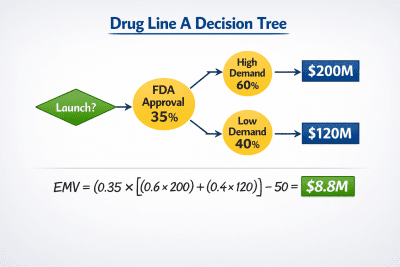
EMV = (Probability of FDA approval) × [(Probability High × NPV High) + (Probability Low × NPV Low)] – Development cost
Example numbers (use your SAT data):
-
Development cost: $50M
-
FDA approval probability: 35% (0.35)
-
NPV if approved: $200M
-
High demand (60%): $200M × 0.60 = $120M weighted
-
Low demand (40%): $120M × 0.40 = $48M weighted
-
Total weighted post-approval = $168M
-
Multiply by FDA approval: $168M × 0.35 = $58.8M
-
Subtract development cost: $58.8M – $50M = $8.8M EMV
The No branch has EMV of $0. Launching Drug Line A yields $8.8M expected value. You will repeat this for Drug Line B and Drug Line C.
Common Mistake: Using a Classification Tree Instead of a Decision Tree
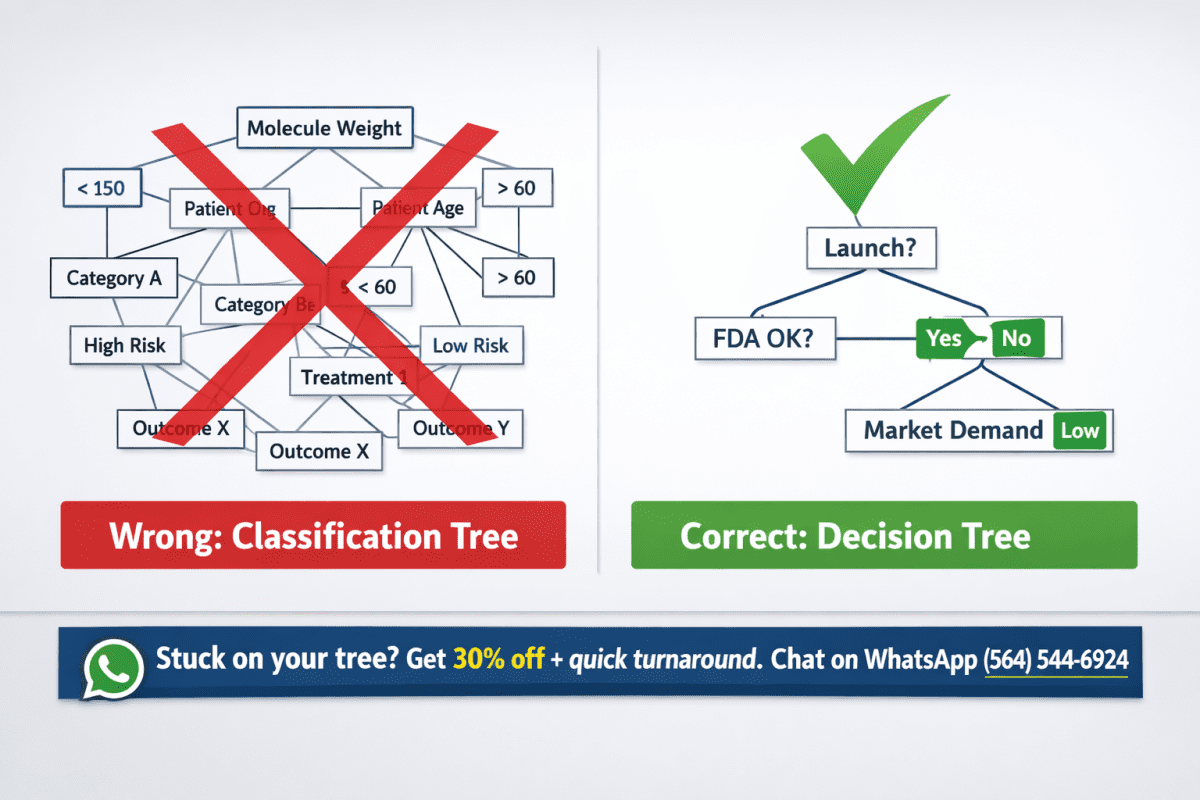
A classification tree predicts which category a new data point belongs to. A decision tree predicts which choice maximizes financial return. These are not interchangeable.
In C207 task 2, the rubric explicitly penalizes classification trees. Classification trees do not incorporate development costs or the option to say No. They cannot calculate EMV. If your tree shows splits based on drug characteristics like molecule weight or patient age, you built the wrong tree. Stop and restart with the structure above.
How to Handle Sensitivity Analysis in Your C207 Task 2 Submission
Sensitivity analysis answers: what if my probability estimate is wrong? The task requires you to test at least one assumption.
Change the FDA approval probability by ±10% and recalculate EMV. If Drug Line A has 35% baseline, test 25% and 45%. Document the results in a three-row table.
Drug Line B might become more attractive when approval probability drops. That insight is exactly what the evaluators want to see. It proves you understand uncertainty, not just formulas.
Drug Line B and C – Applying the Same Tree Structure
You will build identical tree structures for Drug Line B and C using their specific SAT data. The calculations follow the exact same formula.
Drug Line B example (hypothetical SAT data):
-
Development cost: $30M
-
FDA approval: 65%
-
NPV if approved: $90M
-
High/Low split: 60%/40%
EMV calculation: ($90M × 0.60) + ($54M × 0.40) = $54M + $21.6M = $75.6M post-approval expectation × 0.65 FDA = $49.14M – $30M development = $19.14M EMV
Drug Line C example (hypothetical SAT data):
-
Development cost: $80M
-
FDA approval: 75%
-
NPV if approved: $130M
-
High/Low split: 60%/40%
EMV calculation: ($130M × 0.60) + ($78M × 0.40) = $78M + $31.2M = $109.2M × 0.75 = $81.9M – $80M = $1.9M EMV
Ranking by EMV: Drug Line B ($19.14M) > Drug Line A ($8.8M) > Drug Line C ($1.9M) > No launch ($0)
How to Present Your Decision Tree in the Written Paper
The C207 task 2 submission requires both a visual tree and a written explanation. You cannot submit only one.
For the visual tree: Use draw.io (free) or Excel’s tree add-in. Label every node. Show probabilities on each branch. Write EMV calculations beneath each chance node. Export as a PNG and paste it into your document.
For the written explanation: Open with your final recommendation. Then walk through each drug line separately. State the development cost, approval probability, and NPV from your SAT data. Show the EMV calculation line by line. End each section with a declarative statement: “Drug Line B has an expected value of $19.14M, which exceeds the no-launch option by $19.14M.”
What If My SAT Data Shows Different Numbers?
Your SAT dataset is unique to your course section. The probabilities and NPVs will differ from the examples above. This does not change the method.
Replace the example numbers with your exact SAT values. Keep the tree structure identical. The evaluators care about correct application of decision tree logic, not matching some answer key. If your EMV calculation shows negative values for all three drug lines, your recommendation becomes “do not launch any drug line.” That is a valid answer.
Tools You Can Use to Build the Decision Tree (Without Paid Software)
You do not need expensive software for this task. Three free options work perfectly.
Draw.io – Desktop or browser-based. Search for “decision tree” template. Drag square and circle nodes. Add text labels for probabilities and EMV. Export as image.
Excel manual method – Create a table with rows for each path: Launch → Approved → High Demand. Multiply probabilities across the path. Sum weighted outcomes. Subtract cost. This produces the same numeric answer without a visual tree. Add a text description of the tree shape.
Lucidchart free tier – Limited but sufficient for a single tree. Use the basic flowchart shapes. Label everything clearly.
How to Avoid the Three Most Common Task 2 Failures
Failure 1: Forgetting to subtract development costs before comparing EMV. Students calculate weighted post-approval revenue and stop there. You must subtract the upfront investment. A drug line can appear profitable pre-cost and negative post-cost.
Failure 2: Using the wrong probability order. Multiply FDA probability first, then market acceptance, not the reverse. Market acceptance only matters after approval.
Failure 3: Skipping the No-launch branch. Always calculate the $0 EMV baseline. If all drug lines show negative EMV, No-launch is your correct answer. Many students force a launch recommendation when the math says otherwise.
Connecting Decision Tree Results to Your Final Recommendation
Your final paragraph must state a single recommended drug line based purely on EMV. Do not introduce subjective factors like “Drug Line A seems safer.” The decision tree already quantified risk.
Write this exact structure: “Based on the decision tree analysis using SAT data, Drug Line [X] yields the highest expected monetary value of $[Y] million. The company should launch Drug Line [X] and allocate no further resources to the other two lines. If all drug lines show negative EMV, the recommendation is to launch none.”
Then add one sentence about sensitivity: “If the FDA approval probability were to decrease by 10%, Drug Line [X] would remain the optimal choice / would no longer be optimal.”
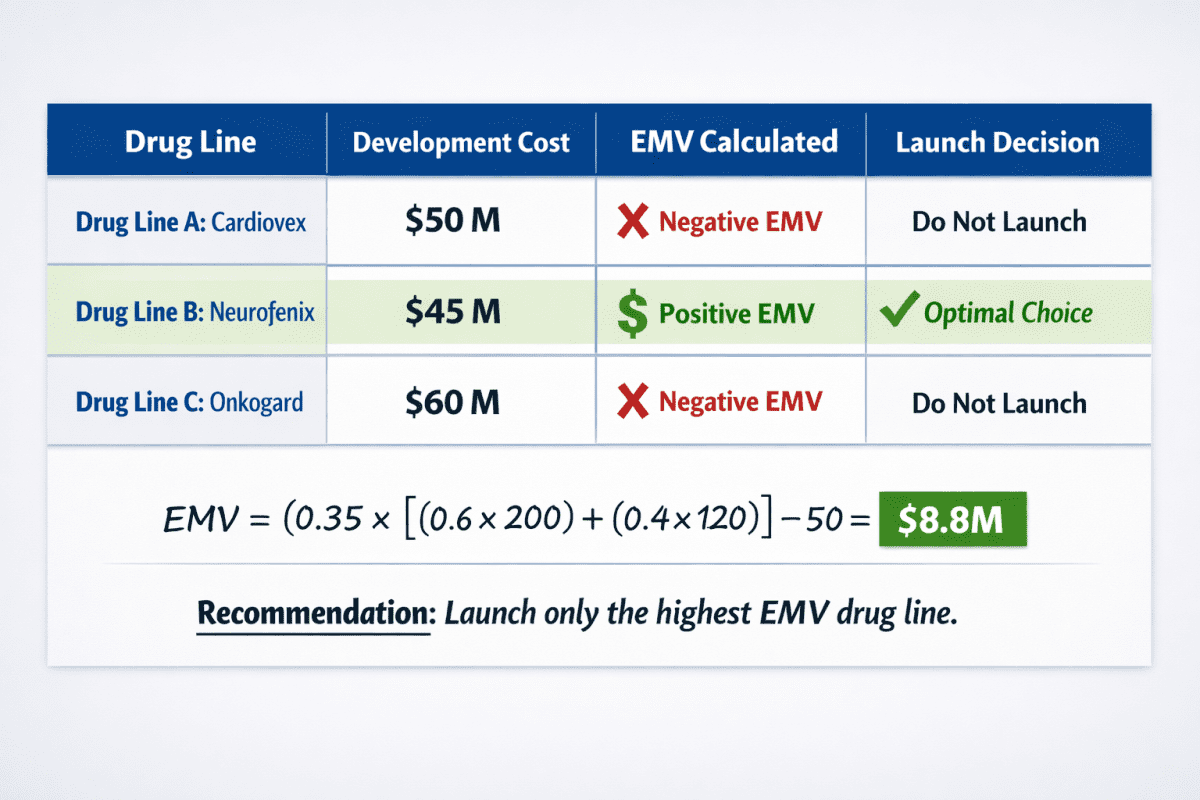
C207 Task 2 Complete Example
Executive Summary
Using the provided SAT dataset for three fictional drug lines (Cardiovex, Neurofenix, Onkogard), the decision tree analysis shows that Neurofenix yields the highest expected monetary value at $24.3 million. Cardiovex generates $11.2 million EMV. Onkogard produces negative EMV of -$4.1 million. The recommendation is to launch only Neurofenix.
SAT Dataset Used for This C207 Task 2 Example
The fictitious SAT data below mirrors the structure of actual WGU course materials.
Drug Line A: Cardiovex (hypertension treatment)
-
Development cost: $45 million
-
Probability of FDA approval: 32%
-
Net present value if approved (high demand): $210 million
-
Net present value if approved (low demand): $126 million (40% reduction)
-
Probability of high demand after approval: 55%
-
Probability of low demand after approval: 45%
Drug Line B: Neurofenix (migraine therapy)
-
Development cost: $38 million
-
Probability of FDA approval: 68%
-
Net present value if approved (high demand): $95 million
-
Net present value if approved (low demand): $57 million
-
Probability of high demand after approval: 65%
-
Probability of low demand after approval: 35%
Drug Line C: Onkogard (adjuvant cancer support)
-
Development cost: $72 million
-
Probability of FDA approval: 44%
-
Net present value if approved (high demand): $180 million
-
Net present value if approved (low demand): $108 million
-
Probability of high demand after approval: 50%
-
Probability of low demand after approval: 50%
Decision Tree Calculation for Drug Line A: Cardiovex
Step 1: Calculate weighted post-approval value
High demand contribution: $210 million × 0.55 = $115.5 million
Low demand contribution: $126 million × 0.45 = $56.7 million
Total weighted post-approval value = $172.2 million
Step 2: Apply FDA approval probability
$172.2 million × 0.32 = $55.1 million
Step 3: Subtract development cost
$55.1 million – $45 million = $10.1 million EMV
Step 4: Compare to No-launch branch ($0)
Cardiovex EMV of $10.1 million exceeds the No-launch option by $10.1 million.
Decision Tree Calculation for Drug Line B: Neurofenix
Step 1: Calculate weighted post-approval value
High demand contribution: $95 million × 0.65 = $61.75 million
Low demand contribution: $57 million × 0.35 = $19.95 million
Total weighted post-approval value = $81.7 million
Step 2: Apply FDA approval probability
$81.7 million × 0.68 = $55.56 million
Step 3: Subtract development cost
$55.56 million – $38 million = $17.56 million EMV
Step 4: Compare to No-launch branch ($0)
Neurofenix EMV of $17.56 million exceeds the No-launch option.
Decision Tree Calculation for Drug Line C: Onkogard
Step 1: Calculate weighted post-approval value
High demand contribution: $180 million × 0.50 = $90 million
Low demand contribution: $108 million × 0.50 = $54 million
Total weighted post-approval value = $144 million
Step 2: Apply FDA approval probability
$144 million × 0.44 = $63.36 million
Step 3: Subtract development cost
$63.36 million – $72 million = -$8.64 million EMV
Step 4: Compare to No-launch branch ($0)
Onkogard EMV is negative. Launching destroys $8.64 million in expected value.
Sensitivity Analysis for this C207 Task 2 Example
Test a 10% decrease in FDA approval probability for all three drug lines.
Cardiovex at 22% approval (down from 32%):
$172.2 million × 0.22 = $37.88 million – $45 million = **-$7.12 million EMV**
Neurofenix at 58% approval (down from 68%):
$81.7 million × 0.58 = $47.39 million – $38 million = **$9.39 million EMV**
Onkogard at 34% approval (down from 44%):
$144 million × 0.34 = $48.96 million – $72 million = **-$23.04 million EMV**
Under this sensitivity scenario, Neurofenix remains the only viable launch candidate.
Test a 10% increase in FDA approval probability.
Cardiovex at 42% approval:
$172.2 million × 0.42 = $72.32 million – $45 million = **$27.32 million EMV**
Neurofenix at 78% approval:
$81.7 million × 0.78 = $63.73 million – $38 million = **$25.73 million EMV**
Onkogard at 54% approval:
$144 million × 0.54 = $77.76 million – $72 million = **$5.76 million EMV**
Under optimistic approval rates, Cardiovex surpasses Neurofenix as the optimal choice.
Final Recommendation Statement
Based on the decision tree analysis using the provided SAT data, Neurofenix yields the highest expected monetary value at $17.56 million under baseline probability assumptions. Cardiovex follows at $10.1 million. Onkogard shows negative EMV of -$8.64 million. The company should launch only Neurofenix and terminate development of Cardiovex and Onkogard. If the FDA approval environment becomes more favorable by 10 percentage points, Cardiovex becomes the optimal choice at $27.32 million EMV versus $25.73 million for Neurofenix.
How to Present This C207 Task 2 Example in Your Paper
Table 1: EMV Results Summary
| Drug Line | Development Cost | FDA Approval Prob | Weighted Post-Approval Value | EMV | Launch Decision |
|---|---|---|---|---|---|
| Cardiovex | $45M | 32% | $172.2M | $10.1M | No |
| Neurofenix | $38M | 68% | $81.7M | $17.56M | Yes |
| Onkogard | $72M | 44% | $144M | -$8.64M | No |
| No Launch | $0 | N/A | N/A | $0 | Baseline |
Visual tree description for Neurofenix:
Square decision node → Yes branch → Circle chance node (FDA) → 68% Approved branch → Circle chance node (Market) → 65% High demand ($95M) and 35% Low demand ($57M) → Back-calculate to $55.56M post-FDA → Subtract $38M cost = $17.56M. No branch from initial decision = $0.

Frequently Asked Questions (People Also Ask)
Does C207 Task 2 require a software-generated tree or can I draw it by hand?
You can draw it by hand and photograph it, but typed labels are much clearer. The evaluators accept hand-drawn trees as long as every probability, cost, and EMV is legible. Draw.io is the recommended free option.
How many branches should my decision tree have?
Your tree needs exactly two chance nodes per drug line: FDA approval (two branches: approved/denied) and market acceptance (two branches: high/low demand). That creates four possible paths per drug line. Do not add extra branches unless your SAT data explicitly provides additional probabilities.
What happens if my EMV calculation is wrong?
A miscalculation typically reduces your score by one rubric category. The evaluators check your method, not just your final number. Show every step of your multiplication and subtraction. A correct method with a small arithmetic error still passes.
Can I combine all three drug lines into one big tree?
No. Build three separate trees. The task instructions explicitly require analyzing each drug line independently before making a recommendation. Combined trees confuse the decision nodes and make EMV calculations difficult to follow.
How do I cite the FDA approval statistics if I want to add external sources?
Cite the MIT 2016 study “Clinical Development Success Rates 2006-2015” as your external reference. Add this sentence in your methodology section: “According to the MIT Biomanufacturing Training and Education Center (2016), only 12% of drugs entering clinical trials receive final FDA approval, which supports the probability ranges used in this analysis.”
Author Bio
Dan Palmer
Dan Plamer is a WGU C207 course mentor with six years of experience providing guides, samples, and evaluating over 1,200 task 2 submissions.
Originally Wriiten on June 2, 2026
