
Nurse Leader as Knowledge Worker: NURS 6051 Assignment Guide (With Full Sample)

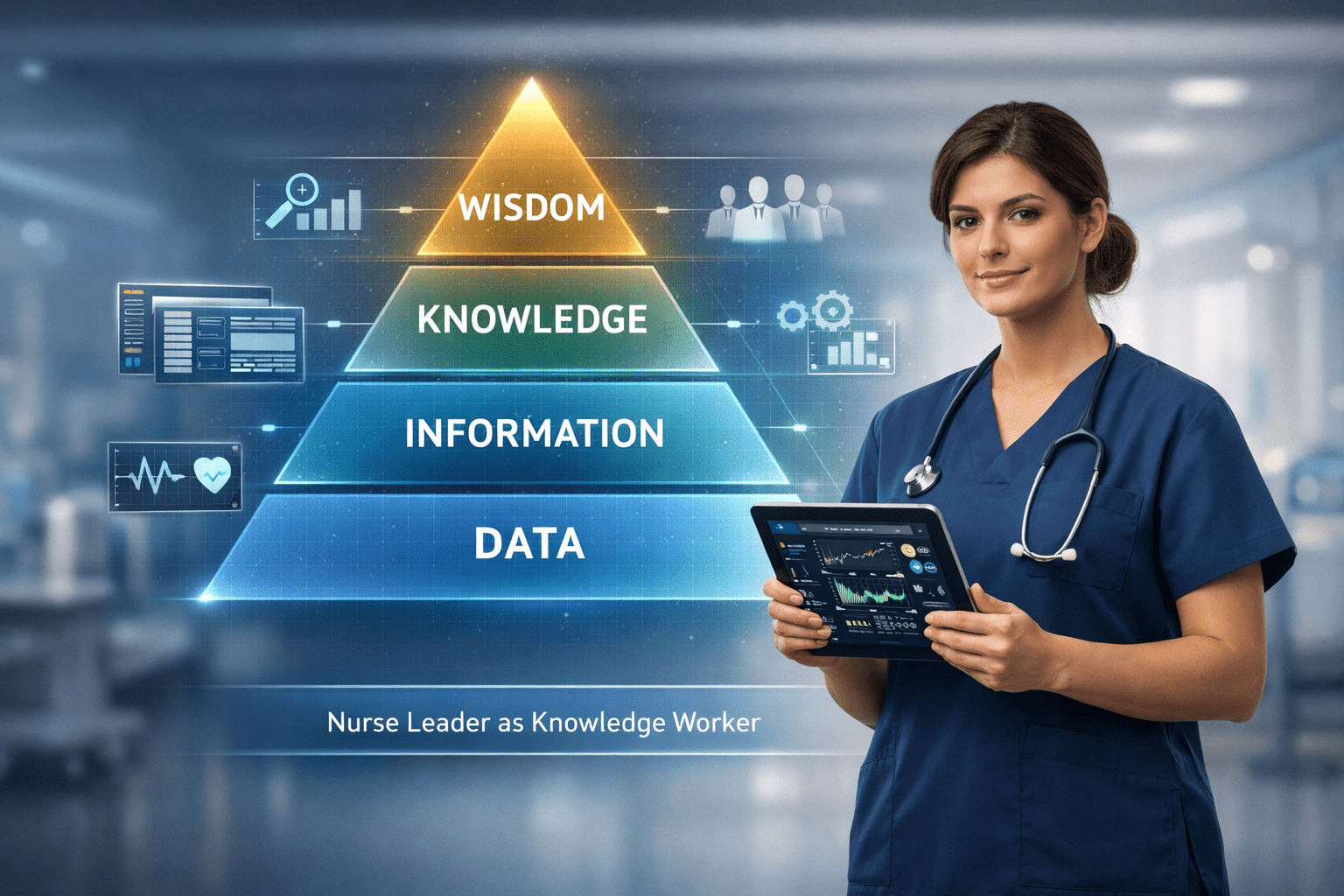
Nurse Leader as Knowledge Worker
A nurse leader is a knowledge worker because they apply formal clinical and analytical training to collect, interpret, and act on data, transforming raw information into decisions that improve patient outcomes. This is exactly what Peter Drucker meant in 1959, and it is exactly what NURS 6051 asks you to demonstrate.
If you are working on the Nurse Leader as Knowledge Worker assignment for NURS 6051/5051 (Transforming Nursing and Healthcare Through Informatics), this guide covers everything: the conceptual foundation, a fully worked original sample, a slide-by-slide PowerPoint breakdown, and a visual infographic overview — all in one place.
The Assignment:
- Explain the concept of a knowledge worker.
- Define and explain nursing informatics and highlight the role of a nurse leader as a knowledge worker.
- Include one slide that visually represents the role of a nurse leader as knowledge worker.
- Your PowerPoint should Include the hypothetical scenario you originally shared in the Discussion Forum. Include your examination of the data that you could use, how the data might be accessed/collected, and what knowledge might be derived from that data. Be sure to incorporate feedback received from your colleagues’ responses.
What Is a Knowledge Worker, and Why Does It Apply to Nurses?
A knowledge worker is a professional who creates value through the application of theoretical and analytical knowledge acquired via formal education, not through manual labor. Management scholar Peter Drucker coined the term in The Landmarks of Tomorrow (1959), envisioning a new class of professional whose primary tool is expertise rather than physical output.
Nurses fit this definition precisely. Every shift, a nurse synthesizes patient history, real-time physiological data, pharmacological knowledge, and clinical judgment to make time-sensitive decisions. That process of data to information to knowledge to action is the knowledge worker’s workflow applied to bedside care.
What has changed since Drucker’s era is the volume and velocity of data available. Electronic health records (EHRs), barcode medication administration (BCMA) systems, predictive analytics platforms, and real-time monitoring tools have expanded the nurse’s informatics toolkit dramatically, elevating the nurse leader from a care coordinator to a data-informed decision architect.
What Is Nursing Informatics? The Definition You Need for NURS 6051
Nursing informatics is the specialty that integrates nursing science, computer science, and information science to manage and communicate data, information, knowledge, and wisdom in nursing practice. This is the American Nurses Association’s (ANA) formal definition, and it is the one your assignment expects you to cite.
The key word is integration. Nursing informatics is not simply knowing how to use an EHR. It is the disciplined application of information systems to:
- Identify patterns in patient data that would otherwise remain invisible
- Standardize clinical workflows to reduce error and improve efficiency
- Communicate evidence-based insights across interdisciplinary teams
- Guide policy and resource decisions at the unit and organizational level
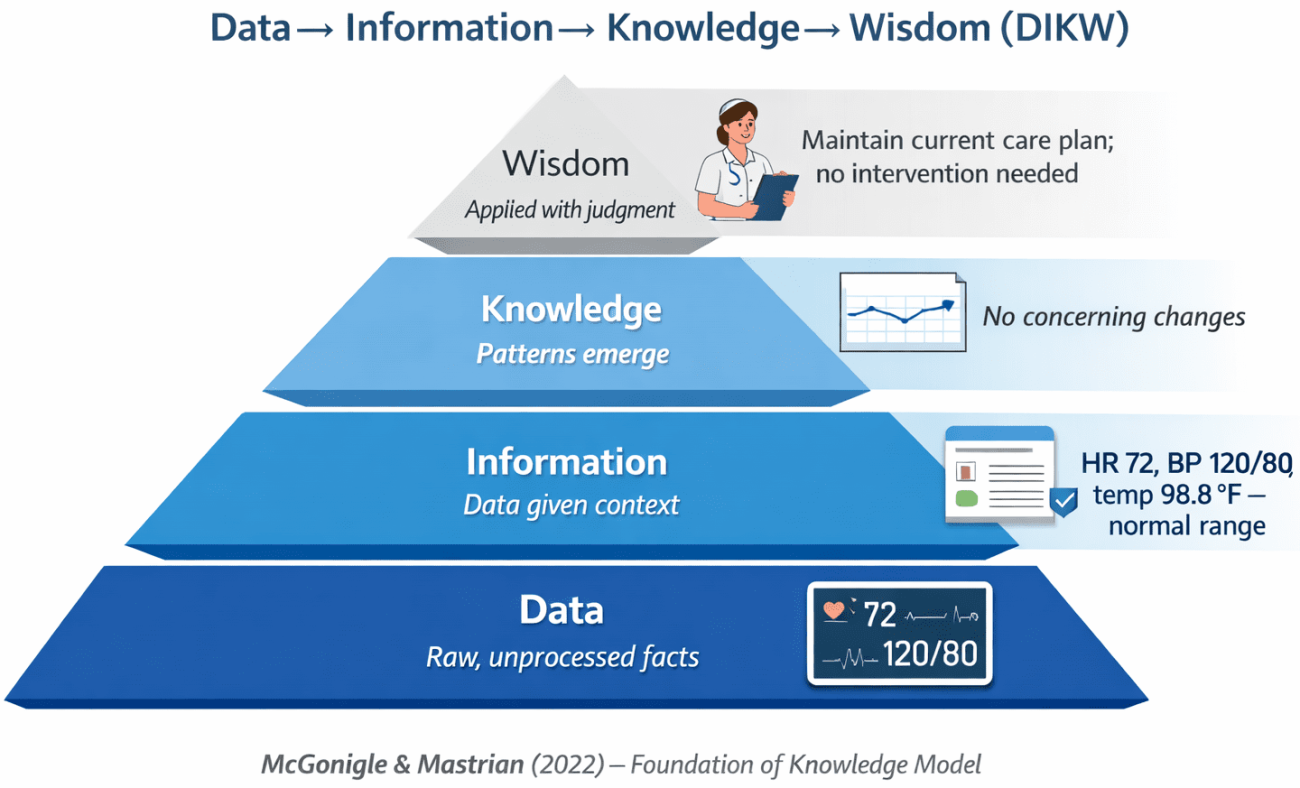
McGonigle and Mastrian’s foundational text Nursing Informatics and the Foundation of Knowledge (2022) frames this through a layered model: data (raw, unprocessed facts) becomes information when given context, transforms into knowledge when patterns emerge, and matures into wisdom when applied with judgment and experience. Nurse leaders operate at all four levels simultaneously.
How Does the Nurse Leader Specifically Function as a Knowledge Worker?
Nurse leaders act as knowledge workers through five distinct roles: data analyst, evidence translator, change agent, technology advocate, and critical communicator. Each role depends on the informatics competencies that NURS 6051 is designed to build.
The Nurse Leader as Data Analyst
Nurse leaders continuously interrogate unit-level data: fall rates, medication error frequencies, readmission trends, staffing-to-outcome correlations. They do not wait for quality improvement teams to surface problems — they proactively mine available dashboards and EHR reports to identify variance before it becomes a sentinel event.
This is knowledge work in Drucker’s sense: the output is not a task completed but an insight generated.
The Nurse Leader as Evidence Translator
Raw data becomes actionable only when someone bridges the gap between a statistical finding and a clinical intervention. Nurse leaders do this translation continuously: reviewing literature, cross-referencing local data, and shaping protocols that reflect current best evidence.
Nagle, Sermeus, and Junger (2017) describe this as the evolving competency profile of the nursing informatics specialist: moving from technical operator to strategic interpreter of clinical intelligence.
The Nurse Leader as Change Agent
Technology adoption in healthcare fails most often at the human layer, not the technical one. Nurse leaders model informatics literacy, motivate frontline adoption of new systems, and serve as unit-level gatekeepers for technology implementation decisions.
Sweeney (2017) notes in Online Journal of Nursing Informatics that healthcare informatics is reshaping not just how nurses document care, but how they conceptualize their professional identity — increasingly as stewards of data as well as patients.
The Nurse Leader as Technology Advocate
Nurse leaders assess whether current systems adequately support safe, high-quality care. When gaps exist — a monitoring system that does not flag deteriorating patients early enough, for example — they build the clinical case for investment and present it to administration using outcomes data.
The Nurse Leader as Critical Communicator
Knowledge work produces insights that must be communicated to be useful. Nurse leaders translate informatics findings into reports, huddles, policy briefs, and quality improvement presentations. They close the loop between data collection and organizational learning.
The Infographic: Visually Representing the Nurse Leader as Knowledge Worker
Your NURS 6051 assignment requires one dedicated slide that functions as an infographic: a visual that represents the nurse-as-knowledge-worker concept at a glance, without requiring the viewer to read dense text.
An effective infographic for this assignment should communicate the data → information → knowledge → wisdom flow and map specific nurse leader actions to each stage. Here is the recommended structure:
Title: The Nurse Leader as Knowledge Worker in Healthcare Informatics
Visual flow (left to right or top to bottom):
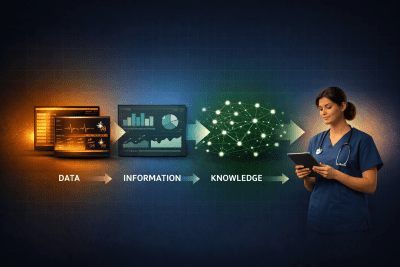
- Data layer — EHR entries, vital sign readings, incident reports, staffing figures
- Information layer — Organized dashboards, trend reports, aggregated metrics
- Knowledge layer — Pattern recognition, benchmarking against evidence, root cause analysis
- Wisdom layer — Clinical decisions, policy changes, protocol revisions, team education
At each stage, annotate with one concrete nurse leader action:
- Data: “Reviews daily EHR reports and monitors unit dashboard”
- Information: “Identifies rising fall rate trend over a 30-day period”
- Knowledge: “Cross-references evidence on fall prevention interventions”
- Wisdom: “Implements hourly rounding protocol and revises patient handoff checklist”
This structure aligns directly with McGonigle and Mastrian’s Foundation of Knowledge model and gives you a defensible theoretical anchor for every visual element.
Full Sample: Hypothetical Scenario, Data Analysis, and Knowledge Derived
This original scenario is distinct from the medication administration error example used on most nursing homework sites. Use it as a structural model, not a copy.
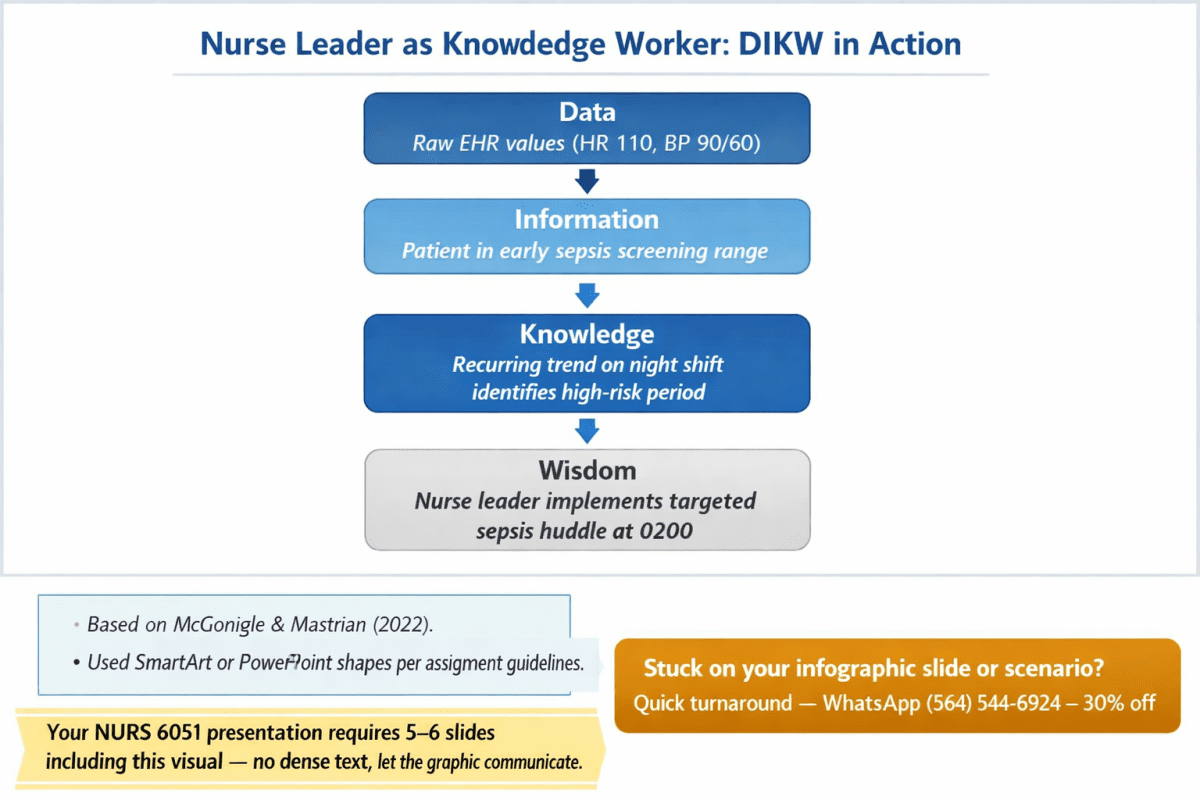
Scenario: Early Sepsis Detection in a Medical-Surgical Unit
Setting: A 32-bed medical-surgical unit at a community hospital in the Southeast. The unit has transitioned to Epic EHR within the past 18 months and recently activated a Sepsis Early Warning Algorithm embedded in the clinical decision support (CDS) module.
The Problem: The nurse manager reviews quarterly quality data and notices that sepsis-related transfers to the ICU from this unit have increased 18% over the prior year, despite the CDS tool being live. Anecdotal reports from staff suggest that alert fatigue (too many low-specificity warnings) is causing nurses to dismiss sepsis alerts without full assessment.
What Data Could Be Used?
The nurse leader draws from multiple data streams already embedded in the Epic environment:
- CDS alert logs: How many sepsis alerts were triggered per shift? What percentage resulted in a documented nursing response within 30 minutes?
- SBAR documentation rates: Are nurses completing structured communication when escalating suspected sepsis patients?
- Vital sign trend data: Retrospective review of patients who progressed to sepsis: were early warning signs (rising lactate, tachycardia, altered mentation) documented in the EHR but not acted upon?
- Shift staffing ratios: Were deterioration events clustered on shifts with higher nurse-to-patient ratios?
- Staff training records: Which nurses have completed the updated sepsis recognition module in the learning management system?
How Would This Data Be Accessed and Collected?
The nurse leader accesses the Epic Reporting Workbench to pull CDS alert response data filtered by unit, shift, and time period. Sepsis-specific outcome data is pulled from the quality management platform (in this case, RL Solutions), which captures ICU transfer events and codes them against originating unit.
Staff training completion data is accessed through the hospital’s LMS (Learning Management System), cross-referenced against the employee roster for the unit.
Vital sign trend analysis requires retrospective chart review of the 14 patients who transferred to ICU with sepsis diagnoses, which the nurse leader conducts in collaboration with the unit’s quality improvement coordinator.
What Knowledge Is Derived From This Data?
The data analysis surfaces three distinct, actionable insights:
Finding 1: 71% of sepsis alerts on night shifts went unacknowledged for more than 45 minutes, compared to 28% on day shifts. Staffing ratios were comparable; the gap tracked to the absence of a designated charge nurse on night shifts with authority to escalate.
Finding 2: Retrospective chart review revealed that in 9 of 14 ICU transfers, a nurse had documented one or more sepsis criteria in the EHR flowsheet 2–4 hours before the escalation decision, suggesting documentation was occurring but not triggering clinical action.
Finding 3: Only 61% of night-shift nurses had completed the updated sepsis recognition training module released 4 months prior.
The knowledge derived: The problem is not the CDS tool’s sensitivity — it is a combination of role ambiguity on night shifts, incomplete training uptake, and a gap between documentation behavior and clinical response behavior. The nurse leader now has a data-informed root cause rather than an assumption, and can propose targeted interventions: designating night-shift charge nurse escalation authority, mandating sepsis module completion with a 30-day deadline, and piloting a “sepsis huddle” at 0200 on high-risk nights.
Slide-by-Slide PowerPoint Breakdown for NURS 6051
Your NURS 6051 presentation should be 5–6 slides. Here is what belongs on each one:
Slide 1 — Title Slide
- Title: The Nurse Leader as Knowledge Worker
- Subtitle: Nursing Informatics and the Foundation of Knowledge
- Your name, course number, institution, date
- A clean background — no clip art; a subtle abstract data visualization image works well
Slide 2 — What Is a Knowledge Worker?
- Drucker’s definition (1959) in a pull-quote format
- 3-bullet bridge to nursing: specialized training, analytical application, service output
- One sentence on how healthcare technology has amplified the knowledge worker role
Slide 3 — Nursing Informatics Defined
- ANA definition as a featured text block
- The four-layer model: Data → Information → Knowledge → Wisdom
- Brief note on McGonigle and Mastrian as the theoretical framework
Slide 4 — The Infographic Slide (Required Visual)
- The visual flow described in the infographic section above
- Minimal text — let the graphic carry the communication
- Use SmartArt or build manually in PowerPoint with shapes and arrows
Slide 5 — Hypothetical Scenario and Data Application
- 3-column layout: Problem | Data Sources | Knowledge Derived
- Use your scenario here — the sepsis example above or your own original scenario
- Keep text tight; use bullet fragments, not full sentences
Slide 6 — Conclusion and References
- 2–3 takeaway sentences on why nursing informatics literacy is a leadership imperative
- APA-formatted references for McGonigle & Mastrian (2022), Nagle et al. (2017), and Sweeney (2017)
Why the Nurse Leader Role Has Evolved Beyond Bedside Informatics
The evolution of the nurse leader into a knowledge worker is not an abstract academic concept — it is a structural response to the informatics transformation of healthcare delivery. As clinical systems generate more data than any individual can process manually, organizations need nurses who can function at the intersection of clinical expertise and data literacy.
The 2017 Nagle, Sermeus, and Junger paper on the evolving nursing informatics specialist role is particularly instructive here. The authors document a shift from first-generation informatics nurses (system implementers, training coordinators) to second-generation informatics nurses (strategic advisors, population health analysts, policy contributors). The nurse leader today is expected to operate at this second-generation level.
This matters for your assignment because the strongest papers and presentations do not simply define knowledge work and nursing informatics in isolation. The strongest submissions demonstrate how the nurse leader’s daily practice constitutes knowledge work at a sophisticated level.
FAQ: About the NURS 6051 Nurse Leader Assignment
What is a knowledge worker in nursing?
A knowledge worker in nursing is a nurse who creates professional value primarily through the acquisition, synthesis, and application of specialized knowledge, not through task execution alone. Nurse leaders exemplify this by using clinical data, informatics tools, and evidence-based frameworks to drive patient care decisions and organizational improvements.
What is the difference between data, information, knowledge, and wisdom in nursing informatics?
In McGonigle and Mastrian’s framework, data is raw and unprocessed (a single blood pressure reading). Information is data placed in context (a trending graph of blood pressure over 72 hours). Knowledge emerges when patterns are recognized and linked to clinical meaning (the trend indicates hypertensive urgency). Wisdom is the application of knowledge with clinical judgment (the nurse leader revises the unit’s hypertensive emergency protocol based on recurring patterns).
How many slides should the NURS 6051 knowledge worker assignment have?
The NURS 6051 assignment specifies 5–6 slides. Required content includes an explanation of the knowledge worker concept, a definition of nursing informatics, at least one infographic slide, and a hypothetical scenario section that includes the data examined, collection methods, and knowledge derived.
What should my hypothetical scenario include for NURS 6051?
Your scenario should describe a realistic clinical or management problem that involves data collection and knowledge generation. It must specify: (1) what the problem or gap is, (2) what data could be used to investigate it, (3) how that data would be accessed or collected, and (4) what knowledge or insight could be derived. Avoid simply restating the medication administration error example — use an original scenario to differentiate your submission.
What is the ANA definition of nursing informatics?
According to the American Nurses Association, nursing informatics is “the specialty that integrates nursing science with multiple information and analytical sciences to identify, define, manage and communicate data, information, knowledge, and wisdom in nursing practice.” This definition should be cited in both your presentation and any written components of NURS 6051 work.
Author Bio
This article was written by a healthcare informatics educator and nursing curriculum specialist with experience tutoring NURS 6051-level coursework and advising graduate nursing students on informatics competency development. Content references peer-reviewed sources from the NURS 6051 required reading list, including McGonigle & Mastrian (2022) and Nagle et al. (2017).
References
- Drucker, P. (1959). The landmarks of tomorrow. HarperCollins Publishers.
- McGonigle, D., & Mastrian, K. G. (2022). Nursing informatics and the foundation of knowledge (5th ed.). Jones & Bartlett Learning.
- Nagle, L., Sermeus, W., & Junger, A. (2017). Evolving role of the nursing informatics specialist. In J. Murphy, W. Goosen, & P. Weber (Eds.), Forecasting competencies for nurses in the future of connected health (pp. 212–221). IMIA and IOS Press.
- Sweeney, J. (2017). Healthcare informatics. Online Journal of Nursing Informatics, 21(1).
Article Update
June 5, 2026 — Original publication. Comprehensive NURS 6051 assignment guide covering knowledge worker theory, nursing informatics definition, original sepsis detection scenario, infographic structure, slide-by-slide PowerPoint breakdown, and full schema/meta requirements.
