
Blog
WGU D219 Task 1 Example & Complete Guide to Scholarship in Nursing Practice

WGU D219 Task 1 Example & Complete Guide
You’re working a full shift, maybe two, and somewhere between charting and picking up your kids you’re supposed to sit down and write a graduate-level evidence-based practice paper. You open the D219 Task 1 instructions and the nursing content isn’t actually the hard part, you already know how to think like a nurse. The hard part is figuring out exactly what WGU wants you to put on the page: seven lettered parts, PICO components, two different article appraisals, and a practice change recommendation, all tied together and cited correctly.
This guide walks you through what D219 is, exactly what Task 1 requires part by part, how to plan your response before you start writing, where to find solid evidence, and what to do if it comes back for revision, plus an original illustrative example so you can see the difference between a weak and a strong response. This breakdown is based on the current MYM2 Task 1 instructions, but WGU does update tasks over time, so always confirm against the copy inside your own course before you submit.
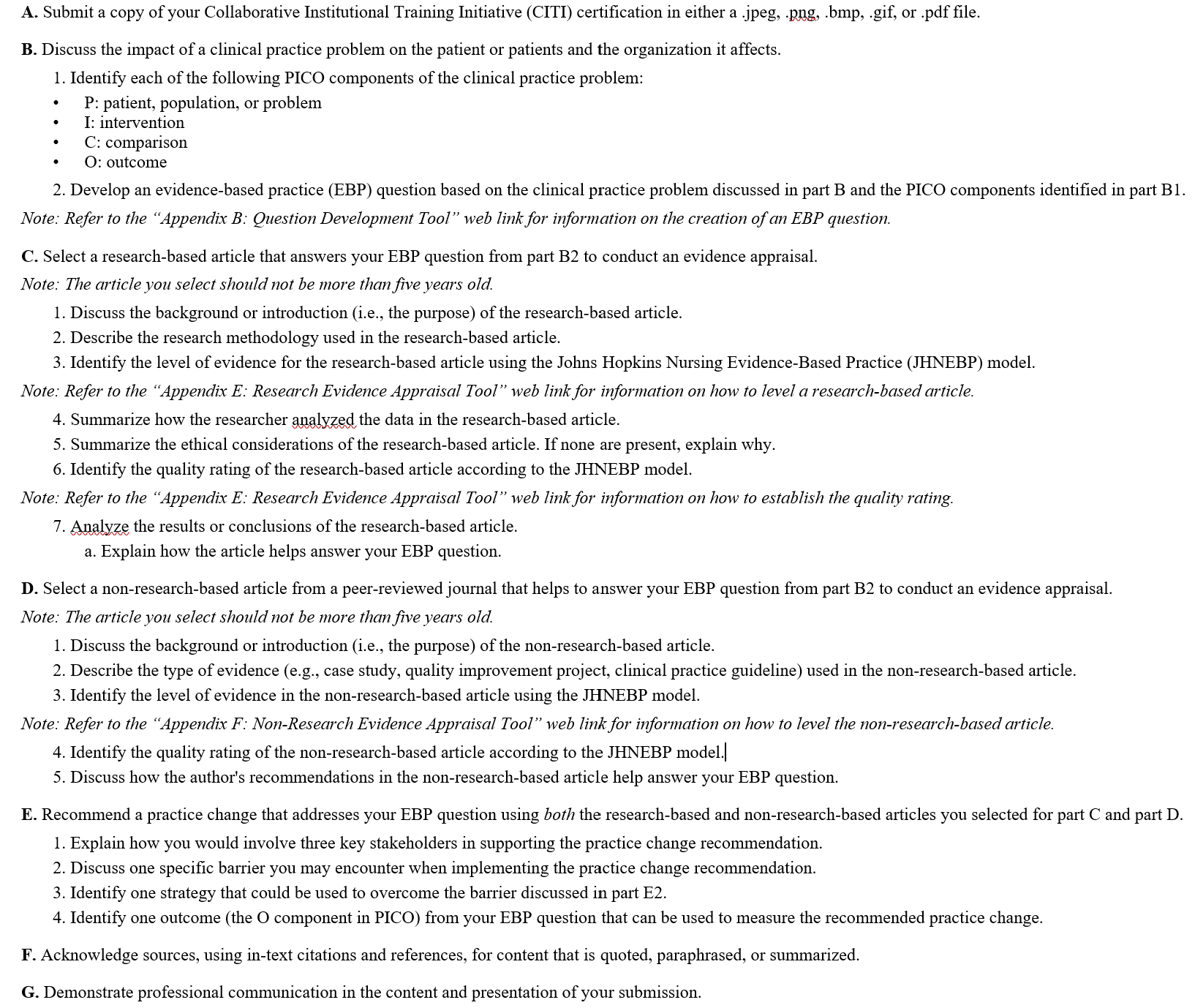
D219 TASK 1 Assignment Prompt
Introduction
Evidence-based literature comes from many sources. The discipline of nursing has an abundance of research data and resources to guide clinical decisions. Therefore, it is of pivotal importance to understand the basic tenets of critical appraisal of such evidence for its use in interprofessional healthcare practices.
In this task, you will identify a healthcare problem, develop an evidence-based practice (EBP) question, and review selected research-based and non-research-based evidence to find answers to that question.
Note that while you will be analyzing only one research-based and one non-research-based article in this task, an actual evidence-based practice change would require the support of many high-quality research studies.
Requirements
Your submission must be your original work. No more than a combined total of 30% of the submission and no more than a 10% match to any one individual source can be directly quoted or closely paraphrased from sources, even if cited correctly. The similarity report that is provided when you submit your task can be used as a guide.
You must use the rubric to direct the creation of your submission because it provides detailed criteria that will be used to evaluate your work. Each requirement below may be evaluated by more than one rubric aspect. The rubric aspect titles may contain hyperlinks to relevant portions of the course.
Tasks may not be submitted as cloud links, such as links to Google Docs, Google Slides, OneDrive, etc., unless specified in the task requirements. All other submissions must be file types that are uploaded and submitted as attachments (e.g., .docx, .pdf, .ppt).
What Is WGU D219?
D219, Scholarship in Nursing Practice, is part of WGU’s RN-to-BSN curriculum. The course sits at the intersection of research literacy and clinical practice: it’s built around five competencies, differentiating quality improvement from evidence-based practice and research, conducting a literature review, understanding research ethics and human subjects protections, distinguishing evidence-based standards from conventional practice, and describing how evidence gets collected, analyzed, and implemented from an interprofessional perspective.
The performance assessment inside D219 is coded MYM2. Before you reach the written task, you’ll typically complete Johns Hopkins Evidence-Based Practice (EBP) modules and submit a CITI (Collaborative Institutional Training Initiative) certification. MYM2 Task 1 itself is organized into seven lettered parts, A through G, each graded against its own rubric aspects. Treat your current task instructions as the authority on structure since WGU does revise tasks periodically.
The reason this course exists isn’t busywork. WGU’s RN-to-BSN pathway is trying to build nurses who don’t just follow protocols but can ask “does the evidence actually support this?” and go find the answer using a real appraisal method. That skill matters whether you’re working bedside or moving into leadership.
What Does D219 Task 1 Cover?
MYM2 Task 1 asks you to identify a clinical practice problem, discuss its impact on a patient and the organization, and build a PICO-based evidence-based practice (EBP) question from it. From there, you appraise one research-based article and one non-research-based article that help answer that question, using the Johns Hopkins Nursing Evidence-Based Practice (JHNEBP) model to level and rate each one. You close by recommending a practice change built on both articles, addressing stakeholder involvement, a barrier, a strategy to overcome it, and a measurable outcome.
Who Typically Takes D219?
D219 is aimed at working RNs finishing an RN-to-BSN degree, which means most students taking it are already juggling shift work, patient care responsibilities, and a life outside the hospital. If you’re reading this between shifts wondering how you’re going to fit “appraise a research article using an unfamiliar evidence model” into a day that already has twelve hours of patient care in it, you’re the exact person this course was built for, even if it doesn’t always feel that way.
WGU D219 Task 1 Requirements Explained
The breakdown below follows the current MYM2 Task 1 instructions part by part. Keep your own task instructions and rubric open alongside this section, since each requirement below may be evaluated by more than one rubric aspect.
Part A: CITI Certification
What WGU Is Asking: Submit your CITI training certificate as a .jpeg, .png, .bmp, .gif, or .pdf file.
What You Need to Demonstrate: Proof that you completed the required CITI human subjects protection training before working with research evidence.
Common Mistake: Uploading the wrong file type, or submitting a certificate from an expired or incomplete CITI module.
Practical Tip: Save your certificate the moment you finish CITI training so it’s not a last-minute scramble on submission day.
Part B: Clinical Practice Problem, PICO, and EBP Question
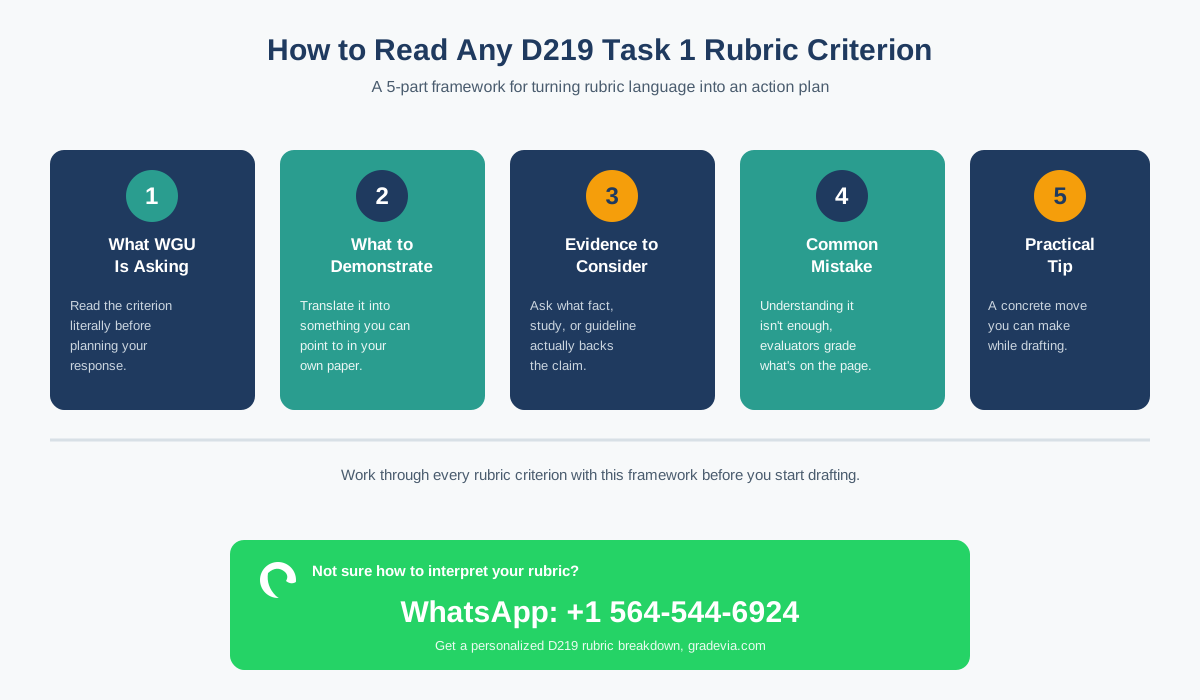
What WGU Is Asking: Discuss how a clinical practice problem affects the patient (or patients) and the organization, then break it into its PICO components (Patient/Population/Problem, Intervention, Comparison, Outcome), then turn that into a single evidence-based practice question.
What You Need to Demonstrate: Two distinct impacts, one on the patient and one on the organization, not a single blended paragraph. Each PICO letter should map to a specific, identifiable element of your chosen problem. Your EBP question should read as a clear, answerable question built directly from those PICO components.
Evidence to Consider: Clinical or organizational data showing the scope of the problem (readmission rates, infection rates, cost figures, patient outcomes).
Common Mistake: Writing a PICO breakdown that doesn’t actually match the EBP question that follows it, or picking a problem too broad to research in a single task.
Practical Tip: Draft your PICO table first, then write your EBP question as a single sentence that literally strings the four components together. If a piece doesn’t fit the sentence, it isn’t part of your PICO yet.
Part C: Research-Based Article Appraisal
What WGU Is Asking: Select a research-based article, published within the last five years, that answers your EBP question. Discuss its background/purpose, describe its methodology, identify its level of evidence using the JHNEBP model, summarize how the researcher analyzed the data, summarize (or explain the absence of) ethical considerations, identify its JHNEBP quality rating, and analyze its results and how they help answer your EBP question.
What You Need to Demonstrate: That you can distinguish a research-based article (one built on original data collection and analysis, such as a quantitative, qualitative, or mixed-methods study) from other kinds of evidence, and that you can apply the JHNEBP leveling and quality-rating system correctly rather than just describing the article in general terms.
Evidence to Consider: The article itself is your primary evidence here. Cross-reference the JHNEBP Research Evidence Appraisal Tool (Appendix E in your course) while you level and rate it.
Common Mistake: Summarizing the article’s topic instead of analyzing its methodology, data analysis, and results the way the rubric asks. Another common one: choosing an article older than five years or one that turns out to be non-research-based once you look closely at its methods section.
Practical Tip: Read the article’s methods section before anything else. If it doesn’t describe original data collection, it’s likely not a research-based article for this part.
Part D: Non-Research-Based Article Appraisal
What WGU Is Asking: Select a non-research-based article from a peer-reviewed journal, also published within the last five years, that helps answer the same EBP question. Discuss its background/purpose, describe the type of evidence it represents (a case study, quality improvement project, or clinical practice guideline, for example), identify its JHNEBP level of evidence, identify its JHNEBP quality rating, and discuss how the author’s recommendations help answer your EBP question.
What You Need to Demonstrate: That you understand non-research evidence is still legitimate evidence, it’s just leveled and rated differently under JHNEBP than a research study is.
Evidence to Consider: The JHNEBP Non-Research Evidence Appraisal Tool (Appendix F in your course).
Common Mistake: Accidentally selecting a second research-based article for this part instead of a genuinely non-research source, which usually costs points on the leveling criterion.
Practical Tip: Before you commit to an article for Part D, confirm it does not report original data collection and analysis. If it does, it belongs in Part C, not here.
Part E: Practice Change Recommendation
What WGU Is Asking: Recommend a practice change that addresses your EBP question, using both articles from Parts C and D together. Explain how you’d involve three key stakeholders in supporting it, discuss one specific barrier you might encounter, identify one strategy to overcome that barrier, and identify one outcome (the O in your PICO) you’d use to measure the change.
What You Need to Demonstrate: That your recommendation is actually built on both pieces of evidence, not just one, and that your stakeholders, barrier, and strategy are specific to your problem rather than generic statements that could apply to any nursing change.
Evidence to Consider: Both appraised articles, plus your own clinical knowledge of who would realistically be involved in implementing this kind of change on a unit or in an organization.
Common Mistake: Naming three stakeholders without explaining their specific role in supporting the change, or naming a barrier so vague (“resistance to change”) that the strategy to overcome it also ends up generic.
Practical Tip: For each stakeholder, write one sentence describing exactly what you’d need from them. If you can’t write that sentence, they may not be the right stakeholder for this recommendation.
Part F: Citations and References
What WGU Is Asking: Acknowledge every quoted, paraphrased, or summarized source with in-text citations and a matching reference list, in APA format.
Common Mistake: A citation in the text with no matching reference entry, or vice versa.
Practical Tip: Build your reference list as you write, not after. It’s much harder to catch mismatches once the paper is finished.
Part G: Professional Communication
What WGU Is Asking: Demonstrate professional communication throughout the content and presentation of your submission, meaning clear organization, correct grammar, and a tone appropriate for a scholarly nursing paper.
Practical Tip: Read your paper out loud before submitting. Awkward phrasing and grammar slips are much easier to catch by ear than by eye.
A Note on Originality
Your MYM2 Task 1 submission has to be your original work. Per the current task instructions, no more than a combined 30% of your submission, and no more than 10% matched to any single source, can be directly quoted or closely paraphrased, even when properly cited. The similarity report WGU provides on submission is meant as a guide for this, so it’s worth checking before you submit rather than after.
Not sure how to translate the D219 requirements into an outline? Gradevia can help you break the assessment into manageable steps.
How to Approach WGU D219 Task 1
Step 1: Read the Task Instructions First
Before you open a single research database, read all seven parts (A through G) straight through, not just the rubric, the instructions too. Students who start researching before they’ve read the actual ask often end up with strong articles that don’t fit what’s being graded, especially the research versus non-research distinction in Parts C and D.
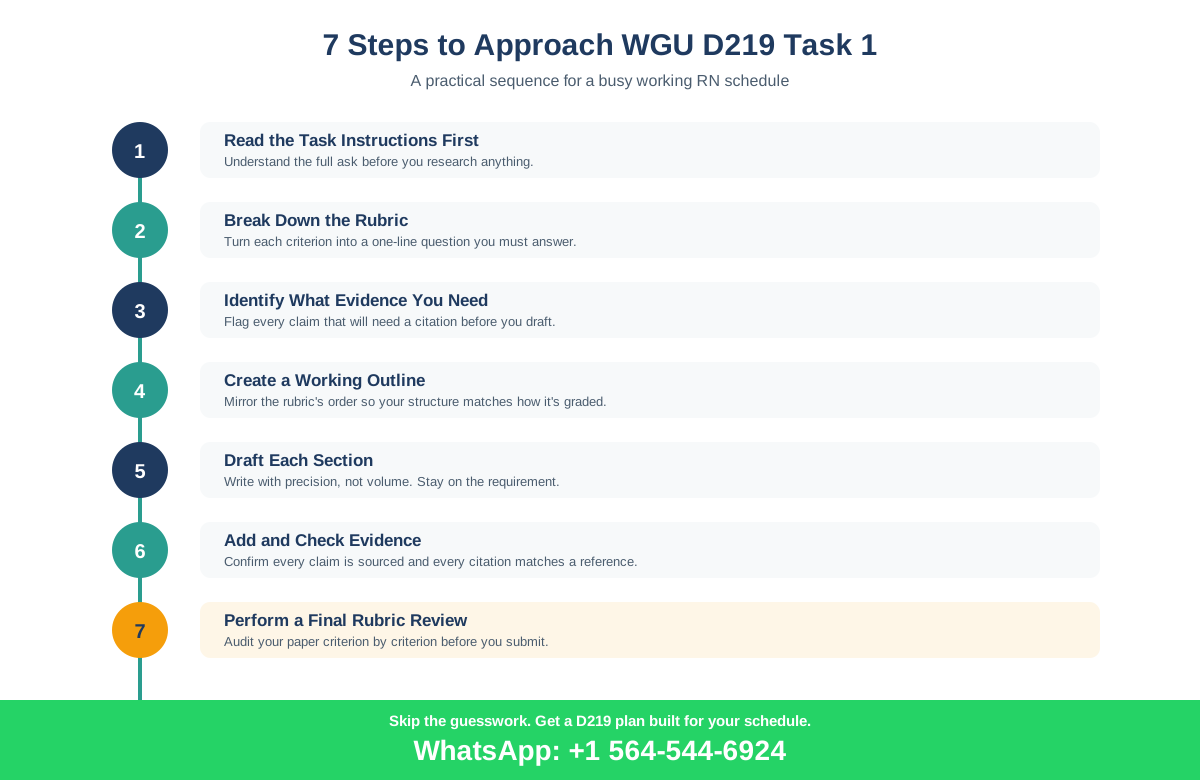
Step 2: Break Down the Rubric
Turn each rubric row into a one-line question you have to answer. A simple version:
- What is this criterion literally asking me to do?
- Which lettered part of the task will answer it?
- What evidence supports that answer?
That three-question pass turns a wall of rubric text into a checklist you can actually work from.
Step 3: Identify Your Problem, PICO, and EBP Question First
Everything else in this task, both article appraisals and the practice change recommendation, depends on Part B. Nail down your clinical practice problem, PICO components, and EBP question before you start searching for articles, or you risk finding great articles that don’t actually answer your question.
Step 4: Create a Working Outline
Use the A through G structure as your paper’s skeleton. WGU evaluators are working through your paper with the rubric next to them, and a paper that mirrors that structure is simply easier to grade favorably.
Step 5: Draft Each Section
Write with the rubric criterion open next to you, part by part. Resist the urge to write everything you know about the topic, this task rewards precision, not volume, and keep the 30%/10% similarity limits in mind as you paraphrase.
Step 6: Add and Check Evidence
Once your draft exists, go back through and confirm your JHNEBP levels and quality ratings for both articles are correct, every factual claim has a source, and every in-text citation has a matching reference entry.
Step 7: Perform a Final Rubric Review
Before you submit, read the rubric one more time, part by part, and confirm your paper answers each one explicitly. This step alone catches a surprising number of “Needs Revision” results.
Already have the rubric but don’t know how to interpret it? Get a personalized D219 rubric breakdown.
WGU D219 Task 1 Outline
This is a planning framework built around the actual MYM2 Task 1 structure, not an official WGU template, always draft your final paper using WGU’s provided MYM2 template.
| Part | What to Address | Evidence to Consider |
|---|---|---|
| A: CITI Certification | Upload your completed CITI certificate | Your CITI completion file |
| B: Problem, PICO, EBP Question | Impact on patient and organization, PICO breakdown, EBP question | Clinical/organizational data on the problem |
| C: Research-Based Article | Background, methodology, JHNEBP level, data analysis, ethics, JHNEBP quality rating, results | One research-based article, five years old or newer |
| D: Non-Research-Based Article | Background, evidence type, JHNEBP level, JHNEBP quality rating, author recommendations | One peer-reviewed non-research article, five years old or newer |
| E: Practice Change Recommendation | Stakeholders, barrier, strategy, measurable outcome | Both appraised articles together |
| F: References | Document every source cited | APA 7th edition |
| G: Professional Communication | Clarity, organization, tone | N/A (self-review) |
How to Find Sources for D219 Task 1
What Counts as a Good Source?
For Part C, you need a genuine research-based article, one reporting original data collection and analysis (quantitative, qualitative, or mixed methods), published within the last five years. For Part D, you need a genuine non-research-based article from a peer-reviewed journal, such as a case study, quality improvement project, or clinical practice guideline, also within the last five years. Mixing the two up is one of the more common ways students lose points on this task.
Where to Find Scholarly Sources
Your WGU Library is the fastest starting point since it’s already filtered for academic quality, but PubMed, CINAHL, and Google Scholar are all reasonable next stops. When searching, filter by publication date to stay within the five-year window, and read the methods section early to confirm whether an article is research-based or non-research-based before you commit to it.
How Many Sources Should You Use?
Task 1 specifically calls for one research-based article (Part C) and one non-research-based article (Part D), each answering the same EBP question. Beyond those two required appraisals, cite whatever additional sources you need to support other claims in your paper, and check your current task instructions for anything that’s changed.
WGU D219 Task 1 APA and Citation Tips
D219 requires APA 7th edition formatting, and the written performance assessment is typically built on WGU’s MYM2 APA template, start there rather than a generic APA guide.
Key things to get right:
- Every paraphrased fact needs an in-text citation
- Every in-text citation needs a matching reference entry, and vice versa
- Direct quotes should be rare, since paraphrasing shows you actually understand the source, and heavy quoting also eats into your 10%-per-source similarity limit
- Reference formatting (hanging indent, italics, capitalization) should be consistent throughout
Common APA Mistakes
- Missing citations on claims that read as fact but aren’t common knowledge
- Citation/reference mismatches, a name in the text that doesn’t appear in the reference list, or vice versa
- Inconsistent formatting between references (some indented, some not)
- Over-reliance on direct quotes instead of paraphrasing
- Weak paraphrasing that’s too close to the original wording
- Unsupported claims stated as fact with no citation at all
Common WGU D219 Task 1 Mistakes
Mistake 1: Writing Before Understanding the Rubric
It happens because the deadline feels closer than the reading. It matters because you end up retrofitting a paper to a rubric it wasn’t built for. Avoid it by doing the rubric breakdown, part by part, first, every time.
Mistake 2: Confusing Research-Based and Non-Research-Based Articles
It happens because both kinds of articles can look similarly academic at a glance. It matters because Parts C and D are graded on correctly leveling and rating the right type of evidence. Avoid it by reading the methods section of every candidate article before you commit to it.
Mistake 3: Picking an Article Older Than Five Years
It happens when a strong-looking article turns out to be outdated once you check the publication date. It matters because both Part C and Part D require sources within the last five years. Avoid it by filtering your database search by date before you start reading abstracts.
Mistake 4: Describing Instead of Analyzing
It happens because description is easier to write than analysis. It matters because most parts of this task, especially C and D, are looking for interpretation and appraisal, not summary. Avoid it by asking “so what does this mean for my EBP question?” after every paragraph you draft.
Mistake 5: Making Unsupported Claims
It happens when a statement feels obviously true and citing it seems unnecessary. It matters because evaluators grade what’s cited, not what you personally know. Avoid it by treating every factual claim as needing a source unless it’s genuinely common knowledge.
Mistake 6: Exceeding the Originality Limits
It happens when a student leans too heavily on a source’s own wording, even with a citation attached. It matters because the task caps direct quoting and close paraphrasing at 30% combined and 10% per source. Avoid it by paraphrasing in your own words first, then checking the similarity report before you submit.
Mistake 7: A Practice Change That Only Uses One Article
It happens when one article feels more relevant than the other by the time you reach Part E. It matters because the recommendation is specifically graded on using both the research-based and non-research-based articles together. Avoid it by outlining Part E before you draft it, and deliberately pulling in a point from each article.
Mistake 8: Submitting Without a Final Rubric Check
It happens because after days of writing, you’re ready to be done. It matters because this single step catches most preventable revisions. Avoid it by treating the final rubric review as non-negotiable, not optional.
WGU D219 Task 1 Example: What a Good Response Should Look Like
Illustrative example, not a WGU submission or official answer.
Say you’re working on Part B, discussing the impact of a clinical practice problem and building your PICO components.
Weaker approach (description only): “Pressure injuries are a problem in hospitals. They can hurt patients and take a long time to heal. P: hospitalized patients. I: better skin care. C: current care. O: fewer injuries.”
Stronger approach (specific impact, evidence-backed, clearly mapped PICO): “Hospital-acquired pressure injuries extend recovery time, increase infection risk, and are associated with worse patient-reported quality of life during recovery (a claim you would support with a citation from your own research). For the organization, each stage 3 or 4 injury adds measurable cost through extended length of stay and potential reimbursement penalties. PICO: P, adult post-surgical inpatients; I, a standardized turning and skin-assessment protocol; C, current inconsistent turning practices; O, reduced incidence of hospital-acquired pressure injuries at 30 days.”
The difference isn’t length, it’s that the second version makes specific, evidence-backed claims for both the patient and organizational impact, and each PICO letter maps to something concrete enough to build a real EBP question from.
WGU D219 Task 1 Template
This is a Gradevia planning worksheet built around the MYM2 Task 1 structure, not an official WGU document, use it to organize your thinking before you draft in the actual MYM2 template.
Clinical practice problem:
Impact on patient:
Impact on organization:
PICO, P: PICO, I: PICO, C: PICO, O:
EBP question:
Research-based article (Part C) citation and key notes:
Non-research-based article (Part D) citation and key notes:
Practice change recommendation:
Three stakeholders and their role: 1. 2. 3.
Barrier and strategy to overcome it:
Measurable outcome:
Final rubric check:
What to Do If Your D219 Task 1 Is Returned
- Read the evaluator feedback carefully, more than once.
- Identify exactly which rubric criterion the feedback is tied to.
- Compare the feedback directly against the rubric language for that criterion.
- Determine specifically what’s missing or unclear.
- Build a short revision plan before you touch the paper itself.
- Revise the affected section, usually you don’t need to rewrite the whole paper.
- Recheck evidence and citations in the revised section.
- Review the complete assessment once more before resubmission, not just the edited part.
WGU D219 Task 1 Revision Help
Received evaluator feedback? Gradevia can help you turn the feedback into a clear revision plan, interpreting what the evaluator flagged, identifying which section needs work, reviewing your own draft, tightening organization and APA, and getting you ready to resubmit with confidence. We won’t promise a guaranteed passing score, since that’s ultimately the evaluator’s call, but we can make sure you’re not guessing at what changed.
How Gradevia Can Help With WGU D219 Task 1
Need Help With D219 Task 1? Text Us on WhatsApp
You’re an RN, not a full-time student with hours to spare on a rubric puzzle. Between 12-hour shifts, charting, and everything waiting for you at home, you don’t need someone to do the work for you, you need a fast, plain-English answer about what D219 Task 1 is actually asking, from someone who understands what “I have twenty minutes before my next shift” really means.
That’s the gap Gradevia fills for working RN-to-BSN students specifically.
Services include:
- D219 rubric breakdown, part by part
- PICO and EBP question development coaching
- Research strategy and article-type screening (research-based vs. non-research-based)
- JHNEBP leveling and quality-rating guidance
- Stakeholder and barrier brainstorming for Part E
- Outline development
- Draft review
- Academic editing
- APA review
- Evaluator feedback interpretation
- Revision planning
- One-on-one coaching
📱 Working full-time and stuck on D219 Task 1? Message Gradevia on WhatsApp at +1 564-544-6924 for a quick reply, no long email chains, no waiting days for a response. Upload your task instructions and rubric and tell us where you’re stuck; most students hear back the same day.
D219 Task 1 Checklist Before Submission
- I understand every task requirement.
- I addressed every applicable rubric criterion.
- My response directly answers the prompt.
- My claims are supported with appropriate evidence.
- My sources are credible and relevant.
- My citations match my references.
- My APA formatting is consistent.
- I removed irrelevant information.
- I reviewed the current rubric one final time.
- I completed a final proofreading pass.
Still checking a box you’re not sure about? WhatsApp us at +1 564-544-6924 and we’ll help you sort it out before you hit submit.
Frequently Asked Questions About WGU D219 Task 1
What is WGU D219 Task 1? D219 Task 1 is the first part of the written performance assessment for Scholarship in Nursing Practice, generally focused on identifying a clinical practice problem and its impact as the foundation for an evidence-based intervention. Confirm the specific structure against your current task instructions.
What is D219 Scholarship in Nursing Practice? D219 is a WGU RN-to-BSN course that teaches evidence-based practice, finding, evaluating, and applying research evidence to real nursing problems, often through Johns Hopkins EBP modules followed by a written performance assessment.
How do I pass WGU D219 Task 1? There’s no shortcut that guarantees a pass. The most reliable approach is reading the current rubric closely, addressing every criterion explicitly with supporting evidence, formatting APA correctly, and reviewing against the rubric one more time before you submit.
Is there a WGU D219 Task 1 example? Actual student submissions circulate online, but treating one as a template is risky, course versions change, and copying structure or language from someone else’s paper raises academic integrity concerns. An original, clearly labeled illustrative example (like the one above) is a safer way to understand what a strong response looks like.
Where can I find the D219 Task 1 rubric? Your rubric lives inside your WGU course alongside the task instructions. That’s the only version that reflects your current assessment, treat anything else, including this guide, as background context rather than the source of truth.
How should I structure D219 Task 1? Structure it around your current rubric’s criteria, in the order they’re listed. Mirroring the rubric’s structure makes your paper easier for an evaluator to grade favorably.
How many sources do I need for D219 Task 1? Check your current task instructions, there’s no fixed number that applies across all course versions. Use enough credible evidence to support every major claim you make.
Does D219 Task 1 require scholarly sources? D219 is built around evidence-based practice, so scholarly and credible sources are central to the assessment. Confirm the specific source requirements in your current rubric.
What should I do if WGU returns my D219 Task 1? Read the evaluator feedback, map it to the specific rubric criterion it addresses, revise that section with the gap in mind, recheck your evidence and citations, and review the whole paper again before resubmitting.
Can someone help me understand D219 Task 1? Yes, legitimate academic support (rubric breakdowns, research strategy help, draft review, and revision coaching) is different from having someone complete the assignment for you. Gradevia focuses on the former: helping you understand and strengthen your own work.
Final Thoughts on WGU D219 Task 1
D219 Task 1 stops feeling overwhelming the moment you stop treating it as one massive assignment and start treating it as a series of individual, answerable rubric requirements. Reading the instructions closely, breaking the rubric into a checklist, and planning your outline before you draft will save far more time than it costs, especially when your writing time is squeezed between shifts.
Working full-time and stuck on D219 Task 1? Skip the back-and-forth, message Gradevia on WhatsApp at +1 564-544-6924, upload your task instructions and rubric, and tell us where you’re stuck. Built for RNs who need real answers between shifts, not another portal to log into.
Related WGU Guides and Examples
WGU C207 Task 1: Complete Guide + Worked Example (Linear Regression Analysis)
WGU C207 Task 2 Guide: Decision Tree Analysis + Example (2026 Edition)
WGU C219 Task 1: Investor Presentation Guide + Example (C219 Healthcare Management Capstone)
WGU C216 Task 1: Complete Investor Presentation Guide + Example (MBA Capstone)
References
- Alsadaan, N., & Ramadan, O. M. E. (2025). Barriers and facilitators in implementing evidence-based practice: A parallel cross-sectional mixed methods study among nursing administrators. BMC Nursing, 24, 403. https://doi.org/10.1186/s12912-025-03059-z
- Pitsillidou, M., Noula, M., Roupa, Z., & Farmakas, A. (2023). Barriers to the adoption of evidence-based practice in nursing: A focus group study. Acta Informatica Medica, 31(4), 306–311. https://doi.org/10.5455/aim.2023.31.306-311
- Mun, K., Lee, M., & Shim, J. (2024). Effects of work engagement and barriers on evidence-based practice implementation for clinical nurses: A cross-sectional study. Healthcare, 12(22), 2223. https://doi.org/10.3390/healthcare12222223
- Rivas-González, N., Martín-Gil, B., & Fernández-Castro, M. (2024). Implementing best practice guidelines under the Best Practice Spotlight Organisation: Facilitators and barriers for nurses, A Delphi study. Nursing Reports, 14(3), 2513–2522. https://doi.org/10.3390/nursrep14030185
- Al Anazi, E., Alassaf, R. N., Alanazi, A. M., Almodaife, H. A., Almalki, R. K., Ismail, H. H., Abuhassan, H. R., & Elsayed, E. A. (2025). Barriers to implementing evidence-based practice among nurses in Saudi Arabia: A systematic review. Saudi Journal of Health Systems Research, 5(3), 145–154. https://doi.org/10.1159/000545235