
Blog
Shadow Health HEENT: How to Complete the Tina Jones Assessment

If Tina Jones’s Shadow Health HEENT assessment is on your weekly assignment list, you are not simply answering a few questions. The assignment requires you to interview Tina Jones, perform a HEENT examination, document what you find, complete the post-exam activities, review your DCE score, and submit the Lab Pass. With an average completion time of about 1 hour and 15 minutes, knowing what to do before you start can save significant time.
This guide walks through exactly what the Shadow Health HEENT assignment requires, how to organize the Tina Jones interview and exam by body region, how to tell subjective from objective data, how to document what you actually find, and what a lot of the “answer key,” “transcript,” and “Quizlet” searches around this assignment are really looking for, plus a more reliable way to get there.
Shadow Health HEENT Assignment
In this assignment you will assess the Head, Eyes, Ears, Nose and Throat (HEENT) system of Tina Jones, a Digital Standardized Patient. Interview and examine the patient, document your findings, and complete post-exam activities. Within the Shadow Health platform, complete HEENT. Students spend, on average, an hour and fifteen minutes on this assignment. Some students may need additional time.
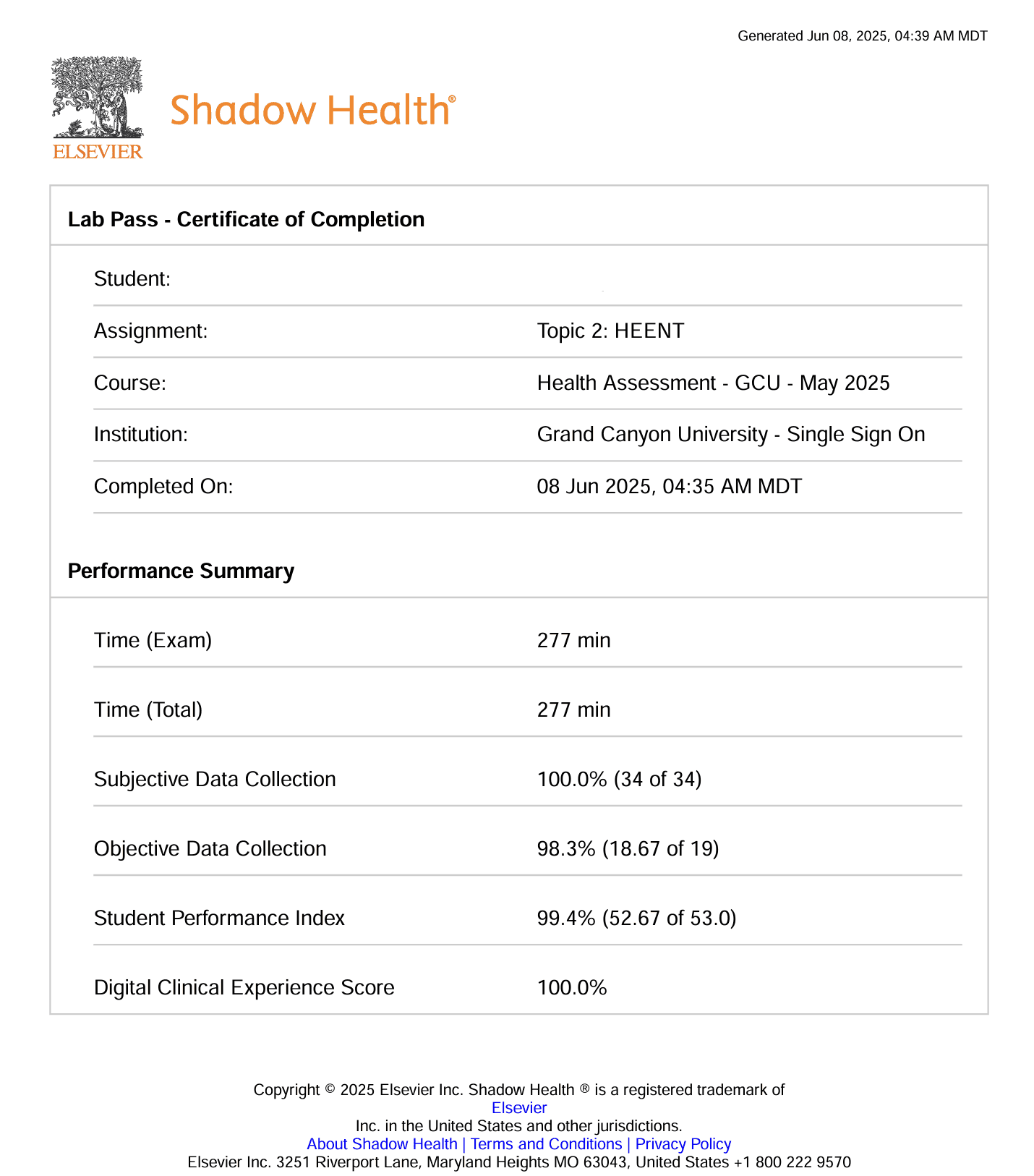
You can attempt this assignment as many times as you would like. After completing the HEENT, you will be awarded a Digital Clinical Experience (DCE) score. The DCE score will appear on your Lab Pass which you will submit to the classroom drop box. The DCE score will be used as your percentage grade for this assignment.
You are not required to submit this assignment to LopesWrite.
What Is Shadow Health HEENT?
Shadow Health HEENT is a Digital Clinical Experience in which you assess the Head, Eyes, Ears, Nose, and Throat system of Tina Jones, a Digital Standardized Patient. The assignment has four required components: interviewing the patient, examining the patient, documenting your findings, and completing post-exam activities. All of it happens inside the Shadow Health platform, and your performance is measured by a DCE score that appears on your Lab Pass.
This is different from a concept lab. Concept labs isolate one narrow skill (see our guides to the Shadow Health Conversation Concept Lab and the Shadow Health Respiratory Concept Lab if you’re working through either of those separately); HEENT is a full patient assessment, which means it rewards organization. Students who interview and examine Tina Jones systematically, region by region, tend to have an easier time documenting afterward than students who jump around.
Shadow Health HEENT Assignment Requirements
| Requirement | What It Means |
|---|---|
| Patient | Tina Jones |
| System | Head, Eyes, Ears, Nose and Throat |
| Platform | Shadow Health |
| Interview | Required |
| Physical examination | Required |
| Documentation | Required |
| Post-exam activities | Required |
| Average time | About 1 hour 15 minutes |
| Attempts | Multiple attempts allowed |
| Performance measure | DCE score |
| Score location | Lab Pass |
| Submission | Lab Pass |
| Submission location | Classroom drop box |
| LopesWrite | Not required |
The 1-hour-15-minute figure is an average, not a guaranteed completion time. A full patient assessment with four required components naturally takes longer than a single-skill concept lab, and needing more time on your first attempt is normal, not a sign you’re doing something wrong.
Working full-time while keeping up with weekly GCU nursing assignments? Get practical academic support when your schedule is already packed. WhatsApp Gradevia: +1 564-544-6924
Shadow Health HEENT Example
How to Complete Shadow Health HEENT Step by Step
Step 1: Open the Correct HEENT Assignment
Confirm you’re working on HEENT specifically, with Tina Jones as the Digital Standardized Patient. Shadow Health includes multiple Tina Jones-based assignments across a nursing curriculum, so it’s worth double-checking you haven’t opened a different system assessment or a different concept lab before you invest 75 minutes into it.
Step 2: Review the Assignment Objective
The goal isn’t to finish quickly. It’s to interview, examine, document, complete the post-exam activities, and review your own performance. Treating any one of those five as optional is usually where students lose points on the DCE score.
Step 3: Conduct the Tina Jones Interview
Organize your questioning by HEENT region instead of asking questions in random order. Below are general assessment areas worth covering, along with original preparation guidance, not Tina Jones’s actual Shadow Health responses.
Head Areas worth exploring: headaches, head injury, dizziness, and other relevant neurological or head symptoms.
Eyes Areas worth exploring: vision changes, eye pain, redness, discharge, visual disturbances, and use of corrective lenses.
Ears Areas worth exploring: hearing changes, ear pain, drainage, tinnitus, and balance concerns.
Nose Areas worth exploring: congestion, nasal drainage, epistaxis (nosebleeds), allergies, and sinus symptoms.
Throat/Mouth Areas worth exploring: sore throat, swallowing difficulty, oral lesions, dental concerns, and voice changes.
Preparing a mental (or written) checklist across these five regions before you start the interview means you’re less likely to skip an area partway through, which is one of the more common reasons students end up back-filling data during documentation.
Shadow Health HEENT Subjective Questions
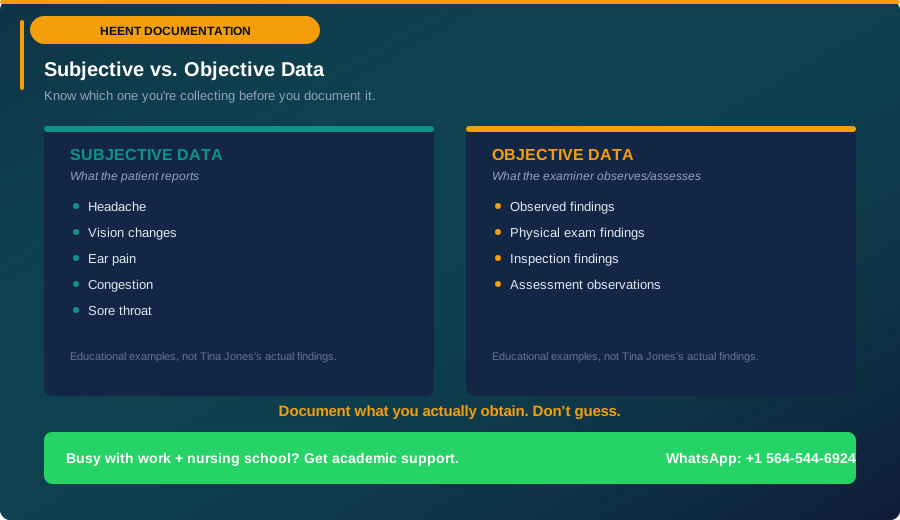
Subjective data is what the patient reports in their own words; objective data is what you observe or measure directly. Both matter, but they get documented differently, so it helps to know which one you’re collecting as you go.
Below are practice examples, not actual Shadow Health questions, showing how to structure subjective questioning by region:
- “Have you noticed any recent changes in your vision?”: gathers subjective visual symptom history.
- “Tell me about any headaches you’ve been experiencing.”: open-ended, invites the patient to describe frequency, quality, and triggers.
- “Have you had any difficulty hearing?”: screens for a specific auditory symptom.
- “Have you experienced nasal congestion?”: screens for a specific nasal symptom.
- “Have you had difficulty swallowing?”: screens for a throat-related functional concern.
Each of these is designed to prompt Tina Jones’s own account of a symptom, which is exactly what subjective data is. Whatever she actually says in your version of the simulation is what you document, not a generic answer copied from somewhere else.
Short on time and struggling with your Shadow Health HEENT assessment? Get help understanding the assignment, organizing your work, and staying on track. Gradevia | WhatsApp: +1 564-544-6924
Shadow Health HEENT Objective Data
Objective data is information you obtain through observation and physical examination, not the patient’s description. It’s assessed rather than reported.
Organized by region, here’s what a HEENT exam generally assesses (these are general clinical reference points, not Tina Jones’s actual Shadow Health findings):
Head: general appearance, symmetry, scalp condition, and any visible abnormalities.
Eyes: pupil response, extraocular movements, visual acuity where assessed, conjunctiva and sclera appearance.
Ears: external ear appearance, hearing screening findings, and otoscopic examination where performed.
Nose: nasal mucosa appearance, patency, and any visible drainage or abnormality.
Throat/Mouth: oral mucosa, tonsils, and pharynx appearance, and any visible lesions.
The technique matters as much as the region. A systematic approach (checking the same features in the same order every time) makes it much easier to notice when something looks different from what you’d expect, and it also makes documentation faster because you’re not trying to reconstruct what you looked at after the fact.
Shadow Health HEENT Assessment: A Practical Examination Framework
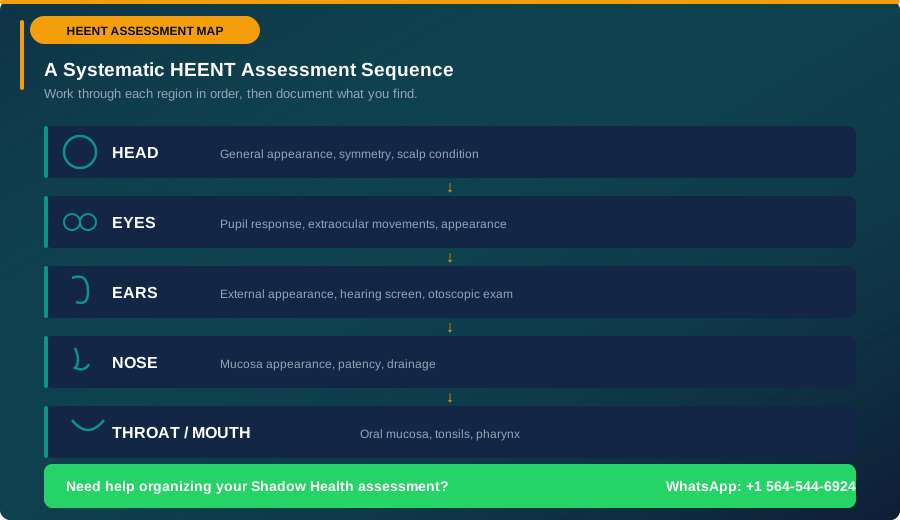
Use a consistent sequence rather than jumping randomly between regions:
Observe → Inspect → Compare → Assess → Document
A practical checklist to work through in order:
- Head: general appearance and any reported symptoms addressed
- Eyes: external appearance and functional assessment completed
- Ears: external appearance and hearing-related assessment completed
- Nose: appearance and patency assessed
- Oral cavity/throat: mucosa and structures assessed
This guide won’t describe exact Shadow Health clicks, menus, or interface buttons, since those can change between platform updates. What stays constant is the underlying clinical sequence, which is what actually earns the DCE credit.
Shadow Health HEENT Documentation
Documentation is a distinct skill from the interview and exam themselves. Three categories to keep separate:
Subjective: what Tina reports in her own words.
Objective: what you observe or measure during the exam.
Assessment findings: what the collected information indicates in the context of the assignment.
Below is a practice documentation example, not Tina Jones’s actual Shadow Health data, showing how vague documentation can be tightened up:
Weak: “Eyes normal.”
Stronger (once supported by actual findings you obtained): “Pupils equal, round, and reactive to light. No discharge or redness noted. Patient reports no vision changes.”
The difference isn’t length for its own sake. It’s specificity: the second version tells another clinician exactly what was checked and what was found, rather than asserting a conclusion with nothing behind it.
How to Document Shadow Health HEENT Findings Without Making Things Up
The single most important documentation rule: only document what you actually obtained from the patient interview or physical examination.
Copying findings from an online Tina Jones answer sheet and pasting them into your own documentation is a real risk here, because HEENT findings are patient-specific within the simulation. If the answer sheet doesn’t match what your version of Tina Jones actually reported or what your exam actually found, your documentation becomes inaccurate, which can cost you more on the DCE score than an incomplete but honest entry would.
A simple framework for writing each documentation entry:
Finding → location/system → relevant characteristics → supporting observation
Accuracy beats completeness. A shorter, accurate note is more useful, and more defensible, than a longer one padded with details you didn’t actually verify.
Shadow Health HEENT Tina Jones Assessment Answers: What Students Should Know
It’s understandable to want to know what Tina Jones will say or what findings should appear before you start. That’s a lot of unknowns to walk into for a 75-minute graded assignment.
The honest answer is that no fabricated “correct answers” belong in this guide, because Tina Jones’s specific responses in your version of the simulation are what you’re supposed to be assessing, not confirming against an outside source. What’s actually useful instead:
- Prepare using the region-by-region interview structure above so you don’t miss areas.
- Recognize which information is relevant to HEENT versus other body systems, so you don’t waste time chasing unrelated symptoms.
- Document only the findings you actually obtained.
- Read any feedback the platform gives you after the attempt.
- Use that feedback to adjust your approach on a subsequent attempt, rather than repeating the same gaps.
Preparation guidance (how to approach the assignment) and patient-specific findings (what Tina Jones actually says or shows in your simulation) are two different things. This guide only offers the former.
Shadow Health HEENT Tina Jones Interview Guide
A practical interview roadmap, organized as questioning strategies rather than a proprietary script:
- Opening the interaction: introduce yourself and establish rapport before diving into clinical questions.
- Identifying the chief concern: start broad enough to let Tina Jones describe what brought her in.
- Head symptoms: headaches, injury history, dizziness.
- Eye symptoms: vision changes, pain, discharge, corrective lenses.
- Ear symptoms: hearing changes, pain, drainage, tinnitus.
- Nose/sinus symptoms: congestion, drainage, allergies.
- Mouth/throat symptoms: sore throat, swallowing, oral lesions, voice changes.
- Relevant history: anything Tina Jones mentions that connects to HEENT findings (prior diagnoses, medications, allergies).
- Clarifying questions: if an initial answer is vague, follow up rather than moving on.
- Closing the interview: confirm you haven’t missed anything before moving to the physical exam.
These are questioning strategies, not an exact Shadow Health transcript. What Tina Jones actually says at each step in your specific attempt is the platform’s content, not something reproduced here.
Shadow Health HEENT Transcript
Students search for transcripts hoping to review or confirm terminology, or to see how a full interaction is supposed to flow. A few things worth knowing before relying on one:
- Transcripts posted by other students may be incomplete or edited.
- Shadow Health content can change between platform updates and course versions.
- A copied transcript from another student’s attempt may not reflect what your version of the activity actually presents.
- Your own interview and exam findings, not someone else’s transcript, are what your documentation should be based on.
No transcript is reproduced or fabricated in this guide, and treating any unofficial transcript as authoritative for your specific attempt is a real risk to your documentation’s accuracy.
Shadow Health HEENT Answer Key PDF
The appeal of an answer-key PDF is obvious: a fast, seemingly verified reference for a complex assignment. The problem is reliability. Unofficial PDFs can be outdated, built around a different course version, and simply inconsistent with what your specific attempt presents. Patient findings in this assignment are meant to come from your own simulation session, not a downloaded document.
Better Than an Answer Key: The HEENT Completion Framework
Interview → Physical Exam → Document → Post-Exam Activities → Review DCE → Lab Pass → Submit
This sequence works regardless of which version of the activity you’re given, which a static PDF can’t guarantee.
Shadow Health HEENT PDF and Quizlet Resources
PDFs and Quizlet sets built by other students can be reasonably useful for:
- Terminology review (subjective vs. objective, HEENT-specific vocabulary)
- General HEENT assessment concepts
- Understanding normal vs. abnormal findings in general
- Documentation principles
- Question preparation before your interview
They’re less reliable as an authoritative answer source for your specific graded attempt, since Tina Jones’s responses and your exam findings are patient-simulation-specific. This guide doesn’t link to or promote any unauthorized copies of proprietary Shadow Health content.
How to Improve Your DCE Score on Shadow Health HEENT
The DCE score is used as your percentage grade for this assignment, so a deliberate approach pays off.
1. Prepare before starting. Review the region-by-region structure so you’re not improvising mid-interview.
2. Use a systematic interview. Working through head, eyes, ears, nose, and throat in order reduces the chance of skipping something.
3. Don’t skip relevant HEENT areas, even ones that seem unlikely to be significant. A quick screening question in every region is faster than realizing later you missed one entirely.
4. Perform the physical assessment systematically, using the same observe-inspect-compare-assess-document sequence every time.
5. Document actual findings, not assumptions or copied answers.
6. Read feedback carefully if the platform provides it after your attempt.
7. Use multiple attempts strategically, since the assignment allows more than one.
8. Review weak areas before retrying, rather than repeating the exact same approach.
9. Check the final DCE score before considering the assignment done.
None of this guarantees a specific score, but deliberate preparation and honest documentation tend to produce more consistent results than rushing or copying.
Not getting the performance you expected from your Shadow Health attempts? Get practical academic guidance before your next attempt. WhatsApp Gradevia: +1 564-544-6924
How to Use Multiple Attempts Strategically
The assignment allows multiple attempts, and a productive approach looks like this:
First attempt → identify weak areas → review → second attempt → compare performance.
Mindlessly repeating the exact same interview and exam approach on a second attempt tends to reproduce the same gaps. Use whatever feedback or DCE breakdown the platform provides to figure out what specifically needs to change first.
How Long Does Shadow Health HEENT Take?
Students spend an average of about 1 hour and 15 minutes on the assignment. This is an average, not a target. Some students need additional time, especially if they’re new to the Shadow Health platform or still building comfort with the interview-exam-document workflow. Rushing through the interview or physical examination to hit a specific time can hurt both your learning and your DCE score, since incomplete data collection tends to show up in weaker documentation.
A 75-Minute Shadow Health HEENT Study Plan
This is a suggested time-management strategy, not an official Shadow Health schedule:
- 0-5 minutes: Review the assignment requirements.
- 5-20 minutes: Prepare your interview strategy using the region-by-region structure.
- 20-45 minutes: Conduct the interview and physical examination.
- 45-60 minutes: Complete documentation and post-exam activities.
- 60-70 minutes: Review feedback and any uncertain areas.
- 70-75 minutes: Verify your DCE score, confirm the Lab Pass reflects it, and check submission requirements.
What to Submit After Completing Shadow Health HEENT
- Complete the HEENT assignment (interview, exam, documentation, post-exam activities).
- Receive your DCE score.
- Locate your Lab Pass.
- Confirm the DCE score appears on it.
- Submit the Lab Pass to your classroom drop box.
- LopesWrite is not required for this assignment.
Do You Need LopesWrite for Shadow Health HEENT?
No. The assignment instructions state that LopesWrite is not required.
12 Common Shadow Health HEENT Mistakes
- Starting without understanding the assignment workflow. Why it matters: you miss the four required components. Instead: review interview, exam, documentation, and post-exam activities before beginning.
- Confusing HEENT with another Tina Jones simulation. Why it matters: you waste time on the wrong assignment. Instead: verify the activity name before starting.
- Asking questions randomly. Why it matters: it’s easy to miss a region entirely. Instead: work through head, eyes, ears, nose, and throat systematically.
- Failing to cover all major HEENT areas. Why it matters: gaps in the interview show up as gaps in documentation. Instead: use the five-region checklist.
- Mixing subjective and objective data. Why it matters: documentation quality depends on the distinction. Instead: label what the patient reports separately from what you observe.
- Documenting assumptions rather than actual findings. Why it matters: inaccurate documentation is worse than incomplete documentation. Instead: only document what you personally obtained.
- Copying findings from an online answer key. Why it matters: patient-specific findings won’t match a generic source. Instead: base documentation on your own attempt.
- Treating a Quizlet set as an official source. Why it matters: crowd-sourced material may not reflect your current activity. Instead: use it for terminology review only.
- Relying on an old transcript. Why it matters: platform content can change between course versions. Instead: work through your own live interview.
- Skipping post-exam activities. Why it matters: they’re a required, gradable component. Instead: treat them as part of the assignment, not an optional add-on.
- Forgetting to review the DCE score. Why it matters: it’s your actual grade. Instead: check it before considering the assignment complete.
- Submitting the wrong item instead of the Lab Pass. Why it matters: your instructor grades the Lab Pass specifically. Instead: confirm you’re uploading the Lab Pass to the drop box.
Shadow Health HEENT Troubleshooting Guide
“I don’t know what questions to ask Tina Jones.” Organize by HEENT region (head, eyes, ears, nose, throat) and use a screening question in each before following up on anything positive.
“I don’t know whether something belongs under subjective or objective data.” Simple test: if it’s something Tina Jones told you, it’s subjective. If it’s something you personally observed, measured, or assessed, it’s objective.
“I found a Tina Jones answer key online. Should I use it?” Verify anything you find against your own assigned activity rather than relying on it directly. Patient-specific findings in this simulation are meant to come from your own attempt, and an unofficial answer key may not match yours.
“My first DCE score was low.” Review whatever feedback the platform gives you, identify which specific areas were weak (interview coverage, documentation accuracy, or a skipped region), and address that specific gap before retrying.
“I finished the assessment but don’t know what to submit.” Your DCE score appears on the Lab Pass. Submit the Lab Pass itself to your classroom drop box; LopesWrite isn’t required.

Final Shadow Health HEENT Checklist
- I opened the correct Shadow Health HEENT assignment
- I confirmed Tina Jones is the Digital Standardized Patient
- I reviewed the assignment requirements
- I completed the patient interview
- I assessed the head
- I assessed the eyes
- I assessed the ears
- I assessed the nose
- I assessed the throat/mouth
- I documented the findings I actually obtained
- I completed the post-exam activities
- I reviewed my performance
- I checked my DCE score
- I located my Lab Pass
- I submitted the Lab Pass to the classroom drop box
- I did not submit the assignment to LopesWrite because it is not required
Working Full-Time + Nursing School + Weekly Assignments? You don’t need to wait until the deadline to look for academic support. Get practical coursework support from Gradevia. WhatsApp: +1 564-544-6924
FAQ
1. What is Shadow Health HEENT? A Digital Clinical Experience where you interview and examine Tina Jones, a Digital Standardized Patient, focusing on the Head, Eyes, Ears, Nose, and Throat system, then document your findings and complete post-exam activities.
2. Who is the patient in Shadow Health HEENT? Tina Jones, a Digital Standardized Patient used across several Shadow Health assignments.
3. What does the HEENT assignment require? An interview, a physical examination, documentation of your findings, and post-exam activities, all within the Shadow Health platform.
4. How long does Shadow Health HEENT take? About 1 hour and 15 minutes on average, though some students reasonably need more time.
5. Can I retake Shadow Health HEENT? Yes, the assignment allows multiple attempts.
6. What is the DCE score? The Digital Clinical Experience score you receive after completing the assignment. It’s used as your percentage grade.
7. Where can I find the DCE score? On your Lab Pass.
8. What is the Lab Pass? The document showing your DCE score that you submit as proof of completion.
9. What do I submit for Shadow Health HEENT? After completing the HEENT assignment, your DCE score appears on the Lab Pass. You submit the Lab Pass to the classroom drop box. LopesWrite submission is not required.
10. Do I need LopesWrite for Shadow Health HEENT? No. The assignment instructions state it isn’t required.
11. What subjective questions should I ask during HEENT? Questions organized by region: head (headaches, dizziness), eyes (vision changes, pain), ears (hearing, drainage), nose (congestion, allergies), and throat/mouth (sore throat, swallowing difficulty).
12. What is objective data in a HEENT assessment? Information you obtain through direct observation or physical examination, such as pupil response or oral mucosa appearance, as opposed to what the patient reports.
13. How should I document Shadow Health HEENT findings? Separate subjective (patient-reported) from objective (examiner-observed) data, and only document findings you actually obtained during your own interview and exam.
14. Is there a Shadow Health HEENT answer key? No verified official answer key is published for students. Patient-specific findings are meant to come from your own attempt, not an outside source.
15. Is the Shadow Health HEENT answer key PDF reliable? Treat any unofficial PDF with caution. It isn’t an official Shadow Health or school resource and may not match your specific attempt.
16. Can Quizlet help with Shadow Health HEENT? It can help with general terminology and concept review, but shouldn’t be treated as an authoritative source for your specific graded findings.
17. Can I use a Shadow Health HEENT transcript? Transcripts from other students may be outdated or incomplete. Your own interview and exam are the reliable basis for your documentation.
18. How do I improve my HEENT DCE score? Prepare using a systematic region-by-region approach, document only actual findings, read feedback carefully, and use additional attempts to address specific weak areas.
19. What should I do if I get a low score? Review the feedback provided, identify the specific gap (missed region, documentation accuracy, incomplete post-exam activities), and address that gap directly before retrying.
20. What is the Tina Jones Shadow Health HEENT assessment? It’s the specific HEENT assignment in which Tina Jones serves as the Digital Standardized Patient for a head, eyes, ears, nose, and throat assessment, distinct from other Tina Jones-based Shadow Health assignments covering different body systems.
More Gradevia Resources for GCU Nursing Students
Conclusion
Shadow Health HEENT rewards the same thing a real HEENT assessment does: a systematic approach. Interview Tina Jones region by region, examine her the same way, document only what you actually find, and treat the post-exam activities as part of the assignment rather than an afterthought. Skip the search for an unverifiable answer key or transcript, since patient-specific findings in this simulation are meant to come from your own attempt, and lean on the completion framework in this guide instead. It transfers across attempts and versions in a way a copied answer sheet never will, and it’s a more reliable path to both your DCE score and the assessment skills you’ll actually use in clinical practice.
References
- Ahn, S., & Jeong, H. (2025). Exploring nursing students’ experiences with virtual patient-based health assessment simulation program: A qualitative study. Nurse Education Today, 153, 106826. https://doi.org/10.1016/j.nedt.2025.106826
- Cho, M.-K., & Kim, M. Y. (2024). Enhancing nursing competency through virtual reality simulation among nursing students: A systematic review and meta-analysis. Frontiers in Medicine, 11, 1351300. https://doi.org/10.3389/fmed.2024.1351300
- Wong, I. Y. F., Kwok, T. T. O., Leung, L. Y. L., Lam, Y. H. L., & So, G. L. H. (2024). Immersive virtual reality simulation for learning fundamental nursing skills: A mixed-methods study. Nurse Educator, 49(6), E321-E326. https://doi.org/10.1097/NNE.0000000000001675
- Gao, Y., & Zhu, X. (2023). Research on the learning experience of virtual simulation class experimental teaching and learning based on the perspective of nursing students. BMC Nursing, 22, 367. https://doi.org/10.1186/s12912-023-01534-z
- Medel, D., Reguant, M., Cemeli, T., Jiménez Herrera, M., Campoy, C., Bonet, A., Sanromà-Ortíz, M., & Roca, J. (2024). Analysis of knowledge and satisfaction in virtual clinical simulation among nursing students: A mixed study. Nursing Reports, 14(2), 1067-1078. https://doi.org/10.3390/nursrep14020081