
Blog
Adolescence Contemporary Issues and Resources: How to Complete This Nursing Assignment + Example

This assignment puts you in the role of a nurse working in a high-school health clinic. You need to pick one contemporary issue a teenager might bring to you, besides teen pregnancy, and cover five specific things about it in 500 to 750 words: the issue and its stressors, how you’d screen for it, how you’d build trust with the teenager, what you can and can’t tell their parents, and where you’d send them for support, backed by at least three peer-reviewed sources from the past five years.
That’s a lot to fit into a short paper. The students who struggle with this assignment usually aren’t struggling with adolescent health as a topic, they’re struggling with narrowing scope: picking an issue specific enough to actually answer all five requirements within 750 words, instead of writing a general overview that touches on all five loosely.
This guide walks through picking a workable issue, answering each requirement specifically, sourcing it correctly, and checking it against the rubric before you submit.
Adolescence Contemporary Issues and Resources Assignment
Research the range of contemporary issues teenagers face today. Select one issue (besides teen pregnancy) a teenager might come to discuss with a nurse in a health clinic at a local high school. In a 500-750-word paper include the following:
- Describe the contemporary issue and explain what external stressors are associated with this issue.
- Identify specific questions or assessment tool would you use to screen for this issue.
- Outline strategies you, the nurse, would use to establish a therapeutic relationship with the teenager.
- Define the legal and ethical parameters regarding what you can and cannot share with the parent or guardian.
- Identify specific support options you will provide for your patient and/or their family to access? Include the contact information for the support option.
You are required to cite a minimum of three peer-reviewed sources to complete this assignment. Sources must be published within the past 5 years, appropriate for the assignment criteria, and relevant to nursing practice.
Prepare this assignment according to the guidelines found in the APA Style Guide, located in the Student Success Center.
This assignment uses a rubric. Please review the rubric prior to beginning the assignment to become familiar with the expectations for successful completion.
You are required to submit this assignment to LopesWrite. A link to the LopesWrite technical support articles is located in Class Resources if you need assistance.

What Is This Assignment Really Asking?
Underneath the prompt, you’re being asked to demonstrate that you can:
- Recognize a contemporary adolescent health issue.
- Explain the external stressors surrounding it.
- Screen the teenager appropriately.
- Communicate therapeutically with an adolescent patient.
- Protect confidentiality within actual legal and ethical limits.
- Connect the patient and family with real support.
- Support all of it with recent peer-reviewed nursing and health literature.
Simply describing an adolescent problem isn’t enough. The paper needs to show nursing action at every step, not just clinical knowledge.
What Are Some of the Contemporary Issues Teenagers Face Today?
A practical list of issues that show up in current adolescent-health literature and clinical practice:
- Mental health concerns, including anxiety and depression
- Suicide and self-harm risk
- Bullying and cyberbullying
- Social media-related pressures
- Substance use, including vaping and nicotine
- Alcohol and drug misuse
- Eating disorders and disordered eating
- Body-image concerns
- Sleep problems
- Violence and abuse
- Sexual health concerns and STIs
- Gender and identity-related stress
- Academic pressure
- Family conflict
- Socioeconomic stress and housing instability
- Discrimination and social exclusion
- Chronic disease management during adolescence
- Technology-related behavioral concerns
None of these apply automatically to every teenager. Prevalence and relevance depend on the specific population, location, and current evidence you’re drawing from, which is exactly why the assignment wants you to research your chosen issue rather than write from assumption.
What Are the Problems Faced by Teenagers Today?
These issues tend to cluster into overlapping domains, which is useful for understanding how your chosen issue connects to broader stressors:
Physical health: sleep problems, nutrition concerns, substance use, sexual health, chronic health conditions.
Mental and emotional health: anxiety, depression, self-harm, suicidal thoughts, stress, low self-esteem.
Social pressures: peer pressure, bullying, cyberbullying, social-media comparison, isolation, relationship conflict.
Academic and family pressures: school performance, college or career pressure, parental expectations, family conflict, financial stress.
Environmental stressors: poverty, unsafe housing, community violence, discrimination, lack of access to healthcare.
These domains overlap constantly in real adolescent presentations, which is worth acknowledging in your paper even while you keep your actual focus narrow.
What Are the 5 Biggest Concerns Today’s Adolescent Faces?
There isn’t one universally accepted “top five.” What follows is a practical framework representing categories consistently identified across contemporary adolescent-health literature, not an unsupported ranking:
- Mental health and emotional well-being
- Substance use, including vaping and other substances
- Bullying, cyberbullying, and social pressures
- Body image, nutrition, and eating-related concerns
- Academic, family, financial, and other environmental stressors
Sexual health, violence, chronic disease, and sleep are also significant concerns; which five matter most depends heavily on the population and source you’re drawing from. Treat this framework as a starting point for topic selection, not a citable ranking.
What Are the Biggest Challenges Faced by Teenagers Today?
One major challenge cuts across nearly every specific issue: stressors interact rather than existing in isolation. For example:
Academic pressure + social-media comparison + family conflict + inadequate sleep → increased emotional stress
This is an illustrative framework, not a claim about every adolescent’s experience. It’s useful for your paper because it reflects why nurses assess the teenager as a whole person rather than treating one issue as if it exists independently of everything else going on in their life.
How to Choose the Best Contemporary Issue for This Assignment
Don’t pick an issue because it’s popular or because you assume it’s an easy topic. Pick one that makes it straightforward to answer all five required components within 750 words.
| Possible Issue | Easy to Describe? | Screening Tool Available? | Therapeutic Communication? | Confidentiality Issues? | Support Resources? |
|---|---|---|---|---|---|
| Adolescent depression | Yes | Yes | Yes | Yes | Yes |
| Anxiety | Yes | Yes | Yes | Yes | Yes |
| Substance use | Yes | Yes | Yes | Yes | Yes |
| Bullying | Yes | Assessment questions | Yes | Yes | Yes |
| Eating concerns | Yes | Yes | Yes | Yes | Yes |
| Sleep problems | Yes | Yes | Yes | Yes | Yes |
A strong issue lets you answer all five columns without stretching. If you find yourself struggling to name a specific screening question or a real support resource for your chosen issue, that’s a sign to reconsider your topic before you’re deep into writing.
Teen pregnancy is explicitly excluded by the assignment. Don’t select it.
A Strong Assignment Topic: Adolescent Mental Health
Mental health concerns (anxiety and depression specifically) tend to work well for this assignment because validated screening tools exist, confidentiality considerations are well documented in nursing literature, and support resources are easy to identify with current contact information. That said, mental health isn’t the only workable choice. Any issue works if you can identify a valid screening approach, relevant stressors, concrete therapeutic communication strategies, real confidentiality considerations, and a credible, current support resource.
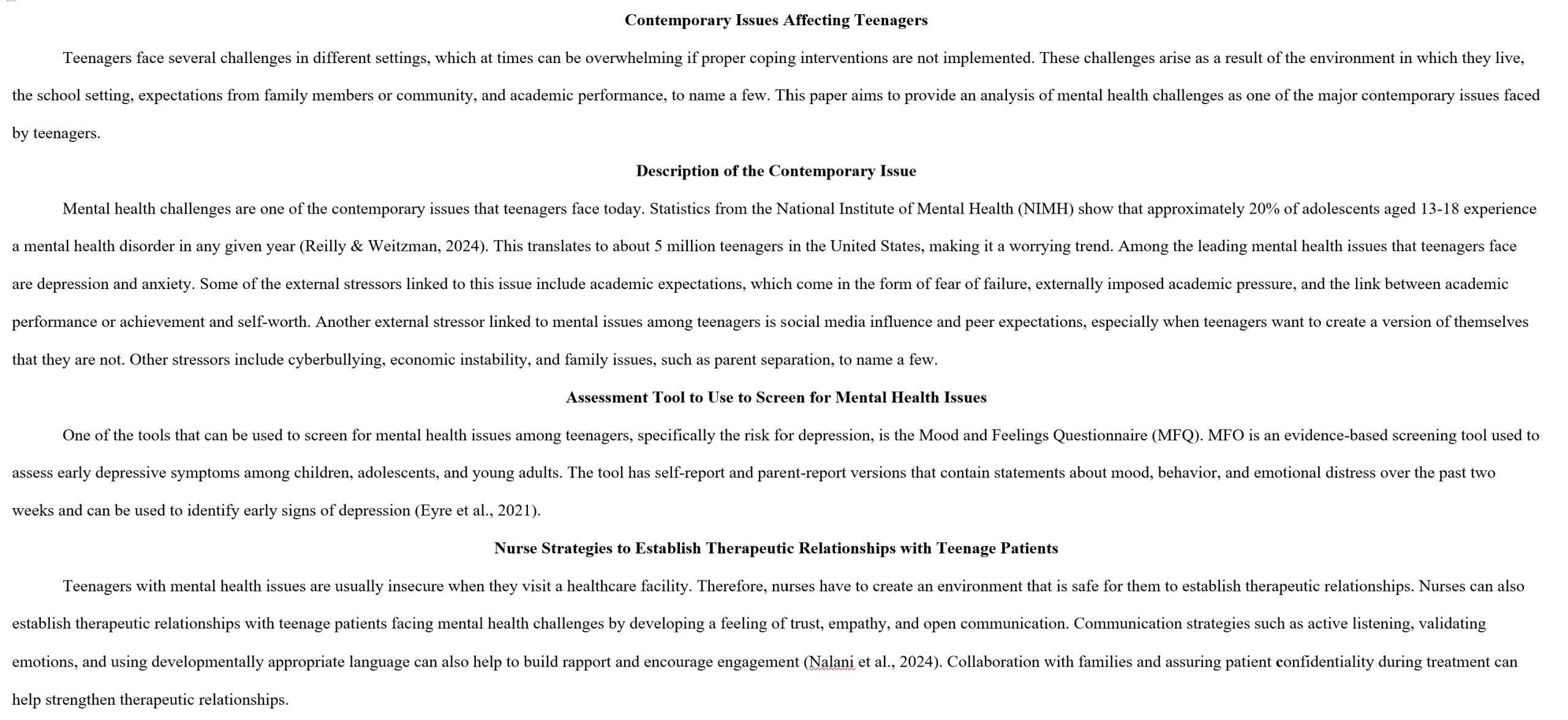
Adolescence Contemporary Issues and Resources Example
Working full-time while keeping up with weekly GCU nursing assignments? Get practical academic support when your schedule is already packed. WhatsApp Gradevia: +1 564-544-6924
Requirement 1: Describe the Contemporary Issue and External Stressors
Structure this section as: Define the issue → Explain why it matters in adolescents → Identify external stressors → Connect stressors to nursing assessment.
“External stressors” shouldn’t become a bare list. Explain how a specific stressor actually contributes to, worsens, or complicates your chosen issue, backed by your sources rather than assumption.
Stressor categories worth considering: family conflict, peer relationships, bullying, cyberbullying, social media, academic pressure, financial hardship, housing instability, community environment, discrimination, relationship conflict, access to healthcare, and substance exposure. Pick two or three that genuinely connect to your chosen issue rather than listing all of them.
Requirement 2: Screening Questions or Assessment Tool
The assignment specifically asks for specific questions or an assessment tool. A vague sentence like “the nurse should assess the teenager’s mental health” won’t satisfy this requirement.
Instead, identify:
- What you would actually ask
- Why you would ask it
- What validated tool could be used, if applicable
- What that tool measures
- Why it fits adolescent screening specifically
- What the nurse should do if screening identifies risk
Some validated tools commonly referenced in adolescent screening literature, depending on your chosen issue: the PHQ-9 (or an adolescent-adapted version) for depression, the GAD-7 for anxiety, the CRAFFT for adolescent substance use, and the SCOFF questionnaire for disordered eating. If you reference a specific instrument, verify its intended population, purpose, scoring approach, and clinical limitations against current, authoritative sources rather than relying on memory or a secondhand summary. Scoring thresholds and interpretation guidance change and vary by version, so confirm them directly against the current instrument documentation before citing a specific cutoff in your paper.
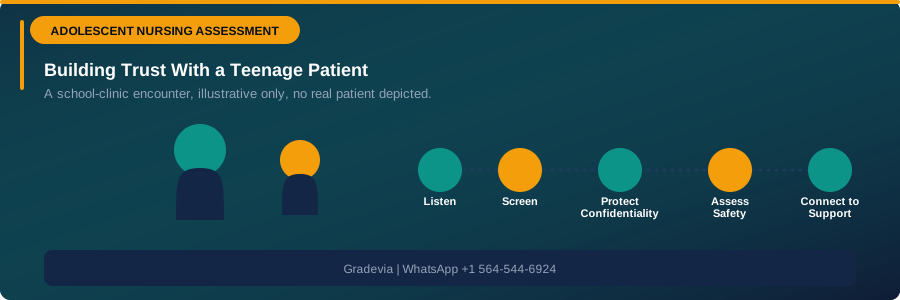
Requirement 3: Establishing a Therapeutic Relationship With the Teenager
A few concrete strategies, adolescent-specific rather than generic:
Privacy. A private conversation, without a parent present for at least part of the visit, can encourage disclosure, subject to your setting’s applicable safety and legal requirements.
Nonjudgmental communication. Avoid language that sounds accusatory or dismissive, even unintentionally, when a teenager discloses something sensitive.
Open-ended questions. These let the adolescent describe concerns in their own words rather than answering to a script.
Active listening. Reflect back what you heard before moving to the next question, so the teenager knows they were actually heard.
Developmentally appropriate language. Skip technical jargon that a teenage patient may not follow or may feel talked down to by.
Transparency about confidentiality. Explain the limits of confidentiality before asking sensitive questions, not after.
Cultural humility. Avoid assumptions about family structure, identity, relationships, substance use, or behavior based on appearance or background.
Safety. Rapport-building never overrides mandatory reporting or safety obligations. Be clear with yourself, and eventually in your paper, about where that line sits.
A practical example of putting transparency and privacy together: “Before we get into some questions about your day-to-day life, I want you to know that most of what we discuss stays between us, but there are a few situations where I’d need to involve someone else to keep you safe. I’ll tell you if we get there.”
Requirement 4: Legal and Ethical Parameters: What Can the Nurse Share With the Parent or Guardian?
This is the section where vague or absolute statements will cost you the most credibility. Confidentiality for minors is not governed by one universal rule that applies in every situation.
Avoid writing either of these:
- “Everything the teenager tells the nurse is confidential.” This is inaccurate and unsafe.
- “The nurse must tell the parents everything.” This is also inaccurate.
What your paper should actually address:
- Applicable state law and minor-consent statutes, since these vary by jurisdiction and by the type of service involved
- Your school or institution’s specific health policies
- Mandatory reporting requirements for abuse or neglect
- Disclosure obligations when there’s imminent safety risk, including suicidal or homicidal risk
- Situations where certain services (such as some mental health, substance use, or reproductive health services) carry specific confidentiality protections for minors under some state laws, separate from general disclosure rules
If your course materials specify a particular state or jurisdiction for this scenario, research that jurisdiction’s actual minor-consent and confidentiality law rather than writing generally. Use current, authoritative sources (state statutes, board of nursing guidance, or recent peer-reviewed nursing ethics literature) rather than a general assumption about how confidentiality “usually” works.
Requirement 5: Support Options for the Teenager and Family
The assignment wants specific support options plus contact information, not a vague referral. “Refer the patient to counseling” doesn’t meet this requirement on its own.
For whatever resource you choose, include:
- Organization name
- Type of service
- Who it serves
- Why it fits your selected issue
- How the patient or family can access it (phone, text, chat, website)
- Whether crisis/emergency services are available, if relevant
A few real, current national resources depending on topic area (verify current details against each organization’s official site before submitting, since contact information can change):
- 988 Suicide & Crisis Lifeline: call or text 988, or chat at 988lifeline.org, for suicide risk or emotional crisis, available 24/7.
- Crisis Text Line: text HOME to 741741 for free, 24/7 crisis support by text.
- SAMHSA National Helpline: 1-800-662-4357 (1-800-662-HELP), for mental health and substance use treatment referrals, available 24/7 in English and Spanish.
- The Trevor Project: call 1-866-488-7386 or text START to 678678, crisis support for LGBTQ+ youth, available 24/7.
- National Alliance for Eating Disorders Helpline: 1-866-662-1235, referrals to eating disorder treatment, staffed by licensed therapists, available weekdays 9am-7pm ET (not a 24/7 crisis line; for crisis support, direct to 988 or Crisis Text Line instead).
Pick the one or two resources that actually match your chosen issue, not this whole list. Confirm the current number and hours directly on the organization’s website before you submit, since this kind of information does change.
Short on time and struggling with your Adolescence Contemporary Issues and Resources paper? Get help understanding the assignment, organizing your research, and staying on track. Gradevia | WhatsApp: +1 564-544-6924
How to Use Three Recent Peer-Reviewed Sources
The assignment requires a minimum of three peer-reviewed sources published within the past five years. Before you cite anything, verify:
- Publication date falls within the required window.
- Peer-reviewed status: check the journal directly, not just whether the article looks academic. A polished website is not the same as peer review.
- Relevance to your selected issue specifically, not adolescent health generally.
- Relevance to nursing practice, not just general psychology or public health.
- Whether the source actually supports the specific claim you’re citing it for, rather than being adjacent to your topic.
Prioritize peer-reviewed nursing journals, peer-reviewed medical or health journals, systematic reviews, and evidence-based clinical literature. When you need legal or policy context (for the confidentiality section, for example), authoritative sources like state statutes or professional nursing organization guidance are appropriate alongside your peer-reviewed clinical sources, but they don’t substitute for the three required peer-reviewed sources themselves.
Research Strategy for Finding Sources
Useful search combinations in your library database:
- adolescent + [your issue] + nursing
- adolescent health + [your issue] + screening
- adolescent + [your issue] + systematic review
- adolescent + [your issue] + therapeutic communication
- adolescent confidentiality + nursing
- adolescent health screening + primary care
Filter results to the most recent five-year window and skim the abstract for actual relevance to your specific issue and to nursing practice before committing to a source. Never invent a citation, and if a specific paper you remember reading turns out to be hard to verify, don’t cite it from memory: find and confirm the actual source, or leave it out.
How to Build the 500-750-Word Paper
A rough word allocation to keep every requirement covered without any one section eating the whole word count:
| Section | Approximate Words |
|---|---|
| Introduction/issue | 80-100 |
| External stressors | 80-100 |
| Screening questions/tool | 100-120 |
| Therapeutic relationship | 100-120 |
| Legal/ethical considerations | 120-150 |
| Support resources | 70-100 |
| Conclusion | 40-60 |
These are planning suggestions, not official rubric requirements, but they add up to roughly the assignment’s actual range. Don’t spend more than a sentence or two on your introduction; the word count is tight enough that a long windup crowds out one of the five graded requirements.
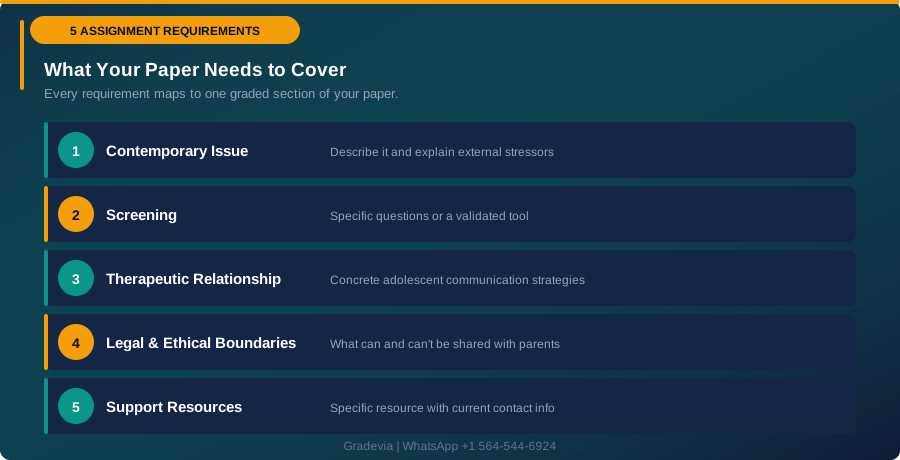
Recommended Paper Structure
- Introduction: briefly name your selected contemporary adolescent issue.
- Contemporary Issue and External Stressors: describe the issue and explain relevant stressors.
- Screening: identify specific questions and/or an appropriate assessment tool.
- Therapeutic Relationship: explain how you’d establish trust and communicate effectively.
- Legal and Ethical Considerations: explain confidentiality and disclosure boundaries accurately.
- Support Resources: identify specific resources and contact information.
- Conclusion: briefly reinforce the nurse’s role in addressing this issue.
This structure maps directly to the five graded requirements, which makes it easy to self-check against the rubric before you submit.
APA 7 Requirements to Check
- Title page, if your course or instructor requires one
- Appropriate headings for a paper this length (often minimal, given the short word count)
- In-text citations for every claim drawn from a source
- A complete reference list matching every in-text citation
- Correct author/date formatting
- DOI formatting when a DOI is available
- Paraphrasing as the default, with quotations used sparingly
- Correct capitalization and italics in titles and reference entries
- Double spacing and any other course-specific formatting requirements
Your course’s specific APA Style Guide and your instructor’s stated requirements take priority over general APA guidance whenever the two differ.
How to Use the Rubric Before Writing
| Rubric Area | Question to Ask Before Submitting |
|---|---|
| Contemporary issue | Did I clearly describe one issue? |
| External stressors | Did I explain relevant stressors rather than merely list them? |
| Screening | Did I identify specific questions or an appropriate assessment tool? |
| Therapeutic relationship | Did I explain concrete nursing communication strategies? |
| Legal/ethical | Did I explain confidentiality and exceptions accurately? |
| Support | Did I provide actual resources and contact information? |
| Sources | Do I have at least 3 recent peer-reviewed sources? |
| APA | Are citations and references formatted correctly? |
| Word count | Is the paper between 500 and 750 words? |
| LopesWrite | Did I complete the required submission? |
Compare every paragraph against this table before you consider the draft finished, not just the paper as a whole.
Common Mistakes That Lower the Quality of This Assignment
- Choosing an issue that’s too broad. Correction: narrow to one specific issue you can cover fully within 750 words.
- Writing about teen pregnancy despite the exclusion. Correction: choose any other issue from the list above.
- Describing the problem without discussing external stressors. Correction: explicitly connect at least two or three stressors to the issue.
- Listing stressors without explaining their relevance. Correction: explain how each stressor actually affects the issue, not just that it exists.
- Saying “screen the patient” without naming questions or a tool. Correction: name a specific tool or specific questions.
- Using a screening tool without explaining why it fits. Correction: connect the tool’s purpose directly to your chosen issue.
- Giving generic communication advice. Correction: use concrete, adolescent-specific strategies with an example.
- Ignoring adolescent confidentiality nuance. Correction: address both the general principle and the exceptions.
- Claiming everything is confidential. Correction: name the specific exceptions (safety, abuse/neglect, jurisdiction-specific rules).
- Claiming parents must always be told everything. Correction: explain that disclosure depends on the issue, jurisdiction, and safety circumstances.
- Ignoring mandatory reporting and safety exceptions. Correction: explicitly state when confidentiality doesn’t apply.
- Providing vague support recommendations. Correction: name the actual organization and current contact method.
- Giving outdated contact information. Correction: verify against the organization’s current official site before submitting.
- Using non-peer-reviewed websites as primary research evidence. Correction: confirm peer-reviewed status directly through the journal or database.
- Using sources older than five years. Correction: filter your database search by publication date.
- Forgetting nursing relevance. Correction: make sure at least your core sources connect to nursing practice specifically.
- Exceeding 750 words. Correction: trim the introduction and conclusion first; they need the least space.
- Failing to use the rubric. Correction: run through the rubric table above before submitting.
- Forgetting APA citations. Correction: check every claim from a source has a matching in-text citation and reference entry.
- Submitting without checking LopesWrite requirements. Correction: confirm the submission actually went through before considering the assignment done.
Example of a Strong Assignment Strategy
This is a reasoning walkthrough, not a paper you can submit. Use it to see how the five requirements connect for one hypothetical issue.
Selected issue: adolescent anxiety.
Why it fits: validated screening tools exist, stressors are well documented in current literature, confidentiality considerations are established in nursing ethics literature, and current support resources are easy to verify.
External stressors: academic pressure and social-media-related social comparison are two stressors with a reasonably direct, literature-supported connection to adolescent anxiety, worth researching and citing specifically rather than asserting.
Screening approach: a validated anxiety screening tool (verify current version and scoring against authoritative sources) alongside open-ended questions about the teenager’s own experience of worry, sleep, and daily functioning.
Therapeutic communication: private conversation, explained confidentiality limits upfront, open-ended questions, nonjudgmental tone.
Confidentiality considerations: general principle of protecting disclosed information, with explicit exceptions for safety risk and any jurisdiction-specific reporting requirements.
Support resource: a resource matched specifically to anxiety and general mental health support, with current contact information verified against the organization’s official site.
Evidence sources: peer-reviewed nursing or adolescent-health literature on anxiety screening, adolescent stressors, and therapeutic communication with adolescent patients, each verified for recency and actual relevance to the claim it’s supporting.
LopesWrite Preparation Checklist
- Paper is 500-750 words.
- One contemporary issue was selected.
- Teen pregnancy was not selected.
- External stressors are explained, not just listed.
- Screening questions or tool are specific.
- Therapeutic relationship strategies are concrete.
- Confidentiality and legal/ethical boundaries are addressed accurately.
- Support resource is specific.
- Current contact information is included and verified.
- At least three peer-reviewed sources are used.
- Sources meet the five-year requirement.
- APA formatting has been checked.
- In-text citations match references.
- Rubric has been reviewed against the final draft.
- LopesWrite submission is complete.
Working Full-Time + Nursing School + Weekly Assignments? You don’t need to wait until the deadline to look for academic support. Get practical coursework support from Gradevia. WhatsApp: +1 564-544-6924
Frequently Asked Questions
1. What are some contemporary issues teenagers face today? Mental health concerns, bullying and cyberbullying, substance use and vaping, eating and body-image concerns, sleep problems, violence, sexual health concerns, identity-related stress, academic pressure, family conflict, and socioeconomic stressors, among others.
2. What are the problems faced by teenagers today? They tend to cluster into physical health, mental and emotional health, social pressures, academic and family pressures, and environmental stressors, which frequently overlap.
3. What are the five biggest concerns today’s adolescent faces? There’s no single universal ranking, but a practical framework includes mental health, substance use, bullying/social pressures, body image and eating concerns, and academic/family/environmental stressors.
4. What are the biggest challenges faced by teenagers today? One major challenge is that multiple stressors interact rather than existing in isolation, which is why nurses assess the whole adolescent rather than one issue at a time.
5. What issue should I choose for the Adolescence Contemporary Issues and Resources assignment? Choose one you can fully support across all five requirements (description, screening, therapeutic communication, confidentiality, and support resources) within 750 words. Mental health issues often work well, but any well-supported issue can work.
6. Can I choose teen pregnancy? No, the assignment explicitly excludes it.
7. What screening tool should I use? Depends on your issue. Commonly referenced tools include the PHQ-9 for depression, GAD-7 for anxiety, CRAFFT for substance use, and SCOFF for disordered eating. Verify the current version and scoring against authoritative sources before citing specifics.
8. How should a nurse establish a therapeutic relationship with an adolescent? Through privacy, nonjudgmental and developmentally appropriate communication, open-ended questions, active listening, transparency about confidentiality limits, and cultural humility, all while maintaining safety obligations.
9. What can a nurse tell a teenager’s parents? It depends on the issue, applicable state law, institutional policy, and safety circumstances. There’s no universal answer; your paper should address the general principle and its specific exceptions.
10. What are the confidentiality exceptions when caring for adolescents? Common exceptions include safety risk (suicidal or homicidal ideation), abuse or neglect reporting requirements, and jurisdiction-specific mandatory disclosure rules.
11. How many sources are required? A minimum of three peer-reviewed sources.
12. How recent must the sources be? Published within the past five years.
13. Do the sources have to be peer-reviewed? Yes, the assignment specifically requires peer-reviewed sources.
14. How many words should the paper contain? Between 500 and 750 words.
15. Does the assignment need APA formatting? Yes, per your course’s APA Style Guide.
16. Does the assignment have to be submitted to LopesWrite? Yes, LopesWrite submission is explicitly required.
Related Content
Shadow Health Health History: How to Complete the Tina Jones Assessment
Shadow Health Conversation Concept Lab: How to Complete It
Shadow Health HEENT: How to Complete the Tina Jones Assessment
NRS-465: Applied Evidence-Based Project and Practicum
Conclusion
Adolescence Contemporary Issues and Resources rewards focus over breadth. Pick one issue you can fully support across all five requirements, connect real stressors to it rather than listing them, name a specific screening approach, ground your confidentiality discussion in the actual nuance the topic requires instead of an absolute statement, and back a real support resource with verified current contact information. Three recent peer-reviewed sources, checked against the rubric before you submit, round out a paper that demonstrates nursing action, not just adolescent-health knowledge.