
Blog
WGU D268 Course Guide: Introduction to Communication: Connecting With Others

By Dan Palmer, MBA · Academic strategy consultant for working adult learners · LinkedIn
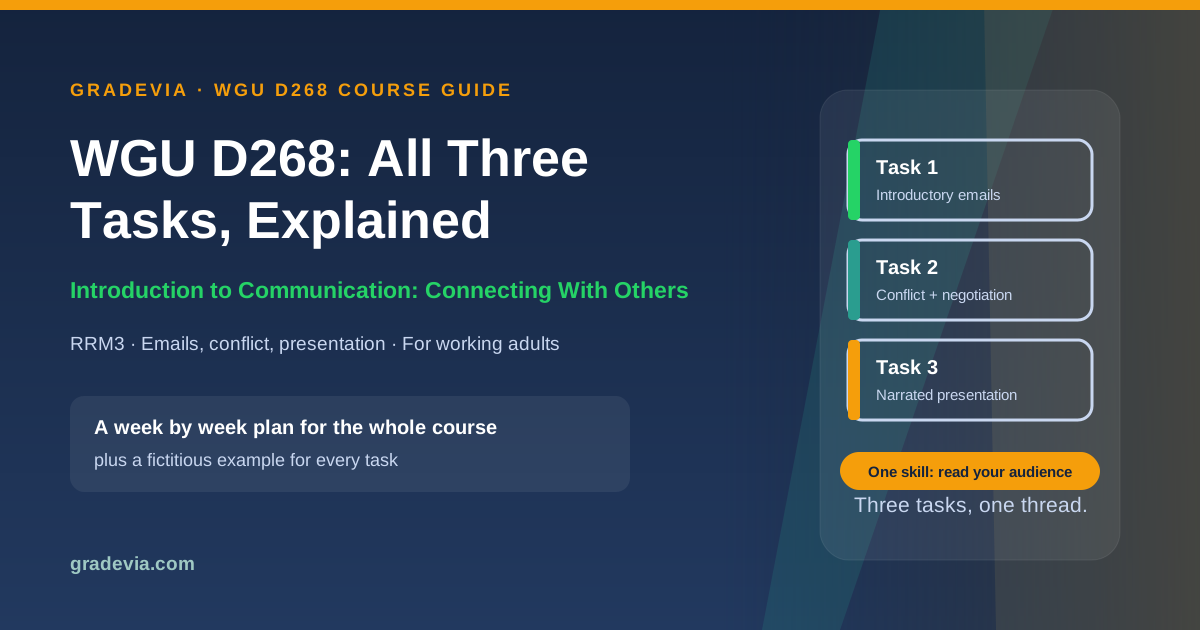
WGU course D268, Introduction to Communication: Connecting with Others, is graded through three performance tasks, and each one tests the same skill in a different format. In Task 1 you adapt written messages to two readers. In Task 2 you analyze spoken and nonverbal behavior in a workplace conflict. In Task 3 you present a policy proposal in your own recorded voice. If you understand that one thread, reading your audience and adjusting your message to it, the three tasks stop feeling like separate assignments.
This page is the starting point for the WGU class D268. It explains what each task asks for, where students lose time, how to fit the course around a full time job, and which detailed guide and example to open next. Every requirement here was checked against the current RRM3 task directions and templates.
D268 at a Glance
| Task 1 | Task 2 | Task 3 | |
|---|---|---|---|
| What you produce | Two introductory emails plus an explanation of your choices | An analysis of a course video conflict, plus negotiation advice for each character | A written presentation plan plus a narrated presentation |
| Where you write it | RRM3 D268 Task 1 Template | RRM3 D268 Task 2 Template | RRM3 D268 Task 3 PPTX template |
| Key requirement | Two different communication styles | A matching alternative for every escalating behavior | A recording between 2 and 7 minutes |
| Sources | Optional | Optional | Optional, but they must be real, and visuals must be cited |
| Typical time for a working adult | 2 evenings | 2 evenings | 3 evenings, including recording |
| Detailed guide | Task 1 guide | Task 2 guide | Task 3 guide |
What Is WGU D268?
WGU Introduction to Communication: Connecting with Others (D268) is an introductory communication course. Its assessments ask you to apply communication concepts from the course lessons, such as communication styles, interpersonal behaviors, the steps of negotiation, and presentation skills, to realistic workplace situations. You’ll see the code RRM3 on every task’s directions and template. RRM3 is WGU’s assessment code for D268, so “RRM3 D268 Task 2” and “WGU D268 Task 2” refer to the same task.
Each task comes with its own template in the Supporting Documents section of the task page. Use the template from your own course, not a copy from a classmate or a study site, because templates are updated and the rubric is tied to the version in your course.
The Thread That Connects the Three Tasks
Seeing the connection saves time, because the thinking you do in one task feeds the next:
| Task | The audience you read | What you adapt |
|---|---|---|
| Task 1 | Two coworkers you haven’t met, described by their branch’s values | The style of your writing: what you include, your tone, your opening and closing |
| Task 2 | Two managers in conflict, Raymond and Jenna | Their behaviors: what they could have said or done instead, and how they could have negotiated |
| Task 3 | A decision maker who could enact your policy | Your case and delivery: the evidence, the visuals, and your voice |
A student who carefully reads the five characters in Task 1 is already practicing the observation skills Task 2 needs, and the habit of naming a specific reader carries straight into Task 3’s audience section.
WGU D268 Task 1: Introductory Emails
What it asks: Choose two of five characters from the scenario (Sarah, Joe, Blake, Talia, and Mei) and write each an introductory email in a different communication style, with an opening and a closing. In Section B, you name the style you chose for each character and explain why (B1), then describe how the emails differ, quoting specific words, phrases, or sentences from each (B2).
Where students lose time:
- Writing two friendly emails that sound the same, with different style names attached
- Explaining a style in B1 without first naming it, or without using the character’s cues from the scenario
- Describing differences in B2 without quoting the emails
The fastest path: choose two characters whose cues point in opposite directions, such as one whose branch values efficiency and structure and one whose branch values relationships. The contrast then writes itself.
Our WGU D268 Task 1 guide walks through each character’s cues and the four communication styles. It includes WGU D268 Task 1 examples in a completed template, written to fictitious practice characters.
WGU D268 Task 2: Workplace Conflict and Negotiation
What it asks: Watch the course video “Workplace Conflict,” in which two managers, Raymond and Jenna, argue about staff reductions. For each character, identify one or two interpersonal communication behaviors that escalated the conflict and explain how (A1, A1a), then give an alternative for each behavior and explain how it would de-escalate the conflict (A2, A2a).
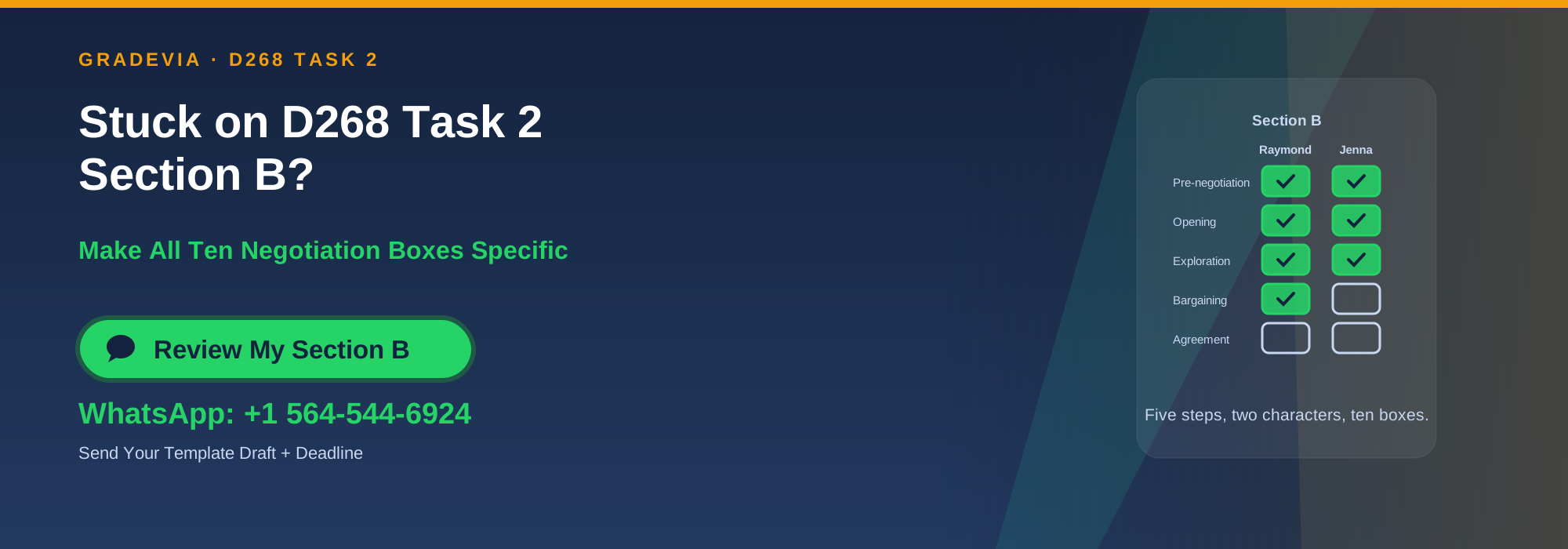
WGU D268 Task 2 Section B is the part the video doesn’t cover. Acting as a conflict consultant, you advise each character on what they could have said or done at each of the five negotiation steps: pre-negotiation, opening, exploration, bargaining, and agreement. That’s ten boxes, and the template asks for a specific example in every one.
Where students lose time:
- An A1 behavior without its matching A2 alternative
- Alternatives that are attitudes (“be calmer”) rather than behaviors
- Section B boxes that give advice anyone could follow, without an example tied to the staff reduction conflict
The fastest path: watch the video three times: once for the story, once for words, and once with the sound off for nonverbal behavior. Timestamp your notes. For alternatives, paraphrasing and letting the other person finish are reliable choices, because research links high quality listening to stronger trust between coworkers (Kluger & Itzchakov, 2022).
Our WGU RRM3 D268 Task 2 guide covers the behaviors, the alternatives, and all ten Section B boxes. Its WGU D268 Task 2 example fills in the template for a fictitious practice conflict between two hotel managers, not the WGU video.
WGU D268 Task 3: Narrated Policy Presentation
What it asks: Propose a new policy for an organization or community. In Section A, you write a plan: the audience who can enact the policy (A1), how it affects them (A1a), the problem (A2), and the policy and its implementation (A3). In Section B, you record a narrated presentation between 2 and 7 minutes, with an effective opening and closing, at least two relevant visual aids, and effective vocalics: pitch, tone, inflection, and volume.
Where students lose time:
- A recording under 2 minutes or over 7, which the template says is returned
- A slide without narration, or a file submitted in the wrong format
- An audience that can’t actually approve the policy, such as “management” instead of a named decision maker
- Visual aids without citations, or sources that don’t exist
The fastest path: choose a problem from your own workplace. You already know the decision maker, the numbers, and the details that make a proposal convincing.
Our WGU RRM3 D268 Task 3 guide covers topics, the plan, the PPTX template, and recording. The WGU D268 Task 3 example is a completed deck for a fictitious credit union proposing a hybrid schedule, with a narration script in the speaker notes. Its evidence comes from a real study, a randomized trial that found hybrid work reduced quitting without hurting performance (Bloom et al., 2024), which shows the kind of source that strengthens a policy case.
Rules That Apply to All Three D268 Tasks
A few rules repeat across the course, and knowing them up front prevents avoidable revisions:
- Use the template. Each task has an RRM3 template in its Supporting Documents section, and the evaluator expects your answers in it.
- Paraphrase course materials. The templates say you don’t have to cite course materials but shouldn’t quote them directly. A phrase such as “Course material explains” works.
- Cite any research you use. Sources are optional in all three tasks, but anything you quote, paraphrase, or summarize needs an in-text citation and reference. Task 3 adds that every source must be real and that visual aids need citations.
- Professional communication is graded. Run Grammarly before submitting each task, and review the similarity report.
How to Fit D268 Around a Full Time Job
Seven evenings is a realistic total for most working adults. One way to schedule it over three weeks:
| Week | Evenings | Work |
|---|---|---|
| Week 1 | 2 | Task 1: read the characters, choose two, write both emails, then write Section B |
| Week 2 | 2 | Task 2: watch the video three times with notes, write Section A, then the ten Section B boxes |
| Week 3 | 3 | Task 3: choose a topic and write the plan, build the slides and script, then rehearse and record |
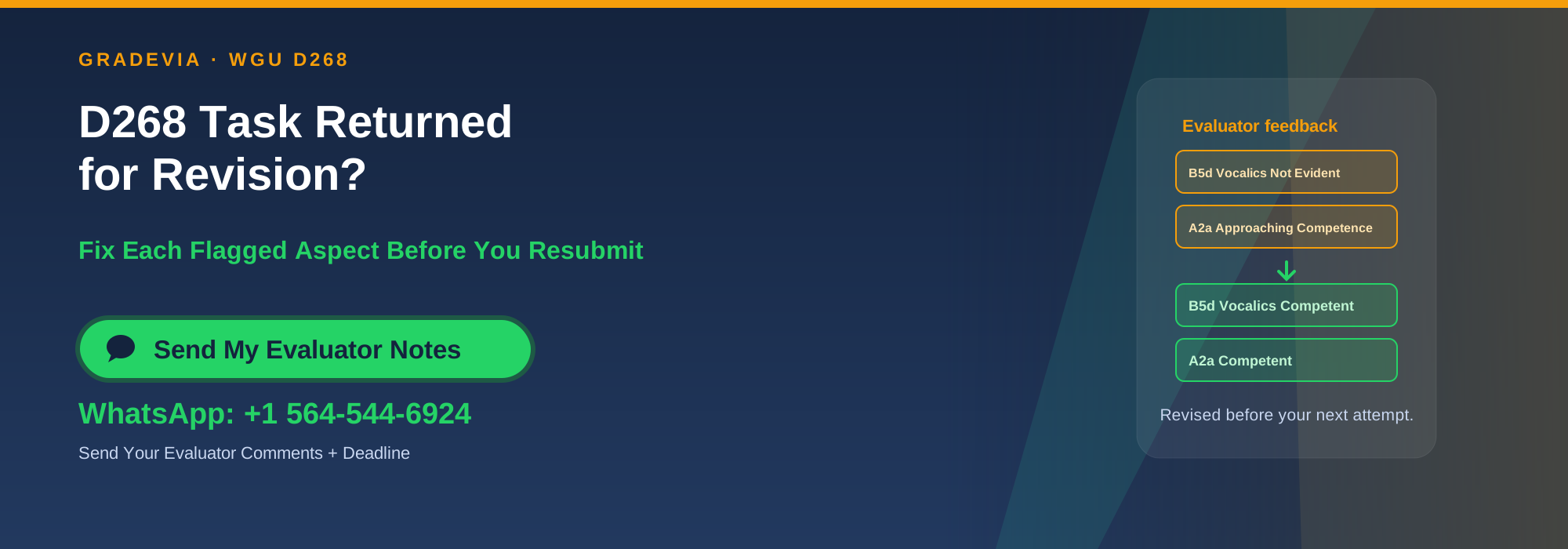
Submit each task as you finish it. While one task is with the evaluator, start the next. If a task comes back, the evaluator’s comments tell you which rubric aspect to fix, so you rarely need to rewrite the whole submission.
WGU D268 Examples: What Each One Shows
Every Gradevia example for this course uses fictitious people, organizations, or practice scenarios, so you can see the structure and level of detail without a paper to copy:
| Example | What it is | Where to find it |
|---|---|---|
| Task 1 | A completed template with two emails to fictitious practice characters, in an analytical and a personal style, plus Section B with quoted phrases | D268 Task 1 guide |
| Task 2 | A completed template for a practice conflict between two fictitious hotel managers, with all ten Section B boxes | D268 Task 2 guide |
| Task 3 | A completed PPTX deck for a fictitious credit union, with four presenter created visuals and a narration script | D268 Task 3 guide |
Papers labeled “passed” on study sites are a different matter. In Tasks 1 and 2, every student works from the same characters and the same video, so shared papers overlap heavily with each other, which is exactly what the similarity checker is built to catch. Task 3 needs your own recorded voice, so a copied deck doesn’t help at all.
Frequently Asked Questions
How many tasks are in WGU D268?
Three. Task 1 is two introductory emails with an explanation, Task 2 is a conflict analysis with negotiation advice, and Task 3 is a narrated policy presentation.
What does RRM3 mean in D268?
RRM3 is WGU’s assessment code for D268. It appears on the directions and templates for all three tasks.
Do I need sources for D268?
Sources are optional in all three tasks. If you use any, cite them, and in Task 3 every source must be real and every visual aid you didn’t create must be cited.
How long does the D268 Task 3 presentation have to be?
Between 2 and 7 minutes. The template says recordings outside that range are returned.
What is Section B in D268 Task 2?
Section B asks you to advise each manager, as a conflict consultant, on what they could have said or done at each of the five negotiation steps, with a specific example in each of the ten boxes.
Can I submit the D268 examples on Gradevia?
No. They use fictitious characters, conflicts, and organizations and are for illustration only. Your submissions must use the WGU scenario, the WGU video, and your own topic, in your own words.
Want Help Planning D268?
If you’re working full time and want structured assignment support planning the course, making your Task 2 Section B specific, or checking a Task 3 script before you record, message Gradevia on WhatsApp at +1 564 544 6924.
Related WGU Guides
- See every D268 guide in one place.
- Our WGU D082 Task 1 guide covers active listening and emotional intelligence, which carry straight into Task 2.
- Our WGU D082 Task 2 guide covers communicating across cultural differences at work.
- Writing for a specific audience and purpose is the focus of our WGU D269 course guide.
- Browse all WGU assignment guides and samples.
Sources
Bloom, N., Han, R., & Liang, J. (2024). Hybrid working from home improves retention without damaging performance. Nature, 630, 920–925. https://doi.org/10.1038/s41586-024-07500-2
Kluger, A. N., & Itzchakov, G. (2022). The power of listening at work. Annual Review of Organizational Psychology and Organizational Behavior, 9, 121–146. https://doi.org/10.1146/annurev-orgpsych-012420-091013