
Blog
WGU C206 Task 1 Guide and Example: Ethical Theories, Leadership, and the Ethical Lens Inventory (EHM2)

Updated on: Oct 15, 2026
By Dan Palmer, MBA · Academic strategy consultant for working adult learners · LinkedIn
WGU C206 Task 1 is the first performance assessment in C206 Ethical Leadership, listed on your directions as EHM2. It’s one essay, with a suggested length of 6 to 8 pages, that asks four different kinds of thinking: describing an ethical leader you admire, analyzing a business dilemma through two ethical theories, classifying five questions by level of moral development, and reflecting on your own Ethical Lens Inventory (ELI) results. You also submit your ELI results PDF as a separate file.
Working adults rarely struggle with the ideas themselves. Task 1 comes back when a section answers the wrong question: Part A describes a leader’s career instead of their ethics, Part B defines two theories without comparing them, or Part D talks about ethics in general rather than your own results. This guide walks through every part in rubric order, shows what “specific” looks like for each, and ends with a complete example built on a practice dilemma, so you can see the method without a model answer to copy.
EHM2 Task 1: Ethical Theories, Leadership, And The Ethical Lens Inventory
Ethical Leadership — C206
Introduction
Leadership is often defined as the ability to influence people. An effective ethical leader guides an organization and its employees to accomplish organizational goals. In the same vein, an unethical leader can guide an organization and its employees to act unethically, harming both the organization and the stakeholders. Being a leader is an exploration, a reflection, and a test of your leadership values. Seeking understanding of how you resolve ethical dilemmas, taking inventory of where an ethical weakness may lie, and examining the traits of an ethical leader helps you define, shape, and apply an ethical decision-making framework, while also taking into consideration all stakeholders who may be affected by your decisions.
For this task, you will respond to an ethical situation as well as analyze the results of the Ethical Lens Inventory (ELI), which should be completed in the course. This task focuses on you as a leader by helping you to define, refine, and test your ethical boundaries through self-reflection and analysis.
Scenario
You are a sales representative for a medical device company that manufactures artificial joints. Your company has developed an artificial knee joint that is less expensive than the competition and will dramatically reduce healing time for patients. However, it is also known to produce a serious and potentially lethal infection in a small percentage of patients. The company refuses to disclose this potential side effect. You feel you have a duty to divulge this issue, but you signed a nondisclosure agreement when you were hired and worry about possible repercussions.
Requirements
Your submission must represent your original work and understanding of the course material. Most performance assessment submissions are automatically scanned through the WGU similarity checker.
Students are strongly encouraged to wait for the similarity report to generate after uploading their work and then review it to ensure Academic Authenticity guidelines are met before submitting the file for evaluation. See Understanding Similarity Reports for more information.
Grammarly Note:
Professional Communication will be automatically assessed through Grammarly for Education in most performance assessments before a student submits work for evaluation. Students are strongly encouraged to review the Grammarly for Education feedback prior to submitting work for evaluation, as the overall submission will not pass without this aspect passing. See Use Grammarly for Education Effectively for more information.
Microsoft Files Note:
Write your paper in Microsoft Word (.doc or .docx) unless another Microsoft product, or pdf, is specified in the task directions. Tasks may notbe submitted as cloud links, such as links to Google Docs, Google Slides, OneDrive, etc. All supporting documentation, such as screenshots and proof of experience, should be collected in a pdf file and submitted separately from the main file. For more information, please see Computer System and Technology Requirements.
You must use the rubric to direct the creation of your submission because it provides detailed criteria that will be used to evaluate your work. Each requirement below may be evaluated by more than one rubric aspect. The rubric aspect titles may contain hyperlinks to relevant portions of the course.
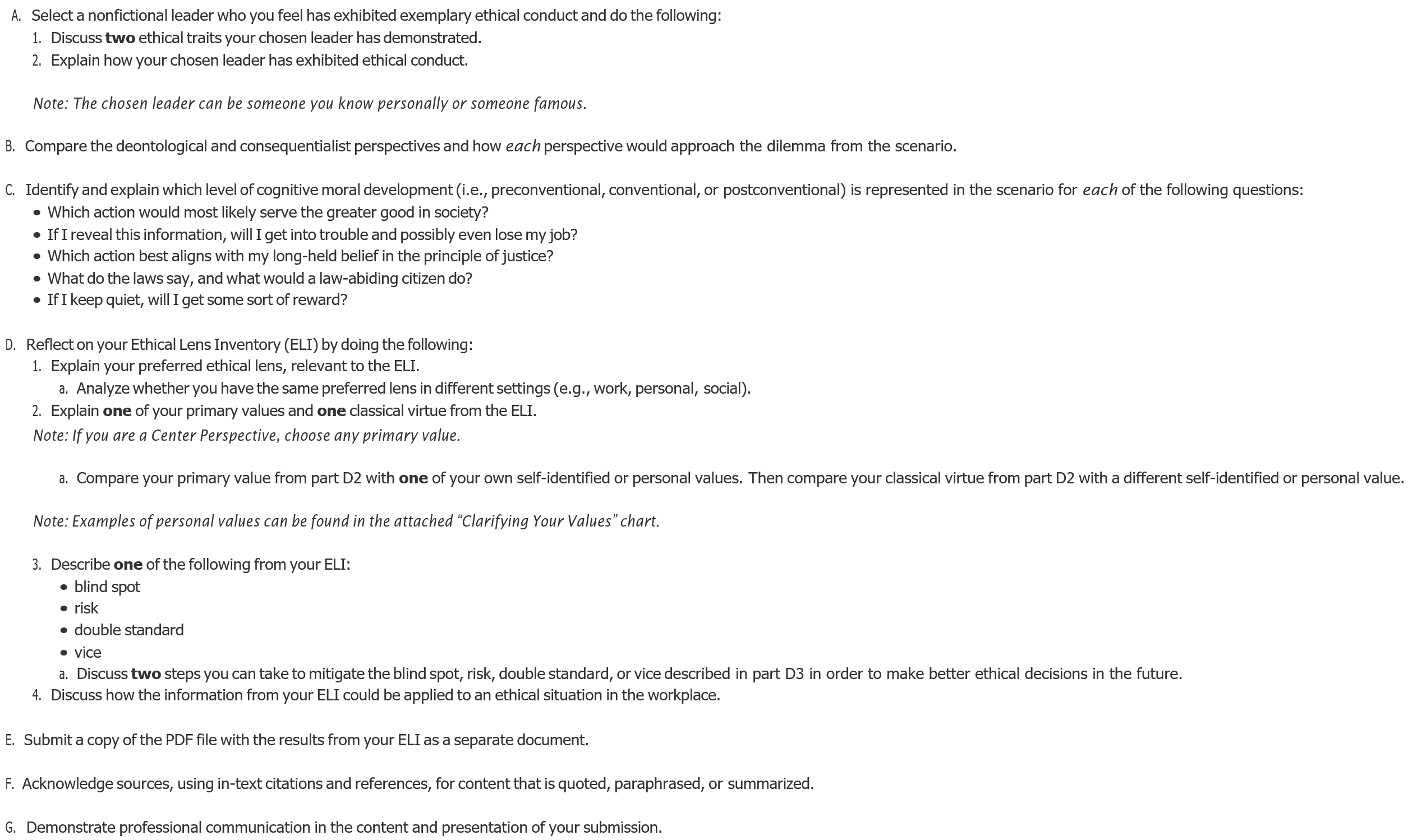
Write an essay (suggested length of 6–8 pages) in which you do the following:
What C206 Task 1 Asks You to Do
| Prompt | What you deliver |
|---|---|
| A | Choose a nonfictional leader who has shown exemplary ethical conduct. It can be someone famous or someone you know personally |
| A1 | Two ethical traits the leader has demonstrated |
| A2 | How the leader has exhibited ethical conduct |
| B | A comparison of the deontological and consequentialist perspectives, and how each would approach the scenario’s dilemma |
| C | The level of cognitive moral development (preconventional, conventional, or postconventional) for each of five questions in the directions |
| D1 to D4 | A reflection on your ELI: your lens, your values and virtue, one blind spot, risk, double standard, or vice, and a workplace application |
| E | Your ELI results PDF, submitted as a separate document |
| F | In-text citations and references |
| G | Professional communication, checked by Grammarly for Education |
Two practical notes from the directions: complete the ELI in the course before you start Part D, and review your similarity report after uploading and before you submit.
The Scenario in Brief
You’re a sales representative for a medical device company. Its new artificial knee joint costs less than competitors’ and dramatically shortens healing time, but it’s known to cause a serious, potentially lethal infection in a small percentage of patients. The company refuses to disclose the risk. You feel a duty to speak up, but you signed a nondisclosure agreement and worry about the consequences.
Parts B and C both depend on this scenario. Part A and Part D don’t, which is why many working learners write those two first.
Part A: Choosing Your Ethical Leader
The directions say the leader must be nonfictional and can be “someone you know personally or someone famous.” Both work, and each has a tradeoff:
| Someone you know | Someone famous | |
|---|---|---|
| Strength | Your examples are firsthand and can’t overlap with other students’ papers | Easy to cite, and the reader recognizes the name |
| Watch for | Give dates and concrete actions, not general praise | Very popular choices appear in many posted papers, so similarity rises |
Choose someone whose ethics you can show through specific actions. A leader who is admired for business success but has no clear ethical decisions on record makes A2 hard to write.
A1 versus A2
- A1 names two traits. Name each trait (such as honesty, fairness, courage, or accountability), define it in a sentence, and support it with one specific example.
- A2 explains conduct. Show how the leader acted ethically over time and why it was ethical, especially when it cost them something. Don’t repeat the A1 examples.
Vague: “She is a very honest and caring leader.”
Specific: Name the trait, then the moment: who, what decision, when, and what it cost the leader to choose that way.
Part B: Deontology Versus Consequentialism
The rubric asks you to compare how each perspective would approach the dilemma. Two separate definitions aren’t a comparison.
| Deontology | Consequentialism | |
|---|---|---|
| Judges an action by | Duties, rules, and rights, not results. Deontological theories judge choices “by criteria different from the states of affairs” those choices bring about (Alexander & Moore, 2024, Section 2) | Its results. Consequentialism holds that “normative properties depend only on consequences” (Sinnott-Armstrong, 2023, para. 1) |
| Asks in the scenario | What duties do I have to patients, to my employer, and to the promise I signed? | What outcomes follow from disclosing or staying silent, for whom, and how likely are they? |
| Weighs the NDA as | A promise, which has to be weighed against other duties | One factor among the costs and benefits |
A strong Part B covers three things:
- How a deontologist would approach the dilemma, naming the specific duties in conflict.
- How a consequentialist would approach it, naming the stakeholders and the outcomes being weighed.
- Where the two agree and where they split. This paragraph is what makes it a comparison. Ask whether they’d reach the same decision for different reasons, and what change in the facts would make them disagree.
Keep the analysis tied to the scenario: the infection risk, the patients who aren’t told, the company’s position, and your NDA.
Part C: The Three Levels of Moral Development
Part C uses Kohlberg’s three levels of cognitive moral development (McLeod, 2026):
| Level | What drives the reasoning | Test to apply to each question |
|---|---|---|
| Preconventional | Avoiding punishment or gaining a reward for yourself | Is the question about what happens to me? |
| Conventional | Laws, rules, and the expectations of society or your group | Is the question about what the rules or others expect? |
| Postconventional | Universal ethical principles and rights, beyond any one law | Is the question about a principle that applies to everyone? |
For each of the five questions in your directions, name the level and then explain why, pointing to the words in the question that show what’s driving the reasoning. The rubric needs sound reasoning for at least four of the five, so the explanation matters as much as the label. Write your classifications from the test above in your own words; our example uses five practice questions instead of the official ones.
Part D and Part E: Your Ethical Lens Inventory
Part D is a personal reflection on your ELI results:
| Prompt | What you deliver |
|---|---|
| D1 and D1a | Your preferred lens, and whether it’s the same at work, at home, and in social settings |
| D2 and D2a | One primary value and one classical virtue, each compared with a different personal value |
| D3 and D3a | One blind spot, risk, double standard, or vice, and two steps to reduce it |
| D4 | How your ELI applies to a workplace ethical situation |
Use your report’s own terms, because the evaluator checks that your reflection is relevant to your results. Part E is your ELI results PDF, uploaded separately.
Our Ethical Lens Inventory guide covers Part D in depth: how to enroll in the ELI through the course, what each section of your report feeds, how to save the PDF, and a Part D example with comments on each prompt.
Sources and Professional Communication (F and G)
Cite the ELI report, any sources on the ethical theories, and any facts about your Part A leader in APA format. Scholarly encyclopedias such as the Stanford Encyclopedia of Philosophy are reliable for definitions of the theories. Then run Grammarly for Education; the directions note the overall submission won’t pass unless professional communication passes.
C206 Task 1 Example: A Full Paper on a Practice Dilemma
Our C206 Task 1 example is a complete APA 7 paper by Jordan Ellis, a fictitious scheduling supervisor. To avoid answering the task, it swaps out everything every student shares:
- Part A: a fictitious leader the student knows personally, with two traits and dated examples
- Part B: a practice dilemma about a snack maker shipping granola bars with trace peanut residue under a confidentiality agreement, in place of the knee joint scenario
- Part C: five practice questions about that dilemma, in place of the five WGU questions
- Part D: a shortened reflection on fictitious Reputation Lens results
- Comments explaining what each section meets in the rubric
Here’s part of its Part B comparison:
The two perspectives therefore reach a similar conclusion for different reasons. The deontologist would disclose because deceiving customers is wrong regardless of outcome, while the consequentialist would disclose because the expected harm of silence is greater than the cost of a recall.
The example can’t be submitted for C206 Task 1 EHM2, because its dilemma, its Part C questions, and its ELI results aren’t yours or the task’s. It shows the structure and depth each part needs.
Download the C206 Task 1 example (.docx)
Why Posted C206 Task 1 Answers Backfire
Every student answers the same knee joint scenario and the same five Part C questions, so papers posted online repeat the same arguments in similar words. That’s the overlap WGU’s similarity checker is built to detect. Part D is worse to borrow: it has to match your own ELI PDF, and an evaluator can see when a reflection describes a lens, value, or blind spot that isn’t in your report. Posted papers may also follow an earlier version of the task, so check that your directions say EHM2.
Plan It Around Your Work Week
- Evening one (about 1 hour): Take the ELI in the course, save the PDF, and choose your Part A leader.
- Evening two (about 1.5 hours): Write A1 and A2.
- Evening three (about 2 hours): Write Part B, ending with the comparison paragraph.
- Evening four (about 1 hour): Write Part C, one short paragraph per question.
- Evening five (about 2 hours): Write Part D, add references, run Grammarly, review the similarity report, and upload the ELI PDF separately.
Common Reasons C206 Task 1 Comes Back
- A1 names traits without a specific example for each
- A2 repeats A1 or summarizes the leader’s career
- Part B defines both theories but never compares them
- Part B drifts away from the scenario’s details
- Part C labels a question without explaining why, or only some of the five are explained
- D2a compares only one value, or uses the same personal value twice
- D3a gives vague steps
- The ELI PDF isn’t uploaded separately
Pre-Submission Checklist
- A: a nonfictional leader, with two traits in A1 and separate conduct examples in A2
- B: both perspectives applied to the scenario, plus a comparison paragraph
- C: all five questions labeled and explained
- D1 to D4: every prompt answered using your report’s terms
- E: ELI results PDF uploaded as a separate file
- F: in-text citations and an APA reference list
- G: Grammarly for Education reviewed, and the similarity report checked
Related C206 Resources
- Our Ethical Lens Inventory guide covers Parts D and E, with a Part D example.
- For the next tasks, see our C206 Task 2 guide and C206 Task 3 guide, or our C206 Ethical Leadership course guide.
- Browse all of our C206 guides.
- For ethics in an MBA business setting, see our WGU C717 Task 1 guide.
Frequently Asked Questions
What is WGU C206 Task 1?
It’s the first performance assessment in C206 Ethical Leadership, coded EHM2. You write an essay about an ethical leader, analyze a medical device dilemma through deontology and consequentialism, classify five questions by moral development level, and reflect on your Ethical Lens Inventory results.
How long should C206 Task 1 be?
The directions suggest 6 to 8 pages. Length matters less than answering each rubric aspect fully.
Can my Part A leader be someone I know personally?
Yes. The directions allow someone you know personally or someone famous, as long as they’re nonfictional. A personal choice works well if you give specific, dated examples.
Do I have to choose a side in Part B?
The rubric asks you to compare how each perspective would approach the dilemma. You can say which you find more convincing, but the comparison is what’s graded.
What if my ELI result is the Center perspective?
The directions say a Center result can choose any primary value for D2. The rest of Part D works the same way.
Can I submit the C206 Task 1 example on this page?
No. It answers a practice dilemma and practice questions, not the WGU scenario and questions, and its ELI results belong to a fictitious learner. It’s for illustration only.
Want a Second Look Before You Submit?
If you’re working full time and want structured assignment support choosing a Part A leader you can document, turning Part B into a real comparison, or connecting your ELI results to Part D, message Gradevia on WhatsApp at +1 564 544 6924 or email Support@gradevia.com.
Sources
Alexander, L., & Moore, M. (2024). Deontological ethics. In E. N. Zalta & U. Nodelman (Eds.), The Stanford encyclopedia of philosophy. Stanford University. https://plato.stanford.edu/entries/ethics-deontological/
McLeod, S. (2026, September 17). Kohlberg’s stages of moral development. Simply Psychology. https://www.simplypsychology.org/kohlberg.html
Sinnott-Armstrong, W. (2023). Consequentialism. In E. N. Zalta & U. Nodelman (Eds.), The Stanford encyclopedia of philosophy. Stanford University. https://plato.stanford.edu/entries/consequentialism/