
Blog
WGU D219 MYM3 Task 2: Evidence Appraisal & Practice Change Guide With Example

You finished a twelve-hour shift, opened your WGU dashboard, and D219 MYM3 Task 2 is sitting there asking you to appraise two articles and turn them into a practice change recommendation. You know the clinical issue cold, you’ve probably managed it at the bedside more times than you can count. What you’re less sure about is how to prove, on paper, that a source is credible, how strong its evidence actually is, and how that evidence logically leads to a specific recommendation an evaluator will accept.
This guide breaks down what evidence appraisal actually means, how to read a research article and a non-research article the way the task expects, how level of evidence differs from quality, and how to build a practice change recommendation that follows from your evidence instead of sitting next to it. There’s also an original illustrative example so you can see the difference between summarizing a source and appraising one. WGU updates task instructions and rubrics from time to time, so treat this as a planning framework and always confirm details against the current instructions and rubric inside your own course.
What Is WGU D219 MYM3 Task 2?
WGU D219 MYM3 Task 2 is a written performance assessment within D219, Scholarship in Nursing Practice, that typically asks students to appraise evidence connected to their evidence-based practice (EBP) question and develop a practice change recommendation from it. If you completed D219 WGU Task 1 first, this task generally continues that same clinical practice problem rather than starting a new one. Because task structure and rubric wording can shift between course versions, confirm the specific requirements against your current task instructions before you plan your response.
Where MYM3 Task 2 Fits
D219 is organized into performance assessments, and MYM3 is one naming convention some students see attached to this stage of the coursework, while others see the same work referenced simply as Task 2. If your dashboard uses different terminology than what’s used here, follow your dashboard, not this guide.
What Does “Evidence Appraisal” Mean?
Evidence appraisal is the process of deciding whether a source is trustworthy enough, and relevant enough, to shape a real clinical decision. It’s a different skill from reading comprehension. Appraisal means asking:
- What does this source actually say?
- How was that finding produced?
- How credible is the process behind it?
- How strong is the resulting evidence?
- Does it relate to my specific question?
- Can it reasonably inform a change in practice?
A simple analogy: two nurses tell you a new wound dressing works well. One based that on a single shift where it seemed to help one patient. The other based it on tracking outcomes across forty patients over six months using a standardized protocol. Both are giving you information, but only one gives you appraisable evidence you’d feel comfortable building a recommendation on. That’s the judgment call evidence appraisal is training you to make on paper.
Not sure how to evaluate your articles? Gradevia can help you organize your evidence and understand what to look for during appraisal.
Research Article Appraisal for D219 MYM3 Task 2
If your current rubric lists specific appraisal criteria for the research-based article, work from that list directly. The concepts below cover what a research article appraisal generally needs to accomplish.
Research Article Purpose
Before anything else, identify why the study was conducted. What problem were the researchers investigating, and what specific question were they trying to answer? A study can be well designed and still be a poor fit for your EBP question if its purpose doesn’t line up with what you’re trying to find out.
Research Methodology
Methodology tells you how much confidence to place in a study’s findings. Knowing whether a study is quantitative, qualitative, mixed methods, experimental, observational, or descriptive matters because each approach answers different kinds of questions and carries different strengths and weaknesses. You don’t need to master every research design to appraise a single article, you need to identify which one this article used and understand what that choice means for how far you can trust its conclusions.
Level of Evidence
Level of evidence describes where a study sits within a hierarchy based on its design, systematic reviews and randomized controlled trials generally sit higher than single observational studies or expert opinion. Different frameworks organize these hierarchies slightly differently, so if your task specifies a particular model, such as the Johns Hopkins Nursing Evidence-Based Practice (JHNEBP) model, use that framework specifically rather than a generic one you found elsewhere. Level of evidence is not the same as quality, a well-conducted Level III study can outrank a poorly conducted Level I study on quality even while sitting lower on the hierarchy.
Data Analysis
Look at how the researchers actually analyzed what they collected. Did the statistical or analytical approach match the type of data and the study’s stated purpose? You don’t need a statistics degree to note whether the analysis method makes sense for the sample size and design described.
Ethical Considerations
Human-subjects research typically involves informed consent, confidentiality protections, privacy safeguards, institutional review or oversight, and consideration of risk to participants. If a study doesn’t explicitly report these, that’s worth noting rather than assuming they were absent, some published articles simply don’t detail every ethical step in the text itself.
Research Findings
Separate what the researchers actually found from what you personally think it means. “The study found a 22% reduction in catheter-associated infections after implementing a standardized insertion checklist” is a finding. “This proves checklists always work” is your interpretation, and it’s a bigger claim than the data alone supports.
Quality Rating
A quality rating goes further than confirming a source is peer-reviewed. Consider methodological strength, whether limitations are acknowledged, potential sources of bias, consistency with other evidence, relevance to your question, and how transparent the reporting is about its own weaknesses. If your course specifies an official rating scale, apply that scale specifically rather than inventing your own criteria.
Alignment With the EBP Question
A high-quality article can still be the wrong fit. A rigorous study on medication adherence in diabetic outpatients doesn’t automatically answer a question about post-surgical pressure injury prevention, even if both fall under “evidence-based nursing practice” broadly. Before you rely on a source, check that its population, intervention, comparison, and outcome genuinely connect to your specific EBP question, not just its general topic area.
How to Appraise a Non-Research Article
Non-research evidence isn’t automatically weaker, it serves a different purpose. Expert opinion, clinical practice guidelines, professional organization publications, policy documents, evidence summaries, and practice recommendations can all provide context and direction that a single research study can’t offer on its own.
To evaluate a non-research source, look at:
- Purpose, why was this document created, and for whom?
- Source credibility, is it published by a recognized professional body, government agency, or expert with relevant standing?
- Evidence basis, what does the document draw on to support its recommendations?
- Recommendations, are they specific enough to act on, or vague?
- Applicability, does it fit your clinical setting and population?
- Quality, is the reasoning transparent, or does it assert conclusions without showing its work?
- Alignment, does it actually address your EBP question?
Research Article vs. Non-Research Article
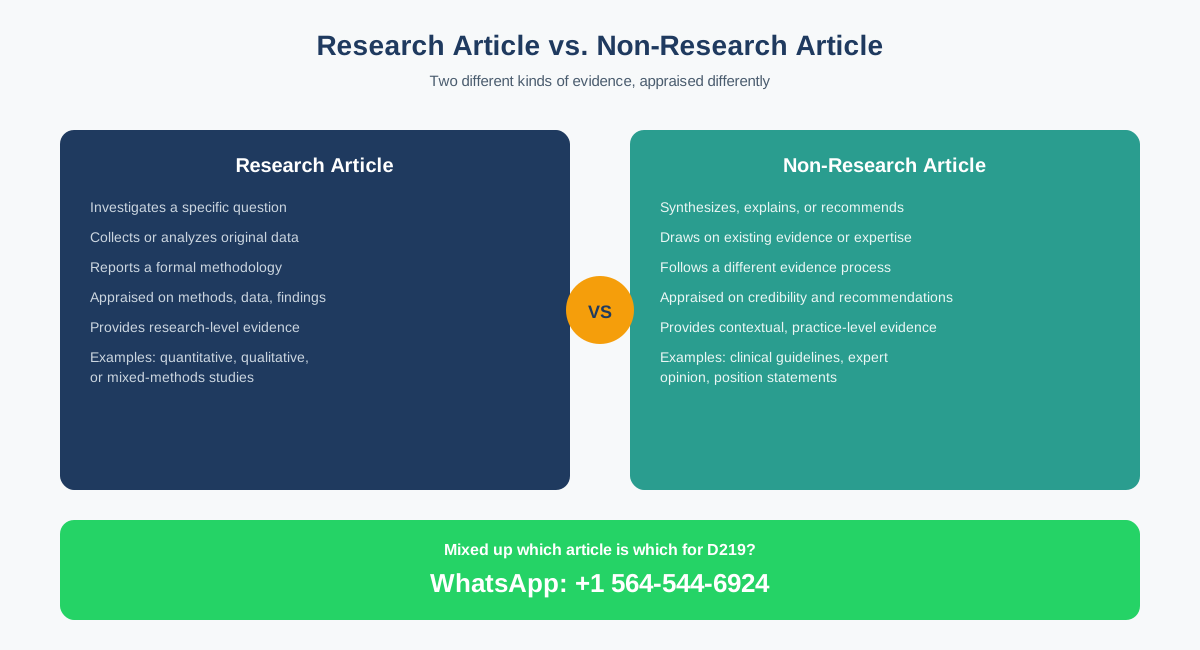
| Feature | Research Article | Non-Research Article |
|---|---|---|
| Primary purpose | Investigates a specific question | Synthesizes, explains, recommends, or informs |
| Data | Collects or analyzes original data | Draws on existing evidence or expert judgment |
| Methodology | A formal research methodology is reported | Follows a different evidence-development process |
| Appraisal focus | Methods, data, findings, limitations | Source credibility, evidence basis, recommendations |
| Use in EBP | Provides research evidence | Provides contextual or practice-level evidence |
Adapt this comparison to whatever your current D219 MYM3 Task 2 rubric specifies. If the rubric names a specific tool for leveling non-research evidence, use that tool directly.
How to Determine the Level of Evidence
- Identify what type of study or source you’re working with.
- Determine which evidence hierarchy or framework your task requires you to use.
- Locate the study within that specific framework’s levels.
- Explain, in your own words, what that level means for how much confidence the evidence deserves.
- Keep level and quality separate in your writing, a source can rank high on one and lower on the other.
Don’t assume a particular hierarchy applies unless your current task instructions specify it. If they do name a framework, work from that exact framework rather than a generic version you find through a search engine.
How to Evaluate Article Quality
Use this checklist as a starting point, then compare it against whatever quality criteria your current rubric actually specifies.
- Is the purpose clearly stated?
- Is the methodology appropriate for the question being asked?
- Is the sample or population appropriate and clearly described?
- Are the methods described clearly enough to evaluate them?
- Are findings presented clearly, separate from interpretation?
- Are limitations acknowledged by the authors?
- Is potential bias addressed anywhere in the article?
- Are the conclusions actually supported by the data presented?
- Is the evidence relevant to your specific EBP question?
How to Determine Whether Evidence Aligns With the EBP Question
Work through this chain for every source you’re considering:
EBP question leads to population, which leads to problem or intervention, which leads to outcome, which leads to evidence.
A source can be well written, current, and generally related to nursing practice while still failing this chain. If your EBP question is about reducing central line infections in ICU patients, an article about general infection control education in outpatient clinics might be interesting, but it doesn’t map cleanly onto your population or setting. If your task uses PICO or PICOT components, run each candidate source through those same components before deciding it belongs in your paper.
How to Develop the Practice Change Recommendation
A strong recommendation follows a logical chain rather than appearing out of nowhere at the end of your paper:
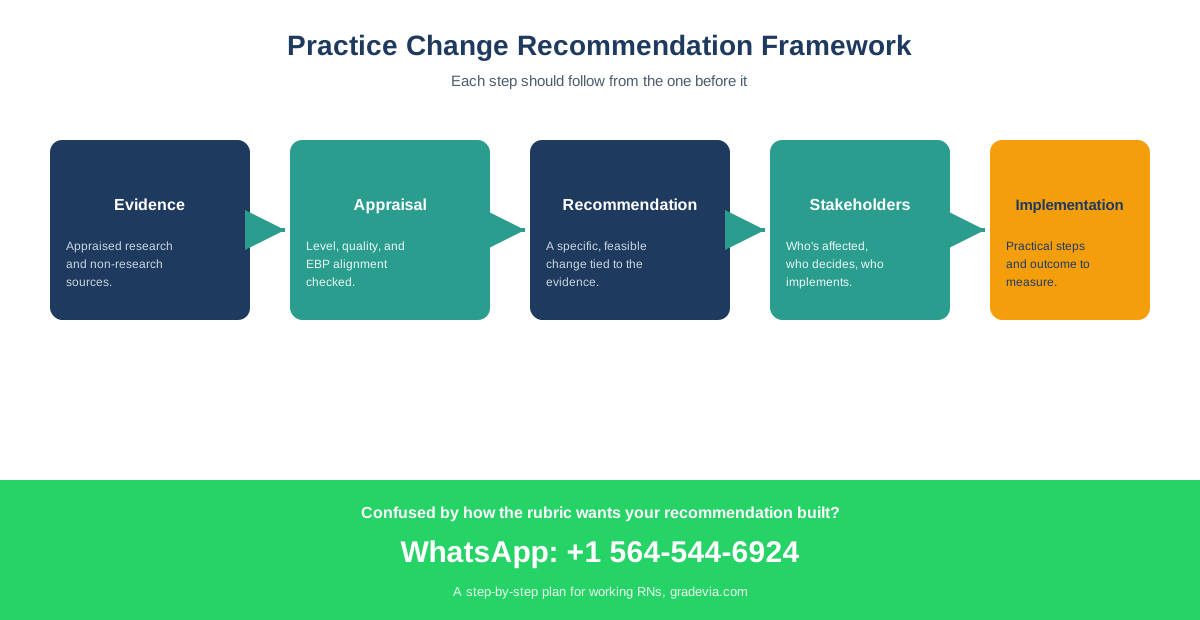
Problem leads to evidence, which leads to appraisal, which leads to a finding, which leads to a practice implication, which leads to a recommended change, which involves stakeholders, and finally implementation considerations.
What Makes a Strong Practice Change Recommendation?
A recommendation an evaluator can follow is:
- Evidence-informed, tied directly back to the sources you appraised
- Specific, not a general statement like “improve communication”
- Relevant to the exact problem you identified
- Feasible within a realistic clinical setting
- Connected explicitly to the appraised findings, not just loosely associated with the topic
- Appropriate for the population and context you described
Connecting Evidence to the Practice Change
Walk through the reasoning explicitly rather than leaving it implied:
The evidence shows that a standardized bedside handoff checklist reduced missed critical information during shift change.
Therefore: The practice problem of incomplete handoff communication on a medical-surgical unit may be addressed through a structured handoff tool.
Therefore: A reasonable practice change could involve piloting a standardized handoff checklist during shift-to-shift report on that unit.
This is a conceptual walkthrough, not a finished D219 answer, your own reasoning needs to reflect your specific problem, evidence, and setting.
Confused by how the rubric wants you to connect evidence to your recommendation? Get help turning the requirements into a practical step-by-step plan.
Identifying Key Stakeholders
A recommendation without stakeholders is a suggestion, not a plan. Ask who’s affected by the change, who makes the decision to approve it, who actually implements it day to day, who provides the resources it needs, and who evaluates whether it worked.
| Stakeholder | Why They Matter | Potential Role |
|---|---|---|
| Nursing staff | Directly affected by the change day to day | Implement the change at the bedside |
| Nurse manager | Holds operational authority over the unit | Coordinate rollout and staffing |
| Clinical educator | Responsible for staff competency | Deliver training on the new process |
| Leadership/administration | Controls budget and resource approval | Approve and support the change |
Label any stakeholder framework you build as a planning tool, not an official WGU requirement, unless your rubric names specific stakeholder categories.
WGU D219 MYM3 Task 2 Step-by-Step Workflow
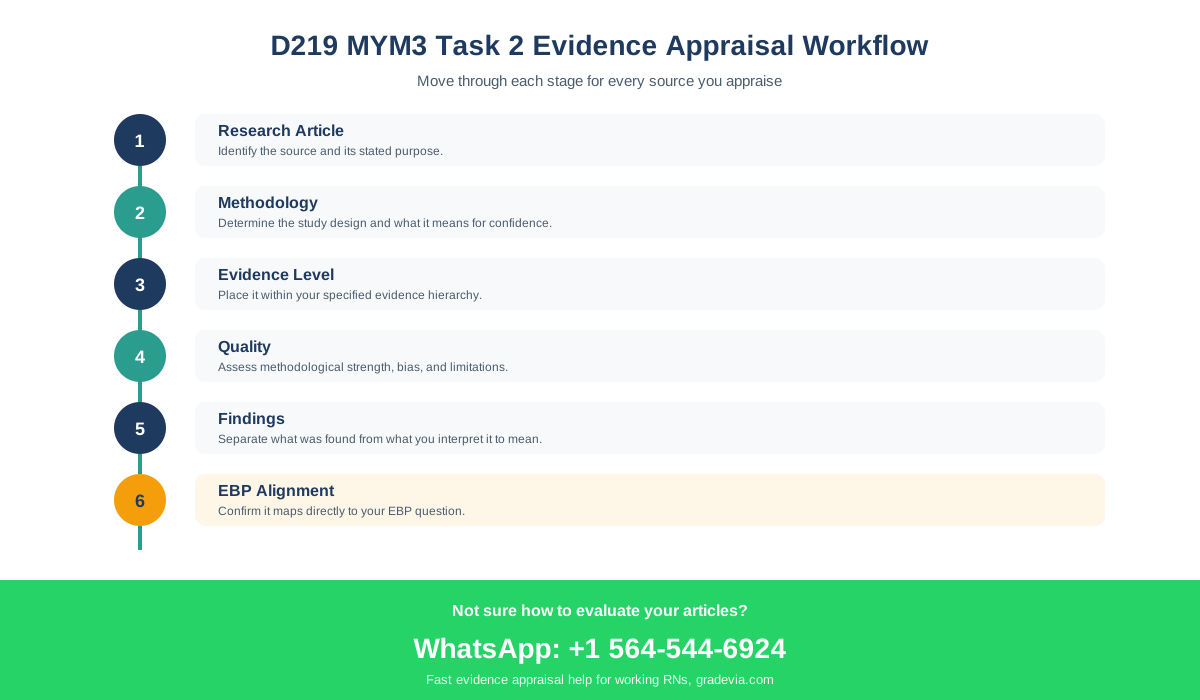
Step 1, Read the Current Task Instructions. Confirm the version you’re looking at matches your actual course.
Step 2, Read the Rubric. Note every criterion before you touch a database.
Step 3, Identify the EBP Question. Confirm it still matches the problem you’re working with, especially if time has passed since Task 1.
Step 4, Identify the Required Evidence. Determine what your task specifically asks you to appraise.
Step 5, Read the Research Article Critically. Focus on purpose, methodology, and findings, not just the abstract.
Step 6, Read the Non-Research Article Critically. Evaluate its credibility and recommendations on their own terms.
Step 7, Determine Evidence Level. Apply whichever framework your task specifies.
Step 8, Evaluate Quality. Work through your quality checklist for each source.
Step 9, Determine Alignment. Run each source through the EBP question chain.
Step 10, Develop the Practice Change Recommendation. Build it from your appraised evidence, not from general knowledge.
Step 11, Identify Stakeholders. Name specific roles and what each one contributes.
Step 12, Draft the Response. Write with the rubric open beside you.
Step 13, Check Evidence and APA. Confirm every claim is supported and every citation matches a reference.
Step 14, Perform a Final Rubric Audit. Go through every requirement one more time before submitting.
D219 MYM3 Task 2 Research Strategy
Reading five research papers before deciding what you actually need from any of them is one of the fastest ways to burn an entire evening on this task. Search with intention instead.
Start with your WGU Library, then move to PubMed, CINAHL, Google Scholar, government health sources, and professional nursing organizations if you need more.
Use search operators to narrow results:
- AND to combine required concepts, “central line infection” AND nursing AND checklist
- OR to capture synonyms, “handoff” OR “handover” AND nursing
- Quotation marks to search an exact phrase
- Truncation (where supported) to catch word variations, nurs* for nurse, nurses, nursing
Search by concept, not by course code. A search for the task itself returns forums and outdated answers, a search built around your actual clinical problem returns usable evidence.
How to Build a D219 Evidence Appraisal Matrix
This is a Gradevia-created planning tool, not an official WGU template, use it to organize your appraisal before you draft.
| Source | Type | Purpose | Method/Approach | Evidence Level | Quality | Key Finding | EBP Alignment |
|---|---|---|---|---|---|---|---|
| Article 1 | Research or non-research | Why it was written | Study design or evidence type | Level per your framework | Strength assessment | Main result in your own words | How it connects to your question |
| Article 2 | Research or non-research | Why it was written | Study design or evidence type | Level per your framework | Strength assessment | Main result in your own words | How it connects to your question |
Filling this out before you write turns your appraisal into reusable material instead of something you have to reconstruct from memory mid-draft.
WGU D219 MYM3 Task 2 Example
Illustrative example only, not an official WGU answer, template, or submission.
Hypothetical topic: reducing hospital-acquired pressure injuries on a medical-surgical unit.
Evidence: A hypothetical study found that a two-hour turning schedule combined with a standardized skin assessment tool reduced new pressure injuries by roughly one-third over a six-month period on a similar unit.
Appraisal: The study used a pre-post design with a reasonably sized sample and a clearly described intervention, which supports its credibility, but it lacked a control group, which limits how confidently the reduction can be attributed to the intervention alone rather than other concurrent changes on the unit.
Alignment: The hypothetical EBP question asked whether a structured turning and assessment protocol reduces pressure injury incidence in adult medical-surgical patients. The population, intervention, and outcome in this source line up closely with that question.
Practice implication: The finding suggests that a structured turning and assessment approach may meaningfully reduce pressure injury rates, even without a control group proving causation outright.
Practice change: A reasonable recommendation might be piloting a standardized two-hour turning schedule paired with a documented skin assessment tool on the unit, with nursing staff trained on both components before rollout.
That’s the shape of a real appraisal, evidence stated plainly, strengths and limitations named honestly, alignment checked explicitly, and a recommendation that traces back to the evidence rather than floating free of it.
WGU D219 MYM3 Task 2 Template
This is a Gradevia planning template, not an official WGU document.
Assessment Requirement:
What the requirement means:
Evidence/source:
Evidence level:
Quality considerations:
Key finding:
Alignment with EBP question:
Implication for nursing practice:
Potential practice change:
Stakeholders:
My response:
Common D219 MYM3 Task 2 Mistakes
Mistake 1, Treating Evidence Appraisal as Article Summary. Summarizing tells the evaluator what the article says, appraisal tells them how much to trust it and why. Fix this by adding a strengths-and-limitations sentence after every source you introduce.
Mistake 2, Confusing Evidence Level With Quality. These are separate dimensions. Fix this by addressing them as two distinct questions in your writing, never a single blended sentence.
Mistake 3, Choosing a Source That Doesn’t Match the EBP Question. A topically related source isn’t automatically an aligned one. Fix this by running every candidate source through the population, intervention, outcome chain before committing to it.
Mistake 4, Making Claims Without Evidence. A statement that sounds obviously true still needs support if it’s a factual claim rather than common nursing knowledge. Fix this by treating every factual sentence as needing a citation unless it clearly doesn’t.
Mistake 5, Accepting Research Findings Without Considering Limitations. Every study has limitations, and naming them shows appraisal skill rather than undermining your argument. Fix this by reading the limitations section of every source before you cite it.
Mistake 6, Recommending a Practice Change That Doesn’t Follow From the Evidence. A recommendation that appears without a clear line back to your appraised sources reads as unsupported. Fix this by writing out the reasoning chain explicitly before you draft the recommendation itself.
Mistake 7, Listing Stakeholders Without Explaining Their Roles. Three names with no explanation isn’t stakeholder analysis. Fix this by writing one specific sentence per stakeholder describing what you’d actually need from them.
Mistake 8, Using Outdated or Weak Sources. An older or lower-quality source undermines the recommendation built on top of it. Fix this by prioritizing recent, credible sources from the databases your program actually gives you access to.
Mistake 9, Writing Everything First and Checking the Rubric Later. Retrofitting a finished draft to a rubric wastes more time than starting with it. Fix this by turning the rubric into a checklist before you write a single paragraph.
Mistake 10, Submitting Without a Final Evidence and Citation Check. A single missing reference or mismatched citation is an easy, avoidable flag. Fix this by running one dedicated pass focused only on evidence and APA before you submit.
How to Review D219 MYM3 Task 2 Before Submission
Rubric: Did you address every requirement explicitly?
Evidence: Did you support every important claim?
Appraisal: Did you actually evaluate the evidence rather than describe it?
Alignment: Did you explain how each source relates to your EBP question?
Practice change: Does your recommendation logically follow from your appraised evidence?
Stakeholders: Did you explain each one’s relevance and specific role?
APA: Are your citations and references accurate and matched?
Writing: Is your response clear, concise, and professional throughout?
What If WGU Returns D219 MYM3 Task 2?
- Read the evaluator feedback carefully.
- Identify the specific rubric requirement it’s tied to.
- Compare that feedback against your current rubric.
- Determine exactly what’s missing.
- Locate the relevant section of your response.
- Decide whether the gap is evidence, analysis, clarity, alignment, or formatting.
- Revise your own work with that specific gap in mind.
- Recheck your supporting evidence.
- Recheck your APA formatting.
- Perform a complete rubric audit before resubmitting.
There’s no guarantee this process results in a passing outcome on any specific attempt, but it’s the most reliable path toward a stronger resubmission.
D219 MYM3 Task 2 Revision Help
If your evaluator flagged insufficient explanation, weak evidence, poor alignment, missing analysis, inadequate support, or APA problems, that feedback usually points to something specific and fixable. Gradevia’s revision support can help you understand what the evaluator actually flagged, identify the gap, build a revision plan, review your own draft, strengthen evidence integration, check APA, and prepare for resubmission. We won’t fabricate what your feedback said or promise a specific outcome, we’ll help you work through what’s actually in front of you.
How Gradevia Can Help With WGU D219 MYM3 Task 2
Stuck on WGU D219 MYM3 Task 2? Message Us on WhatsApp
You may not need someone to do the assignment for you. You may need someone to help you understand what the rubric is actually asking, organize your research, make sense of two dense articles, and pinpoint where your own draft needs work before you spend more hours on it. That’s the specific gap Gradevia fills for working RNs juggling shifts and coursework at the same time.
Services include:
- D219 Rubric Breakdown, turning complicated criteria into a practical checklist
- Evidence Appraisal Support, help organizing and understanding research and non-research evidence
- Research Guidance, efficient search strategies built around your specific topic
- Evidence Matrix Development, organizing sources, findings, quality considerations, and relevance in one place
- Outline Development, turning requirements into a logical writing plan
- Draft Review, feedback on organization, clarity, evidence integration, and rubric alignment
- APA Review, identifying citation and reference issues
- Revision Support, interpreting evaluator feedback and building a revision roadmap
- One-on-One Academic Coaching, personalized support built around a working RN’s actual schedule
📱 Working full-time and stuck on WGU D219 MYM3 Task 2? Upload your current task instructions, rubric, and questions to Gradevia and message us on WhatsApp at +1 564-544-6924. No long email chains, no waiting days for a reply, most students hear back the same day.
Using Examples and Templates the Right Way
Everything above, the matrix, the template, the illustrative example, exists to help you learn, plan, and organize your own thinking, not to be copied into your own submission. An appraisal or recommendation that isn’t genuinely yours is a risk regardless of how closely it seems to fit your assignment. Gradevia doesn’t provide guaranteed answers or write assessments for students, the goal is a student who understands their own evidence well enough to defend it if asked.
Frequently Asked Questions About WGU D219 MYM3 Task 2
What is WGU D219 MYM3 Task 2? It’s a written performance assessment within D219, Scholarship in Nursing Practice, that generally asks students to appraise evidence connected to their EBP question and develop a practice change recommendation from it. Confirm the specific structure against your current task instructions.
What does MYM3 mean? MYM3 is one naming convention some students see for this stage of D219 coursework inside their WGU dashboard. Naming can vary by course version, so follow whatever label your own dashboard uses.
What is evidence appraisal in D219? It’s the process of judging how credible, strong, and relevant a source is, not just summarizing what it says. That includes evaluating purpose, methodology, level of evidence, quality, and alignment with your EBP question.
How do I appraise a research article for D219? Identify its purpose, evaluate its methodology, determine its level of evidence using your specified framework, review how the data was analyzed, note any ethical considerations, separate findings from interpretation, assign a quality rating, and confirm alignment with your EBP question.
How do I appraise a non-research article? Evaluate its purpose, the credibility of its source, what evidence its recommendations are based on, how applicable those recommendations are to your setting, its overall quality, and whether it actually addresses your EBP question.
What is the difference between evidence level and quality? Level of evidence reflects where a study sits in a hierarchy based on its design. Quality reflects how well that specific study was conducted and reported. A study can rank differently on each dimension.
How do I connect evidence to an EBP question? Check that the source’s population, intervention or problem, and outcome specifically match your EBP question, not just its general topic area.
How do I create a practice change recommendation? Build it as a chain, problem, evidence, appraisal, finding, practice implication, recommended change, stakeholders, and implementation considerations, so each step follows from the one before it.
How do I identify stakeholders for a practice change? Ask who’s affected, who decides, who implements, who provides resources, and who evaluates the outcome, then name specific roles rather than generic categories.
What should I do if WGU returns D219 Task 2? Read the feedback, identify the specific rubric requirement it addresses, locate the affected section, revise with that gap in mind, recheck evidence and APA, and complete a full rubric audit before resubmitting.
Can I get help with D219 MYM3 Task 2? Yes. Legitimate academic support, rubric breakdowns, evidence appraisal guidance, research strategy help, draft review, and revision coaching, is different from having someone complete the assignment for you. Gradevia focuses on helping you understand and strengthen your own work.
Final Thoughts
D219 MYM3 Task 2 gets more manageable the moment appraisal stops feeling like summary and starts feeling like a specific set of questions you’re asking every source: what does it say, how strong is it, and does it actually answer what I’m asking. Building your recommendation as a traceable chain from evidence to practice change, rather than as a conclusion that appears at the end, is what turns a returned assessment into an accepted one.
Working full-time and stuck on WGU D219 MYM3 Task 2? Upload your current task instructions and rubric to Gradevia and message us on WhatsApp at +1 564-544-6924, tell us where you’re stuck, and we’ll help you find the next step.
Related esources
WGU C219 Task 1: Investor Presentation Guide + Example (C219 Healthcare Management Capstone)
WGU C200 Task 1: Personal Leadership Evaluation, Complete Guide + Example
WGU C200 Task 1 Example | Personal Leadership Evaluation
References
- Fontaine, G., Vinette, B., Weight, C., Maheu-Cadotte, M.-A., Lavallee, A., Deschenes, M.-F., Lapierre, A., Castiglione, S. A., Chicoine, G., Rouleau, G., Argiropoulos, N., Konnyu, K., Mooney, M., Cassidy, C. E., Mailhot, T., Lavoie, P., Pepin, C., Cossette, S., Gagnon, M.-P., Semenic, S., Straiton, N., & Middleton, S. (2024). Effects of implementation strategies on nursing practice and patient outcomes: A comprehensive systematic review and meta-analysis. Implementation Science, 19(1), Article 68. https://doi.org/10.1186/s13012-024-01398-0
- Younas, A. (2023). Uptake of innovations in nursing: The necessity for implementation science. Creative Nursing, 29(2), 177-181. https://doi.org/10.1177/10784535231195426
- Zhang, Y., Guo, Z., Xu, S., Yao, M., Feng, X., Lan, M., & Jin, J. (2024). Facilitating evidence-based practice among nurses in a tertiary general hospital: A six-year practice of an implementation strategy informed by the i-PARIHS framework. Journal of Nursing Management, 2024, Article 8855667. https://doi.org/10.1155/2024/8855667
- Lv, F. (2024). From evidence to action: Addressing challenges in implementing EBP in nursing. Journal of Evidence Based Medicine and Healthcare, 11(2), 1-2. https://doi.org/10.18410/jebmh/2024/11/02/113
- Pitsillidou, M., Noula, M., Roupa, Z., & Farmakas, A. (2023). Barriers to the adoption of evidence-based practice in nursing: A focus group study. Acta Informatica Medica, 31(4), 306-311. https://doi.org/10.5455/aim.2023.31.306-311