
Blog
WGU C203 Task 1 (MAM1): Personal Leadership Assessment and Profile – Complete Guide

Updated on: Oct 1, 2026
By Dan Palmer, MBA · Academic strategy consultant for working adult learners · LinkedIn
WGU C203 Task 1 is the one MBA paper you can’t start by writing. Before the first sentence, you need three completed self assessments: the 360° Refined™ Leadership Test, the CQ Pro Assessment, and the VIA Character Strengths Survey. Every analytical section then has to point to specific results in those reports, and misreading which results the rubric means is one of the easiest ways to lose a rubric aspect.
This guide walks through the current C203 Task 1 (MAM1) one rubric aspect at a time. It shows you how to read each report the way the rubric expects and links to a complete APA 7 C203 Task 1 example built around a fictitious leader.
C203 Task 1 Assignment
Competencies
3005.1.1 : Theories of Leadership and Personal Development Style
The graduate evaluates theories of leadership as they relate to personal leadership development and effectiveness.
Introduction
For this task, you will assess your personal leadership effectiveness using emotional intelligence, leadership skills, and character strengths. You will complete three self-assessments for this task: 360° Refined™ Leadership Test, CQ Pro Assessment, and VIA Character Strengths Survey. Additionally, you will write a paper assessing and explaining your results of the three assessments and your own leadership effectiveness using a scholarly leadership theory. Finally, to help you develop as a leader, you will create a personal leadership profile.
Requirements
Your submission must represent your original work and understanding of the course material. Most performance assessment submissions are automatically scanned through the WGU similarity checker. Students are strongly encouraged to wait for the similarity report to generate after uploading their work and then review it to ensure Academic Authenticity guidelines are met before submitting the file for evaluation. See Understanding Similarity Reports for more information.
Grammarly Note:
Professional Communication will be automatically assessed through Grammarly for Education in most performance assessments before a student submits work for evaluation. Students are strongly encouraged to review the Grammarly for Education feedback prior to submitting work for evaluation, as the overall submission will not pass without this aspect passing. See Use Grammarly for Education Effectively for more information.Microsoft Files Note:
Write your paper in Microsoft Word (.doc or .docx) unless another Microsoft product, or pdf, is specified in the task directions. Tasks may not be submitted as cloud links, such as links to Google Docs, Google Slides, OneDrive, etc. All supporting documentation, such as screenshots and proof of experience, should be collected in a pdf file and submitted separately from the main file. For more information, please see Computer System and Technology Requirements.You must use the rubric to direct the creation of your submission because it provides detailed criteria that will be used to evaluate your work. Each requirement below may be evaluated by more than one rubric aspect. The rubric aspect titles may contain hyperlinks to relevant portions of the course.
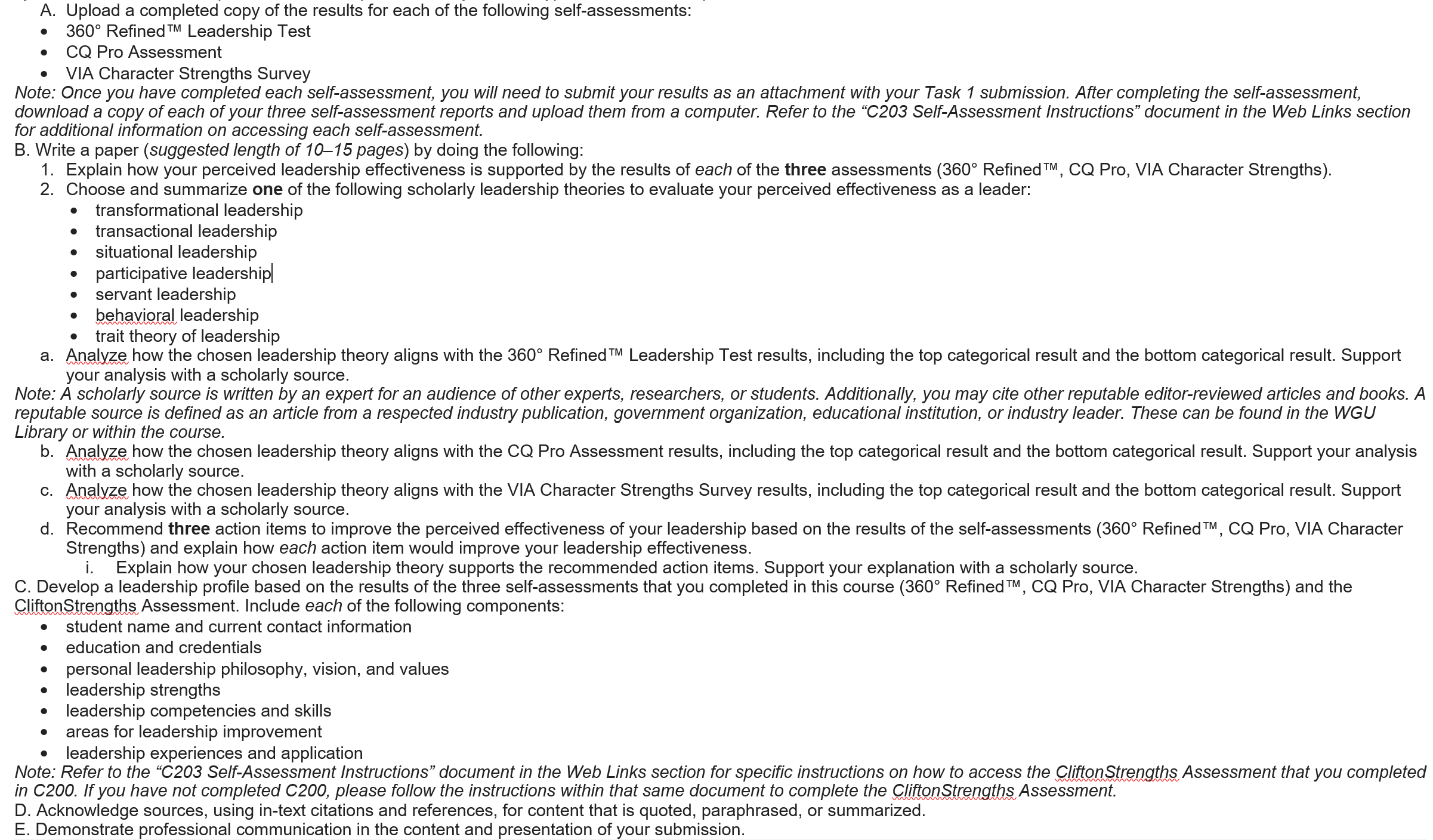
What the Current C203 Task 1 Asks For
The task maps to competency 3005.1.1, Theories of Leadership and Personal Development Style. Here’s how the directions and the rubric line up:
| Rubric aspect | What you deliver |
|---|---|
| A | Completed result reports for all three self assessments, uploaded with your paper |
| B1 | How your perceived leadership effectiveness is supported by each of the three assessments, with specific examples |
| B2 | One theory from the given list, accurately summarized |
| B2a | How the theory aligns with your 360° Refined™ top and bottom categorical results, with a scholarly source |
| B2b | How the theory aligns with your CQ Pro top and bottom categorical results, with a scholarly source |
| B2c | How the theory aligns with your VIA top and bottom categorical results, with a scholarly source |
| B2d | Three action items based on the assessments, and how each would improve your effectiveness |
| B2di | How your theory supports each action item, with a scholarly source |
| C | A leadership profile built on all three assessments plus CliftonStrengths, with seven required components |
| Sources | In text citations and a complete reference list |
| Professional communication | A clean Grammarly for Education Correctness check |
One detail catches students out: the task directions call sources D and professional communication E, but the rubric labels them the other way around. Both are required either way, so don’t let the letters confuse you.
Another point older guides get wrong: CliftonStrengths isn’t one of the uploads for A. You upload three reports. CliftonStrengths results, which most students already have from C200, are used only in the Part C profile.
The suggested length for Part B is 10 to 15 pages.
Are There C203 Task 1 Answers You Can Use?
No, and that matters more in WGU C203 than in most MBA courses. Every analytical aspect, from B1 through C, is built on your own scores. Two students who pick the same theory will still have different top and bottom results, so there are no C203 Task 1 answers to copy. A borrowed paper would describe results that don’t match the reports you upload with it, which makes the problem visible to your evaluator before the similarity checker ever runs.
What you can borrow is structure, which is why the example on this page uses a fictitious leader with invented scores.
Plan the Work Around a Full Time Job
- Evening one: Take all three assessments, download each report as a PDF, and find your CliftonStrengths results from C200. The “C203 Self Assessment Instructions” document in the course Web Links explains how to access each one.
- Evening two: Read the three reports and write down your top and bottom categorical result for each one. Only then choose your theory.
- Evenings three and four: Draft B1 through B2c.
- Evening five: Draft B2d and B2di, then the Part C profile.
- Evening six: Citations, Grammarly for Education, the similarity report, and a final check that every result you name matches your uploaded reports.
How to Read Your Three Reports
Because the rubric marks a paper down when “the top categorical result or bottom categorical result included are not accurate,” the first job is reading each report correctly.
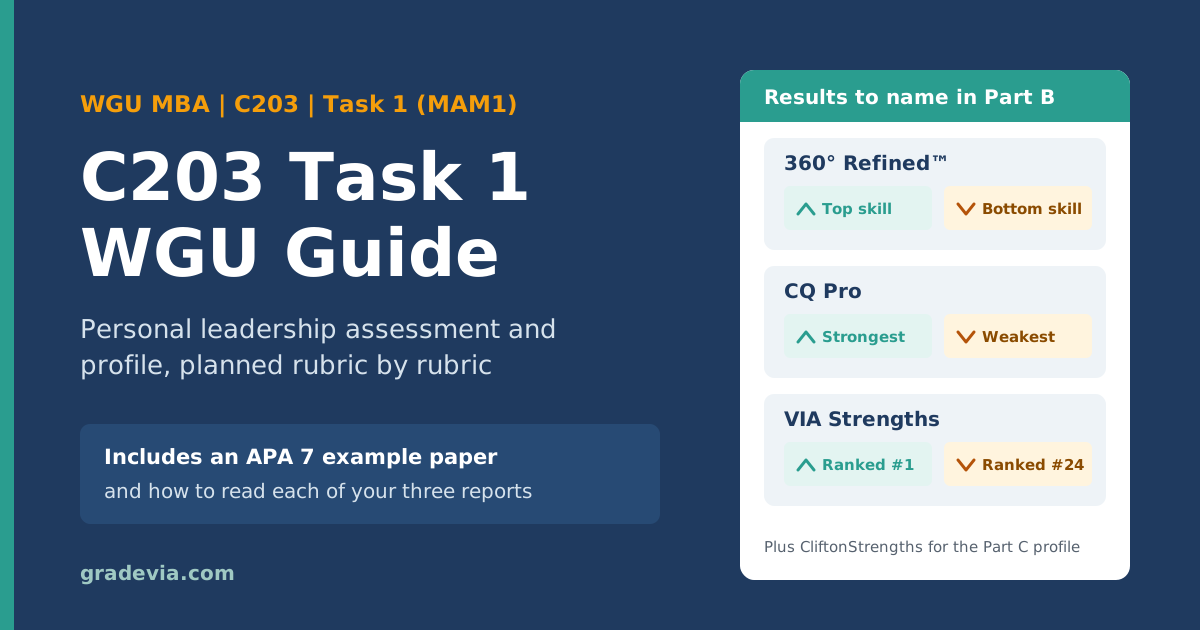
360° Refined™ Leadership Test
The Self Edition report lists your 5 highest and 5 lowest rated leadership skills out of 22, each with a score from 1 to 6, plus your 10 highest and 10 lowest rated behavior statements. The 22 skills sit inside seven skill groups. Strategy, Action, and Results make up Core Leadership. Emotional Intelligence, Organizational Justice, Character, and Development make up Adaptive Leadership.
Use your highest rated skill as your top result and your lowest rated skill as your bottom result, and name the skill group each one belongs to. That covers you whichever level your evaluator treats as “categorical.” This also gives you a natural link to theory. A meta analysis found that emotional intelligence predicts transformational leadership ratings (Hsu et al., 2022), so a top or bottom skill in the Emotional Intelligence group is easy to support with research. If two skills tie for the lowest score, say so and explain which one you’ll analyze and why. Check the score column too, because the bottom table isn’t always listed in score order.
CQ Pro Assessment
The CQ Pro report scores four capabilities: CQ Drive, CQ Knowledge, CQ Strategy, and CQ Action. Each one has sub dimensions. The report states your strongest and weakest capability directly, and it explains that these are “based on your self scores in comparison to the worldwide median, not simply based on the highest numerical scores.”
That sentence matters. Your highest raw number might not be your strongest capability. Use the capabilities the report names on the “strongest” and “weakest” pages as your top and bottom results, and mention your highest and lowest sub dimensions for detail. For your scholarly source, a systematic review of 97 studies found that cultural intelligence is linked to positive outcomes for people working across cultures (Morin & Talbot, 2023).
VIA Character Strengths Survey
The VIA survey ranks all 24 character strengths, which are grouped under six virtues: wisdom, courage, humanity, justice, temperance, and transcendence. Your top result is the strength ranked first, and your bottom result is the strength ranked 24th. Name the virtue each one falls under as well.
Treat the bottom strength as your least used strength, not as a weakness. That framing is more accurate, and it gives you a better path into your action items.
Choose Your Theory After You Read Your Results
B2 requires one of seven theories: transformational, transactional, situational, participative, servant, behavioral, or trait. Choose the one that gives you the most to say about your six results, not the one you like best. A useful test: for each top and bottom result, can you write two sentences about how the theory explains it? If one result leaves you with nothing to say, try another theory.
Your B2 summary should define the theory accurately, name its core components, and cite a scholarly source. If you choose transformational leadership, an evidence based primer on its effectiveness (Deng et al., 2023) is a current source for both the summary and B2di. Keep it to a page or so. The analysis sections carry more weight.
B1: Perceived Leadership Effectiveness
Write one section for each assessment. For each, say what the results suggest about your effectiveness and back it up with a specific example from your work. “My high Decision Making score fits how I handled the route change in March” is specific. “I am a strong decision maker” is not.
B2a, B2b, and B2c: Theory Alignment
Each of these three aspects needs four things:
- Your top categorical result, named exactly as the report names it
- How the theory explains or relates to it
- Your bottom categorical result, with the same treatment
- A scholarly source supporting the analysis
Alignment doesn’t have to mean agreement. Explaining that a bottom result works against the theory’s ideal, and why, is good analysis. Note that the rubric asks for a scholarly source in each of these aspects, so plan for at least one citation per section.
B2d and B2di: Three Action Items
Each action item should come from a specific result, describe a concrete activity with a timeframe, and explain how it would improve your effectiveness. Spreading the three items across the three assessments makes the “based on the results of the self assessments” requirement easy to see.
B2di then connects each item back to your theory with a scholarly source. If you chose transformational leadership, for example, show which component (idealized influence, inspirational motivation, intellectual stimulation, or individualized consideration) each action item strengthens.
C: The Leadership Profile
The profile is a separate section, often formatted like a professional summary page. It must contain all seven components:
- Student name and current contact information
- Education and credentials
- Personal leadership philosophy, vision, and values
- Leadership strengths
- Leadership competencies and skills
- Areas for leadership improvement
- Leadership experiences and application
The rubric also requires the profile to be “logically based on the results of the assessments.” Draw your strengths and improvement areas from your actual results, including CliftonStrengths, and name them, so the connection is obvious.
What a Competent C203 Task 1 Gets Right
- Every top and bottom result matches the uploaded reports word for word
- The theory is chosen from the list and summarized accurately
- B2a, B2b, B2c, and B2di each have their own scholarly source
- Each action item traces back to a named result
- The profile contains all seven components and cites the assessments
- All three reports are uploaded, complete, as separate files from the paper
C203 Task 1 Example: The Taylor Brooks Paper
Our C203 Task 1 example follows Taylor Brooks, a fictitious dispatch operations supervisor at a fictitious regional freight company. Taylor leads 14 dispatchers across two shifts. Taylor’s invented results include Decision Making as the top 360° skill and Relationship Management as the bottom one, CQ Drive and CQ Knowledge as the strongest and weakest CQ capabilities, and Perseverance and Humility as the top and bottom VIA strengths. The paper uses transformational leadership and covers every aspect from B1 to C in APA 7 format. Each section carries a comment explaining which rubric aspect it satisfies.
Here’s a short excerpt from the B2a analysis:
My bottom result, Relationship Management in the Emotional Intelligence skill group, works against the idealized influence component of transformational leadership. Dispatchers notice how a supervisor treats a colleague during a late load escalation, and a leader who handles those moments poorly is harder to trust as a role model.
The example is for illustration only. Your paper has to analyze your own reports, so none of this text would match what you upload.
Download the C203 Task 1 example paper (.docx)
Common Reasons C203 Task 1 Comes Back
- Naming the wrong top or bottom result, especially a CQ capability chosen by raw score
- Choosing a theory that isn’t on the list, or summarizing it loosely
- Discussing only the top results in B2a, B2b, or B2c and leaving out the bottom ones
- Missing a scholarly source in one of the four aspects that require one
- Action items that are generic leadership advice rather than responses to specific results
- A profile missing a component, often contact information or credentials
- Forgetting to upload one of the three reports, or uploading an incomplete one
What Comes After C203 Task 1
WGU C203 Task 2 moves from your own leadership to an organization’s. Our WGU C203 Task 2 guide covers that evaluation. If you haven’t finished C200 yet, our C200 Task 1 example explains how CliftonStrengths fits into that course.
Many students take C204 next. Our C204 Management Communication Task 1 guide covers the communication portfolio and includes a downloadable C204 Task 1 sample paper. If you’re comparing WGU C204 Task 1 examples, note that the current task asks for bias and intercultural sections that many older examples don’t include. For the second assessment, see our C204 Task 2 presentation guide.
Pre-Submission Checklist
- All three self assessment reports are complete and attached as separate files
- The theory comes from the list of seven and is accurately summarized
- B1 covers each of the three assessments with a specific example
- B2a, B2b, and B2c each name the top and bottom categorical result exactly as the report does
- B2a, B2b, B2c, and B2di each cite a scholarly source
- B2d has three action items, each tied to a specific result
- The profile has all seven components and reflects all four assessments, including CliftonStrengths
- Every citation has a reference, Grammarly Correctness is clear, and the similarity report has been reviewed
Frequently Asked Questions
Do I upload my CliftonStrengths report for C203 Task 1?
Part A asks for three reports: 360° Refined™, CQ Pro, and VIA Character Strengths. CliftonStrengths results are used in the Part C leadership profile.
What counts as the top categorical result?
Use the highest rated skill on the 360° Refined™ report, the strongest capability the CQ Pro report names, and the first ranked VIA strength. Name the skill group or virtue as well. Do the same for the bottom results.
How many scholarly sources does C203 Task 1 need?
The rubric requires a scholarly source in B2a, B2b, B2c, and B2di. A source summarizing your theory in B2 also helps. Plan for at least four or five.
Can I use a theory that isn’t on the list?
No. B2 requires one of the seven listed theories. A different theory is scored as Approaching Competence.
Can I submit the C203 Task 1 example from this page?
No. It describes a fictitious leader’s invented results, so it couldn’t match your reports, and copying any example is an academic integrity violation.
Need Help With Your Leadership Paper?
If you’re working full time and want structured assignment support reading your reports, choosing a theory, or checking your draft against the rubric, message Gradevia on WhatsApp at +1 564 544 6924.
References
Deng, C., Gulseren, D., Isola, C., Grocutt, K., & Turner, N. (2023). Transformational leadership effectiveness: An evidence-based primer. Human Resource Development International, 26(5), 627–641. https://doi.org/10.1080/13678868.2022.2135938
Hsu, N., Newman, D. A., & Badura, K. L. (2022). Emotional intelligence and transformational leadership: Meta-analysis and explanatory model of female leadership advantage. Journal of Intelligence, 10(4), Article 104. https://doi.org/10.3390/jintelligence10040104
Morin, G., & Talbot, D. (2023). Cultural intelligence of expatriate workers: A systematic review. Management Review Quarterly, 73(1), 413–454. https://doi.org/10.1007/s11301-021-00245-6