
Blog
WGU C717 Task 1 Guide and Example: TechFite Ethics, Policies, and CSR

Updated on: Oct 14, 2026
By Dan Palmer, MBA · Academic strategy consultant for working adult learners · LinkedIn
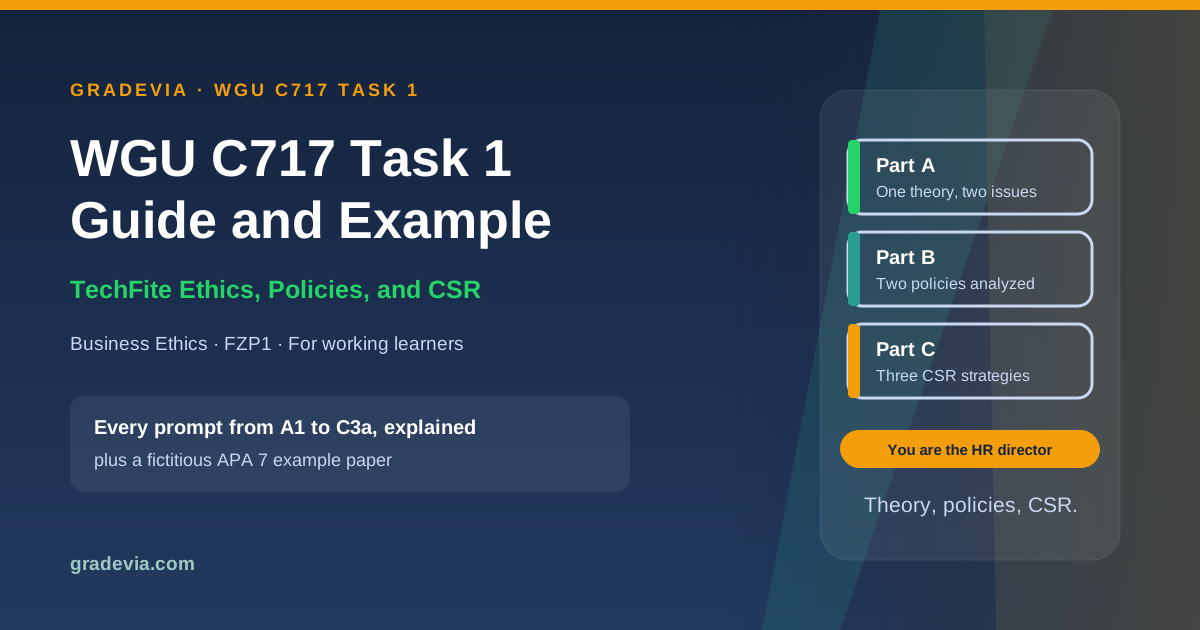
In WGU C717 Task 1, you’re the HR director at TechFite, a British company whose first U.S. factory, in Dellberg, has drifted away from the values it promised. Workers hired for full time roles were moved to part time, executives still receive large bonuses, and none of the commitments made to the Dellberg City Council have been funded. Your job is to show TechFite a path back: one ethical theory applied to two issues, two corporate policies analyzed, and three corporate social responsibility (CSR) strategies.
Business ethics C717 Task 1 isn’t hard to understand. What makes it slow is the number of small, separate requirements: 20 lettered prompts across Parts A to C, several of which ask for exactly one or exactly two of something. This guide walks through each part in the order the evaluator reads it, shows what a specific answer looks like compared with a vague one, and ends with a WGU C717 Task 1 example written for a fictitious company, so you can see the structure without a TechFite paper to copy.
C717 Task 1 Assignment
Introduction
In a complex, multicultural business environment, business professionals must adhere to ethical standards throughout their daily activities. The goal of this course is to introduce you to concepts and guidelines for ethical courses of action in business. In order to assess your understanding, you will analyze the ethical and socially responsible courses of action for the given business scenario. You will take on the role of human resources (HR) director of the firm to discuss the situation, analyze corporate policies and ethical guidelines for the organization, and suggest possible courses of action to address the company’s ethical responsibilities.
Scenario
TechFite, a high-tech British company renowned for its commitment to workplace collaboration, leadership development, and community engagement, recently opened its first U.S. factory in Dellberg to produce a new line of recreational equipment. The company’s culture strongly emphasizes employee empowerment, environmental responsibility, and active community participation.
To staff the new facility, TechFite has hired several local Dellberg residents, originally promising full-time roles with a 40-hour work week. However, due to budget constraints, funding for full-time benefits is limited and has led to the reclassification of many new employees to part-time. This decision has created employee dissatisfaction, as the reduced hours prevent many workers from qualifying for full-time benefits. Recognizing the differences in labor laws and cultural expectations between the United States and the United Kingdom, TechFite’s HR department is now tasked with reviewing its policies to address the ethical implications for employee well-being.
As the HR director, you have noted a troubling trend. While employee hours and benefits are restricted, significant bonuses continue to be awarded to top executives, highlighting a disconnect between executive compensation and the company’s stated values.
During their initial presentations to the Dellberg City Council, TechFite committed to sponsoring local events, supporting youth leadership initiatives, and investing in Dellberg’s infrastructure using environmentally conscious practices. To date, none of these commitments have been funded or acted on, which is beginning to damage TechFite’s reputation in the community. Initial enthusiasm from Dellberg residents has waned, with complaints surfacing about limited hours, inadequate benefits, and the company’s failure to engage in promised community and environmental initiatives.
To regain the trust and support of Dellberg’s residents, TechFite’s leadership team recognizes the need for a clear, actionable plan that realigns the company’s practices with its ethical values. This includes addressing community commitments, employee benefits, and environmentally sustainable practices to strengthen local relationships and fully integrate into Dellberg’s community.
A. Using the scenario, help TechFite determine a path forward by doing the following:
1. Provide a description of one ethical theory from the following list:
- virtue ethics
- utilitarianism
- principle-based ethics
2. Identify one example of an ethical issue from the scenario.
a. Discuss why the example identified in part A2 is an ethical issue.
b. Describe how two stakeholders are impacted by the ethical issue from part A2.
c. Explain how the theory from part A1 can be applied to the ethical issue from part A2 to help TechFite regain ethical alignment.
3. Identify a second example (different from part A2) of an ethical issue from the scenario.
a. Discuss why the example identified in part A3 is an ethical issue.
b. Describe how two stakeholders are impacted by the ethical issue from part A3.
c. Explain how the theory from part A1 can be applied to the ethical issue from part A3 to help TechFite regain ethical alignment.
B. Identify the two corporate policies you have chosen to analyze from the attached “TechFite Corporate Policies” document.
1. Analyze both corporate policies chosen in part B1 by doing the following:
a. Discuss one way the first corporate policy aligns with the ethical principles of TechFite and one way it conflicts with the ethical principles of TechFite.
b. Discuss one way the second corporate policy aligns and one way it conflicts with the stated ethical principles of TechFite.
C. Explain corporate social responsibility.
1. Propose one actionable strategy that TechFite can implement to align its practices with its commitment to corporate social responsibility focused on employees.a. Discuss how the strategy focused on employees would promote TechFite’s reputation as a socially responsible organization.
2. Propose one actionable strategy that TechFite can implement to align its practices with its commitment to corporate social responsibility focused on community engagement.
a. Discuss how the strategy focused on community engagement would promote TechFite’s reputation as a socially responsible organization.
3. Propose one actionable strategy that TechFite can implement to align its practices with its commitment to corporate social responsibility focused on environmental sustainability.
a. Discuss how the strategy focused on environmental sustainability would promote TechFite’s reputation as a socially responsible organization.
D. Acknowledge sources, using in-text citations and references, for content that is quoted, paraphrased, or summarized.
E. Demonstrate professional communication in the content and presentation of your submission.

What C717 Task 1 Asks You to Do
| Part | Prompt | What you deliver |
|---|---|---|
| A | A1 | A description of one ethical theory: virtue ethics, utilitarianism, or principle-based ethics |
| A2, A2a to A2c | One ethical issue from the scenario, why it’s ethical, how two stakeholders are affected, and how your A1 theory helps TechFite regain ethical alignment | |
| A3, A3a to A3c | A second, different issue, with the same three subparts and the same theory | |
| B | B, B1a, B1b | Two policies from the “TechFite Corporate Policies” document, with one way each aligns and one way each conflicts with TechFite’s ethical principles |
| C | C | An explanation of corporate social responsibility |
| C1, C1a | One actionable CSR strategy focused on employees, and how it would promote TechFite’s reputation | |
| C2, C2a | One actionable strategy focused on community engagement, and how it would promote TechFite’s reputation | |
| C3, C3a | One actionable strategy focused on environmental sustainability, and how it would promote TechFite’s reputation | |
| D | In-text citations and references for anything quoted, paraphrased, or summarized | |
| E | Professional communication |
Use a heading for each prompt (A1, A2, A2a, and so on). With 20 separate prompts, headings are the simplest way to make sure the evaluator finds every one.
C717 Task 1 FZP1 and Other Versions
Many students see this task listed as WGU C717 Task 1 FZP1, the same code as the FZP1 Task 2 on business dilemmas. Older papers posted online describe a different TechFite task, in which you write workplace policies and an ethics officer’s role as an HR director. A search for business ethics C717 Task 1 FZP1 usually points to this TechFite task, but before you use any outside material, check the code and the requirement letters on your own directions. Our guide to FZP1, EKP1, and FZP2 explains how to confirm your version.
Read the TechFite Scenario for Its Tensions
Every C717 WGU Task 1 FZP1 paper is built from the same short scenario, so read it closely once and note each place where TechFite’s actions don’t match its stated values. The scenario describes:
- A culture that emphasizes employee empowerment, environmental responsibility, and community participation
- Workers promised full time, 40 hour roles who were reclassified to part time because of budget constraints
- Differences in labor law and cultural expectations between the United Kingdom and the United States
- Large executive bonuses while employee hours and benefits are restricted
- Commitments to the Dellberg City Council on local events, youth leadership, and environmentally conscious infrastructure that haven’t been funded or acted on
- Waning community enthusiasm and complaints about hours, benefits, and unmet commitments
Your two ethical issues (A2 and A3), your policy analysis (B), and your three CSR strategies (C) all come from these tensions. Choose issues you can also connect to the policies document, because the analysis in Part B is stronger when it echoes Part A.
Part A: One Theory, Two Issues
A1: Choose and describe one theory
You describe one theory, then apply that same theory to both issues in A2c and A3c. Choose the one you can apply most naturally:
| Theory | Core question | A good fit when |
|---|---|---|
| Utilitarianism | Which option produces the greatest overall good for everyone affected? (Sinnott-Armstrong, 2023) | You want to weigh harms and benefits across workers, executives, and the town |
| Virtue ethics | What would a person of good character, such as an honest and fair leader, do here? (Hursthouse & Pettigrove, 2026) | You want to focus on integrity, fairness, and keeping one’s word |
| Principle-based ethics | Which duty or moral rule applies, and is it being followed consistently? (Alexander & Moore, 2024) | You want to focus on promises, honesty, and treating people with respect |
Describe the theory in your own words, in three or four sentences, with a citation. A definition that could appear in any textbook is fine for A1, as long as you then use it in A2c and A3c.
A2 and A3: The pattern for each issue
Both issues follow the same four step pattern:
- Identify the issue (A2 or A3) in one sentence that names what TechFite did.
- Explain why it’s an ethical issue (a). Say what makes it more than a budget or legal question, such as a broken promise, unfair treatment, dishonesty, or harm to people with less power.
- Describe two stakeholders (b). Name two different groups and say specifically how each is affected. “Employees are unhappy” is vague. “Reclassified workers lost eligibility for full time benefits they were promised when hired” is specific.
- Apply your theory (c). Use the theory’s own logic to reach a course of action that helps TechFite regain ethical alignment. A utilitarian weighs consequences; a virtue ethicist asks what a fair and honest leader would do; a principle-based ethicist names the duty that applies.
The second issue must be different from the first. Two angles on the same problem, such as reclassification and lost benefits, will read as one issue.
Part B: Two Corporate Policies
Choose two policies from the TechFite Corporate Policies document in your course’s supporting documents. For each one, you need exactly two things:
- One way it aligns with TechFite’s ethical principles
- One way it conflicts with TechFite’s ethical principles
The principles to measure against are the ones the scenario states: employee empowerment, environmental responsibility, and active community participation. A policy can support one principle on paper and undercut it in practice, and pointing to that gap is usually the strongest conflict you can name. Quote or paraphrase the policy wording you’re analyzing, and cite the document as your course directs.
Part C: Corporate Social Responsibility
C: Explain CSR
Start with a short definition and a citation. Corporate social responsibility is generally understood as a business meeting society’s economic, legal, ethical, and philanthropic expectations, not only earning a profit (Carroll, 2021). Two or three sentences are enough.
C1 to C3: Three actionable strategies
The directions use the word actionable for every strategy. An actionable strategy says who does what, by when, and how TechFite will know it worked:
Vague: “TechFite should support the community more.”
Actionable: “TechFite should fund the youth leadership program it promised the city council, name an HR coordinator to run it, and report participation to the council each quarter.”
Each strategy has its own focus: employees (C1), community engagement (C2), and environmental sustainability (C3). Tie each one back to a specific gap in the scenario.
C1a to C3a: Reputation
Each “a” prompt asks how the strategy would promote TechFite’s reputation as a socially responsible organization. Explain who would notice the change and why it would change their view, such as Dellberg residents, current employees, job applicants, or the city council.
Sources and Professional Communication
Cite every theory definition, your CSR definition, and any research you use, in APA format with a reference list. Run Grammarly for Education before you submit, and review the similarity report.
WGU C717 Task 1 Example: Norvik Outdoor
Our C717 Task 1 example is a complete APA 7 paper for a fictitious practice scenario. Norvik Outdoor, a fictitious Norwegian stove maker, opens its first Canadian plant, keeps most workers on fixed term contracts despite promising permanent jobs, hasn’t funded a promised trail project, and hasn’t installed a promised solvent recovery system. The paper shows:
- Utilitarianism described in A1 and applied to both issues in A2c and A3c
- Two different issues, each with two stakeholders and a specific impact
- Two fictitious company policies, each with one alignment and one conflict
- A cited CSR definition and three actionable strategies, each with a reputation explanation
- Comments explaining which prompt each section meets
Here’s part of its A2c section:
Converting workers who meet clear performance standards produces the greater overall good: stable households, a council that can stand behind Norvik, and lower turnover. Utilitarianism therefore supports a published conversion plan as the way for Norvik to regain ethical alignment.
The example is for illustration only. Your submission must analyze TechFite and the TechFite Corporate Policies document in your own words.
Download the C717 Task 1 example (.docx)
WGU C717 Task 1 Answers: Why Copying Doesn’t Work
Every student works from the same TechFite scenario and the same policies document, so papers posted online as WGU C717 Task 1 answers overlap heavily with each other. That overlap is exactly what WGU’s similarity checker is built to detect. Your own reading of the scenario, your own choice of theory, and your own strategies are what make a paper clearly yours.
Plan It Around Your Work Week
Most working learners can finish C717 Business Ethics Task 1 in four evenings:
- Evening one (about 1.5 hours): Read the scenario and the policies document, note the tensions, choose your theory, and write A1.
- Evening two (about 2 hours): Write A2 and A3 with all their subparts.
- Evening three (about 2 hours): Write Part B, the CSR definition, and C1 to C3a.
- Evening four (about 1 hour): Add citations and references, check each heading against the directions, run Grammarly, and review the similarity report.
Common Reasons C717 Task 1 Comes Back
- A2c or A3c defines the theory again instead of applying it to the issue
- A different theory is used for the second issue
- A3 is the same issue as A2 from a different angle
- Only one stakeholder is described, or the impact is general
- A policy has an alignment but no conflict, or the reverse
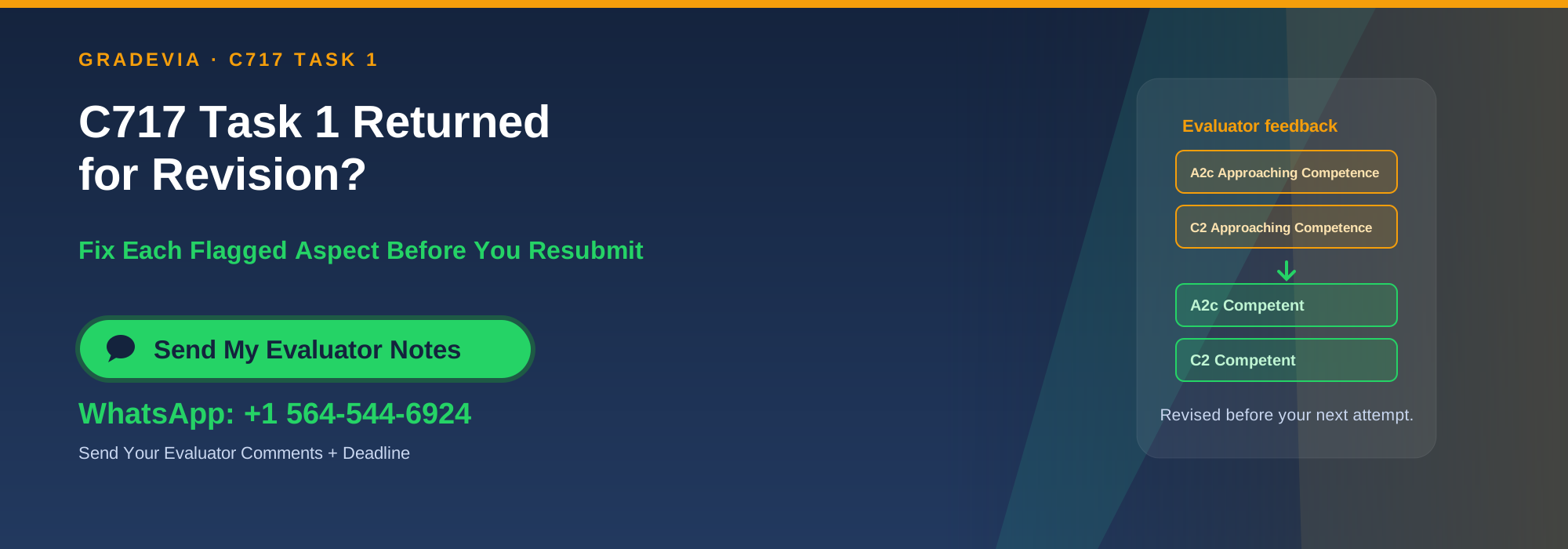
- A strategy isn’t actionable, or two strategies share the same focus
- The reputation prompts restate the strategy instead of explaining the effect on reputation
- Theory and CSR definitions are paraphrased without citations
Pre-Submission Checklist
Run this check against your C717 Task 1 WGU directions before you submit:
- A1 describes one theory from the list, with a citation
- A2 and A3 are two different issues from the scenario
- Each issue explains why it’s ethical and describes two stakeholders
- A2c and A3c apply the same A1 theory and show a path to ethical alignment
- Two policies are named, each with one alignment and one conflict
- CSR is explained with a citation
- C1, C2, and C3 are actionable and cover employees, community, and environment
- C1a, C2a, and C3a each explain the effect on TechFite’s reputation
- Every source is cited in text and listed in the references
Related C717 Guides
- See every C717 guide in one place.
- Our C717 Task 1 example page has more on structuring the paper.
- After Task 1, our WGU C717 Task 2 guide covers the three business dilemmas and the three theories.
- Learn how to identify the type of ethical dilemma in C717 Task 2 and how to cite sources for C717 Task 2.
- Values and leadership carry into D253. See our WGU D253 course guide.
Frequently Asked Questions
What is WGU Business Ethics C717 Task 1?
It’s the first performance assessment in C717 Business Ethics. As TechFite’s HR director, you apply one ethical theory to two issues in its U.S. factory, analyze two corporate policies, and propose three corporate social responsibility strategies.
Is C717 Task 1 FZP1 the TechFite task?
Many students see the TechFite task listed under FZP1. Check the code and the requirement letters on your own directions, because older papers online describe a different TechFite task.
Can I use a different theory for A2 and A3?
No. A2c and A3c both ask you to apply the theory from A1, so use one theory throughout Part A.
How many stakeholders do I need in C717 Task 1?
Two for each issue, in A2b and A3b. They can be different stakeholders for each issue.
Where do the corporate policies come from?
From the “TechFite Corporate Policies” document in your course’s supporting documents. Choose two of them for Part B.
Can I submit the C717 Task 1 example on this page?
No. It’s written for a fictitious company with its own policies and is for illustration only. Your paper must analyze TechFite in your own words.
Want a Second Look Before You Submit?
If you’re working full time and want structured assignment support choosing your theory and issues, making your CSR strategies actionable, or checking your paper against every prompt before you submit, message Gradevia on WhatsApp at +1 564 544 6924.
Sources
Alexander, L., & Moore, M. (2024). Deontological ethics. In E. N. Zalta & U. Nodelman (Eds.), The Stanford encyclopedia of philosophy. Stanford University. https://plato.stanford.edu/entries/ethics-deontological/
Carroll, A. B. (2021). Corporate social responsibility: Perspectives on the CSR construct’s development and future. Business & Society, 60(6), 1258–1278. https://doi.org/10.1177/00076503211001765
Hursthouse, R., & Pettigrove, G. (2026). Virtue ethics. In E. N. Zalta & U. Nodelman (Eds.), The Stanford encyclopedia of philosophy. Stanford University. https://plato.stanford.edu/entries/ethics-virtue/
Sinnott-Armstrong, W. (2023). Consequentialism. In E. N. Zalta & U. Nodelman (Eds.), The Stanford encyclopedia of philosophy. Stanford University. https://plato.stanford.edu/entries/consequentialism/
{ "@type": "Article", "author": { "@type": "Person", "name": "Dan Palmer", "url": "https://gradevia.com/dan-palmer/", "sameAs": [ "https://www.linkedin.com/in/dan-palmer-mba" ] } }