WGU Assignment Guides & Samples

WGU C206 Task 2: Developing Organizational Ethics & Socially Responsible Behavior — Expert Guide

EHM2 Task 2: Developing Organizational Ethics And Socially Responsible Behavior
Reading Time: 29 minutes

WGU C206 Task 2: Developing Organizational Ethics And Socially Responsible Behavior

WGU C206 Task 2, officially coded as EHM2 in the Ethical Leadership course, is one of the most writing-intensive performance assessments in the WGU business curriculum. As a business manager at Paradigm Toys, a fictional publicly held retailer and manufacturer of children’s toys, you have been asked by the board of directors to conduct a full ethics audit and deliver a formal report.

That report must address corporate social responsibility (CSR), ethical leadership, an ethics audit of Paradigm Toys, a real business ethical dilemma, and a structured ethics training program proposal — all in 6–8 pages, APA 7 format, submitted as a .docx file.

As an organizational leader, one of your primary roles is establishing programs and policies that ensure the organization operates under ethical considerations and legal mandates. This responsibility includes informing employees of the organization’s code of ethics, communicating the code of ethics, providing training, and ensuring that operational aspects are administered in a legal and ethical manner.

You will assume the role of a leader and decide what strategies you will use to develop a strong organizational ethical climate. In your position as a leader, you will need to identify primary and secondary stakeholders and satisfy their concerns, understand the organization’s ethical standing, and develop an ethics training program.

Scenario

You are a business manager of Paradigm Toys, a fictional publicly held company that is a retailer and manufacturer of children’s toys. The board of directors has asked you to conduct an ethics audit of the company and report to the board if you find the need for ethics training.

Requirements

Your submission must represent your original work and understanding of the course material. Most performance assessment submissions are automatically scanned through the WGU similarity checker. Students are strongly encouraged to wait for the similarity report to generate after uploading their work and then review it to ensure Academic Authenticity guidelines are met before submitting the file for evaluation. See Understanding Similarity Reports for more information.

Grammarly Note:

Professional Communication will be automatically assessed through Grammarly for Education in most performance assessments before a student submits work for evaluation. Students are strongly encouraged to review the Grammarly for Education feedback prior to submitting work for evaluation, as the overall submission will not pass without this aspect passing. See Use Grammarly for Education Effectively for more information.

Microsoft Files Note:

Write your paper in Microsoft Word (.doc or .docx) unless another Microsoft product, or pdf, is specified in the task directions. Tasks may notbe submitted as cloud links, such as links to Google Docs, Google Slides, OneDrive, etc. All supporting documentation, such as screenshots and proof of experience, should be collected in a pdf file and submitted separately from the main file. For more information, please see Computer System and Technology Requirements.

You must use the rubric to direct the creation of your submission because it provides detailed criteria that will be used to evaluate your work. Each requirement below may be evaluated by more than one rubric aspect. The rubric aspect titles may contain hyperlinks to relevant portions of the course.

Prepare a report (suggested length of 6–8 pages) for Paradigm Toys in which you do the following:
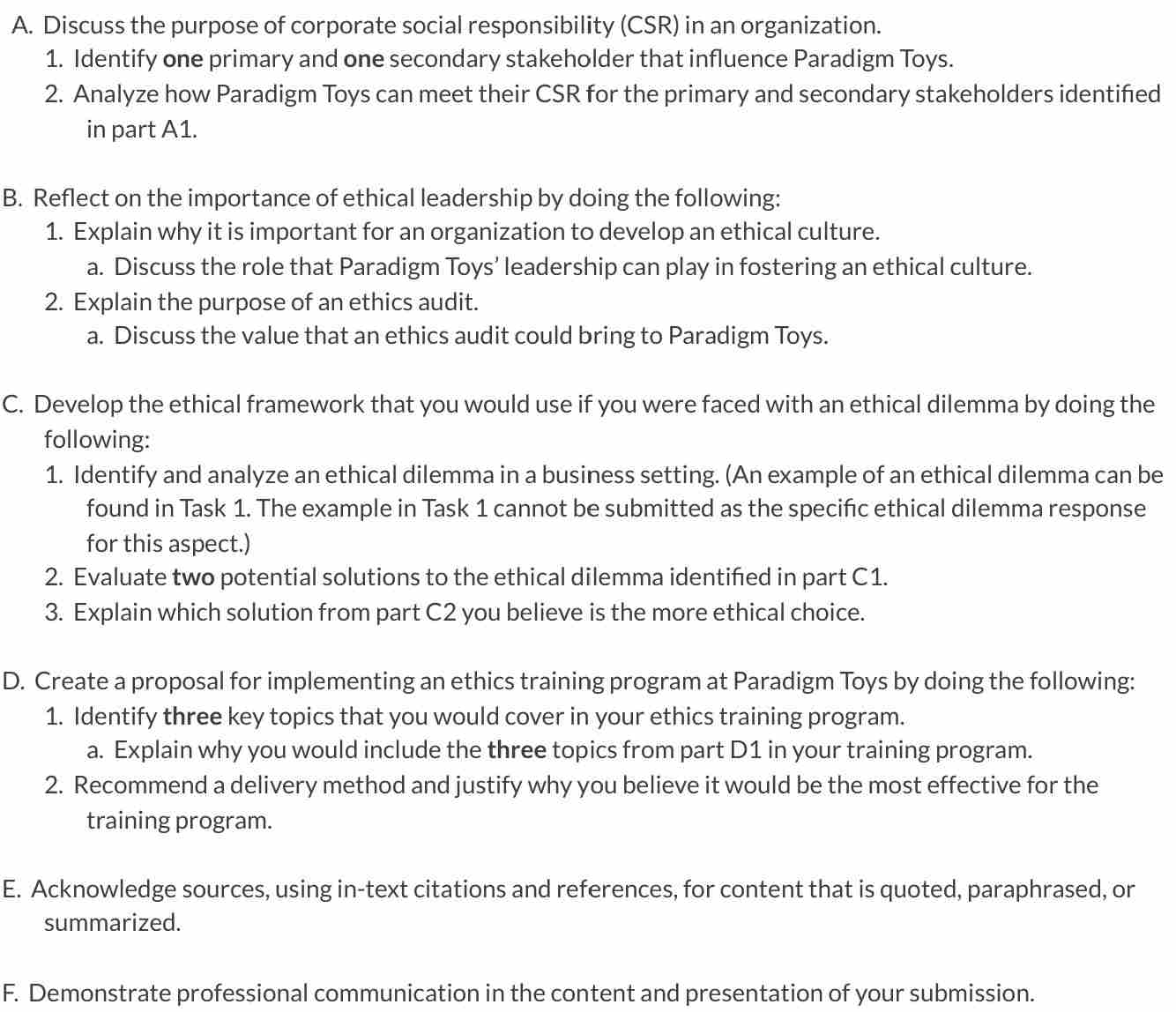
A. Discuss the purpose of corporate social responsibility (CSR) in an

    1. Identify one primary and one secondary stakeholder that influence Paradigm

    2. Analyze how Paradigm Toys can meet their CSR for the primary and secondary stakeholders identified in part

B. Reflect on the importance of ethical leadership by doing the following:

  1. Explain why it is important for an organization to develop an ethical

a. Discuss the role that Paradigm Toys’ leadership can play in fostering an ethical

2. Explain the purpose of an ethics

b. Discuss the value that an ethics audit could bring to Paradigm

C. Develop the ethical framework that you would use if you were faced with an ethical dilemma by doing the following:

    1. Identify and analyze an ethical dilemma in a business (An example of an ethical dilemma can be found in Task 1. The example in Task 1 cannot be submitted as the specific ethical dilemma response for this aspect.)

    2. Evaluate two potential solutions to the ethical dilemma identified in part

    3. Explain which solution from part C2 you believe is the more ethical

D. Create a proposal for implementing an ethics training program at Paradigm Toys by doing the following:

  1. Identify three key topics that you would cover in your ethics training

a. Explain why you would include the three topics from part D1 in your training

2. Recommend a delivery method and justify why you believe it would be the most effective for the training

E. Acknowledge sources, using in-text citations and references, for content that is quoted, paraphrased, or

F. Demonstrate professional communication in the content and presentation of your submission

WGU C206 Task 2: Developing Organizational Ethics & Socially Responsible Behavior

Understanding the WGU C206 Task 2 Paradigm Toys Scenario

Before you write a single word of your report, you need a clear picture of the Paradigm Toys scenario — who the company is, what situation they’re in, and what the board of directors is actually asking you to do. Every section of your C206 Task 2 paper must be grounded in this scenario. Students who treat it as generic business writing, rather than a specific report written for Paradigm Toys, are the ones who get revision requests.

Who Is Paradigm Toys?

Paradigm Toys is a fictional publicly held company that operates as both a retailer and manufacturer of children’s toys. Being publicly held is an important detail — it means Paradigm Toys is accountable to shareholders, a board of directors, and public regulatory scrutiny, all of which are directly relevant to how you frame the ethics audit, CSR obligations, and leadership responsibilities in your report.

The children’s toy industry context is equally important. Paradigm Toys’ end users are children, making the company subject to rigorous consumer product safety standards enforced by the Consumer Product Safety Commission (CPSC). The company also faces scrutiny from the Federal Trade Commission (FTC) regarding advertising practices targeting minors, and from public advocacy groups monitoring labor standards in global toy manufacturing. These aren’t background details — they’re the ethical risk landscape your report is written within.

Your Role: Business Manager Reporting to the Board

In WGU C206 Task 2, you are assigned the role of a business manager at Paradigm Toys. The board of directors has asked you to:

  1. Conduct an ethics audit of Paradigm Toys
  2. Report your findings to the board
  3. Determine whether ethics training is needed — and if so, propose a training program

This framing matters for your writing tone. Your C206 Task 2 report is not a reflective essay or a class assignment — it is a formal business report addressed to the Paradigm Toys board of directors. Every recommendation you make should be framed in the context of what is best for Paradigm Toys as a publicly held children’s toy company, not as a generic organization.

The Four Things the Board Wants From You

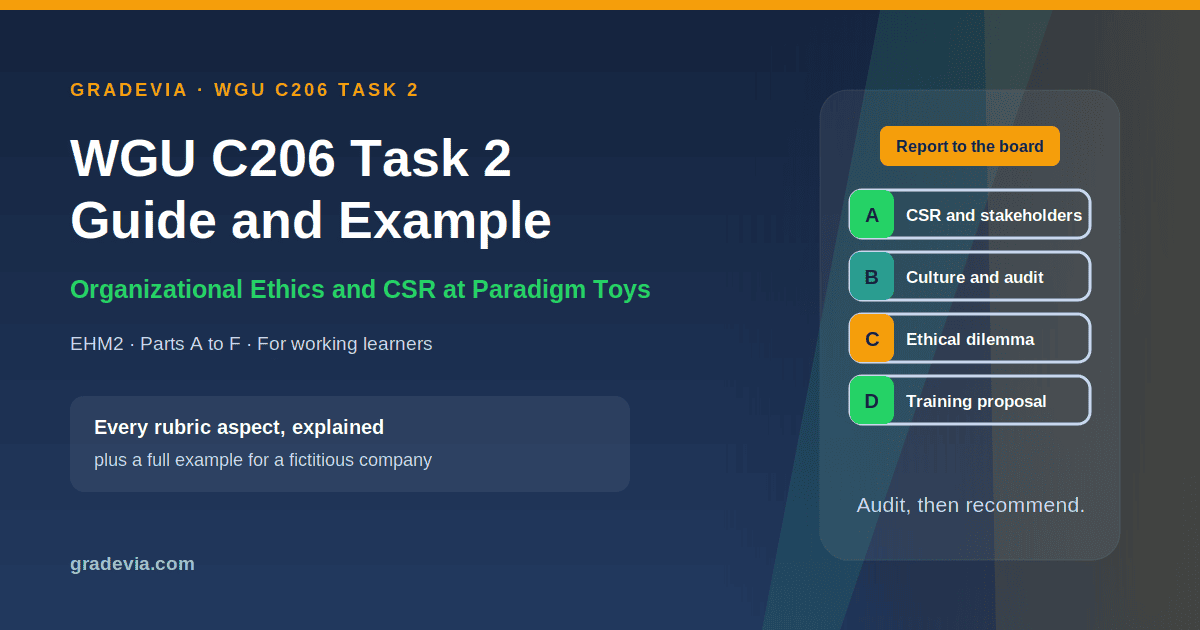
The Paradigm Toys board of directors is asking for four deliverables, which map directly to rubric sections A through D:

Section A — CSR Assessment: Who are Paradigm Toys’ primary and secondary stakeholders, and how should the company fulfill its corporate social responsibility obligations to each? Given that Paradigm Toys manufactures products for children, who are among the most vulnerable consumer groups, CSR here is not abstract — it includes product safety testing, CPSC compliance, ethical sourcing, and environmental stewardship in manufacturing.

Section B — Ethics Audit and Leadership: Does Paradigm Toys have the ethical culture and leadership behaviors needed to operate with integrity? What would an ethics audit of Paradigm Toys look like, and what value would it bring? As a publicly traded company, Paradigm Toys is especially exposed to the reputational and financial consequences of ethical lapses — which makes this section’s analysis directly consequential.

Section C — Ethical Dilemma: What ethical framework do you use when faced with a dilemma? You must identify a specific, realistic ethical dilemma that could occur at Paradigm Toys (not the example used in Task 1), evaluate two potential solutions, and defend your recommended course of action using an ethical framework such as utilitarianism or deontology. The most effective dilemmas are ones tied directly to the toy manufacturing context: child labor in the supply chain, deceptive marketing to children, unreported product safety hazards.

Section D — Ethics Training Proposal: Based on your audit findings, what ethics training does Paradigm Toys need? You must identify three specific training topics relevant to Paradigm Toys’ risk profile, justify why each matters for this company specifically, and recommend a delivery method with justification.

Why “Paradigm Toys” Needs to Appear Throughout Your Paper

One of the most common C206 Task 2 revision triggers is writing a generic ethics report that could apply to any company rather than one clearly written about and for Paradigm Toys. WGU evaluators are assessing whether you can apply ethical frameworks to a specific business context — not whether you know ethics theory in the abstract.

Every section of your report should name Paradigm Toys explicitly and connect the analysis back to the company’s specific situation: its publicly traded status, its children’s toy product line, its regulatory environment, and its obligations to parents, children, and the broader community. If you find yourself writing “the organization” or “the company” without saying Paradigm Toys, go back and make that connection explicit.

Step-by-Step Guide

This guide walks you through every section of the WGU C206 Task 2 rubric step by step: what each criterion is asking for, how to write it using the Paradigm Toys scenario, what evaluators flag for revision, and a complete sample expert answer you can use as a model.

Step 1: Set Up Your Document

  • Open Microsoft Word
  • Use 12pt Times New Roman or Arial, 1-inch margins, double-spacing
  • Add a title page: report title, your name, course, date
  • Create section headings that mirror the rubric (A, B, C, D)
  • Plan for a References page at the end

Step 2: Section A; Corporate Social Responsibility (CSR) at Paradigm Toys

What the rubric wants: A discussion of CSR’s purpose in an organization, identification of one primary and one secondary stakeholder that influence Paradigm Toys, and an analysis of how Paradigm Toys can meet its CSR obligations to each stakeholder.

How to write it:

  1. Define CSR and tie it to Paradigm Toys immediately. Don’t open with a floating definition — open by connecting CSR to Paradigm Toys’ position as a publicly held children’s toy manufacturer. The fact that Paradigm Toys makes products for children makes CSR especially high-stakes: safety failures, labor violations, or environmental harm don’t just affect the bottom line — they directly affect the most vulnerable consumers. Cite Carroll (1991) or a comparable source for your CSR definition.
  2. Identify your two stakeholders for Paradigm Toys:
    • Primary stakeholderCustomers (children and their parents/guardians) — they have a direct, transactional relationship with Paradigm Toys and depend on the company to ensure its products are safe, age-appropriate, and free of hazardous materials. Parents and guardians make purchasing decisions on behalf of children, making their trust foundational to Paradigm Toys’ commercial viability.
    • Secondary stakeholderThe local community (residents and environmental groups near Paradigm Toys’ manufacturing facilities) — affected indirectly through waste disposal, emissions, labor practices, and economic impact, but without a direct contractual relationship with the company.
  3. Analyze how Paradigm Toys meets CSR for each stakeholder:
    • For customers: Paradigm Toys should implement product safety testing that exceeds CPSC minimum standards, establish transparent age-appropriate labeling, and maintain proactive recall procedures. These aren’t optional — they are the baseline expectation for any children’s product manufacturer.
    • For the local community: Paradigm Toys should adopt environmentally sustainable manufacturing practices, responsibly manage industrial waste, and engage with the surrounding community through economic investment and transparent communication about the company’s environmental footprint.

Tip: Evaluators flag Section A responses that stay at the level of general CSR theory without naming Paradigm Toys. Every sentence in this section should either name Paradigm Toys directly or reference a specific feature of the children’s toy industry context. A solid Section A runs 1.5 pages.

Step 3: Section B; Ethical Leadership and the Ethics Audit at Paradigm Toys

What the rubric wants: Why ethical organizational culture matters, the specific role Paradigm Toys’ leadership can play in fostering it, the purpose of an ethics audit in general, and the specific value an ethics audit would bring to Paradigm Toys.

How to write it:

  1. Why ethical culture is important (B1): Ground this in consequences that are real for Paradigm Toys. Ethical culture reduces legal and regulatory risk (critical for a CPSC- and FTC-regulated company), builds employee trust, and strengthens the brand reputation that parents rely on when buying toys for their children. Cite research on ethical climate — Trevino et al. (2021) is a strong source used in the C206 course materials.
  2. Leadership’s role at Paradigm Toys specifically (B1a):
    • Paradigm Toys’ leaders set the ethical tone through both formal mechanisms (the code of conduct, compliance policies) and informal ones (the decisions they visibly make day-to-day)
    • Specific leadership behaviors: open-door communication policies that let employees raise concerns without fear; publicly recognizing employees who demonstrate ethical integrity; actively participating in ethics training rather than delegating it to HR
    • Because Paradigm Toys is publicly held, its leaders are accountable to shareholders and a board of directors — making transparent governance and ethical oversight not just a cultural ideal but a fiduciary expectation
  3. Purpose of an ethics audit (B2): Define it clearly — a systematic, objective assessment of whether Paradigm Toys’ actual practices align with its stated ethical values, policies, and legal obligations. The audit identifies gaps, surfaces ethical risk areas, assesses whether existing compliance programs are working, and gives the board of directors actionable data for improvement.
  4. Value to Paradigm Toys specifically (B2a):
    • Paradigm Toys faces ethical risks that are unique to its industry: product safety lapses, marketing practices targeting children, supply chain labor standards, and environmental impact from toy manufacturing
    • The audit surfaces whether Paradigm Toys’ existing policies adequately address these risks and whether employees understand and follow them
    • In the children’s toy industry, a single high-profile product safety or labor scandal can permanently damage consumer trust — making early identification through an audit far more cost-effective than post-crisis management
    • The audit also establishes a baseline for measuring future ethical improvement, which the board of directors can use for ongoing accountability

Step 4: Section C — Ethical Framework and Dilemma at Paradigm Toys

What the rubric wants: A specific ethical dilemma in a business setting (not the Task 1 example), two evaluated solutions, and a justified recommendation.

How to write it:

  1. Choose your dilemma (C1) — pick one of these three Paradigm Toys-specific options:
    • Dilemma Option 1: Supplier Child Labor Discovery — Paradigm Toys’ procurement team discovers that a key overseas manufacturer (responsible for 40% of production) is employing underage workers and requiring excessive overtime in violation of Paradigm Toys’ supplier code of conduct. Terminating the relationship immediately would cause major production delays and revenue loss during the holiday season. This dilemma pits the ethical obligation to refuse complicity in child labor against the financial obligation to shareholders and retail partners.
    • Dilemma Option 2: Deceptive Marketing to Children — Paradigm Toys’ marketing team proposes an advertising campaign that uses manipulative techniques — false urgency, peer pressure framing, and misleading product demonstrations — to drive holiday sales. The campaign is projected to increase revenue by 18% but would violate FTC guidelines on deceptive advertising to minors. This dilemma pits short-term financial gain against ethical and legal obligations to Paradigm Toys’ most vulnerable stakeholders: children.
    • Dilemma Option 3: Unreported Product Safety Hazard — Internal testing at Paradigm Toys reveals a potential choking hazard in a best-selling product that did not appear in standard regulatory testing. Voluntarily recalling the product before a CPSC complaint is filed would cost an estimated $8 million and damage Q4 earnings. Doing nothing risks harm to children and, if the hazard is later discovered externally, catastrophic reputational and legal consequences. This dilemma pits proactive ethical responsibility against financial and competitive pressures.

    Whichever dilemma you choose, analyze it — explain what makes it a true ethical dilemma (two legitimate but competing obligations, no consequence-free solution) before moving to your solutions.

  2. Two potential solutions (C2): Evaluate each honestly using an ethical framework:
    • Utilitarianism: Which solution produces the greatest benefit for the greatest number of people? Consider all stakeholders — children, employees, shareholders, the community.
    • Deontology: Which solution aligns with Paradigm Toys’ moral duty, regardless of financial consequences? Some actions (profiting from child labor, knowingly selling unsafe products) may be impermissible regardless of outcome.
  3. Your recommendation (C3): State clearly which solution is more ethical and defend it using your chosen framework. There is no wrong answer as long as your reasoning is consistent and tied back to Paradigm Toys’ specific context and obligations.

Reminder: You cannot use the ethical dilemma example from Task 1. If your Task 1 used a supply chain dilemma, choose Dilemma Option 2 or 3 here.

Step 5: Section D — Ethics Training Program Proposal for Paradigm Toys

What the rubric wants: Three specific training topics relevant to Paradigm Toys with justification for each, plus a recommended delivery method with justification.

How to write it:

  1. Three key training topics for Paradigm Toys (D1):
    • Topic 1: Paradigm Toys Code of Conduct and Legal Compliance — Employees across all functions must understand the specific legal and ethical standards governing Paradigm Toys’ operations, including CPSC product safety regulations, FTC advertising standards for children’s products, and applicable labor laws across domestic and international manufacturing operations. Include a walkthrough of Paradigm Toys’ own code of ethics and real case studies of compliance failures in the toy industry.
    • Topic 2: Recognizing and Reporting Ethical Violations at Paradigm Toys — Because organizational misconduct is most often corrected through internal reporting, Paradigm Toys’ training must teach employees how to identify ethical violations (including subtle forms like conflicts of interest and safety data misrepresentation), and how to use Paradigm Toys’ reporting channels — including anonymous hotlines and direct escalation paths — without fear of retaliation. Whistleblower protection rights under applicable law should be covered explicitly.
    • Topic 3: Supply Chain Ethics and Conflicts of Interest — Given Paradigm Toys’ global manufacturing operations, employees in procurement, sourcing, and supplier management need specialized training on applying the supplier code of conduct, identifying and managing conflicts of interest in vendor relationships, and escalating supplier compliance concerns (such as labor violations or quality falsification) through proper channels. This topic directly addresses the ethical risk area most likely to create legal liability for Paradigm Toys.
  2. Justify each topic (D1a): Write 2–3 sentences per topic that connect it explicitly to Paradigm Toys’ industry context and risk profile. Evaluators flag justifications that could apply to any company — yours should reference the CPSC, children’s products, global supply chains, or Paradigm Toys’ publicly traded status.
  3. Delivery method (D2):
    • Recommend blended learning: annual online self-paced compliance modules for all Paradigm Toys employees, combined with semi-annual small-group scenario-based workshops differentiated by role (separate tracks for procurement, marketing, product development, and leadership)
    • Justify: Online modules provide scalable, trackable compliance documentation that the Paradigm Toys board of directors can present to regulators and auditors. Scenario-based workshops give employees practice applying ethical reasoning to realistic Paradigm Toys dilemmas — the kind of applied learning that passive training cannot deliver. Research on ethics training effectiveness confirms that behavioral change requires active application, not just knowledge transfer (Trevino et al., 2021).

Step 6: References & Citations (Section E)

  • Every claim you make that isn’t common knowledge needs an in-text citation
  • Aim for at least 4–6 peer-reviewed or credible sources (textbook, journal articles, government sources like CPSC.gov)
  • Format all references in APA 7
  • Good source areas to search: business ethics journals, CSR frameworks, ethics training research

Step 7: Final Polish (Section F — Professional Communication)

  • Run Grammarly before submitting (required per the instructions)
  • Check that your headings are clear and match the rubric sections
  • Read aloud to catch awkward phrasing
  • Confirm your paper is 6–8 pages (not counting title page and references)
  • Save as .docx

Quick Section-Length Guide

Section Suggested Length
A — CSR ~1.5 pages
B — Ethical Leadership ~1.5 pages
C — Ethical Dilemma ~1.5–2 pages
D — Training Proposal ~1.5 pages
References 1 page

Common Mistakes to Avoid

  • Don’t use the Task 1 dilemma example — the rubric explicitly prohibits it
  • Don’t define terms without connecting them to Paradigm Toys — always bring it back to the scenario
  • Don’t skip the “why” for your training topics — rubric specifically asks for justification
  • Don’t submit as a Google Doc link — must be a .docx file upload

WGU C206 Task 2: Developing Organizational Ethics & Socially Responsible Behavior

Sample Expert Answer and Explanation

Abstract

This report presents a comprehensive ethics audit and training proposal for Paradigm Toys, a publicly held retailer and manufacturer of children’s toys. The report examines Paradigm Toys’ corporate social responsibility (CSR) obligations to its primary and secondary stakeholders, explores the importance of ethical leadership and organizational culture, and analyzes an ethical dilemma relevant to the toy industry.

Additionally, a structured ethics training program is proposed to address identified gaps and strengthen the organization’s ethical climate. The findings suggest that robust ethical frameworks and ongoing training are critical to sustaining public trust, regulatory compliance, and long-term organizational success.

Corporate Social Responsibility at Paradigm Toys

Corporate social responsibility (CSR) refers to an organization’s commitment to conducting business ethically while contributing positively to the economic, social, and environmental well-being of society beyond its obligation to generate profit for shareholders (Carroll, 1991). For a publicly held company such as Paradigm Toys, CSR is not merely a philanthropic gesture; it represents a strategic framework that shapes organizational identity, builds brand trust, and fulfills legal and moral obligations. CSR signals to investors, consumers, and regulators that the organization is accountable for its actions across multiple dimensions, including product safety, labor practices, environmental stewardship, and community engagement (Crane et al., 2019).

In the children’s toy industry, CSR carries particularly high stakes. Paradigm Toys operates in a market where the end users are among the most vulnerable members of society, making ethical conduct in product design, manufacturing, and marketing essential to the company’s social license to operate. A failure to uphold CSR principles can result in product recalls, regulatory penalties, reputational damage, and erosion of consumer trust, all of which have direct financial consequences for a publicly traded company.

Primary and Secondary Stakeholders

Stakeholders are individuals or groups who have an interest in or are affected by the actions and decisions of an organization (Freeman, 1984). Paradigm Toys’ stakeholders can be divided into primary stakeholders, those who have a direct and formal relationship with the company, and secondary stakeholders, those who are indirectly affected by organizational activities.

The primary stakeholder identified for Paradigm Toys is its customers, specifically children and their parents or guardians. Customers are primary stakeholders because they engage directly with the company’s products and services, and their satisfaction, safety, and trust are fundamental to Paradigm Toys’ commercial viability. Parents and guardians make purchasing decisions on behalf of children and rely on the company to ensure that its products are safe, appropriately designed, and free from hazardous materials. This relationship is immediate, transactional, and central to the company’s core business purpose.

The secondary stakeholder identified is the broader community in which Paradigm Toys manufactures its products, including local residents, environmental advocacy groups, and the communities surrounding manufacturing facilities. While community members do not purchase products directly, they are affected by the company’s operational decisions, including waste disposal, emissions, noise levels, and labor practices. Secondary stakeholders exert influence through public opinion, advocacy, and regulatory pressure, making their concerns important to manage proactively.

Meeting CSR Obligations to Stakeholders

To fulfill its CSR obligations to its primary stakeholders, Paradigm Toys should implement rigorous product safety testing protocols that exceed the minimum standards established by the Consumer Product Safety Commission (CPSC). This includes testing for toxic materials, choking hazards, and structural integrity across all product lines. Additionally, Paradigm Toys should establish transparent labeling policies that clearly communicate age appropriateness, potential hazards, and material composition. Proactive recall procedures and a responsive customer service infrastructure would further demonstrate the company’s commitment to consumer well-being (Crane et al., 2019).

To meet its CSR obligations to its secondary stakeholders, Paradigm Toys should adopt environmentally sustainable manufacturing practices, including the use of recycled or biodegradable materials where feasible, and the responsible disposal of industrial waste. The company should also engage with local communities through economic investment, charitable initiatives, and transparent communication about its environmental impact. Establishing a supplier code of conduct that holds manufacturing partners to ethical labor and environmental standards would further demonstrate Paradigm Toys’ commitment to responsible corporate citizenship (Carroll, 1991).

Ethical Leadership and the Ethics Audit

Organizational ethics begins with leadership. The values, decisions, and behaviors demonstrated by organizational leaders set the tone for the entire company and shape the ethical culture experienced by employees at every level. For Paradigm Toys, a company whose reputation depends on the trust of parents and regulators, building and sustaining an ethical culture is a strategic imperative.

The Importance of an Ethical Organizational Culture

Developing a strong ethical culture is essential for organizations seeking long-term sustainability and stakeholder trust. Ethical culture refers to the shared values, norms, and expectations that guide behavior within an organization and determine what is considered acceptable conduct (Trevino et al., 2021). When an ethical culture is well-established, employees are more likely to make decisions consistent with the organization’s values, report misconduct without fear of retaliation, and feel a sense of pride and alignment with organizational goals.

An ethical culture also reduces legal and regulatory risk. Organizations that fail to cultivate ethical norms are more susceptible to fraud, discrimination, safety violations, and other forms of misconduct that expose them to litigation, fines, and reputational harm. For Paradigm Toys, which operates in a heavily regulated industry under the scrutiny of the CPSC, the Federal Trade Commission (FTC), and public advocacy groups, maintaining an ethical culture is directly linked to the company’s operational continuity and market position.

Research consistently demonstrates that organizations with strong ethical cultures outperform their peers in employee engagement, customer loyalty, and financial performance over time (Trevino et al., 2021).

Leadership’s Role in Fostering Ethical Culture at Paradigm Toys

Paradigm Toys’ leadership team has a critical role to play in modeling and reinforcing ethical behavior throughout the organization. Leaders establish ethical culture through a combination of formal mechanisms, such as codes of conduct and compliance policies, and informal mechanisms, such as the behaviors they model in daily decision-making (Brown & Trevino, 2006). When leaders are observed making decisions that prioritize integrity over short-term profit, they communicate to employees that ethics is a genuine organizational value rather than a public relations exercise.

Specifically, Paradigm Toys’ leadership can foster an ethical culture by maintaining open-door communication policies that encourage employees to raise concerns without fear of retaliation. Leaders should visibly reinforce ethical decision-making by recognizing and rewarding employees who demonstrate integrity, even when doing so involves difficult trade-offs. Additionally, leadership should actively participate in ethics training rather than delegating it solely to human resources, signaling that ethical conduct is a priority at the highest levels of the organization.

As a publicly held company, Paradigm Toys’ leadership is also accountable to its board of directors and shareholders, making transparent governance and ethical oversight essential to maintaining investor confidence.

The Purpose of an Ethics Audit

An ethics audit is a systematic and objective assessment of an organization’s ethical practices, policies, and culture relative to its stated values and legal obligations (Ferrell et al., 2019). The purpose of an ethics audit is to identify gaps between organizational ideals and operational realities, surface areas of ethical risk, assess the effectiveness of existing compliance programs, and provide leadership with actionable data for improving ethical performance. Like a financial audit, an ethics audit provides a structured mechanism for accountability and continuous improvement.

The ethics audit process typically involves a review of organizational policies and documentation, surveys and interviews with employees at various levels, an analysis of reported incidents and outcomes, and benchmarking against industry standards and regulatory requirements. The findings are then compiled into a report that identifies strengths, areas for improvement, and recommended interventions.

Value of an Ethics Audit for Paradigm Toys

Conducting an ethics audit would bring significant value to Paradigm Toys by providing the board of directors with a clear, evidence-based picture of the company’s current ethical standing. As a manufacturer of children’s products, Paradigm Toys faces unique ethical risks related to product safety, marketing practices targeting children, supply chain labor standards, and environmental impact. An ethics audit would surface whether the company’s existing policies adequately address these risks and whether employees at all levels understand and comply with those policies.

Moreover, the audit would help Paradigm Toys proactively identify vulnerabilities before they escalate into regulatory violations, consumer harm, or reputational crises. In an industry where a single high-profile product safety failure can devastate consumer trust and trigger costly recalls, early identification of ethical lapses through an audit is far more cost-effective than crisis management after the fact. The audit would also provide a baseline against which future ethical improvements can be measured, enabling ongoing monitoring and accountability (Ferrell et al., 2019).

Ethical Framework and Dilemma Analysis

Navigating ethical dilemmas in a business setting requires a structured framework that enables leaders to evaluate competing interests, consider consequences, and make principled decisions. This section identifies an ethical dilemma relevant to Paradigm Toys, evaluates two potential solutions, and recommends the more ethical course of action.

Identifying an Ethical Dilemma

During a routine supplier evaluation, Paradigm Toys’ procurement team discovers that one of its primary overseas manufacturers has been employing workers in conditions that violate both local labor laws and Paradigm Toys’ supplier code of conduct. Specifically, the facility is found to require excessive overtime without appropriate compensation and to employ workers who are younger than the minimum working age established by the company’s supplier standards. This manufacturer accounts for approximately 40% of Paradigm Toys’ production capacity, and terminating the relationship immediately would result in significant production delays, inventory shortages during the peak holiday season, and an estimated $12 million in lost revenue.

This situation constitutes a genuine ethical dilemma because it presents a conflict between two competing moral obligations. On one hand, Paradigm Toys has a clear ethical and legal obligation to uphold human rights standards and refuse to profit from exploitative labor practices, particularly those involving minors. On the other hand, the company has obligations to its employees, investors, and retail partners who depend on operational continuity. The dilemma is compounded by the financial pressure of the holiday season and the difficulty of finding an alternative supplier on short notice.

Evaluating Two Potential Solutions

Solution 1: Implement a Conditional Continuation Agreement. Under this approach, Paradigm Toys would temporarily continue its relationship with the supplier while issuing a formal notice requiring full compliance with labor standards within a defined timeframe, such as 90 days. Paradigm Toys would engage an independent third-party auditor to monitor compliance and require the supplier to submit a corrective action plan. If compliance is not achieved within the agreed period, the contract would be terminated. This solution prioritizes operational continuity and revenue protection while attempting to address the underlying labor violations through structured accountability.

From a utilitarian perspective, this solution may maximize short-term benefit by avoiding widespread disruption to employees, retail partners, and shareholders. However, it carries significant ethical risks: it signals that Paradigm Toys is willing to delay its ethical obligations for financial gain, it exposes the company to reputational harm if the ongoing relationship becomes public, and it may not result in meaningful improvements for the exploited workers. The continued association with an exploitative supplier, even temporarily, represents a moral compromise that could undermine Paradigm Toys’ ethical standing with consumers and regulators.

Solution 2: Immediate Contract Termination and Supplier Transition. Under this approach, Paradigm Toys would immediately terminate its contract with the non-compliant supplier and communicate transparently with retail partners and investors about the reason for the disruption. The company would activate contingency sourcing plans, accelerate qualification of alternative suppliers, and publicly commit to a zero-tolerance policy for labor violations in its supply chain. This solution prioritizes ethical integrity and human rights over financial gain.

From a deontological perspective, this solution aligns with the moral duty to refuse complicity in the exploitation of vulnerable workers, particularly children. While it entails significant short-term financial costs, it is consistent with Paradigm Toys’ stated values and supplier code of conduct. Stakeholders who believe the company acted with integrity upon discovering the violation may ultimately reward this decision through sustained loyalty and trust. Additionally, immediate termination eliminates the legal liability associated with continued association with a labor law violator.

The More Ethical Choice

Solution 2, immediate contract termination and supplier transition, is the more ethical choice. While the financial consequences are substantial, Paradigm Toys’ core mission involves manufacturing products for children, and it would be fundamentally inconsistent for the company to profit from the exploitation of child labor in its own supply chain. A deontological framework holds that certain actions are morally impermissible regardless of their consequences; the use of child labor and the violation of workers’ rights falls squarely within that category.

Furthermore, the long-term reputational consequences of continued association with an exploitative supplier, particularly if the relationship becomes public, far outweigh the short-term financial losses of a contract termination. In the children’s toy industry, consumer trust is the foundation of commercial success, and that trust cannot be rebuilt easily once lost. By acting decisively and transparently, Paradigm Toys demonstrates that its ethical commitments are genuine, thereby strengthening its reputation with consumers, investors, and regulatory bodies. The company should use this experience to strengthen its supplier vetting processes and build more resilient, ethics-compliant supply chain partnerships going forward (Trevino et al., 2021).

Ethics Training Program Proposal

A comprehensive ethics training program is essential for translating Paradigm Toys’ ethical values and policies into consistent employee behavior. Based on the findings of the ethics audit and the ethical risks specific to the toy manufacturing industry, the following training program is proposed for implementation across all levels of the organization.

Key Training Topics

The first key topic for the ethics training program is the organizational code of conduct and legal compliance. Employees at every level must understand the specific ethical standards and legal requirements that govern Paradigm Toys’ operations, including product safety regulations enforced by the CPSC, advertising standards enforced by the FTC, and labor laws applicable to the company’s domestic and international operations. This training would include an overview of Paradigm Toys’ code of ethics, a summary of relevant regulatory requirements, and case studies illustrating the consequences of non-compliance.

This topic is foundational to the training program because employees cannot be expected to behave ethically if they do not clearly understand what ethical behavior looks like within the specific context of their roles and the company’s industry (Ferrell et al., 2019).

The second key topic is recognizing and reporting ethical violations. One of the most significant barriers to ethical conduct in organizations is the fear of retaliation that prevents employees from reporting misconduct they observe. Paradigm Toys’ training program must include clear instruction on how to identify ethical violations, including subtle forms of misconduct such as conflicts of interest and safety data misrepresentation, as well as the specific mechanisms available for reporting concerns, including anonymous hotlines and direct reporting channels.

Training on whistleblower protections under applicable law should also be included to reassure employees that reporting in good faith is safe and encouraged. Including this topic is critical because organizational misconduct is most often identified and corrected through internal reporting, and a culture that supports reporting is a fundamental characteristic of an ethical organization (Brown & Trevino, 2006).

The third key topic is supply chain ethics and conflict of interest. Given the ethical dilemma described in Section C and the global nature of Paradigm Toys’ manufacturing operations, employees involved in procurement, sourcing, and supplier management must receive specialized training on supply chain ethics. This training would address the identification and management of conflicts of interest in vendor relationships, the application of the supplier code of conduct, and the procedures for escalating supplier compliance concerns.

It would also include guidance on ethical decision-making when financial pressures conflict with ethical obligations. This topic is essential because supply chain misconduct, including the use of exploitative labor, the acceptance of supplier gifts or kickbacks, and the falsification of compliance documentation, represents one of the most significant ethical and legal risks facing Paradigm Toys as a manufacturer (Crane et al., 2019).

Recommended Delivery Method

The recommended delivery method for Paradigm Toys’ ethics training program is a blended learning approach that combines online self-paced modules with facilitated, scenario-based workshops. The online modules would provide employees with foundational knowledge of the code of conduct, regulatory requirements, and reporting procedures in a format that can be completed flexibly and tracked for compliance purposes. Annual completion of the online modules would be required for all employees, with module content updated regularly to reflect changes in regulations and organizational policies.

The scenario-based workshops, conducted semi-annually in small groups, would allow employees to engage with realistic ethical dilemmas drawn from the toy manufacturing industry, practice the ethical decision-making frameworks introduced in the online modules, and discuss challenges and questions in a structured, facilitated setting. These workshops would be differentiated by role, with specialized scenarios for employees in procurement, marketing, product development, and leadership positions.

This blended approach is the most effective delivery method for Paradigm Toys because it combines the scalability and accessibility of online learning with the depth and interpersonal engagement of in-person facilitation. Research on ethics training effectiveness consistently demonstrates that passive knowledge delivery alone is insufficient to change behavior; employees must have the opportunity to apply ethical reasoning in realistic contexts and receive feedback on their decision-making processes (Trevino et al., 2021).

The facilitated workshop component also creates shared ethical language and norms across teams, strengthening the organizational ethical culture that leadership is working to build. For a publicly held company accountable to its board and shareholders, the blended model also provides robust documentation of training completion, which can be used to demonstrate regulatory compliance and due diligence.

WGU C206 Task 2: Developing Organizational Ethics & Socially Responsible Behavior

WGU C206 Task 2 FAQs

What is WGU C206 Task 2?

WGU C206 Task 2 is a performance assessment in the Ethical Leadership course (also coded EHM2) that requires a 6–8 page formal business report written for Paradigm Toys, a fictional publicly held children’s toy company. The report covers four areas mapped to rubric sections A through D: corporate social responsibility, ethical leadership and the ethics audit, an ethical dilemma analysis, and an ethics training program proposal. It must be submitted as a Microsoft Word .docx file in APA 7 format, and all content must pass Grammarly for Education review before submission.

What is the Paradigm Toys scenario in WGU C206 Task 2?

The Paradigm Toys scenario places you in the role of a business manager at Paradigm Toys, a publicly held retailer and manufacturer of children’s toys. The board of directors has asked you to conduct an ethics audit and report whether the company needs ethics training. Because Paradigm Toys serves children — one of the most vulnerable consumer groups — the scenario is built around high-stakes ethical issues specific to the toy industry: product safety regulation, marketing to children, global supply chain labor standards, and accountability to shareholders and regulators including the CPSC and FTC.

Who are the primary and secondary stakeholders in WGU C206 Task 2?

The most commonly used primary stakeholder for C206 Task 2 is Paradigm Toys’ customers — specifically children and their parents or guardians — because they have a direct relationship with the company and are most immediately affected by product safety and ethical conduct. A strong secondary stakeholder choice is the local community surrounding Paradigm Toys’ manufacturing operations, including residents and environmental advocacy groups who are indirectly affected by the company’s labor and environmental practices. The rubric requires only one of each, so pick the ones you can analyze most specifically in relation to Paradigm Toys.

What ethical dilemma should I use for WGU C206 Task 2?

The most effective ethical dilemmas for C206 Task 2 are tied directly to the Paradigm Toys context and present a genuine conflict between two legitimate obligations. Three strong options are: (1) discovering that a key supplier is using child labor but switching suppliers would cause major production delays — the Supplier Child Labor Discovery dilemma; (2) a marketing proposal using deceptive advertising techniques targeting children to boost holiday sales — the Deceptive Marketing to Children dilemma; or (3) internal data flagging a potential product safety hazard before a CPSC complaint is filed — the Unreported Product Safety Hazard dilemma. You cannot reuse the ethical dilemma example from C206 Task 1.

How long should WGU C206 Task 2 be?

WGU specifies a suggested length of 6–8 pages for C206 Task 2, not counting the title page and references. Submissions that pass on the first attempt typically run toward the longer end — 7 to 8 pages — because the rubric requires substantive analysis in each section, especially Section C (ethical dilemma evaluation) and Section D (training proposal justification). Each rubric section needs its own clearly labeled heading, every claim requires an in-text citation, and all content must pass Grammarly for Education before submission. A references page citing 4–6 peer-reviewed sources is required under Section E.

What are the most common reasons WGU C206 Task 2 gets returned for revision?

The most frequent C206 Task 2 revision triggers are: writing a generic ethics report that doesn’t specifically reference Paradigm Toys and its toy industry context; using the same ethical dilemma example that appeared in Task 1 (explicitly prohibited by the rubric); providing justifications for the training topics that could apply to any organization rather than to Paradigm Toys’ specific risk areas; failing to connect the ethics audit discussion back to Paradigm Toys as a publicly held company; and submitting without running Grammarly for Education first. Evaluators also commonly flag Section C responses where the two solutions are not genuinely distinct — each solution must represent a meaningfully different ethical approach, not the same choice with minor variation.

author-avatar

About Dan Palmer

A highly skilled and detail-oriented academic writer with extensive experience providing professional assignment assistance across diverse disciplines, including nursing, education, healthcare, business, and social sciences. Specialized in delivering well-researched, original, and academically sound papers that align with university guidelines, grading rubrics, and APA/MLA/Harvard formatting standards. Possesses strong expertise in evidence-based research, critical analysis, curriculum development, nursing care planning, educational technology, instructional design, and scholarly writing. Adept at handling essays, research papers, discussion posts, case studies, lesson plans, capstone projects, reflective journals, and complex academic assessments for undergraduate, master’s, and doctoral students. Committed to maintaining the highest standards of professionalism, confidentiality, academic integrity, and timely delivery. Known for producing high-quality, plagiarism-free work tailored to individual assignment requirements while ensuring clarity, accuracy, and strong academic performance. Dedicated to helping students meet tight deadlines, improve understanding of course concepts, and achieve academic success through personalized academic support and excellent communication.