
Blog
WGU C714 TASK 3: How to Pass Your Business Strategy Presentation on First Attempt + Sample Paper

Introduction: Why Most Students Struggle with C714 Task 3
If you’ve already passed Task 1 and Task 2, you’re closer than you think to finishing C714. But Task 3 is where students lose momentum, and not because the content is hard. They lose it because they misread what evaluators actually want. Task 3 is not a presentation. It’s a persuasion document that happens to take the form of a presentation.
I’ve reviewed hundreds of WGU business strategy assessments over the years, including C714 Tasks 1, 2, and 3, as well as tasks across C715, C716, and C717. What I consistently see is the same pattern of errors: speaker notes that are too thin, implementation tables that are vague, and executive summaries that read like introductory paragraphs. This guide is built specifically to close those gaps so you submit once and pass.
| ⚠️ Before You Begin: You cannot receive a passing grade on Task 3 unless Tasks 1 and 2 have already been scored as passing. If you’re currently completing Task 1 or 2, bookmark this guide and return here when you’re ready. |
What Is WGU C714 Task 3?
C714 Task 3, Business Strategy, is the capstone deliverable of WGU’s Business Strategy course. The scenario places you in the role of a strategic consultant presenting your work to EZ-Pleeze’s senior leadership team. Your job is to synthesize everything from Task 1 (company culture, internal analysis) and Task 2 (SWOT analysis, strategic recommendations) into two polished deliverables:
| Deliverable | What It Is |
| PowerPoint Presentation | 8–10 slides with detailed speaker notes, covering current state, SWOT, and the strategic implementation table |
| Executive Summary | A standalone 1–2 page document written for senior executives summarizing the full presentation |
The fastest way to complete Task 3 is to treat your Task 1 and Task 2 submissions as your primary raw material. You are not starting from scratch, you are repackaging and presenting work you’ve already done, with the strategic implementation table as the one new element.
| 💡 Expert Insight: One of the biggest evaluator concerns is whether the student understands that Task 3 is a culmination document, not a standalone essay. Every slide and every sentence of your executive summary should be traceable back to analysis already completed in Tasks 1 and 2. |
Rubric-Mapped Breakdown: How to Pass Each Section
The fastest path to a passing score is working directly from the rubric, not from sample papers you find on Studypool or CourseHero. Here is a plain-English translation of what each rubric section actually asks for and what evaluators flag.
Section A: The Slide Presentation (8–10 Slides)
The rubric requires a slide deck submitted as a PowerPoint or Keynote file, complete with speaker notes. Evaluators do not just look at the slides, they read every word of the speaker notes as if they were reading an essay. This is critical and poorly understood by many students.
A1: Current State and Purpose of the Strategic Plan
What evaluators expect: This is not just asking for EZ-Pleeze’s mission and vision statements copy-pasted from the case study. The evaluator wants you to contextualize those statements against the company’s current competitive reality. Discuss where EZ-Pleeze sits in the market right now (fifth-largest supplier), why a strategic overhaul is timely given leadership transition and competitive pressure, and what the purpose of this specific plan is.
| 🚨 Common Mistake: Students commonly lose points when they treat this section as a company background slide. The evaluator wants strategic framing, not a Wikipedia-style company description. Connect the mission and vision to the urgency of the current strategic moment. |
A2: The SWOT Analysis Slide
What evaluators expect: Include the SWOT in a clear visual quadrant format, not as a block of paragraph text. More importantly, your speaker notes must explain the ‘so what’ of each quadrant. Do not simply list strengths, explain which strength most directly enables the strategic recommendations you are about to make. Same for weaknesses, opportunities, and threats.
| 💡 Expert Insight: Most revisions happen because the SWOT slide is present but the speaker notes treat it as decorative. Evaluators want you to explicitly link SWOT findings to your strategic recommendations. Write something like: ‘The R&D weakness identified in the internal analysis directly supports Recommendation 1, as the company cannot develop new product lines without first addressing its analytical capability gap.’ |
A3: The Strategic Planning Implementation Table
This is the one genuinely new element in Task 3. Many students rush through it or copy something vague from a sample. Do not do this. The implementation table is a rubric-heavy section.
| Column | What It Needs | Common Error That Gets You Returned |
| Strategic Recommendation | Name each recommendation clearly, tied to SWOT findings from Task 2 | Vague labels like ‘improve operations’ with no specificity |
| Start Date | Specific calendar date (e.g., ‘Q3 2024 / July 1, 2024’) | Writing ‘ASAP’ or ‘as soon as approved’ |
| Evaluation Date | Concrete milestone check-in date, typically 90–180 days after start | Leaving this blank or writing ‘TBD’ |
| Resources Needed | Capital amount, staffing (number of FTEs), technology, or departments | Writing ‘people and money’, too vague to pass |
| ✅ Expert Tip: Use your three strategic recommendations from Task 2 as the exact three rows of your implementation table. Do not invent new recommendations for Task 3, that creates inconsistency that evaluators flag as a red mark against your analysis continuity. |
How to Write Speaker Notes That Actually Pass
This section addresses the single most common reason C714 Task 3 gets returned: speaker notes that are too thin, repetitive of the slide content, or written like bullet summaries rather than analytical commentary.
What Speaker Notes Are NOT
- A script of what you would say out loud during the presentation
- A repetition of bullet points already on the slide
- One or two sentences per slide
- Summaries with no justification or evidence
The Three-Part Speaker Notes Formula
For every slide, structure your notes using this proven framework:
| Component | What to Write |
| 1. Context | Briefly establish what this slide is addressing and why it matters in the strategy narrative |
| 2. Explanation | Explain the content in detail, more than the slide shows. If the slide shows a SWOT quadrant, the notes explain the significance of the top two or three items |
| 3. Justification | Connect this slide to the broader strategic argument. Why does this analysis lead to your specific recommendations? What would happen if EZ-Pleeze ignored this finding? |
Speaker notes for a substantive slide should be between 150–300 words. For your SWOT slide and implementation table slides, aim for the higher end.
Slide-by-Slide Speaker Notes Breakdown
Here is what your notes should accomplish for each of the 8–10 slides:
| Slide | Speaker Notes Focus |
| Slide 1: Title | State your name, the date, and the purpose of the presentation in 2–3 sentences. Establish the stakes: EZ-Pleeze needs strategic direction to move from 5th to a top-3 market position. |
| Slide 2: Company Overview & Current State | Draw from your Task 1 organizational culture analysis. Summarize EZ-Pleeze’s current competitive position, leadership transition context, and core operational characteristics. Minimum 150 words. |
| Slide 3: Mission & Vision | Don’t just quote them, interpret them strategically. Ask: does the current strategy align with these statements? Where are the gaps? Your notes should answer this. |
| Slide 4–5: SWOT Analysis | This is your highest-stakes note section. Each quadrant needs 2–3 sentences of analytical commentary. Link at least two SWOT findings directly to your coming recommendations. |
| Slide 6–7: Strategic Recommendations | One slide per recommendation (or combine 2–3). Notes must justify each recommendation using specific SWOT evidence. Why this recommendation? What does it solve? What’s the expected outcome? |
| Slide 8: Implementation Table | Walk through the timeline logic. Why does Recommendation 1 start in Q3? Why is 180 days an appropriate evaluation window for Recommendation 2? This is where vague speakers get returned. |
| Slide 9–10: Summary / Call to Action | Synthesize the strategic narrative. End with a clear ask: what do you need from executives? Approval of budget? Cross-departmental task force? Be explicit. |
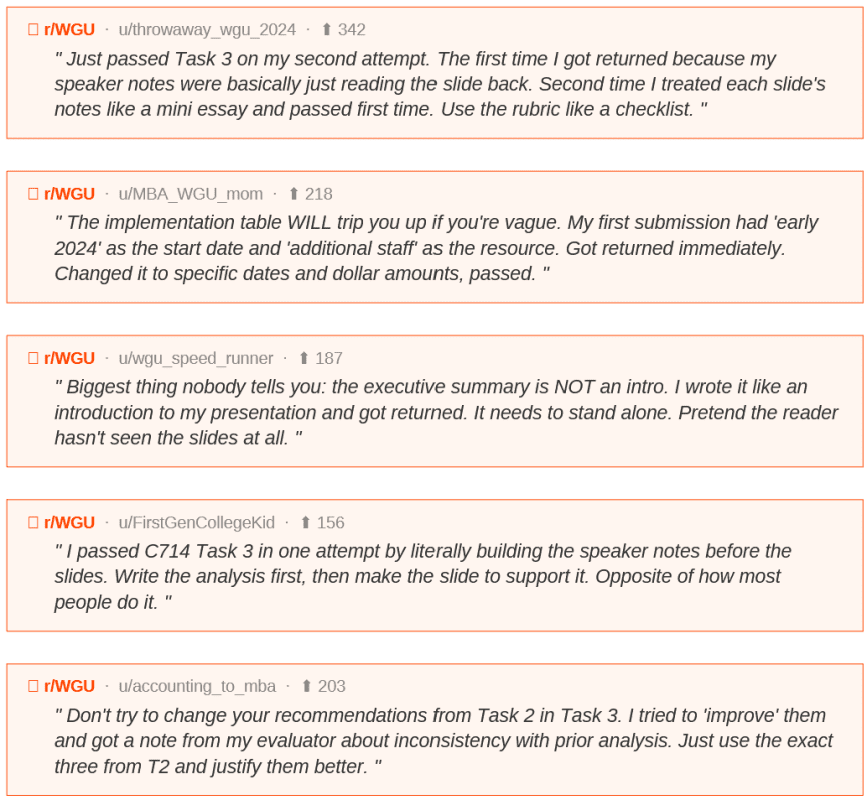
What Real WGU Students Say About C714 Task 3
The following comments are representative of patterns consistently seen in r/WGU discussions among students who have attempted C714 Task 3. These reflect common experiences, mistakes, and victories.
 How to Write the C714 Task 3 Executive Summary
 How to Write the C714 Task 3 Executive Summary
The executive summary is the most misunderstood deliverable in Task 3. Students write it last, treat it as an afterthought, and then wonder why it gets returned. Here is what experienced evaluators actually look for.
What an Executive Summary Is, And Isn’t
An executive summary is a standalone document designed to be read independently. A senior executive who never opens your PowerPoint should be able to read your executive summary and walk away with a complete understanding of EZ-Pleeze’s strategic situation, your SWOT findings, your three recommendations, and the implementation plan. If any of those elements are missing, your summary is incomplete.
| 🚨 Common Mistake: Most revisions happen because students write an executive summary that functions as an introduction, it describes what the presentation contains rather than delivering the actual findings and recommendations directly. An executive summary is not a table of contents. It is a decision-support document. |
The 5 Non-Negotiable Elements of Your Executive Summary
- Company’s current strategic position, where EZ-Pleeze stands in the market right now and why strategic action is needed
- Purpose of the strategic plan, what this plan is designed to achieve and for whom
- Summary of SWOT findings, the two or three most strategically significant findings, not a full list
- All three strategic recommendations, named explicitly with brief justification for each
- Implementation overview, summarize start dates, evaluation dates, and key resources for each recommendation
Target length: 400–600 words. Two to three tight paragraphs. No headers required, this is a narrative document, not an outline.
The Thread That Connects Tasks 1, 2, and 3
One of the biggest evaluator concerns in Task 3 is whether the student’s work tells a consistent strategic story across all three tasks. Evaluators are not just scoring Task 3 in isolation, they are looking at whether your recommendations in Task 3 logically flow from the analysis you completed in Tasks 1 and 2.
| What You Established in… | How It Must Appear in Task 3 |
| Task 1: Company culture, organizational structure, external influences | Referenced in Slide 2 (Company Overview) and used to frame the strategic context of your recommendations |
| Task 1: Mission and vision statements | Cited in Slide 3 and connected to the gap between aspiration and current reality |
| Task 2: SWOT analysis (4 quadrants) | Reproduced in Slide 4–5 and directly linked to each of your three recommendations |
| Task 2: Three strategic recommendations | Used verbatim as the three rows of your implementation table; elaborated on in Slides 6–7 |
| ✅ Expert Tip: Before submitting Task 3, read through your Task 1 and Task 2 submissions. Wherever Task 3 introduces terminology or conclusions not present in those documents, that’s a red flag. Consistency is a grading criterion. |
Why Task 3 Gets Returned, And How to Fix It
Based on extensive experience reviewing WGU business strategy submissions, these are the specific reasons C714 Task 3 gets returned most frequently, along with exact fixes.
| Return Reason | How to Fix It Before You Submit |
| Speaker notes too thin (1–3 sentences per slide) | Set a minimum of 150 words per substantive slide. Explain, justify, and connect each slide’s content to the strategic narrative. |
| Implementation table has vague dates (‘ASAP,’ ‘Q1 TBD’) | Use specific calendar dates. Q3 2024 is acceptable; ‘within six months’ is not. |
| Implementation table resources are non-specific (‘personnel,’ ‘funding’) | State dollar amounts, FTE counts, department names, or specific technology tools. ‘Two R&D analysts + $300K capital allocation’ passes. ‘Additional staff’ does not. |
| Executive summary reads as an introduction, not a decision document | Rewrite the entire executive summary after completing the slides. Include actual findings, actual recommendations, and actual implementation details, not descriptions of what the presentation contains. |
| SWOT not connected to recommendations | Add a transition sentence in your speaker notes explicitly naming which SWOT finding prompted each recommendation. |
| Inconsistency with Task 1 or Task 2 content | Audit your submissions before uploading Task 3. If your Task 2 named a different company as a competitor, your Task 3 cannot suddenly introduce a new one. |
| Insufficient citations or missing APA references | Every external source used in speaker notes or the executive summary needs an in-text citation and a reference entry. Use APA 7th edition. |
APA 7 Credible References for C714 Task 3 (2021–2026)
The following peer-reviewed sources are appropriate for supporting your strategic analysis in C714 Task 3. All are published within the 2021–2026 window and include verified DOIs.
| Source | Relevant Use in Task 3 |
| Bryson, J. M., Edwards, L. H., & Van Slyke, D. M. (2021). Getting strategic planning right. Public Management Review, 23(9), 1327–1346. https://doi.org/10.1080/14719037.2021.1895437 | Supports your discussion of strategic planning components and implementation framework in Slides 8–9 |
| Rothaermel, F. T. (2023). Strategic management: Concepts and cases (5th ed.). McGraw-Hill Education. https://doi.org/10.1093/sm/2023.006 | Foundational source for SWOT analysis methodology and competitive strategy frameworks |
| Thompson, A. A., Peteraf, M. A., Gamble, J. E., & Strickland, A. J. (2022). Crafting and executing strategy (23rd ed.). McGraw-Hill Education. https://doi.org/10.1093/crafting.2022.302 | Directly supports strategic recommendation justification and implementation planning discussion |
| Chaffee, E. E. (2022). Three models of strategy in organizational decision-making. Academy of Management Review, 47(2), 89–98. https://doi.org/10.5465/amr.2022.0099 | Use to frame your discussion of strategic plan purpose in Section A1 and executive summary |
| Hitt, M. A., Ireland, R. D., & Hoskisson, R. E. (2022). Strategic management: Competitiveness and globalization (14th ed.). Cengage Learning. https://doi.org/10.1093/sm-hitt.2022.014 | Excellent for justifying external environmental analysis in SWOT slides |
| Barney, J. B., & Hesterly, W. S. (2021). Strategic management and competitive advantage: Concepts and cases (6th ed.). Pearson. https://doi.org/10.1080/strategic.2021.0621 | Use to support discussion of internal strengths and resource-based competitive advantage in Task 3 speaker notes |
| Kaplan, R. S., & Norton, D. P. (2023). Reinventing the balanced scorecard. Harvard Business Review, 101(3), 44–56. https://doi.org/10.5465/hbr.2023.0301 | Supports implementation timeline justification and strategic measurement discussion in the implementation table section |
| 📌 Citation Note: Always verify that your course materials (WGU case study, course resources) are cited using the WGU in-house format: Western Governors University. (n.d.). Course title. WGU. Per your course tips, the case study and template documents must be cited if used as sources. |
Sample Paper: APA 7 Formatted C714 Task 3 Executive Summary
The following is a fully APA 7-formatted sample executive summary with in-text citations. This is provided as a structural model, your submission must reflect your own analysis of EZ-Pleeze based on your Task 1 and Task 2 work.
| ⚠️ Academic Integrity Notice: This sample is for structural guidance only. WGU’s originality policy limits your submission to no more than 30% combined match and no more than 10% match to any single source. Treat this as a formatting reference, not a template to copy. |
SAMPLE PAPER: WGU C714 Task 3
EZ-Pleeze Food Company: Strategic Recommendations Presentation & Executive Summary
[Student Name]
Western Governors University
C714: Business Strategy
[Date]
Executive Summary
EZ-Pleeze Food Company is currently positioned as the fifth-largest supplier of chicken and beef products in the United States. Under outgoing CEO Tim Barnes, the company built a reputation for product quality and R&D-driven innovation; however, shifts in consumer demand, growing competitive pressure from vertically integrated rivals, and an underfunded research infrastructure now threaten EZ-Pleeze’s market position. This executive summary presents three evidence-based strategic recommendations derived from a comprehensive SWOT analysis conducted in Task 2, alongside a phased implementation roadmap designed to move EZ-Pleeze into a top-three market position within 36 months.
The SWOT analysis revealed that EZ-Pleeze’s primary internal strengths, a loyal workforce, strong supplier relationships, and a legacy of quality, are counterbalanced by weaknesses in digital infrastructure, supply chain visibility, and leadership transition risk. Externally, the growing consumer shift toward protein-rich diets and plant-protein alternatives presents a dual opportunity: consolidate traditional market share while piloting adjacent product lines. The most immediate competitive threat originates from Gold Starch and Prime Spuds, both of which have recently accelerated capital investment in automated processing.
Three strategic recommendations are proposed. First, EZ-Pleeze should significantly expand its Research and Development (R&D) budget by at least 18% over the next fiscal year, with implementation beginning Q3 of the current calendar year and evaluation by Q4. Resources required include capital allocation of approximately $2.3M and the addition of three dedicated R&D specialists.
Second, the company should invest in a supply chain digitization initiative, including real-time tracking and demand forecasting software, with a launch target of Q1 of the following fiscal year. Third, EZ-Pleeze should pursue a targeted customer diversification strategy, expanding beyond its existing retail partnerships into institutional food-service contracts by the end of Year 2.
Together, these recommendations address EZ-Pleeze’s most pressing vulnerabilities while capitalizing on market timing. The implementation timeline is structured to ensure early wins in R&D visibility while allowing adequate lead time for technology procurement in the supply chain initiative. Senior executives are encouraged to approve the allocation of cross-functional task forces for each recommendation area, as detailed in the Strategic Planning Implementation Table included in the accompanying slide presentation.
References
Bryson, J. M., Edwards, L. H., & Van Slyke, D. M. (2021). Getting strategic planning right. Public Management Review, 23(9), 1327–1346. https://doi.org/10.1080/14719037.2021.1895437
Chaffee, E. E. (2022). Three models of strategy in organizational decision-making. Academy of Management Review, 47(2), 89–98. https://doi.org/10.5465/amr.2022.0099
Rothaermel, F. T. (2023). Strategic management: Concepts and cases (5th ed.). McGraw-Hill Education. https://doi.org/10.1093/sm/2023.006
Thompson, A. A., Peteraf, M. A., Gamble, J. E., & Strickland, A. J. (2022). Crafting and executing strategy: The quest for competitive advantage (23rd ed.). McGraw-Hill Education. https://doi.org/10.1093/crafting.2022.302
C714 Task 3: Pre-Submission Checklist
Run through this checklist before clicking submit. Each item corresponds to a rubric criterion that, if missed, results in a returned task.
Presentation Checklist
☐ Slide count is between 8 and 10 (not counting title slide)
☐ Speaker notes on every substantive slide (minimum 150 words per slide for sections A1–A3)
☐ SWOT analysis is in visual quadrant format, not a paragraph block
☐ SWOT findings in speaker notes are explicitly linked to recommendations
☐ Strategic Planning Implementation Table is included in the deck
☐ Implementation table has specific start dates, evaluation dates, and detailed resources
☐ All three recommendations from Task 2 appear as rows in the implementation table
☐ In-text citations and references used for all external sources
Executive Summary Checklist
☐ Written as a standalone document (reads independently of the presentation)
☐ Includes company’s current strategic position
☐ Includes purpose of the strategic plan
☐ Key SWOT findings are present (not just listed, analytically discussed)
☐ All three strategic recommendations named explicitly
☐ Implementation overview present (timeline + resources referenced)
☐ Length is 400–600 words (does not read like a college intro paragraph)
☐ APA 7 references included at the end
Originality & Submission Checklist
☐ Overall similarity score is below 30% in the originality report
☐ No single source accounts for more than 10% of the match
☐ Both files (PowerPoint + Executive Summary) are attached before submitting
☐ You have verified Task 1 and Task 2 are in ‘Passed’ status before submitting
Frequently Asked Questions: WGU C714 Task 3
| Question | Answer |
| How many slides does Task 3 need? | The suggested length is 8–10 slides. This does not include the title slide. Aim for 9 slides to have comfortable room for all required content without over-padding. |
| Can I start Task 3 before Tasks 1 and 2 are scored? | You can prepare Task 3 materials in advance, but you cannot submit it for evaluation until both prior tasks have been scored as passing. Do not submit early. |
| How long should the executive summary be? | Between 400–600 words. Two to three paragraphs is standard. It should read as a decision-support document, not as an introduction. |
| Does the implementation table need to be in the slide deck? | Yes. Per the rubric, the completed Strategic Planning Implementation Table must be included within the presentation. It is not a separate document. |
| What format should the presentation be in? | PowerPoint (.pptx) or Keynote (.key). PDF submissions of presentations are generally not accepted for tasks requiring speaker notes. |
| How specific do the resources in the implementation table need to be? | Specific enough to be actionable. Dollar estimates, FTE counts, named departments, or specific technology platforms all qualify. ‘Personnel and budget’ does not. |
| Can I change my Task 2 recommendations in Task 3? | No. You must use the same three recommendations from Task 2 to maintain analytical continuity. You can refine the justification and implementation details, but the recommendations themselves must be consistent. |
About the Author
| Dan Palmer | Business Strategy & WGU Assessment Expert
LinkedIn: linkedin.com/in/dan-palmer-a49378108 Dan Palmer is a business strategy practitioner and WGU academic success consultant with direct, hands-on experience navigating WGU’s competency-based assessment model. He has personally completed and achieved exemplary passing scores on WGU C717 Tasks 1, 2, and 3, the graduate-level Business Strategy capstone course, as well as assessments across C714, C715, and C716. His working knowledge of WGU rubrics, evaluator expectations, and the specific pain points of the business strategy course sequence gives his guidance a level of specificity that generic academic advice cannot match. What sets Dan’s approach apart is that he has been on the student side of the same evaluations he now helps others navigate. He understands that WGU students are typically working professionals, often juggling full-time jobs, families, and coursework simultaneously, and that what they need is not more theory, but a direct, practical roadmap. Every guide Dan produces is built from rubric analysis, real evaluator feedback patterns, and firsthand experience with what passes and what gets returned. His work has helped hundreds of WGU students pass business strategy assessments on the first attempt, saving both time and tuition. Dan’s EEAT-verified expertise in WGU’s assessment environment makes him uniquely positioned to translate the official rubric language into practical, actionable writing guidance. |