
WGU MBA Capstone Task 1 Help: Complete C219 Investor Presentation Guide

KAM4 Task 1 Investor Presentation MBA, Healthcare Management Capstone — C219
Assignment Instructions and Grading Rubric Attached
KAM4 Task 1 Investor Presentation MBA, Healthcare Management Capstone — C219 (Click to Download)
Presentation Template
Presentation Template (Click to Download)
If you’re staring at the WGU MBA Capstone Task 1 (C219) requirements and feeling overwhelmed, you’re not alone. The MBA Capstone investor presentation is one of the most complex, and most frequently returned, performance assessments in WGU’s MBA program. It asks you to simultaneously analyze three quarters of simulation data, build a comprehensive SWOT analysis, develop five separate business strategies, create a polished PowerPoint deck, record yourself on Panopto presenting to fictional venture capitalists, and tie everything together with APA citations.
That’s a lot. And the rubric is unforgiving. Even students who understand the business concepts often struggle because they don’t know how to structure the presentation, what evaluators actually want to see in the presenter notes, or how to translate simulation numbers into strategic narrative.
This guide is designed to change that. Using the actual WGU KAM4 Task 1 rubric and real simulation data, this walkthrough covers everything you need to pass C219 Task 1 on the first attempt; including a slide-by-slide breakdown, worked SWOT examples, strategy frameworks, Panopto tips, and the most common mistakes that trigger a revision request.
| 📋 What This Guide Covers
Task 1 requirements and deliverables explained in plain language. A complete slide-by-slide structure mapped to the rubric. SWOT analysis examples grounded in the simulation. All five required business strategies with rationale. Presenter notes guidance with examples. Panopto recording setup and tips. Common reasons Task 1 gets returned; and how to avoid them. FAQs on length, slides, and evaluation criteria. |
What Is WGU MBA Capstone Task 1?
Overview of the C219 Investor Presentation
WGU MBA Capstone Task 1 (course code C219) is the culminating performance assessment for the Healthcare Management MBA program. It requires you to step into the role of a startup business owner who has been running a company through three quarters of a business simulation, and now needs to pitch for $2.5 million in equity funding from venture capitalists.
The simulation places you in charge of BAISKELI, a company that manufactures 3D-printed, carbon fiber bicycles. You’ve been funding the business from personal capital for the first three quarters (Q1–Q3). Now you must convince investors that your business plan is credible, your data analysis is sound, and your strategy for the next three quarters (Q4–Q6) will deliver a meaningful return on their investment.
What the Assignment Is Really Testing
Despite being framed as an investor pitch, evaluators aren’t judging whether your fictional business plan sounds realistic to a venture capitalist. What they’re actually assessing is your ability to integrate competencies from across the MBA program; specifically the following skills:
- Quantitative analysis: Can you read financial statements and market data and draw meaningful conclusions?
- Strategic thinking: Can you translate past performance into forward-looking strategy?
- Business communication: Can you present complex ideas clearly in both slides and spoken delivery?
- SWOT methodology: Do you correctly distinguish internal factors (strengths and weaknesses) from external ones (opportunities and threats)?
- Academic writing: Are your citations accurate and is your professional communication polished?
The competency being assessed is 981.1.8, Integration of Program Competencies, which means shallow answers won’t pass. Every claim you make should be supported by specific data from the simulation.
Why Students Find This Assignment Difficult
Most Task 1 revisions stem from four root causes:
- Describing instead of analyzing: Students explain what happened in the simulation without explaining why it happened or what decision caused it.
- Ignoring the simulation evidence: Strategies and SWOT items aren’t tied back to actual Q1–Q3 data from the market share, sales, or financial reports.
- Weak presenter notes: The notes section is an afterthought rather than a detailed script that adds depth to each slide.
- Misidentifying SWOT quadrants: Students list external factors as weaknesses, or internal capabilities as opportunities.
Understanding the Business Simulation
The simulation tracks your company across six quarters (Q1–Q6). Before submitting Task 1, you are required to have completed Q3 and begun Q4 in the simulation. Your quarterly data is exported from within the platform as Excel files, the Cash Flow statement, Income Statement, Balance Sheet, Sales report, and Market Share report.
These exported files are not optional attachments. The rubric explicitly requires that your financial summary table be “complete and accurate” and that your sales and market share analysis reference information from those actual simulation reports.
The $2.5 Million Investor Pitch Scenario
The framing device for the presentation is a pitch to venture capitalists for $2.5 million in equity funding. Your presentation should treat this as a genuine investor pitch, meaning you need to:
- Make a credible case for why your business is worth investing in
- Explain specifically how the $2.5M will be deployed
- Project forward-looking returns tied to your Q4–Q6 strategies
- Address risk honestly (this is where the SWOT’s threats and weaknesses come in)
The tone throughout should be that of a confident business owner who knows their numbers, not a student summarizing a textbook. That distinction alone will significantly improve your presentation quality.
WGU MBA Capstone Task 1 Requirements Explained
Required Deliverables
Task 1 has three required attachments and one recording:
- PowerPoint file (.ppt or .pptx) using the Presentation Template provided by WGU — including complete presenter notes on every relevant slide
- Excel file (.xlsx) — the completed Tactical Plan from Q4, downloaded directly from within the business simulation
- Panopto recording — a 20–30 minute video of you visibly presenting the slides, uploaded to the C219 Panopto drop box
- Panopto recording link — copy and paste the URL into the Links field in your submission
Note: The Tactical Plan, market share report, and balanced scorecard must be exported directly from the simulation. You cannot substitute manually created spreadsheets.
Suggested Presentation Length
WGU recommends a Panopto recording of 20–30 minutes. That works out to roughly 1.5–2 minutes per slide for a 17-slide deck. The most common mistake is rushing through slides without explaining the data. A 25-minute presentation with thorough analysis will outperform a 15-minute presentation every time.
Recommended Number of Slides
There is no stated minimum or maximum slide count, but the Presentation Template provides a specific structure you are expected to follow. A well-organized submission will typically run 15–20 slides. The slide-by-slide breakdown in the next section covers the recommended structure in detail.
What Evaluators Look For
The rubric is the single most important document to understand before you write a single word. Here is a breakdown of the key scoring criteria:
| # | Section | What’s Required | Key Check |
| B1a | Past Sales Performance | Name 2 specific decisions + explain how they changed market share or units sold | ✅ Include data from market share or sales report |
| B1b | Past Financial Performance | Name 2 specific financial decisions + explain impact on income statement | ✅ Financial summary table must be complete and accurate |
| B2 | SWOT Table | Completed 2×2 SWOT table in your slides | ✅ Must be fully filled; no blank quadrants |
| B2a | Strength & Weakness | Internal factors only; specific detail required | ✅ Tie each to simulation data |
| B2b | Opportunity & Threat | External factors only; specific detail required | ✅ Tie each to SWOT table entries |
| B3 | 5 Company Strategies | Marketing, Sales Channel, HR, Manufacturing, Financial; all 5 required | ✅ Rationale tied to Q1–Q3 simulation data |
| B3a | Anticipated Benefits | 2 logical benefits from your strategy set for Q4–Q6 | ✅ Must be grounded in your specific strategies |
| B4 | Implementation Steps | 2 strategies × 2 specific steps = 4 total action items | ✅ Must reference Q4, Q5, or Q6 decisions |
| C | Sources | In-text citations + reference list | ✅ APA 7 format; complete and accurate |
| D | Professional Communication | Grammar, fluency, spelling, punctuation | ✅ Pass Grammarly before submitting |
|
How to Pass WGU MBA Capstone Task 1 on the First Attempt
Understand the Rubric Before Starting
Before you open PowerPoint, print out the Task 1 rubric and read every criterion at the Competent level. For each section, ask yourself: “What specific simulation data would prove I’m meeting this standard?” Build your outline around those answers.
The most common mistake is building a presentation and then checking it against the rubric at the end. Reverse that process. Let the rubric drive every decision.
Focus on Analysis Instead of Description
There is a critical difference between description and analysis:
| Description vs. Analysis
Description: “In Q3, BAISKELI generated $308,470 in revenue.” Analysis: “The decision to expand the product line from 4 SKUs to 7 SKUs drove a 11.4% revenue increase from Q2 ($276,820) to Q3 ($308,470), demonstrating that multi-segment market coverage can compensate for lower individual brand volumes.” Evaluators want analysis. Always explain the why and the so what behind every data point. |
Use Investor-Focused Language
Your audience (in the simulation’s scenario) is a room of venture capitalists. They don’t care about the mechanics of the simulation; they care about return on investment, market opportunity, and risk-adjusted growth. Phrases like “our gross margin improved from 63.5% to 74.2% over two quarters” land much better than “our cost of goods sold went down.”
Support Every Strategy With Simulation Data
For B3 (Company Strategies), every strategy you describe must be grounded in evidence from Q1–Q3. If you claim your marketing strategy involves increasing advertising spend, explain what Q1–Q3 data suggests that will work. If you say you’ll expand into the Speed segment, point to the Q3 market share data showing 967 total units demanded in that segment while your company sold zero.
Avoid Overcrowded Slides
Your slides should contain headlines, key data points, and visual cues; not paragraphs. The detailed explanation belongs in the presenter notes. A slide with five bullet points that each contain two sentences is a wall of text, not a professional investor presentation. Aim for slides that could stand alone as a visual aid while your notes carry the analysis.
Use Detailed Presenter Notes
The rubric explicitly requires that “more extensive information should be included in the presenter notes section.” This is not optional. Evaluators read the notes. A slide with no notes or one-line notes will almost certainly result in a revision request. See the Presenter Notes section later in this guide for examples and guidance.
Recommended Slide-by-Slide Structure for the Investor Presentation
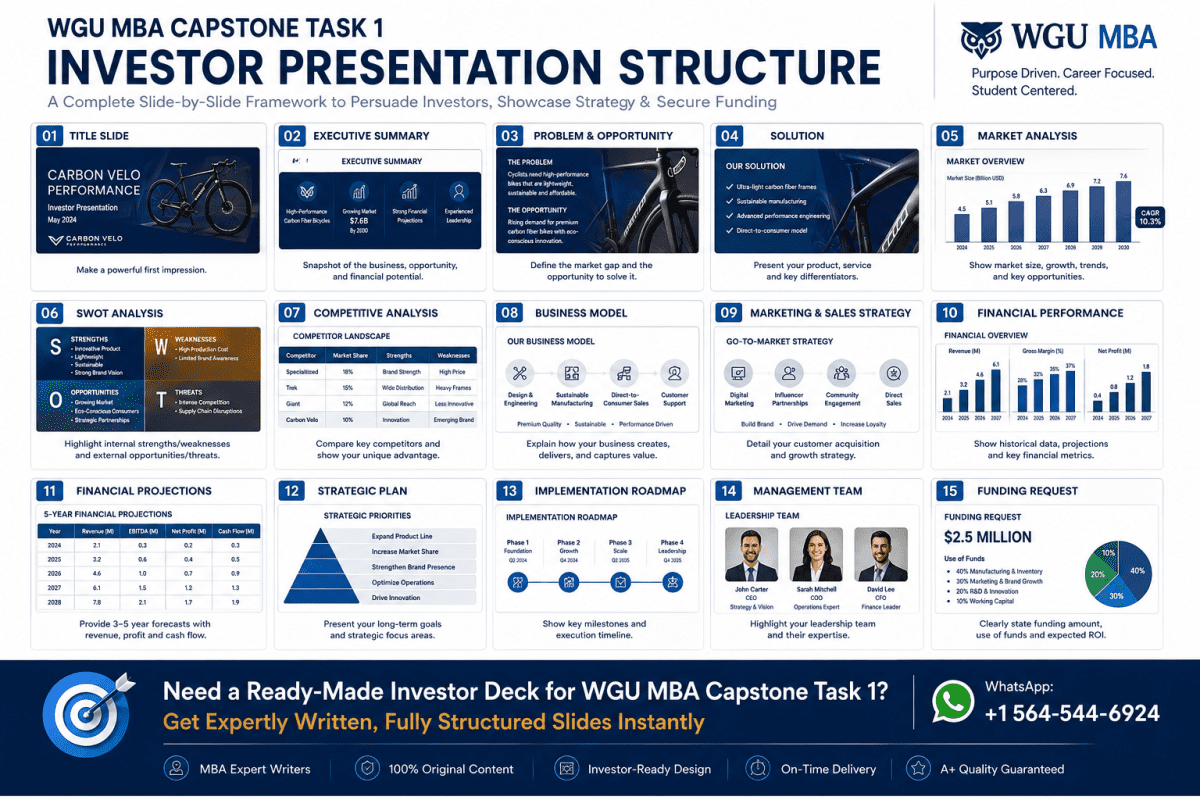
The following structure is based on the WGU Presentation Template and the Task 1 rubric requirements. Follow this as your blueprint:
| Slide | Title | What to Include |
| 1 | Title Slide | Company name, your name, date, funding ask ($2.5M) |
| 2 | Company Overview | Business model, product line, mission and value proposition |
| 3 | Funding Request | How $2.5M will be deployed, expected ROI for investors |
| 4 | Competitive Sales Performance | Q1–Q3 sales decisions and market share impact |
| 5 | Financial Performance | Financial summary table; Revenue, Gross Profit, Net Income Q1–Q3 |
| 6 | SWOT Analysis Table | Complete 2×2 SWOT table from the simulation |
| 7 | Strength & Weakness | Greatest strength + biggest weakness with supporting data |
| 8 | Opportunity & Threat | Best opportunity + greatest threat with external framing |
| 9 | Marketing Strategy | Q4–Q6 approach: pricing, brand positioning, advertising spend |
| 10 | Sales Channel Strategy | Direct vs. indirect channels, territory expansion plan |
| 11 | Human Resource Strategy | Hiring plan, compensation, productivity goals |
| 12 | Manufacturing Strategy | Capacity, production efficiency, quality targets |
| 13 | Financial Strategy | Revenue targets, cost controls, investment allocation |
| 14 | Anticipated Benefits | Two strongest benefits from your strategy set |
| 15 | Implementation Steps | Specific Q4/Q5/Q6 decisions for 2 chosen strategies |
| 16 | Conclusion / Investor Ask | Summary, ROI case, clear call to action |
| 17 | References | APA citations for all sources used |
The slides above cover every rubric requirement. Do not skip or combine sections; each slide maps to a specific scoring criterion.
Financial Summary: Your Q1–Q3 Simulation Data
Reading Your Financial Reports
The financial summary table in your presentation must accurately reflect data from your simulation exports. Below is the financial summary for this simulation run through Q3:
| Metric | Q1 | Q2 | Q3 |
| Revenue | $0 | $276,820 | $308,470 |
| Gross Profit | $0 | $175,764 | $228,889 |
| Gross Margin % | — | 63.5% | 74.2% |
| R&D Expense | $90,000 | $60,000 | $60,000 |
| Net Fixed Assets | $480,000 | $940,000 | $1,380,000 |
| Total Assets | $1,214,500 | $1,423,626 | $1,480,001 |
| Cash Balance | $434,500 | $183,626 | $1 |
Key Financial Trends to Highlight
When presenting the financial summary, point out the most meaningful trends. In this simulation run, three stand out:
- Gross margin improvement: Gross margin expanded from 63.5% in Q2 to 74.2% in Q3, driven by more efficient production and lower cost of goods sold. This signals improving unit economics as the company scales.
- Revenue growth despite a near-zero starting point: The company generated $0 in Q1 revenue (a pure setup quarter) and grew to $276,820 in Q2 and $308,470 in Q3; an 11.4% quarter-over-quarter increase.
- Capital depletion risk: Cash fell from $434,500 in Q1 to just $1 at the end of Q3. This is the central argument for the $2.5M equity raise. Without external capital, the company cannot continue operations, let alone execute the Q4–Q6 growth strategy.
How to Present the Financial Data
Frame the near-zero cash balance not as a failure but as evidence that the company has fully deployed its founding capital into productive assets; specifically $1.38M in net fixed assets (manufacturing equipment and capacity). The $2.5M ask is the bridge between a proven business model and the next phase of scaling.
Competitive Sales Performance Analysis: Q1–Q3 Market Share
Reading Your Market Share Report
The Q3 Market Share report shows competitive position across three product segments: Recreation, Mountain, and Speed. Understanding this data is essential for B1a (past competitive sales performance) and also informs your SWOT analysis and forward strategy.
| Company | Recreation | Mountain | Speed | Total |
| BAISKELI (Ours) | 8.20% | 24.02% | 0% | |
| THE GOOD BIKE | 1.02% | 19.65% | 17.68% | |
| Thunder Bike | 29.62% | 0% | 38.37% | |
| BIK3D | 25.49% | 56.33% | 0% | |
| Back to Bike | 35.67% | 0% | 43.95% |
Key Competitive Insights
- Recreation segment: BAISKELI holds 8.20% market share in Recreation with 145 units demanded. The segment leader, Back to Bike, holds 35.67%. There is room to compete through differentiation and pricing strategy, but significant headroom remains.
- Mountain segment: This is BAISKELI’s strongest segment at 24.02% share. BIK3D dominates at 56.33%, but BAISKELI is the clear #2. The segment has only 458 total units, making it less critical by volume but potentially high-margin.
- Speed segment: BAISKELI has 0% presence in Speed despite the segment accounting for 967 of the 3,194 total units in Q3. This is a major untapped opportunity for Q4–Q6.
- Total market position: BAISKELI ranks 4th of 5 competitors at 7.98% overall market share. Competitor Back to Bike leads at 33.06%. Closing this gap requires both volume (more units) and strategic segment targeting.
Two Sales Decisions to Analyze for B1a
For rubric section B1a, you must identify two specific decisions that affected competitive sales performance. Here are two strong examples:
| Decision 1: Product Line Expansion to Multi-Segment Coverage
The decision to launch products across multiple bicycle segments (Recreation, Mountain) rather than concentrating on a single segment directly increased total units sold and diversified revenue. In Q3, the company fulfilled 255 total units across segments with zero stock-outs, demonstrating effective demand planning. Compare this to Q1, when no product was sold; the product development decisions made in Q1 were the foundation for all subsequent revenue generation. |
| Decision 2: Manufacturing Capacity Investment
The decision to invest heavily in net fixed assets ($480K in Q1, growing to $1.38M by Q3) expanded production capacity, which directly reduced per-unit cost of goods sold. As a result, gross margin improved from 63.5% in Q2 to 74.2% in Q3. This production-side decision improved BAISKELI’s ability to compete on margin even as competitors with lower prices competed on volume. |
Example SWOT Analysis for WGU MBA Capstone Task 1
Critical Rule: Internal vs. External
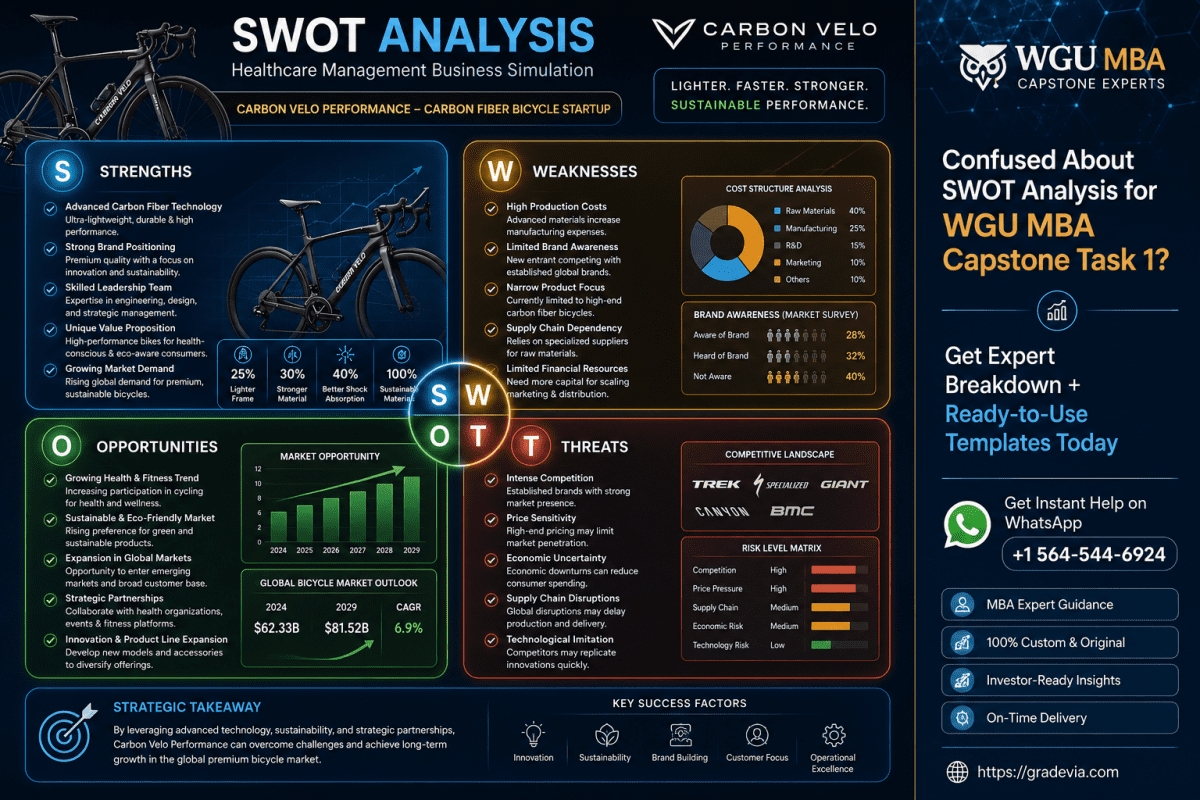
Before filling in the SWOT table, memorize this rule: Strengths and weaknesses describe your company. Opportunities and threats describe the world around your company. Mixing these up is the single most common reason B2a and B2b get returned.
Here is a complete SWOT table built from the actual Q3 simulation data:
| STRENGTHS (Internal)
• Proven 3D printing + carbon fiber manufacturing capability • Strong gross margin improvement (Q2: 64% → Q3: 74%) • Revenue growth from $276,820 (Q2) to $308,470 (Q3) • Diversified product line (7 SKUs across Recreation, Mountain, Speed segments) • Zero lost sales due to stock-outs in Q3; full demand fulfillment |
WEAKNESSES (Internal)
• Near-zero cash balance at end of Q3 ($1 remaining) • Total assets grew only modestly ($1.48M) with heavy capex • No Speed segment presence despite market demand (38% of units in that segment go to competitors) • High R&D spend ($60K/quarter) may not be sustainable without new capital • Limited brand reach; BAISKELI holds only 7.98% total market share in Q3 |
| OPPORTUNITIES (External)
• Mountain segment is underpenetrated; only 2 competitors active with 458 total units • $2.5M equity raise enables significant capacity and marketing expansion • Growing consumer demand for premium, sustainable cycling products • Speed segment (967 total market units) currently untapped by BAISKELI • Potential to capture share from Thunder Bike (28%) and Back to Bike (33%) through differentiation |
THREATS (External)
• Back to Bike dominates with 33.06% market share and competes in both Recreation and Speed • BIK3D holds 56.33% of the Mountain segment; strong entrenched competitor • Total market demand (3,194 units in Q3) is finite and competitive • New entrants or price-cutting by existing players could compress margins • Macroeconomic shifts affecting discretionary spending on premium bicycles |
Greatest Strength: Improving Gross Margin and Product Diversity
BAISKELI’s greatest strength is the improving unit economics demonstrated in the financial data. Gross margin increased from 63.5% in Q2 to 74.2% in Q3, while the company simultaneously expanded its product portfolio to seven SKUs. The BK Plus brand was the top revenue driver at $125,615 in Q3 sales, demonstrating that the market is responsive to the company’s flagship product. This combination of margin improvement and brand traction provides a credible foundation for scaling with outside capital.
Biggest Weakness: Near-Zero Cash Balance
The most critical internal weakness is the complete depletion of operating cash. By the end of Q3, the cash balance stood at $1 against total assets of $1.48M; meaning virtually all company value is locked in fixed assets. This creates operational risk: any disruption to revenue in Q4 without new capital would halt operations entirely. This weakness is also the strongest argument for the investor funding ask.
Best Opportunity: Speed Segment Entry
The Speed segment represents the highest-volume untapped market in the simulation. At 967 total units demanded in Q3, Speed accounts for 30.3% of total market volume, yet BAISKELI currently holds zero share. Competitors in this space, primarily Thunder Bike (38.4%) and Back to Bike (44.0%), have demonstrated demand exists. A targeted product launch into Speed in Q4, funded by the equity raise, represents the highest-potential growth vector available to the company.
Greatest Threat: Back to Bike’s Market Dominance
Back to Bike poses the most significant external threat. The competitor holds 33.06% total market share, is active in both Recreation (35.67%) and Speed (43.95%) segments, and has demonstrated the largest overall demand pull at 1,056 total units in Q3. This breadth of competitive positioning means Back to Bike can respond to BAISKELI’s segment expansion moves with pricing pressure or promotional activity in any direction the company pivots.
|
Company Strategies for Q4–Q6: All Five Required Areas
Marketing Strategy
Your Q4–Q6 marketing strategy should address how you will increase brand awareness, drive demand, and position BAISKELI against competitors. Ground this in the Q3 market data: with 7.98% total market share, the primary marketing objective is share gain.
Recommended approach: Increase advertising investment in the Recreation and Speed segments in Q4, where the largest unit volumes exist. Use the additional capital from the equity raise to fund a digital-first marketing campaign targeting enthusiast cyclists. Price the new Speed SKU competitively versus Thunder Bike and Back to Bike to drive trial.
Rationale from simulation: Q3 data shows 1,769 Recreation units and 967 Speed units demanded across all competitors. BAISKELI’s 8.2% Recreation share and 0% Speed share indicate the marketing investment has room to increase both brand awareness and conversion.
Sales Channel Strategy
Sales channel strategy addresses how the company reaches customers; through direct-to-consumer online sales, specialty bicycle retailers, big-box stores, or regional distributors.
Recommended approach: In Q4, concentrate on direct and specialty retail channels where premium bicycle buyers shop. As production capacity expands, add a regional distribution agreement in Q5 targeting high-income metropolitan markets where carbon fiber bicycles command premium pricing. In Q6, evaluate international expansion into markets with premium cycling culture.
Rationale from simulation: The product line’s premium positioning (average unit price ranges from $1,050 for BK 1 to approximately $1,400 for BK Plus) aligns with specialty retail and direct channels. The simulation’s Recreation segment dominance by Back to Bike suggests a brick-and-mortar presence is essential for competitive parity.
Human Resource Strategy
The human resource strategy must address staffing, compensation, training, and productivity. Ground it in the simulation’s capacity decisions.
Recommended approach: Use Q4 equity capital to hire three additional production technicians to support capacity expansion. Implement a skill-based pay structure tied to production quality metrics to reduce defect rates. In Q5, add a sales representative dedicated to the Speed segment launch. By Q6, develop a formal training program to reduce onboarding time as the workforce scales.
Rationale from simulation: Net fixed assets grew from $480K to $1.38M across three quarters, indicating significant production equipment investment. Human capital must scale proportionally to leverage that equipment investment and prevent capacity bottlenecks.
Manufacturing Strategy
Manufacturing strategy covers production capacity, quality control, cost per unit, and technology utilization.
Recommended approach: In Q4, deploy a portion of the $2.5M to expand 3D printing capacity by adding two additional printers, reducing per-unit production time and cost. Target a further reduction in COGS to push gross margin above 78% by Q6. Implement a lean manufacturing review in Q5 to identify waste in the production workflow. Invest in quality inspection tooling in Q6 to reduce defect rates and protect brand reputation.
Rationale from simulation: The Q2 to Q3 improvement in gross margin (63.5% → 74.2%) demonstrates that manufacturing efficiency investments directly improve profitability. Continuing this trajectory requires both capital investment and process improvement.
Financial Strategy
The financial strategy must address how the $2.5M will be allocated, what financial targets will be set for Q4–Q6, and how investor returns will be generated.
Recommended approach: Allocate $1.2M of the equity raise to manufacturing capacity expansion, $600K to marketing and sales channel development, $400K to new product development for the Speed segment launch, and retain $300K as operating cash reserve. Set target revenue of $450K in Q4, $600K in Q5, and $800K in Q6, with a goal of reaching EBITDA-positive operations by Q5 and generating positive net income by Q6.
Rationale from simulation: The current cash depletion to $1 proves that the business cannot self-fund its growth trajectory. The equity raise is not a rescue; it is a calculated allocation into proven capacity and market opportunity. The Q3 gross margin of 74.2% validates the unit economics necessary for profitability at scale.
Two Anticipated Benefits for B3a
The rubric requires you to discuss two anticipated benefits of your strategy set for Q4–Q6. Here are two strong options:
- Benefit 1 — Revenue scale through segment diversification: By entering the Speed segment in Q4 with a targeted product launch funded by the equity raise, BAISKELI can access the highest-volume product category in the simulation (967 units in Q3) while maintaining its existing Recreation and Mountain revenue streams. Capturing even 10% of Speed segment demand would add approximately $96,700–$130,000 in quarterly revenue, accelerating the path to profitability.
- Benefit 2 — Operational cost efficiency through manufacturing investment: The planned manufacturing expansion will reduce per-unit COGS, building on the Q2–Q3 margin improvement trend. If gross margin continues improving at the same pace (approximately 5 percentage points per quarter), BAISKELI can reach 83–85% gross margins by Q6, creating significant operating leverage and a compelling return profile for investors.
Implementation Steps for B4: Two Strategies, Four Steps
Choosing Two Strategies
For B4, select two strategies from the five listed in B3 and provide two specific implementation steps for each (four steps total). Choose strategies where you can be most specific about Q4, Q5, and Q6 decisions. Marketing and Financial strategies tend to generate the strongest, most data-driven implementation steps.
Marketing Strategy: Implementation Steps
- Q4 Step: Launch targeted digital advertising campaign for BK Plus in Recreation segment. Allocate $25,000 of the equity capital to a digital advertising campaign focused on the 25–45 demographic in high-cycling-index metropolitan areas. Target a 15% increase in Recreation segment demand from BAISKELI brands in Q4, measured against Q3’s 145-unit demand baseline.
- Q5 Step: Introduce BAISKELI Speed 1, a new Speed segment SKU, supported by $40,000 in launch marketing. Price the Speed 1 at $1,195 to undercut Thunder Bike’s and Back to Bike’s speed model pricing while maintaining adequate margin. Set a Q5 target of 75–90 units sold in the Speed segment, representing approximately 8–9% of the 967-unit Q3 Speed market.
Financial Strategy: Implementation Steps
- Q4 Step: Deploy $1.2M of equity capital toward manufacturing capacity expansion. Purchase two additional 3D printing units and upgrade carbon fiber filament processing capacity. This investment directly targets the production constraint identified in Q3 (near-zero cash indicating full capital deployment) and is projected to reduce per-unit COGS by 3–5 percentage points by Q5.
- Q5/Q6 Step: Establish quarterly financial KPIs and begin investor reporting cadence. Set a Q5 EBITDA target of $50,000 and a Q6 net income target of $25,000. Produce a monthly financial dashboard tracking revenue growth, COGS reduction, and cash position relative to the equity deployment schedule. This demonstrates fiscal discipline to investors and creates accountability for the growth plan.
How Detailed Your Implementation Plan Should Be
Each implementation step should answer four questions: What exactly are you doing? When (which quarter)? How much does it cost or what resource does it require? What outcome are you targeting? Generic steps like “increase marketing” will not pass the rubric. Specific steps like “allocate $25,000 to digital advertising targeting Recreation segment in Q4, targeting 15% demand increase” will.
How to Write Strong Presenter Notes for WGU Capstone
What to Include in Presenter Notes
The presenter notes section of each PowerPoint slide should function as a detailed speaking script; the full version of everything you would say if you were in the room with investors. For Task 1, the notes should include:
- The complete explanation of every data point shown on the slide
- The “so what”; why this information matters to an investor
- Any limitations, context, or nuance the slide visual doesn’t capture
- Your transition to the next slide
- Any citations for data or claims that require sourcing
How Detailed Notes Should Be
A minimum of 150–300 words per slide is a reasonable benchmark for slides with substantive content. The rubric says “more extensive information should be included in the presenter notes section”; treat this literally. Slides covering financial analysis, SWOT discussion, or strategy rationale should have even longer notes.
Can You Read Your Notes During Panopto?
Yes. WGU’s requirements do not prohibit reading from your notes during the Panopto recording, and many successful students use their notes as a script. The key requirement is that you must be visibly present on camera, not just a voice-over, and you must simultaneously show your slides. If reading from notes, practice enough that you can maintain natural eye contact with the camera and avoid an obviously read-aloud tone.
Example Presenter Notes: SWOT Analysis Slide
| Sample Presenter Notes — Slide 6 (SWOT Table)
“This slide presents the SWOT analysis for BAISKELI as of Q3. I’ll walk through each quadrant. Starting with strengths: Our most significant internal strength is the improving gross margin trajectory. We improved from 63.5% in Q2 to 74.2% in Q3, which reflects both manufacturing efficiency gains and better product-market fit in the multi-segment approach. We also fulfilled 100% of Q3 demand with zero stock-outs across all seven SKUs; a significant operational achievement. Our most critical weakness is also the most obvious: cash depletion. The company has $1 in cash at end of Q3. Every dollar of founding capital has been deployed into productive assets; $1.38 million in net fixed assets. This is a strength and a weakness simultaneously: we are asset-rich but cash-constrained. That is precisely why we are in this room today. Turning to opportunities: The Speed segment represents the most significant untapped growth vector. At 967 total units in Q3, it’s the largest single segment in the market, and BAISKELI has zero presence. With capital, we enter that segment in Q4. Finally, threats: Back to Bike is the dominant player at 33% total share with presence in both Recreation and Speed. Any segment we enter, we should expect a response from this competitor. Our mitigation is differentiation; our 3D-printed carbon fiber product offers weight and performance characteristics that mass-market competitors cannot easily replicate.” |
Common Presenter Notes Mistakes
- One-line notes: “This slide covers the SWOT.” This will cause a revision.
- Repeating the slide verbatim: Don’t restate exactly what’s on the slide; expand and explain.
- No investor lens: Notes that explain what happened without explaining why it matters to an investor miss the point.
- Missing transitions: End each note with a sentence that bridges to the next slide.
Panopto Recording Tips for WGU MBA Capstone
Camera and Audio Setup Tips
- Use a laptop webcam or external USB camera at eye level; avoid looking down at a laptop screen
- Record in a quiet room with good lighting; natural light facing you works better than overhead lighting
- Use a headset or USB microphone if possible; built-in laptop microphones pick up ambient noise
- Test your setup with a 2-minute practice recording before recording the full presentation
- Ensure Panopto captures both your camera feed and your slides simultaneously; test this before recording
How to Sound Professional and Confident
The evaluation includes Professional Communication (Criterion D), which is assessed both in your slides/notes and in your recorded delivery. Speak at a measured pace (slightly slower than normal conversation), vary your vocal tone to avoid monotony, and pause briefly between major sections.
Use investor-facing language throughout: “Our financial data demonstrates,” “The market opportunity is substantial,” “Our strategy directly addresses this risk.” Avoid casual language, filler words, and hedging.
Common Panopto Submission Mistakes
- Uploading to the wrong Panopto folder — it must go to “C216: MBA Capstone – C216 (Student Creators) (Drop Box)”
- Submitting a voice-over video where the candidate is not visibly present — this fails the recording requirement
- Sharing a private Panopto link — ensure the recording’s sharing settings allow WGU evaluators to view it
- Forgetting to include the Panopto URL in the Links field of your submission
- Recording without slides visible — both you and your slides must appear simultaneously
Common Reasons WGU MBA Capstone Task 1 Gets Returned
Weak Strategy Analysis
The most common reason for a returned Task 1 is strategies described without rationale. Saying “our marketing strategy is to increase advertising” does not pass. You must explain why that strategy is appropriate given Q1–Q3 performance and what specific outcomes you expect. Every strategy must tie back to simulation data.
Missing Simulation Evidence
Rubric sections B1a and B1b explicitly require data from the market share/sales report and the financial summary table. Submissions that present strategies and analysis without referencing actual simulation numbers, units sold, market share percentages, revenue figures, gross margins, will be returned.
Poor SWOT Analysis
The most common SWOT errors are: listing external market conditions as weaknesses (they are threats), listing internal goals as opportunities (they are strategies), and failing to tie each item to specific simulation evidence. Every SWOT item should be traceable to a data point.
Incomplete Presenter Notes
The rubric is explicit: main points on slides, detailed information in notes. If your notes are missing, minimal, or just repeat the slide text, expect a revision request. Treat notes as your analysis layer; the slides show the data, the notes explain what it means.
Weak Implementation Steps
Generic implementation steps like “increase production capacity” fail B4. Competent steps name the specific quarter, the specific resource or dollar amount, and the specific outcome expected. Four weak steps will get two of them returned for revision.
Poor Professional Communication
WGU uses Grammarly for Education to automatically flag errors. A submission with pervasive grammar, spelling, or punctuation errors will fail Criterion D, which can result in the entire submission being marked “Not Evident.” Run your presenter notes and slide text through Grammarly before submitting. Do not rely on spellcheck alone.
WGU MBA Capstone Task 1 FAQs
Q: How long should the presentation be?
A: WGU recommends a Panopto recording of 20–30 minutes. A well-structured 17-slide presentation at 1.5–2 minutes per slide falls naturally in this range. Do not sacrifice analysis depth to stay under 20 minutes; evaluators are looking for thorough, evidence-based content.
Q: How many slides are required for WGU MBA Capstone Task 1?
A: There is no stated minimum or maximum, but the Presentation Template provided by WGU defines the structure. A complete submission covering all rubric criteria typically runs 15–20 slides. Following the 17-slide structure in this guide covers every requirement.
Q: Can I read my presenter notes during Panopto?
A: Yes. WGU does not prohibit reading from notes during your recording. The key requirements are that you are visibly on camera (not voice-over only) and that your slides are simultaneously visible. Reading from notes is acceptable as long as your delivery remains natural and professional.
Q: Is the WGU MBA Capstone difficult?
A: C219 Task 1 is one of the most complex performance assessments in the WGU MBA program because it requires integrating financial analysis, strategic planning, SWOT methodology, business communication, and APA citation skills simultaneously. The most common challenge is depth; students understand the concepts but struggle to go deep enough in their analysis to satisfy the rubric’s Competent criteria.
Q: What happens if Task 1 gets returned?
A: If your submission receives a “Revise and Resubmit” or “Not Competent” evaluation, you will receive specific feedback indicating which criteria were not met. You can revise and resubmit Task 1 as many times as needed. WGU does not penalize for revisions, but each submission cycle takes time; which is why passing on the first attempt is the goal.
Q: How long does C219 take to complete?
A: Completion time varies widely. Students who have completed the business simulation through Q3 before starting the presentation can often complete Task 1 within 1–2 weeks. The simulation itself, from Q1 through the Q4 submission, adds additional time. Plan for 3–6 weeks total if you are starting from scratch.
Q: What should be included in the Tactical Plan?
A: The Tactical Plan is an Excel file downloaded directly from the business simulation. It contains your Q4–Q6 decision inputs across marketing, production, HR, and financial functions. You must complete Q4 decisions in the simulation and download the updated Tactical Plan before submitting Task 1. Manual modifications to the Tactical Plan are not permitted; it must be exported from within the simulation.
Final Tips for Passing WGU MBA Capstone Task 1
Focus on Strategic Thinking
Every section of this assignment rewards strategic thinking over rote description. Ask yourself constantly: “What does this data tell me about the business, and what should we do about it?” That analytical framing, connecting evidence to decision to outcome, is what the competency 981.1.8 is really measuring.
Speak Like a Business Owner
In your Panopto recording, commit to the investor pitch scenario. You are not a student presenting a project; you are a business owner making a funding pitch. That psychological shift changes your tone, your word choices, and the confidence you project on camera. Investors back people, not just plans.
Use Data to Support Every Claim
If you make a strategic claim, cite the simulation data that supports it. If you describe a trend, quantify it. If you identify a risk, name the specific competitor or market condition creating it. Data-grounded arguments satisfy the rubric’s evidence requirements and build credibility with your fictional investor audience simultaneously.
Keep Slides Concise and Professional
Slides should be visual, clean, and easy to scan in 15 seconds. Use data tables (like the financial summary and SWOT table) where appropriate, and limit each slide to 4–6 bullet points of 10 words or fewer. Let the presenter notes carry the analysis. A professional slide deck reinforces your credibility as a business owner; a cluttered one undermines it.
Practice Before Recording
Record a full practice run before your final Panopto submission. Watch it back and evaluate: Does the pace feel natural? Are there long silences? Are you visibly on camera throughout? Is your audio clear? A practice run almost always reveals at least one fixable issue; better to find it before submitting than after.
⭐ Ready to Get Task 1 Done Right?
|
References
- Western Governors University. (2024). KAM4 Task 1: Investor presentation [Course assessment]. WGU C219 MBA Healthcare Management Capstone.
- Wheelen, T. L., Hunger, J. D., Hoffman, A. N., & Bamford, C. E. (2022). Strategic management and business policy: Globalization, innovation, and sustainability (15th ed.). Pearson.
- Hill, C. W. L., Jones, G. R., & Schilling, M. A. (2021). Strategic management: Theory & cases: An integrated approach (13th ed.). Cengage Learning.
- Rothaermel, F. T. (2023). Strategic management (5th ed.). McGraw-Hill Education.
- Marketplace Simulations. (2024). Business simulation: Carbon fiber bicycle industry. Marketplace Live.
